
Federal vs Provincial Incorporation for Non-Residents: Pros & Cons
Federal incorporation Canada offers non-resident companies broader name protection and the ability to operate nationwide compared to provincial incorporation Canada. Understanding differences in Canadian company registration and compliance requirements helps non-residents choose the right option for their business setup.
Quick Summary
The trade-off is reach against simplicity. Federal gives you a name protected in every province and one set of rules, but carries a director residency requirement and higher fees. Provincial is cheaper and often has no residency rule, but confines you to one market. Please note the residency question usually decides this, not the fee difference.
| Aspect | Details |
|---|---|
| Federal strength | Nationwide name protection and one set of rules. |
| Federal cost | 25% resident director requirement, higher fees. |
| Provincial strength | Lower fees, often no residency rule. |
| Provincial cost | One province only; extra registrations to expand. |
Reading time: 25 minutes.
Table of Contents
- Federal vs Provincial Incorporation: A Guide for Non-Resident Company Setup
- Can a Non-Resident Open a Corporation in Canada?
- Why Canada Is Attractive for Foreign Entrepreneurs
- Federal vs Provincial Incorporation for Non-Residents
- Resident Director Requirement Explained
- Step-by-Step: How to Open a Corporation in Canada
- How Much Does It Cost to Open a Corporation in Canada?
- What You Get With Open Corporation For $35
- Common Challenges and Mistakes
- Realistic Example Scenario
- Frequently Asked Questions
- Conclusion and Next Steps
- FAQs
- Professional Guidance and Quick Reference
The Numbers That Matter
This article covers Canada, with Ontario and Toronto context, and assumes a foreign entrepreneur choosing a jurisdiction without living in Canada. All figures are estimates in Canadian dollars. Fees, thresholds, processing times and director residency rules are set by the federal and provincial governments, and they change. This is educational information only and not tax, legal, or financial advice. Please confirm your own position with a CPA before acting.
Federal Incorporation Canada vs Provincial Incorporation Canada: A Guide for Non-Resident Company Setup with Open Corporation For $35
Federal vs Provincial Incorporation: A Guide for Non-Resident Company Setup
The Basics
Federal incorporation in Canada protects your business name across the whole country. It also lets you operate nationwide. Provincial incorporation is usually faster. It might have easier rules about where directors live. Knowing these differences helps non-residents pick the best choice.
Comparison Table of Federal vs Provincial Incorporation
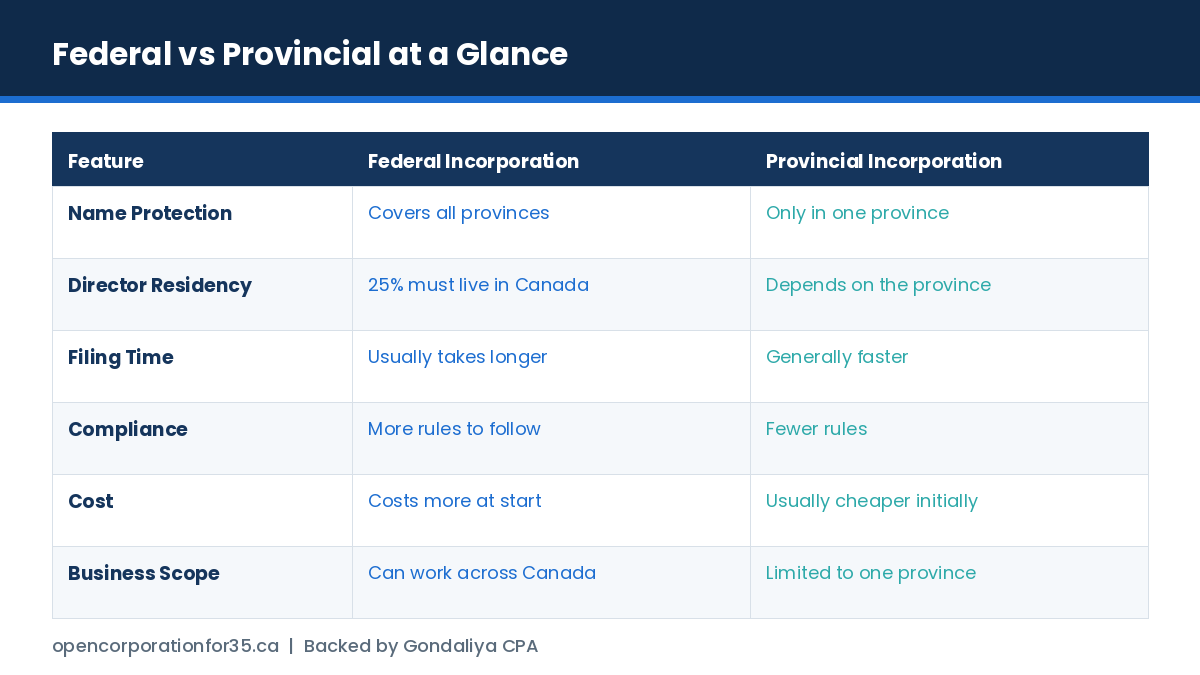
| Feature | Federal Incorporation | Provincial Incorporation |
|---|---|---|
| Name Protection | Covers all provinces | Only in one province |
| Director Residency Requirement | 25% must live in Canada | Depends on the province |
| Filing Time | Usually takes longer | Generally faster |
| Compliance Requirements | More rules to follow | Fewer rules |
| Cost | Costs more at start | Usually cheaper initially |
| Business Scope | Can work across Canada | Limited to one province |
Can a Non-Resident Open a Corporation in Canada?
Can a Non-Resident Open a Corporation in Canada?
Eligibility
Yes, non-residents can start a company in Canada. You don’t need to be a citizen or have a visa just to incorporate. But some rules matter:
- Director Residency Rules: Federal law says 25% of directors must live in Canada. Some provinces don’t need this.
- Federal or Provincial?: Think about where you want to work — nationwide or only inside one province.
So, setting up as a non-resident works, but watch the legal details.
Key Stat: Ownership carries no residency test at all. A non-resident can hold 100% of the shares in either jurisdiction. The 25% figure applies to the board of directors, not to who owns the company.
Why Canada Is Attractive for Foreign Entrepreneurs
Why Canada Is Attractive for Foreign Entrepreneurs
Why Canada
Canada offers good reasons for foreign business owners:
- The law system is steady and safe.
- Canadian companies look good worldwide.
- You get easy access to North America markets like the U.S. and Mexico.
- Payment systems like Stripe work well here.
- The tech scene is friendly and supports startups with help and funding.
These points make Canada a smart spot for entrepreneurs from outside.
Federal vs Provincial Incorporation for Non-Residents
Federal vs Provincial Incorporation for Non-Residents
In Detail
If you’re a non-resident thinking about how to incorporate Canada non-resident, you need to know the difference between federal incorporation Canada and provincial incorporation Canada. Each one works differently. They change how you run your business, follow the law, and reach customers.
What Is Federal Incorporation in Canada?
Federal incorporation means you register your company with the Government of Canada under the Canada Business Corporations Act (CBCA). This lets a non-resident company Canada work in every province and territory with one corporate name.
Key things about federal incorporation:
- Your company name gets protected all over Canada.
- You can do business anywhere in the country.
- One set of federal rules applies to your corporation.
What Is Provincial Incorporation in Canada?
Provincial incorporation means registering your company in just one province or territory. For example, Ontario follows the Ontario Business Corporations Act, and British Columbia has its own rules.
Key things about provincial incorporation:
- Your company name is only protected inside that province.
- You must follow that province’s laws.
- If you want to do business outside that province, you might need extra steps.
Comparison Table: Federal vs Provincial Incorporation for Non-Residents
| Feature | Federal Incorporation | Provincial Incorporation |
|---|---|---|
| Jurisdiction | All provinces & territories | Only one specific province |
| Name Protection | Protected nationwide | Protected only within chosen province |
| Regulatory Compliance | Governed by CBCA | Governed by local provincial law |
| Filing Requirements | Centralized federal system | Separate filings per province |
| Cost | Usually higher fees | Lower initial filing fees |
| Suitability for Non‑Residents | Best if working across many provinces | Best if focused on one region |
When Does Federal Incorporation Make More Sense?
If you want your business to grow across many provinces, federal incorporation helps a lot. It makes following the rules simpler. It also protects your brand across Canada. This works well if you want one set of consistent rules no matter where you are.
When Does Provincial Incorporation Make More Sense?
If your focus is only on one Canadian area—say Alberta or Quebec—and you want to pay less at first, provincial incorporation can work better. Some provinces also have fewer rules about resident directors. That can make it easier if you’re from outside Canada.
Resident Director Requirement Explained
Resident Director Requirement Explained
Directors
If you plan to incorporate Canada non-resident, you must understand who can be a director. Many places require directors to live in Canada.
What Is the Resident Director Requirement?
A resident director is someone who lives in Canada based on certain legal tests. This rule exists so there is some local control of companies.
The 25% ownership rule Canada ties into this: If 25% or more owners are Canadians, then some rules on resident directors may relax depending on where you register. But these rules change by province and federally, so check what applies.
Residency Rules Across Jurisdictions
Not every place wants Canadian resident directors:
- Federal: You need at least 25% of directors living in Canada unless your board has fewer than four people; then at least one must live here.
- Provinces like British Columbia, Alberta, and Manitoba don’t ask for resident directors right now—but check updates just in case.
This often guides foreign owners on whether they pick federal or provincial incorporation based on where they can easily meet director requirements.
How Do Non‑Residents Typically Comply?
Non-residents usually hire nominee directors or choose trusted Canadians as their resident directors for startup periods. Or they pick provinces without these demands so they keep full control but skip extra hassle.
Resident Director Requirements Comparison Table
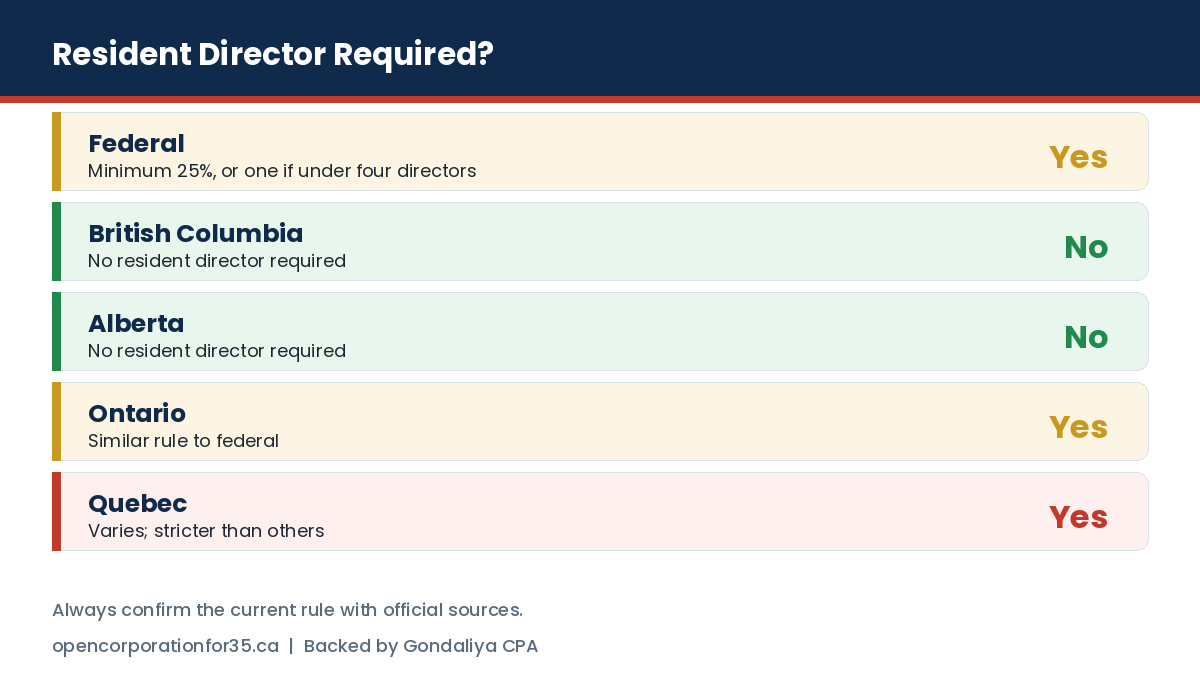
| Jurisdiction | Resident Director Required? | % Residency Rule Applies? |
|---|---|---|
| Federal | Yes | Yes – minimum 25% unless <4 directors (then min 1) |
| British Columbia | No | N/A |
| Alberta | No | N/A |
| Ontario | Yes | Yes (similar to federal) |
| Quebec | Yes | Varies; stricter than others |
Always confirm latest rules with official sources.
To wrap up, choosing federal incorporation canada versus provincial depends mainly on where you want to do business and how easily you can meet resident director requirement s. For most non-resident company canada owners who want broad reach and clear governance, federal incorporation fits best despite higher fees because it offers national protection and easier management overall.
Risk Warning: This article gives Ontario and Alberta different answers in different sections, and its own worked example says a federal corporation needs no resident director while the tables say 25%. Please confirm the current rule for your chosen jurisdiction directly before filing.
Step-by-Step: How to Open a Corporation in Canada for Non-Residents
Step-by-Step: How to Open a Corporation in Canada for Non-Residents
Step by Step
Opening a corporation in Canada when you’re not a resident is pretty straightforward. You can go federal incorporation Canada or provincial incorporation Canada. Either way, you’ll need to follow some key steps to set up your non-resident company Canada smoothly.
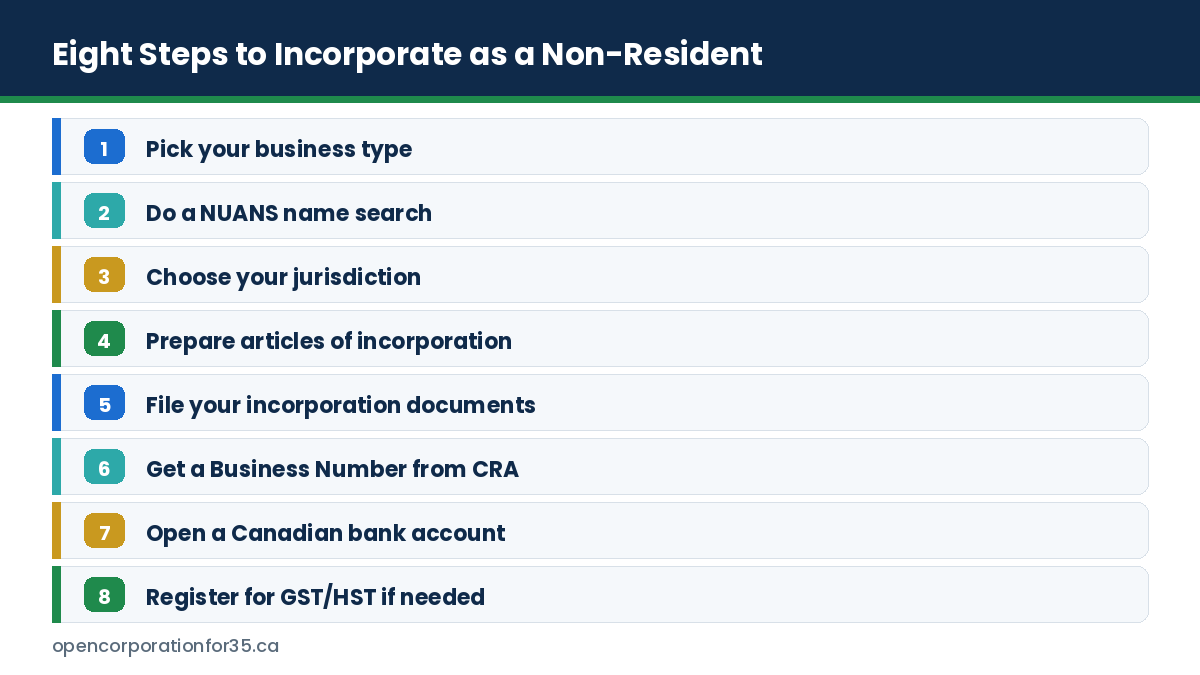
- Pick Your Business Type
Most non-residents go for corporations because they protect personal assets and look professional. Decide if you want a federal or provincial corporation depending on where you want to do business. - Do a Name Search (NUANS Report if Needed)
If you pick federal incorporation or some provinces, you must check your company name isn’t taken. Use NUANS (Newly Upgraded Automated Name Search) to see if the name is free. - Choose Your Jurisdiction
– Federal Incorporation: Covers all provinces under one registration. Rules come from the Canada Business Corporations Act (CBCA).
– Provincial Incorporation: Only good for one province. Each has its own rules and fees. - Prepare Articles of Incorporation
Write articles that include your company name, share details, directors’ info, and any limits on shares or business activities. - File Your Incorporation Documents
Send your papers online or by mail to the right office—Corporations Canada for federal or the provincial registry for provincial incorporation. - Get a Business Number from CRA
Once incorporated, register with the Canada Revenue Agency (CRA) for your business number. You’ll need this for taxes and GST/HST registration if it applies. - Open a Canadian Bank Account
Banks often want you there in person, but some offer ways to open accounts remotely for non-resident companies in Canada. - Register for GST/HST If Needed
If your sales go over $30,000 CAD yearly or expect taxable sales, register for Goods and Services Tax / Harmonized Sales Tax with CRA.
| Step | What to Do | Federal vs Provincial Notes |
|---|---|---|
| 1 | Pick business type | Federal covers all provinces; Provincial is local only |
| 2 | Do NUANS name search | Required federally & in some provinces |
| 3 | Pick jurisdiction | Based on market reach and rules |
| 4 | Prepare articles | Standard form but can vary by place |
| 5 | File documents | Online filing available both federally & provincially |
| 6 | Get CRA business number | Needed no matter jurisdiction |
| 7 | Open bank account | Some banks allow remote setup |
| 8 | Register GST/HST | Depends on your revenue |
Rules can change so double-check with Canadian officials before starting.
How Much Does It Cost to Open a Corporation in Canada?
How Much Does It Cost to Open a Corporation in Canada?
Costs
Knowing the costs upfront helps avoid surprises while you incorporate canada non resident businesses.
Typical Costs
- Government Fees: Federal incorporation canada fees are about $200–$250. Provinces usually charge $300-$400 or more.
- Registered Office: Some provinces ask for an official address. Virtual offices cost around $50-$150 per month.
- Resident Director Service: Provinces like Ontario may require local directors; nominee services cost extra.
- Bank Account Fees: Usually small but depend on the bank.
- Annual Compliance: Filing annual returns costs $20-$100 plus accounting fees.
- Tax Filing Help: Accountants can help but it’s optional at first; fees vary by complexity.
Price Comparison Table
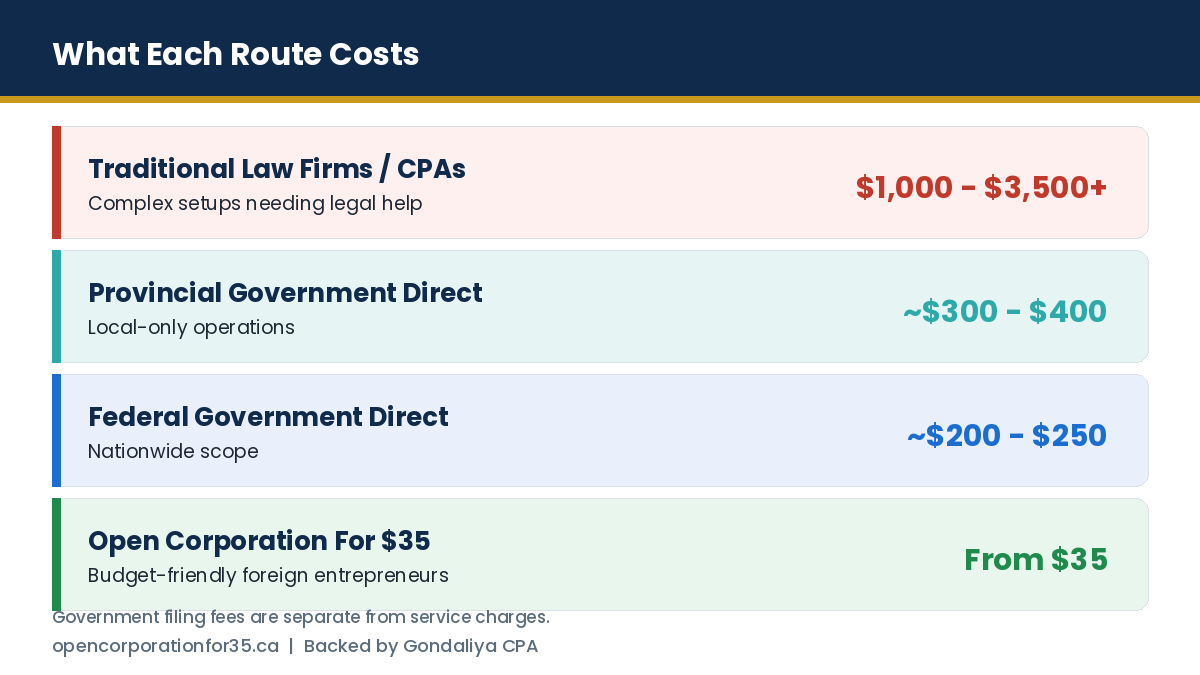
| Option | Typical Cost Range | Complexity | Best For |
|---|---|---|---|
| Traditional Law Firms/CPAs | $1,000 – $3,500+ | High | Complex setups needing legal help |
| Provincial Government Direct | ~$300 – $400 | Moderate | Local-only operations |
| Federal Government Direct | ~$200 – $250 | Moderate | Nationwide scope |
| Virtual Office + Nominee Director Service | Extra monthly fees | Variable | Non-residents without local contacts |
| Open Corporation For $35 | Starting at $35* | Low | Budget-friendly foreign entrepreneurs |
*Government filing fees may change by province and are separate from service charges.
This low price option makes it easier than ever to incorporate without big legal bills while keeping government costs clear.
What You Get With Open Corporation For $35
What You Get With Open Corporation For $35
Included
Our service gives you all the basics so you can start fast without headaches:
Included Items
| Deliverable | Description |
|---|---|
| Articles of Incorporation Template | Ready-to-file paper that fits Canadian rules |
| Corporate Minute Book Template | Helps keep track of corporate records |
| Business Number Registration Help | Guidance for signing up with CRA |
| Basic Support | Email help for common questions |
| Email Confirmation Docs | Digital copies sent quickly after filing |
We keep things simple and affordable starting at just $35. Our focus is on what global founders need without extra charges.
This package works well for digital entrepreneurs who want easy options when they incorporate Canada non resident companies.
Follow these steps carefully and think about costs before choosing services. This will help you open your corporation in Canada even if you’re a foreign entrepreneur working remotely.
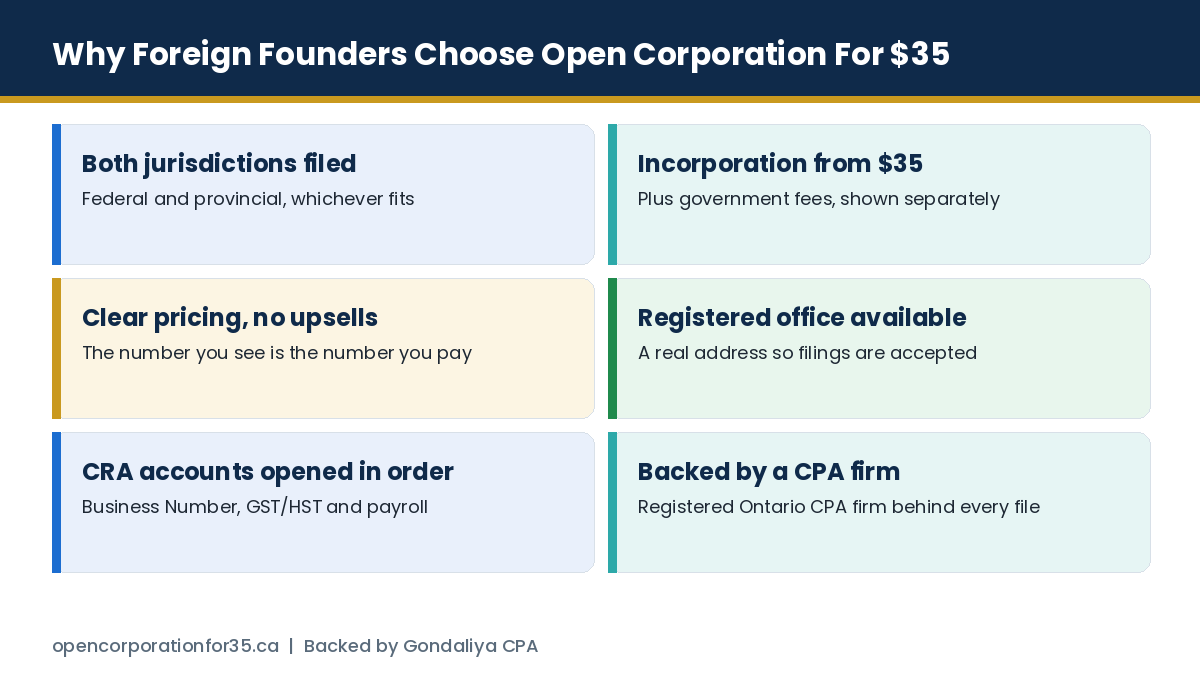
Federal or provincial, we file both
Name search, incorporation filing, registered office address and CRA Business Number registration, all handled remotely for non-resident owners. Please book a free consultation.
Common Challenges and Mistakes
Common Challenges and Mistakes
Mistakes
Starting a business in Canada as a non-resident means dealing with either federal incorporation Canada rules or provincial incorporation Canada laws. Many people get stuck because they don’t know Canadian rules well. Residency needs and compliance can confuse them. Knowing the usual mistakes helps you dodge delays and legal trouble.
Here are some challenges you might face:
- Getting the right type of incorporation—federal or provincial.
- Meeting residency requirements that differ by province.
- Keeping up with government paperwork and deadlines.
Common Mistakes Non-Residents Make
Non-residents often think all provinces have the same rules or that every province needs a resident director. That’s not true, and it causes problems like wrong forms, missed dates, or picking the wrong place to start a business.
They also forget how much ongoing work running a company needs in Canada. For example:
- Keeping good corporate records (like minute books).
- Signing up for GST HST taxes on time if their sales pass certain limits.
- Filing yearly reports when needed.
Another mistake is not setting up a Canadian bank account early enough. Banks want special papers from foreign owners, and without an account, paying bills is harder. Also, skipping the NUANS report (the name search) can cause rejection when filing your articles of incorporation Canada.
Here’s a simple table showing common errors by non-resident companies incorporating in Canada, the risks involved, and ways to avoid them:
| Mistake | Why It’s Risky | How to Avoid It |
|---|---|---|
| Picking wrong jurisdiction | Higher fees; tougher local rules | Check federal vs provincial options first |
| Ignoring resident director rules | Could make your corporation invalid | Look up current laws; pick provinces wisely |
| Skipping NUANS name search | Your name might get rejected | Always get NUANS done when needed |
| Missing government filing fees | Unexpected costs | Plan for fees based on where you incorporate |
| Forgeting corporate minute book | You may face penalties | Keep records updated from day one |
| Late GST/HST registration | Fines for late tax registration | Register quickly if your sales hit thresholds |
| Not opening Canadian bank account | Hard to pay or get paid | Prepare papers early; ask banks about foreigners |
| Misunderstanding ownership rules | Breaking regulations | Know share limits; ask for advice if unsure |
Avoiding these mistakes makes your setup easier and keeps your company in good standing whether you go federal incorporation Canada or choose provincial routes.
Facing these challenges early saves time and stress while making sure you follow both federal regulations Canada and any provincial regulations Canada that apply.
Knowing this helps founders choose if federal incorporation Canada’s wider coverage fits better than local provincial options—especially useful for digital entrepreneurs who want fast service at low cost like Open Corporation For $35.
The jurisdiction decision is worth more than any fee saving. Choosing somewhere with no director residency requirement can remove a recurring nominee cost that outweighs the difference in filing fees several times over.
Realistic Example Scenario
Realistic Example Scenario
Worked Example
Opening a corporation in Canada when you’re not a resident might sound tricky. But seeing how it works in real life can help. Say you’re a SaaS founder from the US. You want to grow your business into Canada by using federal incorporation Canada. You don’t plan to move there, just run things from afar.
Going with federal incorporation Canada means your non-resident company Canada gets protection for its name all over Canada. Plus, you only register once and cover every province. That beats doing separate registrations in each province.
In this case, the founder uses services like Open Corporation For $35 to set things up fast. That includes getting a business number registered, which is key for taxes and opening bank accounts later on.
Scenario Summary
| Aspect | Details |
|---|---|
| Business Type | Non-resident company Canada (a US SaaS startup) |
| Incorporation Choice | Federal incorporation Canada |
| Ownership | Fully owned by foreigner |
| Residency Requirements | No need for a Canadian resident director (check rules) |
| Physical Presence | Set up remotely with virtual office |
| Payment Processing | Uses Stripe for global payments |
This shows you don’t have to be in Canada or live there to start a business. It works well for digital entrepreneurs anywhere.
Assumptions Table
| Assumption | Explanation |
|---|---|
| Federal Incorporation | Chosen because it covers all provinces broadly |
| Non-Resident Company | Owner lives outside Canada |
| Director Residency | No local director required (but check current laws) |
| Virtual Office Use | Allowed as the official registered address |
These points help set what to expect when you plan your incorporate Canada non-resident steps.
Setup Outputs Table
| Deliverable | Description |
|---|---|
| Articles of Incorporation | The official paper filed federally |
| Corporate Minute Book Template | A tool to keep your records organized |
| Business Number Registration | ID needed for taxes at CRA |
| Basic Support | Email help during setup |
This package makes setup fast and clear, with no hidden surprises.
Frequently Asked Questions
Frequently Asked Questions
FAQ
Can I incorporate without visiting Canada?+
Yes. Lots of non-resident companies finish all paperwork online without stepping foot in Canada. Many services let you file everything digitally and handle rules from overseas. Still, check details with your provider or government before starting.
Do I need a Canadian bank account?+
Not exactly at incorporation time. Having one helps with local payments but isn’t required right away. Some banks ask you to be there in person or want more papers. But many fintech options work fine for remote businesses. Services often guide you about banking after setup.
Can I own 100% as a foreigner?+
Yes, you can own the entire company even if you’re not Canadian or living there. Most places don’t limit foreigners owning shares. Some provinces may want directors to live locally, but that doesn’t affect how much of the company you own.
Do I need a visa to incorporate?+
No visa needed just to open or register your company in Canada as a non-resident owner. You only need one if you plan to work inside Canada after setting up your business.
Can I use a virtual address for registration?+
Many provinces accept virtual addresses if they meet certain rules — like being open during business hours and able to get legal mail reliably. Using trusted providers helps keep things official while letting you work remotely with services like Open Corporation For $35.
Conclusion and Next Steps
Conclusion and Next Steps
Conclusion
Choosing between federal incorporation Canada and provincial incorporation Canada depends on what you want for your business and where you plan to work. If you’re a non-resident, you can still incorporate in Canada without needing to live there or get a visa. Knowing the differences helps you pick what fits your goals.
Federal incorporation gives you name protection across all provinces. It lets you operate nationwide but comes with stricter rules to follow. Provincial incorporation suits businesses that focus on one province. It usually costs less and has simpler regulations. Both let non-residents incorporate Canada non-resident companies if they have the right help.
Picking the right type based on where you want to work sets your business up well and keeps you on the right side of the law.
Why Choose Open Corporation For $35?
Open Corporation For $35 makes it easy and cheap for foreign entrepreneurs to open a corporation in Canada fast. Here’s why:
- Pricing starts at $35 plus government fees, which is way cheaper than many lawyers or CPAs.
- It’s made for non-resident company Canada owners who want a quick setup.
- Prices are clear with no hidden charges or pushy sales.
- They handle both federal incorporation Canada and provincial incorporation Canada filings fast.
- You can do everything online from anywhere, perfect if you live outside Canada.
This mix of low cost, clear pricing, speed, and online access makes Open Corporation For $35 a solid choice for those wanting to incorporate in Canada non-resident style.
| Feature | Open Corporation For $35 | Traditional Providers |
|---|---|---|
| Starting Price | From $35 (plus government fees) | Hundreds to thousands of dollars |
| Designed for Non-Residents | Yes | Often limited |
| Processing Speed | Fast | Variable |
| Transparency | Full pricing disclosure | Often unclear |
| Online Convenience | Fully online | May require physical visits |
| Upselling Pressure | None | Common |
Next Steps
Ready to set up your non-resident company Canada through federal incorporation Canada or provincial incorporation Canada? Here’s what comes next:
- Figure Out Your Business Needs – Decide if you want national coverage (federal) or just local presence (provincial).
- Gather Your Documents – Get info like your chosen company name(s), director details, and address (a virtual office works too).
- Start Your Application – Use an affordable service like Open Corporation For $35 that’s built for remote foreign entrepreneurs.
- Register for Taxes – After incorporating, sign up with CRA for GST/HST if your revenue requires it.
- Open a Canadian Bank Account – Even as a non-resident, this step is key. Many banks now allow remote account opening.
Check current rules with Canadian authorities before moving forward because regulations can change.
Following these steps helps you register smoothly while keeping within federal regulations canada or provincial regulations canada.
FAQs
FAQs
More FAQ
Can non-resident investors Canada fully own a corporation?+
Yes, non-resident investors can own 100% of a Canadian company. Ownership rules do not limit foreigners.
Is extra-provincial registration needed for out-of-province business?+
Yes, if you incorporate provincially but operate elsewhere in Canada, extra-provincial registration is usually required.
What are corporate minute book requirements?+
Corporate minute books store official records like meeting minutes and resolutions. They keep your company compliant.
Do I need nominee director services as a non-resident?+
Nominee directors help meet residency rules if you lack local directors. Some provinces require them; others don’t.
Can virtual office services be used for registered office addresses?+
Yes, many provinces accept virtual office addresses if they receive legal mail and meet business hour criteria.
What are typical director service fees?+
Director service fees vary but usually range from $50 to $150 per month for nominee director provision.
When must I register for GST/HST in Canada?+
You must register for GST/HST if your taxable sales exceed $30,000 CAD in a year or you expect to reach that.
What tax filing obligations exist for Canadian corporations?+
Corporations must file annual tax returns with CRA and comply with GST/HST reporting when applicable.
Are there government incentives startup funding options available?+
Canada offers grants and funding programs to startups. Eligibility depends on business type and location.
Key Points for Non-Resident Company Setup in Canada
Key Points
- Opening a corporation in Canada for non-residents requires understanding federal vs provincial rules.
- Business bank account setup may require in-person verification, but remote options exist.
- Shareholder agreements help define ownership rights and protect all parties.
- Permanent residency PR Canada status is not needed to incorporate or own shares.
- Canadian visa requirements apply only if you work physically in Canada after setup.
- Common mistakes non-residents make include ignoring resident director rules and skipping NUANS searches.
- Digital entrepreneur support is available through government and private incubators.
- SaaS founder Canada incorporation often benefits from federal incorporation’s nationwide scope.
- Compliance & reporting Canada corporations require yearly filings and record keeping to avoid penalties.
- Registered office fee varies by province; virtual offices reduce costs for remote owners.
This concise list highlights critical points when incorporating Canada non-resident companies with ease and clarity.
Professional Guidance on Choosing a Jurisdiction: How Open Corporation For $35 Helps
Professional Guidance and Quick Reference
Guidance
Two questions settle this, and neither is the fee. Where will you actually trade, and can you supply a director resident in Canada? If you trade in one province and have no Canadian director, provincial is usually the answer. If you trade nationally, federal is worth the residency obligation.
Open Corporation For $35, backed by Gondaliya CPA, files in both jurisdictions and handles the whole chain: the name search, the incorporation filing, the registered office address, the Business Number and the program accounts.
Everything is done remotely. No travel to Canada is required to incorporate or register.
Quick Answers: Key Numbers & Concepts at a Glance
At a Glance
- Federal filing fee: $200 to $250
- Provincial filing fee: $300 to $400 and up
- Federal director residency: 25%, or one director on a board under four
- Virtual office: $50 to $150 per month
- Nominee director: $50 to $150 per month
- Annual return filing: $20 to $100
- Law firm route: $1,000 to $3,500 and up
- GST/HST threshold: $30,000 CAD a year
- Foreign share ownership: 100% permitted
- PR or visa needed to incorporate: No
Who This Is For / Not For
Fit Check
- For: Foreign founders choosing between federal and provincial, owners weighing a nominee director against changing jurisdiction, businesses planning to expand across provinces, and anyone needing a Canadian registered office address.
- Not For: People hoping a company will support an immigration application, since it grants no status, and businesses in regulated sectors that carry foreign ownership limits.
People Also Ask
Quick Answers
Is federal always the better choice?+
No. Federal carries a director residency obligation that provincial routes often do not. If you trade in one province and have no Canadian director, provincial is usually cheaper and simpler.
Can I move from provincial to federal later?+
Yes, by continuing the corporation into the federal jurisdiction. It costs time and fees, so it is worth deciding properly at the outset rather than planning to switch.
Does federal incorporation avoid provincial registration entirely?+
No. A federal corporation still registers extra-provincially in each province where it carries on business. Federal gives you the right to operate nationally, not exemption from provincial filings.
Glossary of Key Terms
Plain-English Definitions
- CBCA: The Canada Business Corporations Act, governing federal corporations.
- Resident director: A director who meets the legal test for living in Canada.
- Nominee director: A director appointed to satisfy a residency requirement.
- Extra-provincial registration: Registering to operate in a province other than where you incorporated.
- NUANS: The name search report confirming your proposed name is available.
- Registered office: The official street address of the corporation in its jurisdiction.
- Business Number (BN): The nine-digit CRA identifier every tax account attaches to.
- Minute book: The corporate record holding bylaws, resolutions and share registers.
- Annual return: The yearly filing that keeps the corporation in good standing.
- Continuance: Moving a corporation from one jurisdiction to another.
Choose on trading footprint and director availability, not on the filing fee. Federal buys national name protection at the cost of a residency obligation. Provincial buys simplicity at the cost of reach. Either way, budget for extra-provincial registration wherever you actually operate.
Jurisdiction Choice Check
This quick self-check points to the jurisdiction that likely fits. Please answer the six questions below.
Jurisdiction Choice Check
Six quick questions on your plans. No fee quoted.
Points to review:
This is a general prompt, not tax or legal advice or a quote. Your position depends on your full facts, so for a real review please book a free consultation.
Want a checklist to work from? Please download our free federal vs provincial checklist before your consultation.
Pick the right jurisdiction the first time
We compare federal against provincial for your trading footprint and director situation, then file it. Registered office address and CRA registrations included. Please book a free consultation.
What to Send Us
Send us the province or provinces you will trade in, whether any director lives in Canada, whether you need nationwide name protection, and your expected Canadian sales. We will confirm the jurisdiction before anything is filed.
Published: April 6, 2026 · Last updated: April 6, 2026
Editorial policy: Our content is prepared by our team and reviewed by Sharad Gondaliya, CPA, and we update it as incorporation rules, fees and CRA thresholds change.
Disclaimer: This article is educational information only and is not tax, legal, or financial advice. Fees, thresholds and processing times change, and outcomes depend on your specific facts. Please consult a CPA before acting.