
How Much Does It Cost to Open a Corporation in Canada for Non-Residents
How much does it cost to open a corporation in Canada for non-residents is a common question for foreigners looking to start a business. Gondaliya CPA breaks down the services, incorporation costs, and processing times involved in setting up a corporation in Canada for non-residents.
Quick Summary
The base filing starts at $35, but the honest total depends on three variables: which jurisdiction you file in, whether you need a registered office address, and whether you need a nominee director. Choosing a jurisdiction with no director residency requirement removes the largest single recurring cost. Please note the government fee is separate from any service fee and is unavoidable.
| Aspect | Details |
|---|---|
| The base fee | Incorporation from $35, plus the government filing fee. |
| The government fee | Roughly $200 to $500 depending on jurisdiction. |
| The optional extras | Registered office and nominee director, both annual. |
| The realistic range | Around $400 up to over $3,000 for the first year. |
Reading time: 30 minutes.
Table of Contents
- Can a Non-Resident Open a Corporation in Canada?
- Director Residency Considerations
- Federal vs Provincial Differences
- Why Canada Is Attractive for Foreign Entrepreneurs
- Federal vs Provincial Incorporation for Non-Residents
- Step-by-Step: How to Open a Corporation in Canada
- How Much Does It Cost to Open a Corporation in Canada?
- What You Get With Open Corporation For $35
- Common Mistakes Non-Residents Make
- Realistic Example Scenario: US-Based SaaS Founder
- Frequently Asked Questions About Incorporating in Canada
- Why Choose Open Corporation For $35?
- Next Steps
- Professional Guidance and Quick Reference
The Numbers That Matter
This article covers Canada, with Ontario and Toronto context, and assumes a foreign entrepreneur incorporating here without living in Canada. All figures are estimates in Canadian dollars. Fees, thresholds, processing times and director residency rules are set by the federal and provincial governments, and they change. This is educational information only and not tax, legal, or financial advice. Please confirm your own position with a CPA before acting.
Opening a corporation in Canada when you’re not a resident isn’t too hard. Costs can vary, but here’s the gist:
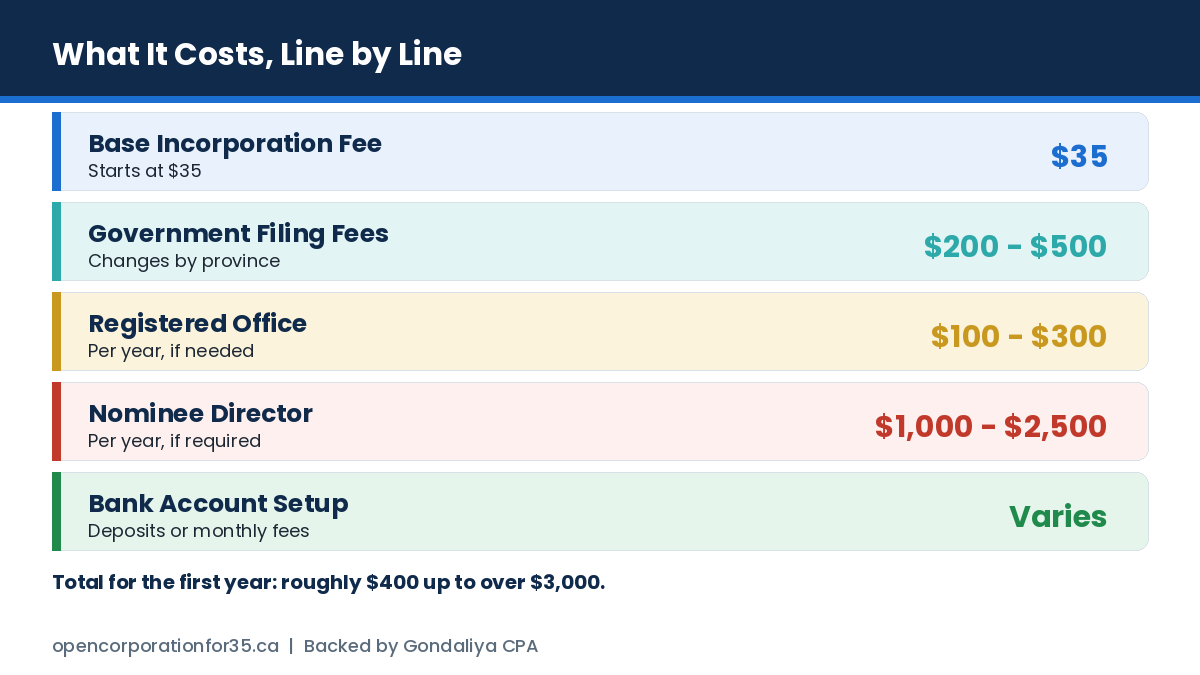
- Base Incorporation Fee: Starts at $35.
- Government Filing Fees: These change by province. Usually between $200 and $500.
- Registered Office Cost: Around $100 to $300 each year if needed.
- Director Service Fees: If you need a nominee director, expect to pay about $1,000 to $2,500 per year.
- Bank Account Setup Costs: Might include initial deposits or monthly fees.
All in all, the cost to incorporate in Canada for foreigners runs from roughly $400 up to over $3,000. It depends on what services and options you pick.
Summary of Costs and Process
Summary
Setting up your company as a non-resident costs money but can be pretty simple.
Here’s what to expect:
- Government fees differ by province but usually fall in the $200-$500 range.
- A basic filing fee kicks off at $35.
- You might pay yearly for a registered office address—about $100 to $300.
- Need a nominee director? That could be another big chunk, like $1,000 to $2,500 yearly.
- Opening a bank account might have some extra charges too.
So yeah, depending on your needs, expect to spend anywhere from several hundred dollars up into the thousands.
Comparison Table of Incorporation Options and Fees
Options
| Option | Typical Cost Range | Complexity | Best For |
|---|---|---|---|
| Online Incorporation | Starting at $35 | Low | Founders on tight budgets |
| Full-Service Law Firm | Usually $1,500+ | High | Those wanting lots of support |
| Nominee Director Services | Around $1,000 – 2,500 | Medium | Non-residents without local ties |
| Registered Office Services | About $100 – 300/year | Low | Businesses needing an address |
Who This Guide Is For
Fit Check
This guide helps:
- Non-residents who want to know how much it costs to open a corporation in Canada.
- Entrepreneurs curious about Canada corporation setup cost non-resident options online.
If you want clear info on starting your business in Canada without fuss and with an eye on cost—this guide suits you.
Key Stat: The nominee director is the largest recurring line on this list, at roughly $1,000 to $2,500 a year. Incorporating where no resident director is required removes it entirely, which is the single biggest saving available to a foreign founder.
Can a Non-Resident Open a Corporation in Canada?
Can a Non-Resident Open a Corporation in Canada?
Eligibility
Yes, non-residents can open a corporation in Canada. Many foreign business owners like Canada because of its steady economy and strong reputation. Starting a corporation as a non-resident is pretty simple. But you do need to know some rules that affect the total cost of opening a business in Canada for non-residents.
The cost to incorporate in Canada for foreigners includes several fees. These are government filing fees, registered office costs, and nominee director fees if you need them. Other setup costs might apply too. These prices change if you choose federal or provincial incorporation.
Non-residents don’t have to be permanent residents or hold visas just to form a corporation here. But some provinces want directors to live in Canada. That can affect your incorporation plan and the Canada corporation setup cost non-resident.
You can find incorporation services with packages as low as $35 plus government fees. This helps you manage how much does it cost to open a corporation in Canada for non-residents without surprises.
Here’s a quick look:
- Who can incorporate? Non-residents, no PR or visa needed
- Residency rules: Vary by province; some want Canadian resident directors
- Filing fees: Depend on where you register—federal or provincial
- Extra costs: Registered office, nominee directors, bank account setup
- Time: Usually 1–2 weeks using online services
Director Residency Considerations
Director Residency Considerations
Directors
A big part of the cost to incorporate in Canada for foreigners comes from director residency rules. Some provinces say at least 25% of the directors must live in Canada.
For example:
- Ontario needs one resident director.
- British Columbia doesn’t require any.
- Federal corporations usually want 25% resident directors, but this can change—check latest rules.
If you don’t qualify yourself, you might need to hire nominee directors. This adds extra cost and affects your Canada corporation setup cost non-resident budget.
Nominee director fees can be between CAD 500 and CAD 1,200 per year depending on who you pick. Picking provinces with no residency rules can save money here.
Knowing these details before starting helps avoid surprises about how much does it cost to open a corporation in Canada for non-residents and keeps your company legal.
Here’s a quick table:
| Province / Jurisdiction | Resident Director Requirement | Notes |
|---|---|---|
| Federal | At least 25% resident directors | Check current regulations |
| Ontario | One resident director minimum | Popular for foreign founders |
| British Columbia | No resident director required | Costs less over time |
| Alberta | No clear residency rule | Offers more flexibility |
Risk Warning: This article quotes nominee director fees three different ways, and the residency tables differ from one another. Please confirm the current rule for your chosen jurisdiction directly before budgeting, because this single decision swings the first-year cost by over a thousand dollars.
Federal vs Provincial Differences
Federal vs Provincial Differences
Comparison
Choosing federal or provincial incorporation changes your costs and what rules you follow. This also changes how much does it cost to open a corporation in Canada for non-residents.
Key Cost Points:
Costs
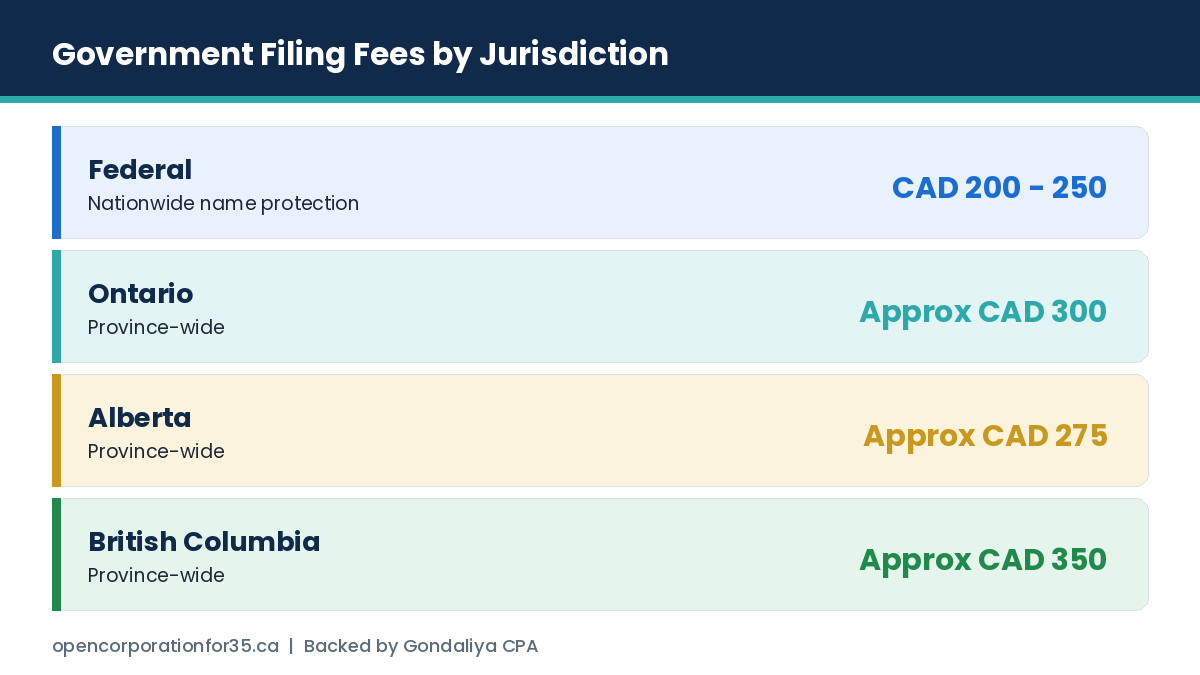
- Government filing fees vary: Federal is around CAD 200–250; provinces differ.
- Registered office costs depend on where you set up.
- Compliance is tougher federally since it covers all Canada; provincially it’s simpler but only local.
Federal suits businesses planning to work across Canada or many locations. It protects your name everywhere but involves more paperwork.
Provincial incorporations usually cost less upfront.
For example:
- Ontario charges about CAD 300 government fee
- British Columbia around CAD 350
These numbers change so check before deciding your total cost of opening business in Canada for non-residents.
When To Choose?
Decide
Choose federal if:
- You want name protection all over Canada
- Plan quick expansion beyond one province
- Can handle more paperwork
Choose provincial if:
- Your business stays local
- You want lower start-up fees
- Prefer easier yearly rules
Both let foreigners own fully with no citizenship limits but differ mainly on procedures that affect your costs and accounting after setup.
Comparison Table: Federal vs Provincial Incorporation Costs & Features
Compare
| Feature | Federal | Ontario | British Columbia |
|---|---|---|---|
| Government Filing Fee Range | CAD $200-$250 | Approx CAD $300 | Approx CAD $350 |
| Name Protection Scope | Nationwide | Province-wide | Province-wide |
| Director Residency Requirement* | At least 25% | One minimum | None |
| Annual Compliance Complexity | Moderate | Moderate | Low |
| Best For | Large/national firms | Local startups | Entrepreneurs wanting low-cost entry |
*Always confirm latest rules with official sources.
Deciding federal or provincial shapes your expected expenses when thinking about how much does it cost to open a corporation in Canada for non-residents. Pick wisely based on price and goals early on.
Why Canada Is Attractive for Foreign Entrepreneurs
Why Canada Is Attractive for Foreign Entrepreneurs
Why Canada
When you ask how much does it cost to open a corporation in Canada for non-residents, the price is just part of the story. Foreign entrepreneurs often find more than just good rates here. Canada gives you a solid place to start and grow your business. Let’s look at why it works well.
Stable Legal System
Canada’s rules for businesses are clear and steady. The Canada Business Corporations Act (CBCA) plus provincial laws protect everyone involved—owners, directors, and creditors. If you think about the cost to incorporate in Canada for foreigners, this legal setup cuts down on surprises.
With clear rules, your investment stays safe. Non-residents can feel sure about their rights under Canadian law. This lowers risks that might raise the total cost of opening a business in Canada for non-residents because fewer legal problems come up.
Global Credibility
A Canadian company gains trust fast worldwide. Investors and partners know Canadian businesses follow strict rules and honest practices. This trust helps you get money and partners more easily than places with weaker systems.
Thinking about Canada corporation setup cost non-resident owners face? This global respect adds value without charging extra fees. In fact, incorporation can start at just $35 through services like Open Corporation For $35.
Access to North American Markets
Why do many ask how much does it cost to open a corporation in Canada for non-residents? One big reason is market access. Trade deals like USMCA (with the US and Mexico), CETA (with Europe), and CPTPP (across Pacific nations) give Canadian companies easier entry.
These agreements let your goods move with low or no tariffs. They also make cross-border work smoother. So, when thinking of the total cost of opening a business in Canada for non-residents, remember this access can bring bigger profits that beat startup costs.
Stripe/Global Payment Compatibility
If you run a digital business, payment options matter a lot. Incorporating in Canada works well with big payment platforms like Stripe. That means getting paid worldwide is simpler and faster.
This ease avoids troubles many foreign founders face elsewhere—like banks that don’t work well with non-residents or complicated checks that slow payments down. When you add up fees and hidden costs abroad, this makes Canadian incorporation affordable and smooth for startups on tight budgets.
SaaS and Tech Ecosystem
Canada offers great support for SaaS companies and tech startups. Cities like Toronto, Vancouver, Montreal, and Ottawa have strong hubs full of skilled workers, incubators, accelerators, and government programs encouraging growth.
Foreign entrepreneurs wondering how much does it cost to open a corporation in Canada for non-residents will see this is more than just setting up an address. It’s about joining a helpful network where every dollar helps your business grow instead of disappearing in overheads connected to setup.
| Key Advantage | Description | Relevance To Cost Considerations |
|---|---|---|
| Stable Legal System | Clear governance via CBCA & provincial laws | Cuts risk-related expenses |
| Global Credibility | Trusted jurisdiction recognized internationally | Boosts investor confidence without extra fees |
| Access To North American Markets | Trade deals enable tariff-free exports | Opens revenue chances beyond initial costs |
| Stripe/Global Payment Compatibility | Supports major payment platforms crucial for online businesses | Cuts banking/payment gateway issues |
| SaaS & Tech Ecosystem | Innovation hubs support growth-oriented startups | Offers resources that lower indirect costs |
Choosing where to incorporate isn’t just about comparing filing fees. You need to think about these bigger benefits too. Many foreign entrepreneurs pay reasonable upfront fees because they know long-term gains come from Canada’s solid environment.
If you pick affordable options like Open Corporation For $35—starting at $35 plus government fees—you get low-cost entry plus these advantages all in one package made for global founders who want simple but strong setups without losing opportunity or quality.
Federal vs Provincial Incorporation for Non-Residents
Federal vs Provincial Incorporation for Non-Residents
In Detail
If you’re wondering how much does it cost to open a corporation in Canada for non-residents, you should know the difference between federal and provincial incorporation. Each has its own pros and cons. Costs and rules vary quite a bit, especially for foreigners.
Federal incorporation lets you run your business across all provinces with just one registration. But provincial incorporation means your company is recognized mainly in one province. If you want to do business elsewhere, you might need extra registrations.
When looking at the cost to incorporate in Canada for foreigners, federal fees are usually set by the government and can be higher than some provinces’. Provinces like Alberta or British Columbia often have cheaper fees but may add local compliance costs later.
Residency requirements also play a big part. Some places want directors who live in Canada. Others don’t. This affects how hard or easy it is to set up and keep your company running.
Key Differences Between Federal and Provincial Incorporation
- Federal lets you operate anywhere in Canada; provincial limits you mostly to one area.
- Federal fees can be higher but cover nationwide operations.
- Some provinces have lower fees but extra rules if you expand.
- Residency rules differ; some require Canadian directors, others don’t.
Residency Requirements Impact on Choice
One big thing that affects your choice is the director residency requirement. Many places ask for a certain percent of directors to live in Canada — often called the 25% rule. But this isn’t the same everywhere.
For non-residents, picking an option without strict residency rules can save money and trouble. You might avoid paying for nominee director services that add to overall costs.
When Federal Incorporation Is Preferable
Federal incorporation is best if you want to do business across Canada from the start. It gives you:
- Name protection all over Canada
- Easy expansion without new registrations
- One set of rules under the Canada Business Corporations Act (CBCA)
The federal incorporation cost includes government fees and maybe some office expenses, but it’s often worth it if you want simple national coverage.
This option fits well with startups or tech firms that serve clients all over Canada.
When Provincial Incorporation Suits Better
Provincial incorporation works better if your business stays mainly in one province. Reasons include:
- Lower initial government filing fees in some provinces
- Easier local regulations
- Sometimes fewer residency rules
Provinces like Ontario or British Columbia can have cheaper province-specific business registration costs. That can help if you don’t plan to grow outside your home base quickly.
Also, check current rules because some provinces don’t require resident directors at all. That means less need for nominee services, which cuts total cost of opening a business in Canada for non-residents.
| Feature | Federal Incorporation | Provincial Incorporation |
|---|---|---|
| Jurisdiction Coverage | Nationwide | Province-specific |
| Government Filing Fees | Moderate (varies) | Often lower per province |
| Director Residency Requirement | Usually 25% Canadian directors | Varies; some no requirement |
| Name Protection | Across all Canada | Only within incorporated province |
| Expansion Ease | Simple without new incorporations | Requires extra filings outside home prov. |
| Registered Office Requirement | Mandatory | Depends on province |
Resident Director Requirement Explained
If you’re a non-resident thinking about Canada corporation setup cost non-resident, the resident director rule matters a lot. This rule means some directors must live in Canada. It’s meant to keep businesses accountable locally but makes things tricky for foreigners without Canadian ties.
Explanation of the 25% Director Residency Rule Context
In many parts of Canada — including federal law — at least 25% of your directors must live here. If your board has fewer than four members, usually at least one needs to be a resident.
This rule makes sure there’s someone local involved in company decisions but can slow down fully foreign-owned companies trying to get going fast.
Rules can change though, so always check up-to-date info before deciding. It affects how much does it cost to open a corporation in Canada for non-residents because you might need nominee directors.
Provinces Without Residency Requirements (Confirm Current Rules)
Some provinces don’t require any resident directors right now — good news if you want to avoid nominee services:
- British Columbia
- Alberta
- Manitoba
Picking these provinces can lower hidden costs and make setup easier.
Common Solutions Non-Residents Use To Meet Director Requirements
Lots of non-residents use nominee director services from pros who charge around CAD $500–$1,200 yearly depending on provider and service level.
These nominees meet legal needs so companies run smoothly while keeping owner privacy where allowed.
| Province / Jurisdiction | Resident Director Required? |
|---|---|
| Federal | Yes – min 25%, except very small boards |
| Ontario | Yes – min 25% |
| Quebec | Yes – min 50%, stricter |
| British Columbia | No |
| Manitoba | No |
*Check current rules first as laws may change.*
Choosing between federal vs provincial incorporation comes down to where you want your business, what budget you have for incorporating in Canada for foreigners, and how easily you can meet residency needs either directly or through nominee services.
The nominee decision is worth making before the jurisdiction decision, not after. Choosing somewhere with no residency requirement saves the annual fee permanently, whereas choosing first and hiring a nominee later locks in that cost every year.
Step-by-Step: How to Open a Corporation in Canada for Non-Residents
Step-by-Step: How to Open a Corporation in Canada for Non-Residents
Step by Step
Opening a corporation in Canada as a non-resident takes a few clear steps. Knowing each step helps you plan for the total cost of opening a business in Canada for non-residents. It also keeps you on the right side of Canadian rules. Here’s a simple guide that covers what you need to do, what it costs, and how long it might take.
Choosing the Right Business Structure for Non-Residents
First, pick your business structure. Most non-residents choose to incorporate either federally or provincially as corporations. This gives them some protection and makes their business look more serious.
- Corporation: Gives limited liability, easier access to money, and better reputation.
- Sole Proprietorship or Partnership: Less used by foreigners because they don’t protect personal assets.
Thinking about how much does it cost to open a corporation in Canada for non-residents? Fees change depending on where you file but start low. Some services let you open a corporation for as little as $35, which beats expensive lawyers.
The structure you choose affects what you pay later too — like accounting bills and yearly fees. Corporations cost more upfront but have benefits over time.
Conducting a Name Search (NUANS Report if Required)
Before filing papers, check if your business name is free in Canada. You often need a NUANS report (Newly Upgraded Automated Name Search) for this:
- NUANS looks for existing company names and trademarks.
- Usually required for federal incorporation and some provinces.
This report costs around CAD 20–75 depending on where you get it and how fast. This fee adds to the cost to incorporate in Canada for foreigners because it proves your name is okay before applying.
Selecting Jurisdiction and Filing Incorporation Documents
Picking federal or provincial incorporation changes your fees and rules:
| Jurisdiction | Gov’t Filing Fees* | Residency Rules | When It Fits Best |
|---|---|---|---|
| Federal | CAD 200–250 | At least 25% directors live there† | For nationwide operations |
| Ontario | CAD 300 | No residency needed‡ | If you want local Ontario focus |
| British Columbia | CAD 350 | No residency needed‡ | For West Coast tech startups |
*Fees can change; check latest info
†Rules may vary; check before filing
‡Residency needs can shift—always verify
You file articles of incorporation plus forms online or on paper through government sites.
Obtaining CRA Business Number Registration
After incorporating, get your CRA business number:
- CRA gives this unique number for taxes.
- No government fee to register here but third-party help may cost money.
You need this number to set up GST/HST accounts when required. This step matters for total cost of opening a business in Canada for non-residents because taxes come later.
Opening a Canadian Business Bank Account Considerations and Fees
Non-residents often find opening Canadian bank accounts tricky:
- Banks ask to verify who you are; some let you open accounts remotely, others want you there.
- Fees differ—some banks charge nothing monthly while others ask CAD 30+ plus transaction costs.
Knowing these fees helps with canada corporation setup cost non resident plans. Some offer nominee directors to ease banking but expect extra charges if you use them.
Registering for GST/HST if Applicable
If your sales inside Canada go over CAD 30,000 yearly, register for GST/HST:
- Registration is free once you have your CRA number.
- You must collect taxes and file reports regularly, which may raise accounting costs after starting up.
Sign up early if your sales will hit that limit soon. Otherwise, join later when it makes sense.
Process Timeline Table With Estimated Durations
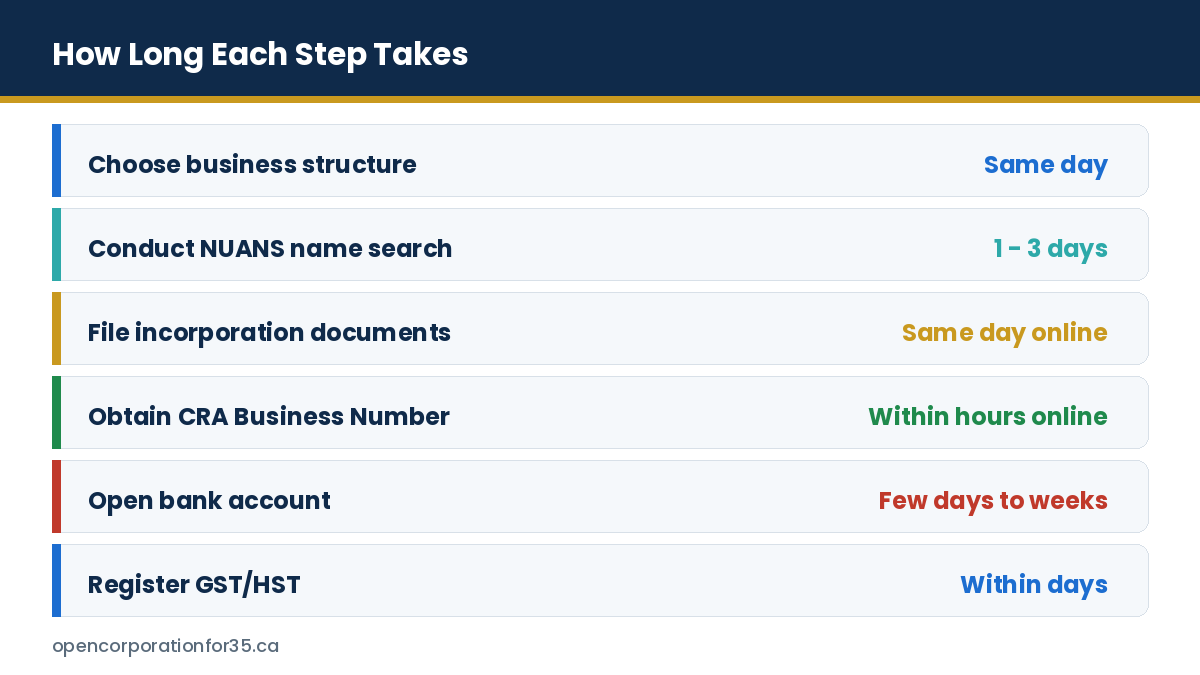
Here’s a quick look at how long each step usually takes when opening your corporation:
| Step | Time Needed |
|---|---|
| Choose Business Structure | Same day |
| Conduct Name Search (NUANS)* | 1–3 days |
| File Incorporation Documents | Online: same day Paper: up to 2 weeks |
| Obtain CRA Business Number | Within hours online |
| Open Bank Account | Few days up to weeks |
| Register GST/HST | Confirmation within days |
*Time depends on where you do the search
Following these steps carefully helps you guess how much does it cost to open a corporation in Canada for non-residents without surprises from hidden fees or delays. Options starting at just $35 make the process easier without losing quality or speed.
How Much Does It Cost to Open a Corporation in Canada?
How Much Does It Cost to Open a Corporation in Canada?
Full Costs
Starting a corporation in Canada costs different amounts depending on where you register and what you need. If you’re a non-resident, it’s smart to know these costs before jumping in. Here’s a simple breakdown of what you might pay, including government fees, office addresses, director services, bank accounts, and taxes.
Government Filing Fees Overview
Governments charge fees when you file to incorporate. These fees change by province or if you go federal:
- Federal: Usually about CAD 200 to CAD 250 online.
- Ontario: Around CAD 300.
- British Columbia: Close to CAD 350.
- Alberta: About CAD 275.
These are just government fees. Service providers often charge extra. Always check current rates with the government.
Registered Office Address Costs
Every corporation needs a registered office address in Canada. Non-residents often rent virtual or physical addresses from companies.
Typical costs:
- Virtual addresses cost about CAD 50 to CAD 150 per year.
- Physical offices might be pricier if mail handling or location is included.
Plan for this when figuring your Canada corporation setup cost non-resident budget.
Director Service or Nominee Director Fees
Some provinces want at least one resident director. Non-residents may pay for nominee director services.
Fees often range:
- From CAD 500 to CAD 1,000 yearly for nominee directors.
Not all provinces require this; check local rules before you spend money.
Business Bank Account Setup Fees and Maintenance Costs
Setting up a business bank account is needed but can have costs:
- Opening might be free.
- Monthly fees usually run from CAD 10 up to over CAD 30.
- Banks may charge for transactions or wire transfers, especially international ones.
Non-residents may need more documents but usually don’t pay extra banking fees.
Tax Filing Obligations Including CRA T2 Filing Costs
Corporations file yearly income tax returns with CRA using form T2. CRA doesn’t charge filing fees itself, but accountants do.
Typical tax return help costs:
- Start around CAD 800 to CAD 1,500 per year.
You might also pay for GST/HST registration or payroll help. Plan your budget carefully for these ongoing costs.
Pricing Comparison Table: Traditional Providers vs Open Corporation For $35
| Option | Typical Cost Range | Complexity | Best For |
|---|---|---|---|
| Traditional Law Firms/CPAs | $1,000 – $3,000+ | High | Complex incorporations needing legal advice |
| Online Incorporation Services (General) | $100 – $400 | Moderate | Entrepreneurs wanting convenience without high cost |
| Open Corporation For $35 | Starting at just $35 + govt. fees | Simple & Fast | Non-residents seeking affordable & clear incorporation |
Open Corporation For $35 is aimed at foreign founders who want a quick and easy process without hidden extras.
The line people forget to budget is the annual T2 preparation. It recurs every year whether the company traded or not, and over three years it usually exceeds the entire cost of incorporating.
Incorporate from $35, plus government fees
Name search, incorporation filing, registered office address and CRA Business Number registration, all handled remotely for non-resident owners. Please book a free consultation.
What You Get With Open Corporation For $35
What You Get With Open Corporation For $35
Included
| Deliverable | Description |
|---|---|
| Articles of Incorporation | Official paperwork filed with the government |
| Corporate Minute Book Template | Tools to keep your records organized |
| Business Number Registration | Help getting your CRA business number |
| Basic Support | Email help during the incorporation process |
| Confirmation Documents | Digital copies sent right after setup |
This package keeps things straightforward and covers the basics legally required.
Common Mistakes Non-Residents Make When Incorporating in Canada
Common Mistakes Non-Residents Make When Incorporating in Canada
Mistakes
Avoid these errors—they slow you down and cost money:
- Not checking residency rules first — causes delays.
- Forgeting registered office address needs — risks losing good standing.
- Ignoring different government fee amounts — pays more than expected.
- Skipping name search steps — can lead to application rejection.
- Not preparing bank docs early — slows account opening.
- Underestimating yearly compliance costs — risks fines.
- Thinking no tax filings are needed — leads to trouble.
- Using untrustworthy service providers — risk scams.
- Not understanding shareholder rights — causes disputes.
- Delaying GST/HST registration if needed — pays penalties.
- Trying DIY without guidance — makes errors needing fixes.
- Neglecting corporate records upkeep — loses protections.
Realistic Example Scenario: US-Based SaaS Founder Incorporating in Canada
Realistic Example Scenario: US-Based SaaS Founder Incorporating in Canada
Worked Example
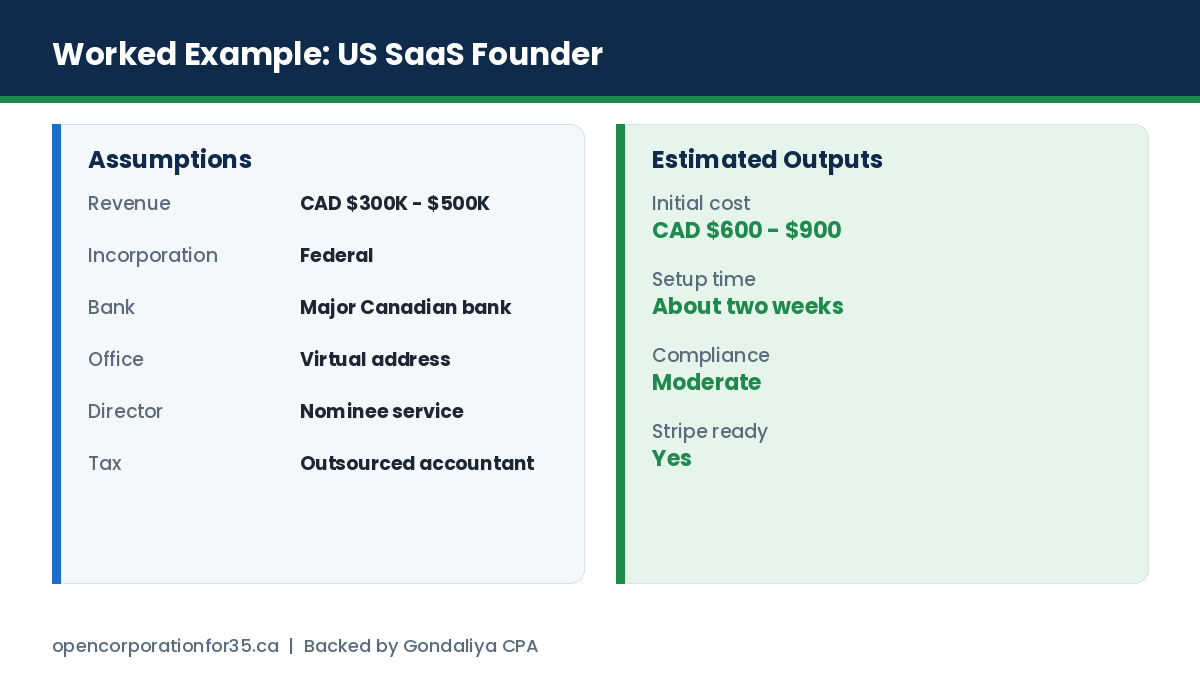
Here’s Jane Doe’s example. She runs a SaaS company in the US and wants to expand by incorporating in Canada remotely using Stripe payments. She isn’t a Canadian resident.
Assumptions Table
Assumptions
| Item | Detail |
|---|---|
| Projected Annual Revenue | CAD$300K–$500K |
| Incorporation Type | Federal |
| Bank Account Location | Major Canadian bank |
| Registered Office | Virtual address provider |
| Director Requirement | Uses nominee/director service |
| Tax Preparation | Outsourced accountant |
Setup Outputs Table
Outputs
| Output | Estimate |
|---|---|
| Total Initial Cost Estimate | CAD$600–$900* |
| Time To Complete Setup | About two weeks |
| Compliance Burden | Moderate – annual filings required |
| Payment Processing Ready | Yes – works with Stripe |
*Figures can vary based on chosen services and providers.
Frequently Asked Questions About Incorporating in Canada as a Non-Resident
Frequently Asked Questions About Incorporating in Canada as a Non-Resident
FAQ
Here are common questions folks ask along with quick answers:
FAQ Summary Table
Quick Answers
| Question | Answer Summary |
|---|---|
| Can I incorporate without visiting Canada? | Yes – many platforms let you do this fully remote |
| Do I need a Canadian bank account? | Recommended but not always required |
| Can I own 100% as a foreigner? | Yes – foreigners can own whole company usually |
| Do I need a visa? | No visa needed just for incorporating |
| Can I use a virtual address? | Yes – allowed as registered office |
| Are there hidden costs beyond filing fees? | Possibly – plan ahead |
| How long does it take to incorporate? | A few days up to two weeks |
| What ongoing compliance is required? | Annual reports and tax filings |
Expanded answers:
In Full
Can I incorporate without visiting Canada?+
Yes. Many services let you send everything online without traveling there.
Do I need a Canadian bank account?+
Not always right away, but it helps if you want local payments or services like Stripe.
Can I own my company entirely as a foreigner?+
Usually yes unless your business needs special permits for certain fields.
Is visa required just because I’m incorporating here?+
Nope. Incorporating doesn’t mean you must have Canadian visa.
Are virtual addresses acceptable as registered offices?+
Most provinces say yes if they follow local rules; double-check your province first.
More questions can come up depending on your case.
Why Choose Open Corporation For $35?
Why Choose Open Corporation For $35?
Why Us
Here’s why many pick Open Corporation over pricier options:
| Feature | Details | Others |
|---|---|---|
| Affordable Starting Price ($35+) | ✓ | × |
| Made For Non‑Residents | ✓ | × |
| Clear Pricing Without Hidden Charges | ✓ | × |
| Fast Online Process With Little Paperwork | ✓ | × |
| Basic Email Support Included | ✓ | Limited |
| No Pushy Upsells Or Extras | ✓ | Often Present |
Open Corporation keeps things cheap and clear—good if you want easy steps and no surprises when setting up from abroad.
Next Steps
Next Steps
Get Going
You can start forming your company today knowing support is ready and pricing starts low at just $35 plus government filing charges. If questions pop up while signing up, reach out anytime. The process stays simple so global founders like you can get going quickly with confidence!
Frequently Asked Questions (FAQs)
Can I use the Express Incorporation option for faster setup?+
Yes, many services offer express incorporation with processing times as quick as 1–3 business days.
Does Open Corporation For $35 include a Registered Office address?+
The package includes a basic virtual registered office address suitable for compliance needs.
Is a nominee director service mandatory for non-residents?+
Nominee directors are optional but needed if provincial rules require resident directors.
Are annual returns and CRA filings required after incorporation?+
Yes, annual returns and CRA tax filings are mandatory to maintain corporate compliance.
Does the service provide basic compliance support and corporate minute book templates?+
Yes, these are included to help you meet legal record-keeping requirements easily.
Can I incorporate in Canada without permanent residency or a visa?+
Yes, incorporation does not require PR or visa status for non-residents.
Will the corporation be compatible with payment platforms like Stripe?+
Canadian corporations generally work well with Stripe and other global payment systems.
Does federal incorporation include an express option?+
Federal incorporation often offers express filing to speed up the process nationwide.
Key Benefits of Open Corporation For $35
Benefits
- Incorporation starting at $35 plus government filing fees.
- Fast online setup with minimal paperwork.
- Basic compliance support including Corporate Minute Book Template.
- Email confirmation documents sent promptly after setup.
- Registered office basic virtual address included by default.
- Optional nominee director service for non-residents needing local directors.
- Business Number Registration in Canada handled as part of the package.
- Annual compliance reminders and guidance provided.
- Suitable for incorporation without PR or visa requirements.
- Compatible with Stripe and global payment systems for SaaS businesses.
- Ideal choice for those seeking affordable, clear pricing without hidden fees.
Important Compliance Points
Compliance
- Annual returns must be filed on time to avoid penalties.
- CRA filings include corporate income tax using T2 forms yearly.
- Local physical presence is only required if specific provincial laws apply.
- Complex licensing may be necessary depending on your business sector.
- Tax filing services or CPA services can help manage ongoing obligations efficiently.
Federal vs Provincial Incorporation Summary
Summary
| Aspect | Federal Incorporation | Provincial Incorporation |
|---|---|---|
| Service Speed | Express option often available | Varies by province |
| Registered Office | Virtual office included | Usually required locally |
| Nominee Director Service | Optional, depending on residency | Depends on provincial rules |
| Compliance | Annual returns + CRA filings | Similar but varies per province |
| Expansion Flexibility | Nationwide coverage | Restricted to one province |
Choose based on your business goals and residency status to minimize costs and maximize benefits when opening a corporation in Canada as a non-resident.
Professional Guidance on Incorporation Costs: How Open Corporation For $35 Keeps It Predictable
Professional Guidance and Quick Reference
Guidance
The headline figure is the least useful number here. What actually decides your first-year cost is whether you need a nominee director, because that single line is larger than the incorporation fee and the government fee combined, and it repeats every year.
Open Corporation For $35, backed by Gondaliya CPA, prices the whole chain up front: the name search, the incorporation filing, the registered office address, the Business Number and the program accounts.
Everything is done remotely. No travel to Canada is required to incorporate or register.
Quick Answers: Key Numbers & Concepts at a Glance
At a Glance
- Base incorporation: From $35 plus government fees
- Federal government fee: CAD 200 to 250 online
- Ontario government fee: Around CAD 300
- British Columbia government fee: Around CAD 350
- Alberta government fee: Around CAD 275
- NUANS report: CAD 20 to 75
- Virtual registered office: CAD 50 to 150 per year
- Nominee director: CAD 500 to 2,500 per year
- Bank monthly fee: CAD 10 to 30 and up
- Annual T2 preparation: CAD 800 to 1,500
Who This Is For / Not For
Fit Check
- For: Foreign founders budgeting a Canadian incorporation, owners comparing jurisdictions on cost, anyone weighing a nominee director against changing jurisdiction, and SaaS businesses wanting a Stripe-compatible entity.
- Not For: People hoping a company will support an immigration application, since it grants no status, and businesses in regulated sectors that carry ownership limits.
People Also Ask
Quick Answers
What is the realistic minimum first-year cost?+
The incorporation fee plus the government fee, plus a registered office if you have no Canadian address. Budget the annual T2 preparation as well, since it applies whether or not the company trades.
Can I avoid the nominee director fee altogether?+
Usually yes, by incorporating somewhere that carries no director residency requirement. That decision is worth making before you choose the jurisdiction, not after.
Is the cheapest jurisdiction always the right one?+
No. If you will trade across provinces, extra-provincial registrations can cost more over time than the higher federal fee would have. Match the jurisdiction to where you will actually operate.
Glossary of Key Terms
Plain-English Definitions
- Government filing fee: The unavoidable fee charged by Corporations Canada or the provincial registry.
- Service fee: What a provider charges on top of the government fee.
- NUANS: The name search report confirming your proposed name is available.
- Registered office: The official street address of the corporation in its jurisdiction.
- Nominee director: A director appointed to satisfy a residency requirement.
- Extra-provincial registration: Registering to operate in a province other than where you incorporated.
- Business Number (BN): The nine-digit CRA identifier every tax account attaches to.
- T2: The corporate income tax return filed every year.
- Minute book: The corporate record holding bylaws, share registers and resolutions.
- Annual return: The yearly filing that keeps the corporation in good standing.
Decide the nominee question first, because it drives the biggest recurring cost. Then pick the jurisdiction by where you will trade rather than by filing fee alone. Then budget the registered office and the annual T2, which are the two lines most people forget.
Incorporation Cost Readiness Check
This quick self-check flags which cost lines will apply to you. Please answer the six questions below.
Incorporation Cost Readiness Check
Six quick questions on your plans. No fee quoted.
Cost lines to plan for:
This is a general prompt, not tax or legal advice or a quote. Your position depends on your full facts, so for a real review please book a free consultation.
Want a checklist to work from? Please download our free incorporation cost checklist before your consultation.
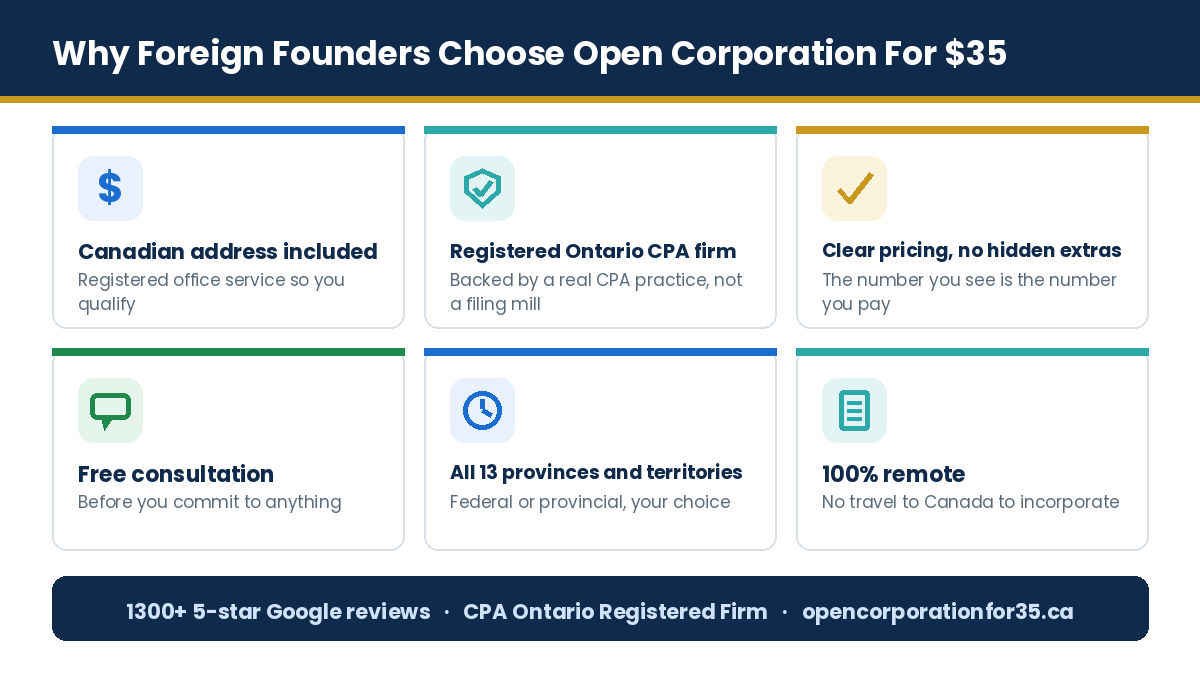
Know your real cost before you file
We price the jurisdiction, the address, the director options and the annual filings together, so the number you see is the number you pay. Please book a free consultation.
What to Send Us
Send us whether you can supply a Canadian resident director, the province or provinces you will trade in, whether you need a Canadian address, and your expected Canadian sales. We will give you the full first-year cost before you commit.
Published: April 25, 2026 · Last updated: April 25, 2026
Editorial policy: Our content is prepared by our team and reviewed by Sharad Gondaliya, CPA, and we update it as incorporation fees, thresholds and CRA rules change.
Disclaimer: This article is educational information only and is not tax, legal, or financial advice. All figures are estimates and subject to change. Please consult a CPA before acting.