
FAQs: Opening a Corporation in Canada as a Non-Resident
Canada business incorporation for foreigners is made easy with Gondaliya CPA, specializing in helping non-residents understand requirements for Ontario and federal corporations. Their expertise includes registering non-resident businesses, obtaining business numbers, and managing CRA program accounts to ensure a smooth start for those who want to start a business in Canada as non-resident.
Quick Summary
A non-resident can own 100% of a Canadian corporation with no permanent residency and no visit required. The decision that actually matters is jurisdiction, because director residency differs: federal requires 25% resident Canadian directors, while Ontario and British Columbia require none. Please note the registered office must be a real street address inside the jurisdiction, which is what most rejected filings get wrong.
| Aspect | Details |
|---|---|
| Ownership | 100% foreign ownership, no PR or citizenship needed. |
| Directors | Federal needs 25% resident; Ontario and BC need none. |
| The address | A real street address inside the jurisdiction, never a PO box. |
| The timeline | Roughly one to two weeks with complete paperwork. |
Reading time: 28 minutes.
Table of Contents
- FAQs: Opening a Corporation in Canada as a Non-Resident (2026 Guide)
- FAQ Section Overview
- Non-Resident Ownership
- Residency Requirements
- Federal vs Provincial Options
- Banking
- Nominee Director
- GST/HST Registration
- Tax Filing
- Incorporation Timeline
- Required Documents
- Remote Incorporation
- Key Requirements for Non-Residents
- Federal vs Provincial Incorporation Explained
- Costs of Opening a Corporation in Canada
- Common Mistakes Non-Residents Make
- Step-by-Step Process Overview
- Benefits of Incorporating in Canada as a Non-Resident
- Final Summary
- FAQs: Key Questions on Incorporating in Canada
- Essential Points on Compliance & Corporate Requirements
- Additional Must-Know Facts for Foreign Entrepreneurs
- Professional Guidance and Quick Reference
The Numbers That Matter
This article covers Canada, with Ontario and Toronto context, and assumes a foreign entrepreneur incorporating here without living in Canada. Fees, thresholds, processing times and director residency rules are set by the federal and provincial governments, and they change. This is educational information only and not tax, legal, or financial advice. Please confirm your own position with a CPA before acting.
FAQs: Opening a Corporation in Canada as a Non-Resident (2026 Guide)
FAQs: Opening a Corporation in Canada as a Non-Resident (2026 Guide)
2026 Guide
Starting a business in Canada as a non-resident can be pretty exciting. This guide answers common questions about incorporating in Canada, focusing on what foreign entrepreneurs need to know. We’ll cover topics like ownership rules, residency requirements, incorporation choices, banking tips, and more.
FAQ Section Overview
FAQ Section Overview
Overview
Here’s a quick look at the main questions about opening a corporation in Canada for non-residents:
| FAQ Topic | Key Points |
|---|---|
| Non-resident Ownership | Can you own 100%? |
| Residency Requirements | Do you need permanent residency? |
| Federal vs Provincial Options | How federal and provincial incorporation differ |
| Banking | How to open a Canadian business bank account |
| Nominee Director | Role and legality of nominee directors |
| GST/HST Registration | Registration rules for non-residents |
| Tax Filing | Corporate tax obligations |
| Incorporation Timeline | How long incorporation takes |
| Required Documents | Docs needed for remote incorporation |
| Remote Incorporation | Operating without being physically in Canada |
Non-Resident Ownership
Non-Resident Ownership
Ownership
Can I Own 100% of My Canadian Corporation as a Foreigner?
Yes, foreigners can own all of their Canadian corporation. No rules stop non-residents from having full ownership. This means you can control your business fully while taking advantage of Canada’s stable economy.
What You Should Know
Key Points
- Foreigners can have 100% shares
- No special limits on ownership
- You keep full management power
Key Stat: Share ownership of a Canadian corporation carries no residency or citizenship test whatsoever. The only residency question that ever arises concerns the board of directors, and it depends entirely on the jurisdiction you choose.
Residency Requirements
Residency Requirements
Residency
Do I Need Permanent Residency to Start a Business in Canada?
Nope, you don’t need permanent residency to start or register your company here. People outside Canada can set up corporations without living permanently in the country.
PR vs. Non-PR Requirements
Compare
Permanent residency does give perks, like easier access to government programs. But it’s not required to legally start or run a business in Canada.
Federal vs Provincial Options
Federal vs Provincial Options
Options
Federal vs Provincial Incorporation
You can incorporate federally or provincially. Both have their own rules and benefits.
Quick Comparison: Federal vs Provincial Incorporation
Snapshot
| Feature | Federal Incorporation | Provincial Incorporation |
|---|---|---|
| Coverage | Works all over Canada | Only within one province |
| Name Protection | Stronger across provinces | Limited to the specific province |
| Legal Rules | Follow federal laws | Follow provincial laws |
Federal incorporation lets you do business across Canada but means dealing with both federal and local rules.
Banking
Banking
Banking
Opening a Canadian Business Bank Account for Foreigners
Non-residents can open business bank accounts in Canada. Banks will ask for some papers like ID and proof of your company registration. Policies vary by bank, so call ahead to check what they want.
Things To Prepare
Prepare
- Valid ID
- Company registration docs
- Maybe extra verification
Nominee Director
Nominee Director
Nominees
What Is the Role and Legality of Nominee Directors in Canada?
A nominee director is someone who acts for another person who can’t be on the board because of residency rules or other reasons. Using nominee directors is legal if done right. They must understand their duties before accepting the job.
Key Points About Nominee Directors
Key Points
- They act on behalf of others
- Legal when used properly
- Must know their responsibilities
GST/HST Registration
GST/HST Registration
GST/HST
Understanding GST/HST Registration for Non-Residents
If your company sells more than $30,000 worth of taxable goods or services inside Canada per year, you must register for GST/HST. This applies even if you live outside the country.
Tax Filing
Tax Filing
Tax
Corporate Taxes and Filings
Foreign-owned corporations that earn income from Canadian sources must file T2 tax returns with the CRA. Understanding tax treaties between your country and Canada helps avoid double taxes.
For deadlines and filing details, visit the Canada Revenue Agency.
Incorporation Timeline
Incorporation Timeline
Timeline
Typical Duration of The Incorporation Process
Usually, incorporation takes from one week up to several weeks depending on how complex your case is and any extra approvals needed.
Steps Involved:
Steps
- Pick your business structure
- Do a name search
- File articles of incorporation
- Get a business number
- Open a bank account
- Register for taxes if needed
Expect about 10 days minimum if paperwork is right!
Required Documents
Required Documents
Documents
To incorporate remotely from outside Canada you’ll need:
- Articles of Incorporation
- Director info
- Registered office address
- Payment for fees
Make sure all documents meet government standards before sending them!
Remote Incorporation
Remote Incorporation
Remote
Can I Operate My Canadian Corporation Remotely Without Living In Canada?
Yes! Many owners manage their businesses fully online while living abroad. Just keep up with local laws where your company operates to avoid trouble.
Almost everything above can be handled from anywhere. The one step that regularly needs a real-world presence is the bank account, and that is worth planning for before you file rather than after.
Key Requirements for Non-Residents
Key Requirements for Non-Residents
Requirements
Starting a corporation in Canada as a non-resident takes some extra steps. The rules aren’t the same as for Canadians living here. If you want to open corporation in Canada non resident, or start a business in Canada as non-resident, you need to know what’s expected. Canada business incorporation for foreigners has some key points that make the process clearer.
Director Residency Requirements
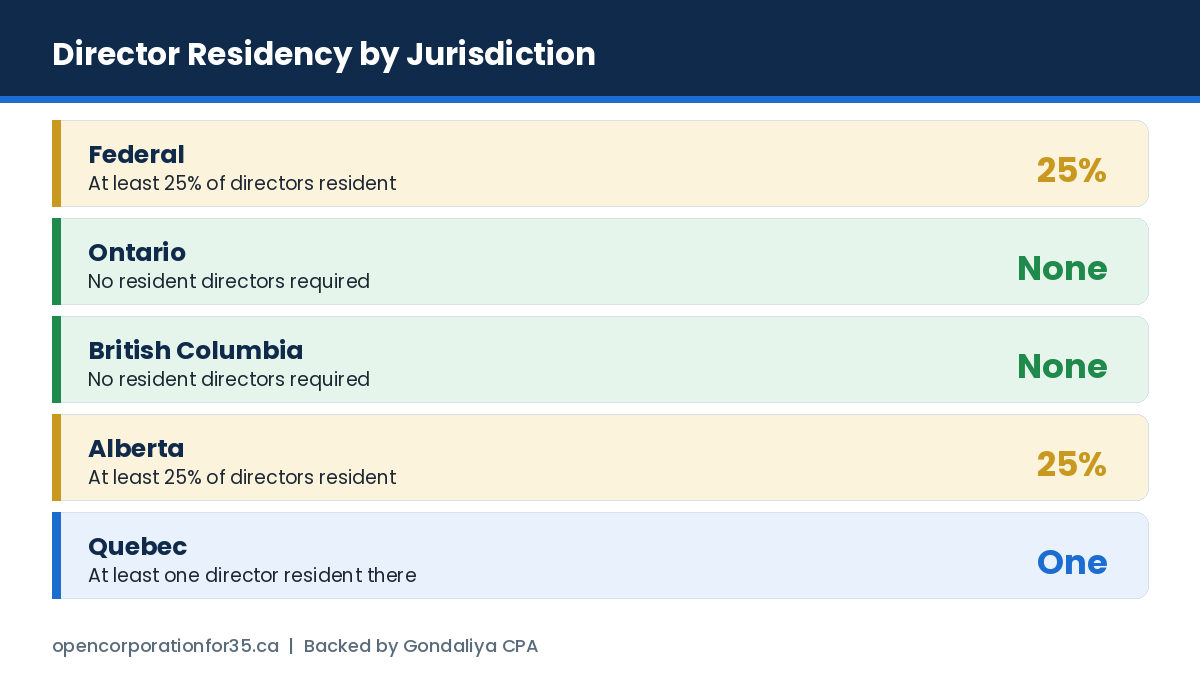
A big question is about who can be a director. It depends on whether you pick federal or provincial incorporation.
- Federal Incorporation: At least 25% of directors must live in Canada. For example, if you have four directors, one must be a Canadian resident.
- Provincial Incorporation: Rules change by province:
- Ontario and British Columbia don’t require any resident directors.
- Alberta asks for at least 25% of directors to be residents.
- Quebec wants at least one director who lives there.
Non-residents can choose provinces like Ontario or BC to avoid residency rules. But watch out—some provinces might need you to appoint an agent for service.
This matters because federal rules are strict about residency. If you can’t meet those, provincial incorporation might work better. Always check the latest from official sources; these rules change sometimes.
Shareholder Eligibility
Can non-residents own shares? Yes, no problem.
- You can own 100% of your company, even if you don’t live in Canada.
- No need to be a citizen or permanent resident to hold shares.
This makes it easier if you want full control over your Canadian business. But remember, some industries have limits on foreign ownership. Double-check any special rules before moving forward.
Registered Office Address Requirement
Every Canadian corporation needs a registered office address.
- This is where the government sends legal papers and notices.
- The address must be physical—not just a P.O. Box—and inside the province or territory where you incorporate.
If you do federal incorporation, your address can be anywhere in Canada. For provincial companies, it must be inside that province.
If you’re opening a company remotely, many services offer registered office addresses. They help meet this rule legally and easily.
Business Number (BN) Registration
Your Business Number (BN) is important after you start operating.
- The BN comes from the Canada Revenue Agency (CRA).
- You use it when filing taxes or dealing with government programs.
To get your BN:
- Register online through CRA’s Business Registration Online portal,
- Or send Form RC1 by mail or fax.
Non-residents selling taxable goods or services over $30,000 a year in GST/HST areas must register for GST/HST too. This links directly to your BN with CRA rules.
Banking: Opening Business Bank Accounts for Non-Residents
Getting a business bank account can be tricky for foreigners.
- Big Canadian banks usually allow non-residents to open accounts.
- Banks often want an in-person visit.
- You’ll need ID like passports and proof of incorporation.
- Some banks ask for extra documents like a business plan.
Opening accounts fully online is rare because banks follow strict anti-money laundering and Know Your Customer (KYC) laws worldwide.
It’s smart to talk with banks early on so you know what they require before incorporation finishes.
| Key Requirement | Details |
|---|---|
| Director Residency | Federal: ≥25% resident directors; varies by province |
| Shareholder Eligibility | No restrictions; foreigners can own up to 100% |
| Registered Office Address | Physical address inside jurisdiction needed |
| Business Number | Get from CRA after incorporation; required for tax and GST/HST |
| Banking | Usually requires personal visit; ID & proof of incorporation needed |
Knowing these basics will help you start your Canadian business right as a non-resident. Check official info often since policies change regularly.
Risk Warning: A PO box as the registered office will get the filing rejected. It must be a real street address inside the jurisdiction of incorporation, which is the most common cause of rejection we see on remote filings.
Federal vs Provincial Incorporation Explained
Federal vs Provincial Incorporation Explained
In Detail
If you’re a non-resident thinking about how to open a corporation in Canada, you’ll want to know the difference between federal and provincial incorporation. Both let foreigners incorporate in Canada as a foreigner. But each one has its own rules, benefits, and features. This section breaks down those differences to help you decide what’s best for your Canada business incorporation for foreigners.
Here’s what you should know:
- Federal incorporation lets you run your business across all of Canada.
- Provincial incorporation works only in one province.
- Costs and requirements vary between the two.
Understanding these basics will make your choice easier.
Features of Federal and Provincial Incorporation
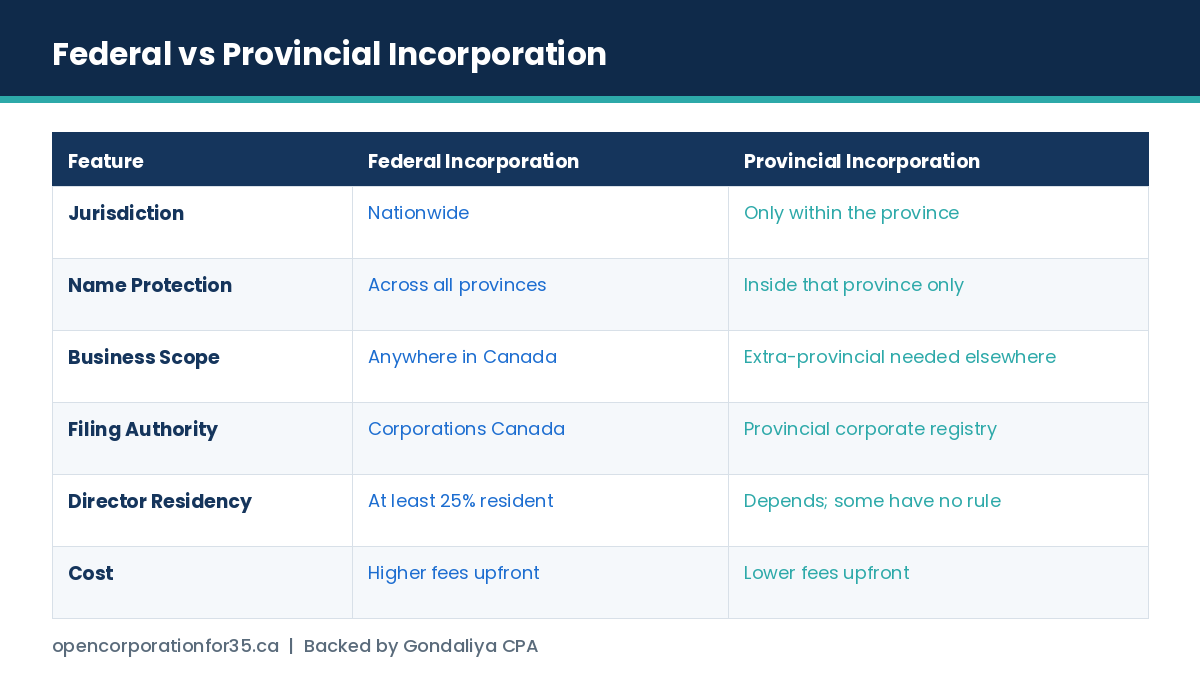
| Feature | Federal Incorporation | Provincial Incorporation (e.g., Ontario) |
|---|---|---|
| Jurisdiction | Nationwide | Only within the province |
| Name Protection | Protected across all provinces | Protected inside that province only |
| Business Scope | Can operate anywhere in Canada | Mostly limited to the province; needs extra-provincial registration elsewhere |
| Filing Authority | Corporations Canada (federal government) | Provincial corporate registry |
| Director Residency Requirement | At least 25% of directors must be Canadian residents (rules change by province) | Depends on the province; some have no residency rule |
| Cost | Usually higher fees upfront | Usually lower fees upfront |
Federal incorporation fits businesses wanting to work nationwide. Provincial incorporation suits local or regional businesses better.
Federal Incorporation: What Non-Residents Need to Know
If you’re a non-resident, registering a federal corporation Canada non resident is possible through Corporations Canada. This gives your company permission to do business all over Canada without registering separately in each province. But some provinces might ask for extra-provincial registration anyway.
Here’s what matters:
- Director Residency: At least 25% of directors need to live in Canada—this rule can differ, especially outside Quebec.
- Name Protection: Your company name gets protected everywhere in Canada once approved.
- Remote Process: You don’t have to be in Canada physically to register federally.
- Compliance: You must file yearly reports with Corporations Canada and keep an address in any Canadian province or territory.
Federal incorporation brings credibility and reach but watch those director residency rules if you’re a foreign owner.
Provincial Incorporation: Focus on Local Markets
Provincial incorporation, like in Ontario, works well if you want to start a business focused on just one area. Here’s what foreigners should remember:
- Residency Rules: Some provinces like British Columbia don’t require directors to live there. Ontario also has no residency rules now. Always check current rules before starting.
- Business Area: Your company mainly operates within that province unless you register extra-provincially elsewhere.
- Lower Costs & Simplicity: Fees are usually lower than federal fees. The process might be easier if your market is local.
- Name Registration: Your company name is protected only inside that province. So similar names can exist outside unless registered federally.
Provincial incorporation fits businesses targeting local customers or wanting simpler setup with fewer restrictions.
Comparison Table: Federal vs Provincial Incorporation for Non-Residents
| Aspect | Federal Incorporation | Provincial Incorporation |
|---|---|---|
| Market Reach | All Canadian provinces | Only one specific province |
| Director Residency Requirement | About 25% directors must be Canadian residents* | More flexible; varies by province |
| Name Protection | Protected country-wide | Protected only within the province |
| Filing Fees | Higher ($200-$300 approx.) | Lower ($100-$400 approx., depends on region) |
| Annual Maintenance | Mandatory federal annual return | Province-specific yearly reports |
| Extra-provincial Registration Required? | No unless operating outside home base | Yes if expanding beyond original province |
*Rules change often—always check with authorities before applying.
Choosing between federal and provincial incorporation depends on what kind of business you want. If you plan to work across many provinces, federal incorporation makes sense despite stricter director rules. If you just want to focus locally with less hassle and lower fees, provincial incorporation might fit better.
Gondaliya CPA suggests looking at where your main activities will happen first. Then get advice from someone who knows the latest rules so you don’t miss anything when setting up your business as a non resident in Canada.
For a foreign owner with no Canadian director available, Ontario or British Columbia is usually the practical answer, because neither carries a residency requirement while the federal rule does.
Costs of Opening a Corporation in Canada
Costs of Opening a Corporation in Canada
Costs
Opening a corporation in Canada as a non-resident costs money. Knowing these fees helps you plan and avoid surprises. This part talks about government fees, service charges, yearly costs, and money mistakes to watch out for.
Government Incorporation Fees (Federal and Provincial)
Government
You must pay fees to the government when you incorporate in Canada. Fees change if you pick federal or provincial incorporation.
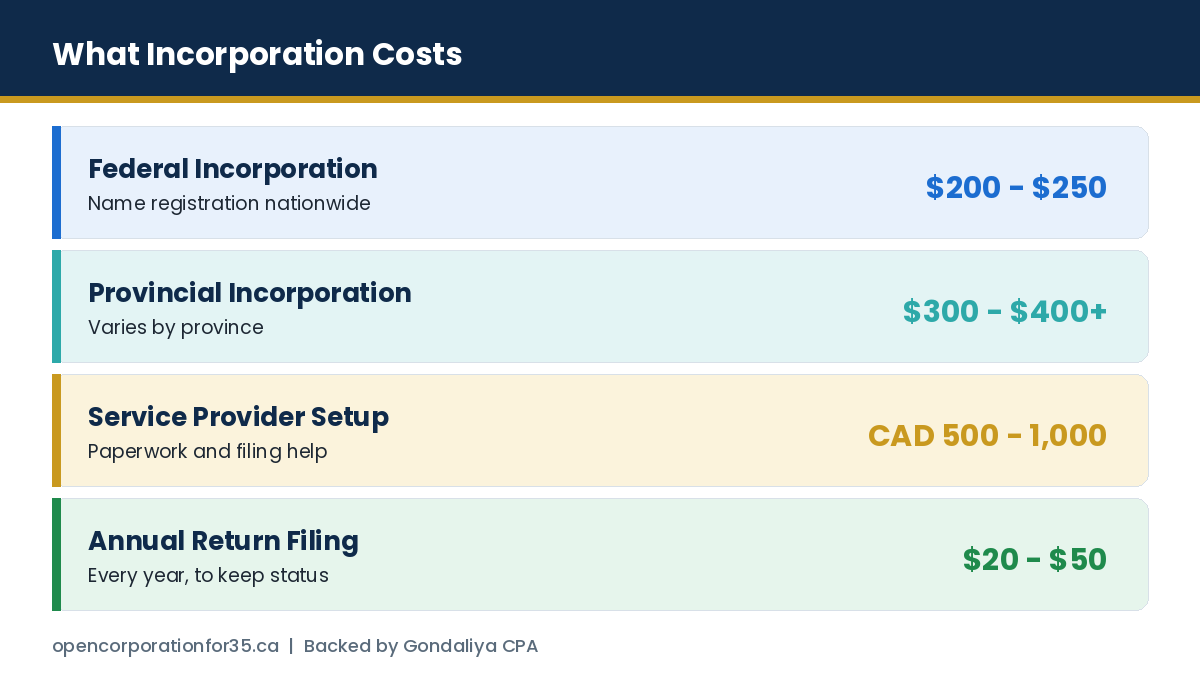
| Incorporation Type | Typical Government Fee Range (CAD) | Notes |
|---|---|---|
| Federal Incorporation | $200 – $250 | Covers business name registration nationwide; valid across all provinces. |
| Provincial Incorporation | $300 – $400+ | Varies by province; applies only within that province’s jurisdiction. |
Fees change sometimes—check official sites before you start.
- Federal incorporation covers the whole country and may cost less.
- Provinces charge different fees. Some have extra costs if you do business outside their area.
- Non-residents pay the same fees as residents.
Service Provider Fees
Services
Many non-residents hire firms like Gondaliya CPA. They help with paperwork and rules.
Typical fees:
- Basic setup: CAD 500 – 1,000
- Extra services (like nominee directors): CAD 300 – 700
- Ongoing help: varies by what you need
Using experts cuts mistakes and speeds things up. You also get surety that rules are met.
Annual Filing and Maintenance Fees
Annual
Corporations must file yearly reports and stay legal. Missing deadlines can cause fines or even company cancellation.
Here are common yearly costs:
| Expense Type | Approximate Cost (CAD) | Description |
|---|---|---|
| Annual Return Filing Fee | $20 – $50 | Must file every year with Corporations Canada or provincial office. |
| Corporate Tax Filing | Varies | Preparing T2 tax returns depends on accountant or service chosen. |
| Registered Office Address | CAD 100 – 500 annually | If using third-party address services for registered office. |
Non-residents should also save money for bookkeeping, accounting, or audits based on their business size.
Common Mistakes Non-Residents Make When Opening a Corporation in Canada
Common Mistakes Non-Residents Make When Opening a Corporation in Canada
Mistakes
Knowing usual mistakes helps foreigners avoid delays or problems when starting a Canadian corporation.
Assuming Permanent Residency Is Required
Mistake 1
Many think they must have permanent residency (PR) to start a business here. That’s not true:
- You don’t need PR just to open a corporation.
- Many foreigners start businesses without any immigration status.
But some provinces want at least one director who lives there or in Canada. That doesn’t mean owners must live there—just directors.
Always check local rules about director residency before choosing where to incorporate.
Ignoring Registered Office Address Rules
Mistake 2
Every Canadian company needs a registered office address inside its incorporation area:
- It can’t be only a PO Box; it needs a real street address.
- Some provinces allow virtual offices, but check rules carefully.
Not giving the right address can slow approval or cause fines later.
Overlooking GST/HST Registration Obligations
Mistake 3
Non-resident corporations making taxable sales in Canada usually must register for GST/HST:
- You register if your revenue hits $30,000.
- Even below that, if you plan growth, register early.
Missing this registration means fines and paying back taxes with interest.
Failing To File Corporate Taxes Timely
Mistake 4
All Canadian companies must file T2 corporate tax returns every year no matter profit or loss:
- Late filing causes penalties that grow over time.
Not filing risks audits that bring more trouble and can hurt your business operations.
Understanding these cost parts and common errors helps foreign business owners open corporations without wasted cash or trouble. Getting good help is smart if rules seem confusing.
Incorporate in Canada from anywhere
Name search, incorporation filing, registered office address and CRA Business Number registration, all handled remotely for non-resident owners. Please book a free consultation.
Step-by-Step Process Overview for Opening a Corporation in Canada as a Non-Resident
Step-by-Step Process Overview for Opening a Corporation in Canada as a Non-Resident
Step by Step
Starting a business in Canada as a non-resident takes some clear steps. Knowing the process helps foreign entrepreneurs get through Canada business incorporation for foreigners with less stress. This guide shows each stage you need to open corporation in Canada non resident. It sets you up right and keeps things legal from the start.
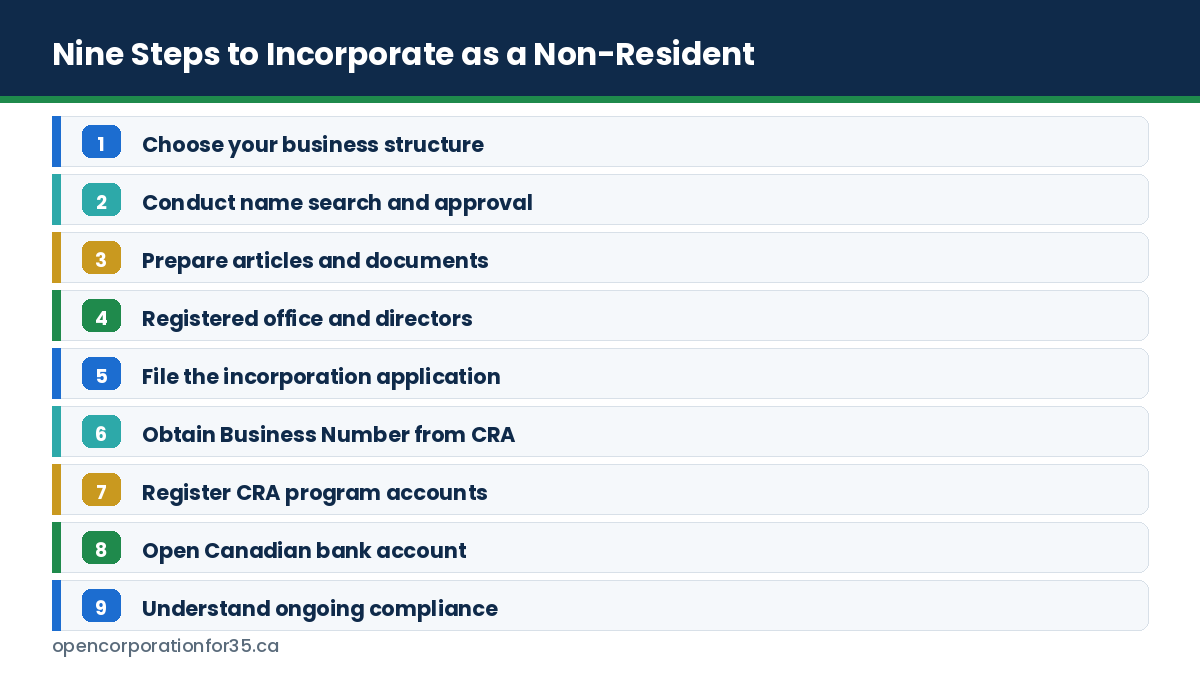
1. Choose Your Business Structure (Corporation Type)
First, pick the type of corporation that fits your needs and residency. Non-residents often go for federal or provincial corporations, limited partnerships (LP), or extra-provincial corporations if they want to expand.
- Federal incorporation works across all provinces.
- Provincial incorporation limits you to one province but can be simpler.
- Non-residents can own shares fully without permanent residency.
The type you choose changes taxes, rules, and where you can do business.
2. Conduct Name Search and Approval
Before filing, check if your company name is free and allowed.
- For federal filings, get a NUANS report to compare your name against all Canadian companies.
- Provinces have their own name searches with different rules.
This step stops name conflicts and speeds up approvals.
3. Prepare Articles of Incorporation and Supporting Documents
Next, get these docs ready:
- Articles of Incorporation showing company goals, share setup, directors
- Registered office address info
- Director/officer consent forms
These papers form your company’s legal base when sent to officials.
4. Establish Registered Office Address & Appoint Directors/Officers
Your corporation needs a registered office address in Canada for official mail.
Non-residents usually must name Canadian directors due to provincial rules—some places allow nominee directors or drop this federally in certain cases.
Appoint officers like president or secretary to finish the leadership setup needed to register.
5. File Incorporation Application with Appropriate Government Body
Send all docs and fees to:
- Corporations Canada for federal files
- Provincial registries for provincial files
Times vary but usually take days or weeks based on location and online vs paper filing.
6. Obtain Business Number (BN) from CRA
After incorporation, register with the Canada Revenue Agency (CRA) to get a Business Number (BN). This ID is needed for taxes like income tax or payroll deductions if you have employees.
Having a BN makes tax dealings easier after your company starts.
7. Register for Necessary CRA Program Accounts
Depending on what you do, sign up for:
- GST/HST if sales pass $30K yearly
- Payroll deductions if you hire staff
- Import/export if you trade across borders
Register early so your business follows Canadian tax laws from day one.
8. Open Canadian Business Bank Account
A Canadian bank account helps handle money within Canada’s system. This step is key after incorporating, especially if you’re managing things from abroad.
Banks ask for proof of incorporation and ID of shareholders or directors before opening accounts made for foreign-owned firms.
9. Understand Ongoing Compliance & Reporting Requirements
Once your corporation runs, keep these up:
- File yearly returns per local rules
- Submit T2 Corporate Tax Returns every year no matter where owners live
- Keep records at the registered office
- Pay GST/HST if registered
Doing these avoids fines and keeps your business legal inside Canada.
Summary Table: Step-by-Step Process Overview
Summary
| Step | Description | Related Keywords |
|---|---|---|
| Choose Business Structure | Pick federal or provincial corp type | open corporation in canada non resident |
| Conduct Name Search | NUANS/federal or provincial search | incorporate in canada as a foreigner |
| Prepare Articles & Documents | Write articles/incorporator consents | open corporation in canada non resident |
| Registered Office & Director Appointment | Set address; appoint directors/officers | start a business in canada as non-resident |
| File Incorporation Application | Submit docs + fees online/paper | canada business incorporation for foreigners |
| Obtain CRA Business Number | Register BN after incorporation | start a business in canada as non-resident |
| Register CRA Programs | GST/HST/payroll registrations | start a business gst hst registration |
| Open Bank Account | Open Canadian bank account | Business bank account non residents |
| Understand Compliance | Do annual filings/taxes/GST reporting | corporate taxes filings compliance |
Following these steps will help any foreign entrepreneur incorporate remotely while meeting Canada’s rules well without needing permanent residency just to start working here.
Benefits of Incorporating in Canada as a Non-Resident
Benefits of Incorporating in Canada as a Non-Resident
Benefits
Starting a business in Canada as a non-resident has many perks. If you want to open corporation in Canada non resident or start a business in Canada as non-resident, it helps to know what you gain. Many foreigners pick Canadian incorporation because it fits their goals well.
Access to the Canadian Market
Canada’s economy is strong and steady. When you incorporate, you can:
- Work legally inside one of the world’s biggest economies.
- Reach more than 38 million people across different provinces.
- Use trade deals like USMCA to ease cross-border business.
This access opens up sales chances and lets you connect with local suppliers and partners.
Enhanced Credibility with Clients and Suppliers
A Canadian corporation builds trust fast. It shows you follow local laws and rules. This trust often means:
- Easier contract talks.
- Better terms with suppliers.
- More confidence from banks or investors.
If you want long-term presence or brand strength, this really helps.
Ability to Receive Payments in Canadian Dollars (CAD)
Using a Canadian corporation lets you take payments in CAD. This cuts down on currency exchange problems when working with Canadian clients or agencies like CRA. You get:
- Simple invoicing for local customers.
- Quick payments through Canadian banks.
- No extra fees from currency conversions.
Getting paid directly in CAD helps keep your money flow smooth inside Canada.
Remote-Friendly Incorporation Process
You don’t need to be physically present to incorporate. Today, many steps can happen online. Here’s how:
| Feature | Description |
|---|---|
| Online Name Search | Instantly check if your company name is free |
| Electronic Filing | Send your papers without leaving home |
| Virtual Office Services | Use agents’ addresses if you don’t have one |
| Remote Director Options | Some places allow nominee directors |
This setup makes it easy for foreigners to start companies quickly while staying abroad.
Flexibility Around Address & Director Requirements
Some provinces ask that at least one director lives in Canada. But federal rules are looser—up to 25% of directors can be non-residents depending on where you register. Also:
- Your registered office must be inside the province or federal area but can be an agent’s address.
These choices lower residency barriers but keep you legal during registration.
Final Summary
Final Summary
Summary
Opening a corporation in Canada as a non-resident is possible and smart for many foreign entrepreneurs. You can incorporate in Canada as a foreigner using simple processes made for people living outside the country.
Remember these points:
- You don’t need permanent residency just to register your company
- Federal and provincial options differ based on your needs
- You get benefits like better credibility, easy CAD payments, and wide market access
Rules may change over time, so check with officials before starting. Still, incorporating offers a clear way to grow your business under Canada’s trusted system.
Gondaliya CPA helps non-residents understand the steps and succeed with Canada business incorporation for foreigners.
FAQs: Key Questions on Incorporating in Canada as a Non-Resident
FAQs: Key Questions on Incorporating in Canada as a Non-Resident
FAQ
What are the Canadian address and director requirements for non-resident corporations?+
A registered office must be a physical address inside the jurisdiction of incorporation. Director residency rules vary; federal requires 25% Canadian resident directors, but some provinces like Ontario have no residency requirement.
Can I use nominee directors to meet residency rules?+
Yes, nominee directors can serve when residency is required. Their role must be legal, with full understanding of fiduciary duties. Using nominee directors is common and accepted if done properly.
What is the typical timeline to incorporate a business in Canada as a non-resident?+
Incorporation usually takes about 1-2 weeks if documents are complete. Delays may occur due to name approvals or missing paperwork.
How does the remote incorporation process work for foreigners?+
Non-residents can file online or via mail with proper documents. Registered office services and nominee directors facilitate remote setup without physical presence.
What corporate taxes and filings must non-resident corporations handle?+
Foreign-owned companies must file annual T2 tax returns with CRA, pay GST/HST if applicable, and submit annual returns to maintain good standing.
Which documents are required for incorporating as a non-resident?+
Articles of Incorporation, director information, registered office address, name approval (NUANS report if federal), and payment of government fees.
How can non-residents open a business bank account in Canada?+
They need company registration papers and valid ID. Banks often require an in-person visit for KYC checks but policies vary by institution.
What differences exist between federal vs provincial incorporation for foreigners?+
Federal covers all Canada but requires 25% resident directors; provincial is limited to one province with varied residency rules and often lower fees.
When must non-resident corporations register for GST/HST?+
Registration is mandatory if taxable sales exceed $30,000 annually within Canada, regardless of owner’s residency status.
Does permanent resident (PR) status affect the ability to incorporate?+
PR status is not required to incorporate or own shares. However, some provinces ask for at least one resident director which may require local representation.
Essential Points on Compliance & Corporate Requirements
Essential Points on Compliance & Corporate Requirements
Compliance
- Ongoing Annual Return Fees: Corporations must file yearly returns and pay associated fees to keep their status active. Costs vary by jurisdiction.
- Additional Licensing Permits: Certain industries require extra permits beyond incorporation; verify before starting business activities.
- Extra-Provincial Registration: Operating outside the home province needs extra-provincial registration to comply legally across regions.
- Corporate Bylaws and Minute Books: Maintaining corporate bylaws and minute books is mandatory for record keeping and legal compliance.
- Shareholding Limitations: Generally, no foreign ownership restrictions exist except in regulated sectors like financial services or telecommunications.
- Canada Business Corporations Act: Federal corporations follow this act which governs incorporation, management, and dissolution procedures.
- Nominee Director Services: Many service providers offer nominee director options to assist foreign owners with residency rules compliance.
- Filing and Compliance Deadlines: Missing tax or annual return deadlines risks fines and possible dissolution of your corporation.
Additional Must-Know Facts for Foreign Entrepreneurs
Additional Must-Know Facts for Foreign Entrepreneurs
Also Note
- Non-residents face strict business number registration through CRA after incorporation to manage tax accounts smoothly.
- Registered office addresses cannot be P.O. boxes; they must accept legal notices promptly within the province or federally.
- Service provider fees vary widely; engaging experts reduces errors and ensures timely compliance in complex setups.
- Understanding director residency rules helps select the right jurisdiction based on your ability to appoint local representatives.
These points guide you through less obvious but vital aspects of opening a corporation in Canada as a non-resident successfully.
The minute book is the item owners skip and later need urgently. Banks, buyers and the CRA all ask for it, and reconstructing years of resolutions after the fact costs far more than keeping it current.
Professional Guidance on Incorporating From Abroad: How Open Corporation For $35 Supports Foreign Owners
Professional Guidance and Quick Reference
Guidance
One decision drives most of this. If you have no Canadian director available, the jurisdiction is chosen for you, because the federal 25% rule applies while Ontario and British Columbia carry no residency requirement at all. Settle that before anything else.
Open Corporation For $35, backed by Gondaliya CPA, handles the whole chain in one pass: the name search, the incorporation filing, the registered office address, the Business Number and the program accounts.
Everything is done remotely. No travel to Canada is required to incorporate or register.
Quick Answers: Key Numbers & Concepts at a Glance
At a Glance
- PR or citizenship required: No
- Maximum foreign share ownership: 100%
- Federal director residency: 25% resident Canadians
- Ontario and BC director residency: None
- Alberta director residency: 25%
- Quebec director residency: At least one resident
- GST/HST threshold: $30,000 CAD in annual taxable sales
- Federal incorporation fee: $200 to $250
- Provincial incorporation fee: $300 to $400 and up
- Annual return fee: $20 to $50
Who This Is For / Not For
Fit Check
- For: Foreign entrepreneurs incorporating without PR, owners choosing a jurisdiction based on director residency, anyone needing a Canadian registered office address, and businesses selling into Canada above the GST/HST threshold.
- Not For: People hoping a company will support an immigration application, since it grants no status, and businesses in regulated sectors such as financial services or telecommunications that carry ownership limits.
People Also Ask
Quick Answers
I have no Canadian director. Where should I incorporate?+
Ontario or British Columbia, since neither requires a resident director. Federal incorporation would require 25% of your board to be resident Canadians.
Do I still need a nominee director?+
Only if you incorporate somewhere that requires one. Choosing a jurisdiction with no residency rule avoids the cost and the legal complexity entirely.
Can I incorporate federally later if I start provincially?+
Yes. You can continue the corporation into the federal jurisdiction, or incorporate federally and register extra-provincially. Both routes have costs, so it is worth deciding early.
Glossary of Key Terms
Plain-English Definitions
- Registered office: The official street address of the corporation in its jurisdiction.
- Director residency: The rule requiring a proportion of directors to be resident Canadians.
- Nominee director: A director appointed to satisfy a residency requirement or preserve privacy.
- Agent for service: A local party appointed to receive legal documents on the company’s behalf.
- NUANS: The name search report confirming your proposed name is available.
- Business Number (BN): The nine-digit CRA identifier every tax account attaches to.
- T2: The corporate income tax return filed every year.
- Extra-provincial registration: Registering to operate in a province other than where you incorporated.
- Minute book: The corporate record holding bylaws, share registers and resolutions.
- KYC: Know Your Customer, the identity checks banks apply before opening an account.
Pick the jurisdiction by whether you can supply a resident director, secure a real street address before filing, open the BN and program accounts straight after incorporation, and start the bank application the day the certificate arrives. Those four decide how quickly you can trade.
Non-Resident Incorporation Readiness Check
This quick self-check flags which parts of your setup need attention. Please answer the six questions below.
Non-Resident Incorporation Readiness Check
Six quick questions on your plans. No fee quoted.
Points to review:
This is a general prompt, not tax or legal advice or a quote. Your position depends on your full facts, so for a real review please book a free consultation.
Want a checklist to work from? Please download our free non-resident incorporation checklist before your consultation.
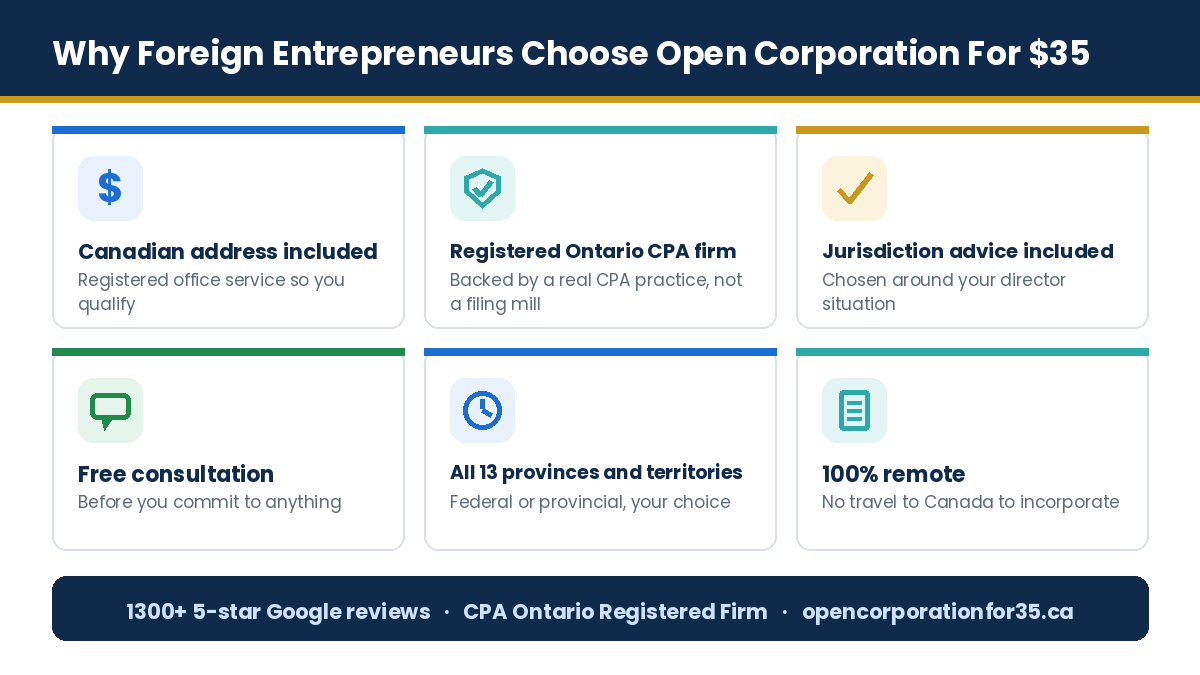
Open your Canadian corporation for $35
Jurisdiction advice, name search, incorporation, registered office address and CRA registrations, all set up together and handled entirely remotely. Please book a free consultation.
What to Send Us
Send us your preferred company name, whether any director lives in Canada, the province or provinces you will trade in, and whether you need a Canadian address. We will confirm the right jurisdiction and handle the whole registration remotely.
Published: May 4, 2026 · Last updated: May 4, 2026
Editorial policy: Our content is prepared by our team and reviewed by Sharad Gondaliya, CPA, and we update it as incorporation rules, fees and CRA thresholds change.
Disclaimer: This article is educational information only and is not tax, legal, or financial advice. Fees, thresholds and processing times change, and outcomes depend on your specific facts. Please consult a CPA before acting.