
Can You Open a Corporation in Canada Without PR or Citizenship?
Starting a business in Canada as a non-resident is something many foreign entrepreneurs want to do. You might wonder if you can open a corporation without having permanent residency (PR). Well, you can. You don’t need to be a Canadian citizen or PR to incorporate in Canada. This guide answers common questions about opening a corporation as a non-resident. We cover eligibility, requirements, and the difference between federal and provincial incorporation.
Quick Summary
The short answer is yes. Neither permanent residency nor citizenship is required to own or incorporate a Canadian company, and full foreign ownership of the shares is permitted in almost every sector. What actually shapes the decision is director residency, which differs by jurisdiction, and the registered office address, which must be a real Canadian street address. Please note banking is usually the slowest part, not the incorporation.
| Aspect | Details |
|---|---|
| PR or citizenship | Not required to own or incorporate a Canadian company. |
| Share ownership | 100% foreign ownership is permitted outside restricted sectors. |
| The address | A registered office inside the jurisdiction. Virtual offices qualify. |
| The timeline | Usually one to three weeks, depending on jurisdiction. |
Reading time: 25 minutes.
Table of Contents
- FAQ Section Overview: The Basics
- FAQs: Opening a Corporation in Canada as a Non-Resident (2026 Guide)
- FAQ Section Overview: Quick Answers Table
- Core FAQs
- Key Requirements for Non-Residents
- Federal vs Provincial Incorporation Explained
- Costs of Opening a Corporation in Canada
- Common Mistakes Non-Residents Make
- Step-by-Step Process Overview
- Final Summary
- Additional FAQs on Incorporating in Canada as a Non-Resident
- Essential Points on Canadian Corporate Tax & Banking
- Benefits & Practical Aspects of Incorporating as a Non-Resident
- Federal vs Provincial Incorporation – Detailed Differences
- Common Mistakes in Incorporation by Non-Residents
- Step-by-Step Process Overview: Incorporation Timelines Detailed
- Professional Guidance and Quick Reference
The Numbers That Matter
This article covers Canada, with Ontario and Toronto context, and assumes a foreign entrepreneur incorporating here without permanent residency. Fees, thresholds, processing times and director residency rules are set by the federal and provincial governments, and they change. This is educational information only and not tax, legal, or financial advice. Please confirm your own position with a CPA before acting.
FAQ Section Overview
Start Here
This part answers popular questions about opening a corporation in Canada as a non-resident. Here’s what we’ll cover:
| Topic | Description |
|---|---|
| Eligibility | Can you open a corporation Canada non resident? What does it involve? |
| Requirements | What documents are needed to incorporate in Canada as a non-resident? What about nominee directors? |
| Federal vs. Provincial | What’s the difference between federal vs provincial incorporation Canada? |
| Tax Obligations | What taxes do non-residents have for Canadian corporations? How does GST/HST registration work? |
| Banking | How to open Canadian bank account as a non-resident? What banking challenges do foreign businesses face? |
Eligibility
Yes, you can open a corporation in Canada even if you’re not a resident! Foreign businesses can register without being PR or citizens. But there are some rules.
Here’s what matters:
- You must have at least one director on the board.
- Your company name must follow Canadian rules.
- You need to provide all required paperwork when applying.
Knowing this helps your foreign business get set up faster and easier.
Requirements
To incorporate from outside Canada, you need some key documents:
- Articles of Incorporation – this explains how your company is set up.
- Business Name Registration – it has to be unique where you apply.
- ID for all directors – valid government-issued IDs work best.
- Nominee Director info – some provinces want at least one director who lives there.
A nominee director acts for owners who don’t live in Canada but still want someone local legally responsible for the company.
Federal vs Provincial Incorporation
Picking between federal or provincial incorporation depends on what you want your company to do.
| Feature | Federal Incorporation | Provincial Incorporation |
|---|---|---|
| Jurisdiction | Covers all of Canada | Limited to one province |
| Name Protection | Protected across country | Protected only in that province |
| Filing Fees | Usually higher | Usually lower |
Federal incorporation lets you run business nationwide but needs more rules followed. Provincial is simpler but only works locally.
Tax Obligations
Taxes matter for any business, including ones owned by non-residents:
- Corporate tax applies on income from Canadian operations.
- If sales go above certain amounts, you may have to register for GST/HST with the CRA (Canada Revenue Agency).
It’s smart to talk with tax pros who know cross-border rules before moving forward.
Banking
Opening bank accounts can be tricky for foreigners wanting to work with Canadian banks:
- Banks often ask for proof of business and ID checks.
- Many require the same docs used in incorporation.
- Some banks offer special accounts made just for foreign clients.
Knowing this stuff helps avoid surprises when setting up money handling for your company.
By covering these basics about opening corporations as a foreigner, we hope readers feel ready and informed. Starting out might seem confusing, but with right info at hand it gets easier every step of the way!
Key Stat: There is no residency or citizenship test attached to share ownership of a Canadian corporation. A non-resident can hold 100% of the shares. The only residency question that ever arises concerns the board of directors.
The question we are asked most is whether incorporating here helps with a visa. It does not. Company ownership and immigration status are entirely separate tracks, and conflating them leads people into the wrong process.
FAQs: Opening a Corporation in Canada as a Non-Resident (2026 Guide)
FAQs: Opening a Corporation in Canada as a Non-Resident (2026 Guide)
2026 Guide
Starting a business in Canada is popular for many non-residents. You might want to grow your foreign business or begin something new. Knowing the rules and steps helps a lot. This guide answers common questions about opening corporations in Canada for people who don’t live there. We cover things like residency rules, types of incorporation, banking, taxes, and following the law. If you want to open corporation Canada non resident, this FAQ will explain what you need to know even if you don’t have permanent residency (PR).
FAQ Section Overview
FAQ Section Overview
Quick Answers
This part answers key questions about setting up a Canadian company as a foreigner. It covers who can do it, legal needs, how to run the business, and what steps to take.
| Question | Quick Summary |
|---|---|
| Can a non-resident open a corporation in Canada? | Yes; no PR needed for federal or provincial incorporation. |
| Do I need PR to open a corporation? | No; foreigners can own companies without permanent residency. |
| Can I own 100% of my Canadian company? | Yes; full foreign ownership is mostly allowed. |
| Federal vs Provincial Incorporation – what’s different? | Federal protects your name everywhere; provincial covers one area and might be cheaper or simpler. |
| What address do I need for incorporation? | A registered office inside the jurisdiction is required; virtual offices often work if legal. |
| How does banking work for non-residents? | Banks check carefully; some need you in person, others may offer remote options with docs ready. |
| What is nominee director status? Do I need one? | Some places want local directors unless federal; nominee directors fill that role when needed. |
| Must I register for GST/HST as foreign-owned company? | Depends on sales inside Canada; not all register right away. |
| What corporate tax obligations apply? | Foreign companies pay tax only on income made in Canada. |
| How long does it take to incorporate? | Usually 1–3 weeks depending on federal or province chosen. |
| Which documents are needed? | Articles of Incorporation plus ID of directors/shareholders. |
| Can the corporation operate remotely? | Yes; many run businesses from abroad using online tools. |
Core FAQs
Core FAQs
FAQ
Can a Non-Resident Open a Corporation in Canada?+
Yes, you can open corporation Canada non resident without much trouble through federal or provincial routes. You don’t have to be a citizen or have PR just to start the company.
Canada likes it when foreign businesses set up here because it’s stable and linked to many trade deals.
Still, check rules carefully since some provinces have specific director requirements.
Do I Need Permanent Residency (PR) To Open A Corporation In Canada?+
Nope, PR isn’t needed just to form your company under Canadian laws.
You can incorporate Canada foreigners with full ownership while living anywhere.
Some provinces ask for at least one local director though, unless you pick federal incorporation which usually has looser rules about this.
Can A Non-Resident Own 100% Of A Canadian Corporation?+
Yes! Foreigners often own all shares and control their business fully when they incorporate canada foreigners style companies here.
Restrictions only pop up in special sectors like telecom for security reasons.
This makes it easier for overseas investors wanting access to North America through Canada’s economy.
What’s The Difference Between Federal Vs Provincial Incorporation?+
Both let you run legally but differ mostly by reach:
Federal Incorporation:
- Works across all provinces and territories
- Protects your company name everywhere in Canada
- Usually no local director required
- Slightly higher fees
- More annual filings
Provincial Incorporation:
- Limits business to one province
- Name protected only inside that province
- Often requires at least one local director
- Cheaper fees
- Less paperwork
If you plan to work in many provinces, go federal. For local focus, provincial may suit better.
What Canadian Address Is Required For Incorporation?+
You must provide an official registered office address inside the province or federally recognized area.
Many international founders use virtual office services in Canada that handle mail and meet legal rules while letting them work from afar.
How Can A Non-Resident Open A Business Bank Account In Canada?+
Banks check things closely because of anti-money laundering laws:
- Many banks want you there in person
- Some allow remote applications but with strict documents
- You’ll need ID like passports and your company papers
Rules change by bank so prepare well before trying.
What Is A Nominee Director In Canada And Do I Need One?+
Certain provinces require at least one director who lives locally—Ontario is an example.
Federal incorporation often doesn’t ask for this anymore.
A nominee director fills this spot officially but usually doesn’t control the company beyond what owners say.
Do I Need To Register For GST/HST As A Non-Resident Corporation?+
If your sales inside Canada go over $30,000 CAD yearly:
- You must register for GST/HST tax regardless of where owners live
If not over that amount yet:
- Registration is optional until sales hit that limit
What Are The Corporate Tax Obligations For Non-Residents In Canada?+
Foreign companies pay taxes only on money earned inside Canada based on CRA rules.
They file returns every year showing income made from Canadian sources even if owners live abroad.*
Check current rates regularly from official sites.*
Note: This info isn’t tax advice.
How Long Does The Incorporation Process Take?+
It depends on where you register:
- Federal: Usually faster online—5 to 10 business days*
- Provincial: From several days up to 3 weeks depending on workload*
Always look at current times before applying.
What Documents Are Required For Incorporation Involving Foreigners?+
You’ll need:
- Articles of Incorporation showing company details
- ID copies like passports or driver’s licenses
- Proof of registered office address
- Signed consent forms from directors/shareholders
Sometimes other papers are asked depending on the region.
Can A Non-Resident Corporation Operate Remotely From Outside Of Canada?+
Yes! Lots of foreign owners run their Canadian companies from home countries now.
Tech lets them hold meetings online and use cloud accounting so they keep track no matter where they are.
Key Requirements for Non-Residents
Key Requirements for Non-Residents
Requirements
Opening a corporation in Canada when you’re not a resident is possible. It’s usually pretty simple, but you gotta know the rules. Whether you want to open corporation Canada non resident style or incorporate Canada foreigners, understanding the basics helps a lot. Here are some key things non-residents need to keep in mind.

| Requirement | Description |
|---|---|
| Residency Rules | Federal incorporation lets non-resident directors be part of the board. Some provinces, though, need at least one director who lives in Canada. You can use nominee director services to handle this if needed. |
| Director Structure | Foreigners can fully own Canadian corporations without having PR. Nominee directors help when local residency is legally required or banks ask for it. The foreign owner still controls everything even if they use nominees. |
| Compliance | Non-resident corporations must follow Canadian corporate tax rules and register for GST/HST if they sell enough stuff here. They have to file yearly returns and keep up with CRA registration Canada rules no matter where they live. |
| Banking | Opening a Canadian bank account as a non-resident can take more paperwork and checks because of anti-money laundering laws. Some banks limit accounts for foreign business Canada companies; sometimes virtual office addresses make this easier. |
Residency Rules
Canada’s federal incorporation system doesn’t require directors to live in Canada. That makes it good for foreign entrepreneurs who want to open corporation Canada non resident style. But many provinces want at least one director living locally.
Examples:
- British Columbia allows all directors to be non-residents.
- Ontario wants at least 25% of directors (or one) to live in Canada.
Nominee director services mean trusted locals act as directors so you follow the law but keep control.
Director Structure
Foreign owners can start companies in Canada without PR or citizenship most times.
Here’s what matters:
- You can own all the shares even if you don’t live here.
- Directors run the company but don’t need PR unless province says otherwise.
- Nominee directors fill local residency spots while keeping privacy and control.
This setup helps startups abroad get into the Canadian market easily.
Compliance Obligations
Non-resident companies must follow the same rules as Canadian ones:
- Register with CRA when incorporated.
- Get a Business Number (BN).
- Register for GST/HST if sales pass $30,000 CAD yearly.
You pay corporate tax on money made inside Canada; tax rates depend on province and business type.
Not filing right can lead to fines or losing your company—even if you work from far away. So keeping up with corporate tax stuff is key.
Banking Challenges
Getting a bank account is tricky since banks check foreigners closely under Know Your Customer (KYC) rules.
Things you might face:
- Having to show up in person at the bank.
- Providing lots of ID like passports, proof of home address abroad, and business papers.
Some banks accept online applications plus virtual office addresses in cities like Toronto or Vancouver to make this easier.
Calling several banks that know international clients can help your chances.
Approaching more than one bank is the practical advice here. Policies on non-resident directors vary considerably between institutions, and a refusal at one branch tells you very little about the next.
Federal vs Provincial Incorporation Explained
Federal vs Provincial Incorporation Explained
Comparison
Picking federal incorporation or provincial incorporation depends on your plans about where you want to do business, name protection needs, rules, and cost when you open corporation canada non resident style or incorporate canada foreigners look into these differences before deciding.
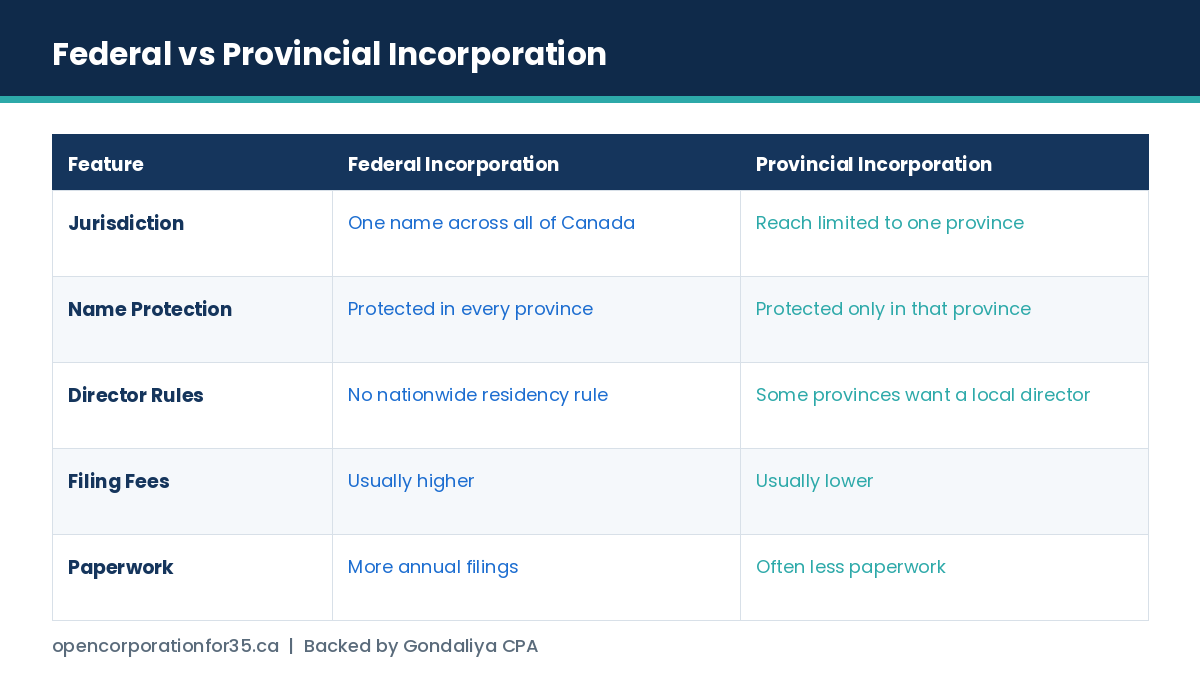
| Feature | Federal Incorporation | Provincial Incorporation |
|---|---|---|
| Jurisdiction | Lets you do business under one name all across Canada — good if you want to operate nationwide. | Limits your company’s reach only inside one province — better if you focus locally. |
| Name Protection | (Your business name gets protected across all provinces.) | (Your name is protected only within that province; others could use similar names.) |
| Requirements | No rule that most directors must live in a certain province; some provinces still want one local director. | Most provinces want some directors living locally — like Ontario needs at least one. |
Federal incorporation covers the whole country but costs more upfront than provincial options which suit smaller local businesses.
Summary Comparison
Federal incorporation works well if you want to grow nationwide with stronger name protection everywhere in Canada’s economy. Provincial incorporation fits businesses focusing on just one region with simpler setup fees and filings.
Check current rules on government sites like Corporations Canada’s portal or each province’s registry because things change sometimes.
Costs of Opening a Corporation in Canada
Costs of Opening a Corporation in Canada
Costs
If you want to open a corporation in Canada as a non-resident, you need to know what costs are involved. There are fees from the government, charges for incorporation services, and some yearly expenses you must pay. Knowing these costs helps you plan your budget well and avoid surprises.
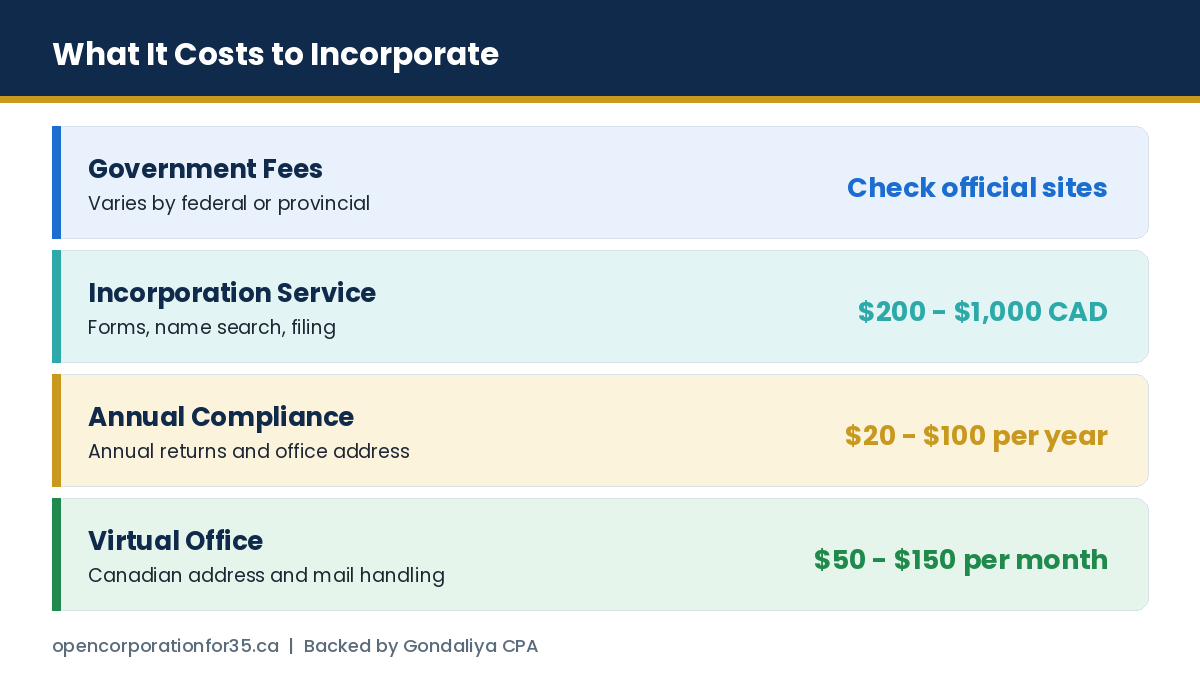
| Cost Category | Description |
|---|---|
| Government Fees | The government charges fees to set up your company. These fees change depending on where you incorporate (federal or provincial). Check official websites to get the latest numbers. |
| Incorporation Service | You can hire experts who help with forms, checking your business name, and filing papers. Their prices usually range from $200 to $1,000 CAD or more based on what you need. |
| Annual Compliance Fees | You must pay yearly fees to keep your corporation legal. This includes filing annual returns and keeping an office address in Canada. These fees are around $20–$100 CAD each year depending on the province. |
| Virtual Office Canada | Many foreigners use virtual offices to have a Canadian address. This costs about $50–$150 CAD per month, depending on services like mail handling or phone answering. |
Here’s what you should keep in mind:
- Government fees vary if you pick federal incorporation or provincial options like Ontario or BC.
- Hiring an incorporation service helps if you don’t know Canadian rules well.
- Remember to budget for annual compliance so your company stays legal.
- A virtual office gives you the Canadian address needed when foreign businesses open corporations here.
Planning for these common costs helps non-resident business owners make smart decisions about their investment.
Common Mistakes Non-Residents Make
Common Mistakes Non-Residents Make
Mistakes
Non-residents often make mistakes when setting up companies in Canada because they don’t know local rules well. Avoiding these errors can save time and money.
Biggest mistakes to watch out for:
- Ignoring director residency requirements
Some provinces want at least one director to live in Canada as a citizen or permanent resident. Federal incorporation relaxes this rule but provinces differ. - Not registering for GST/HST when required
If your business earns more than $30,000 CAD, you must register for GST/HST with the CRA. If not, you might get fines. - Using incorrect or incomplete documentation
Sending wrong forms or missing papers slows down the process a lot. Always check carefully before submitting. - Neglecting registered office address rules
You need a real physical address in the province where your company is registered — not just any PO box — so official letters reach you. - Underestimating banking challenges
Opening bank accounts from outside Canada is tricky. Some banks ask for personal visits even after incorporation.
Other mistakes include:
- Picking the wrong province without knowing tax or compliance differences
- Forgetting annual filing deadlines which cause penalties
- Assuming permanent residency is needed for owning shares (it’s not always true)
- Not checking current laws leads to outdated actions
- Avoiding professional help that could fix tricky tax and corporate issues
Here’s a simple table of common mistakes vs solutions:
| Mistake | Impact | How To Avoid |
|---|---|---|
| Ignoring residency rules | Application rejected | Check director residency rules early |
| Missing GST/HST registration | Fines & back taxes | Watch revenue limits & register quickly |
| Incorrect documentation | Processing delays | Use lists & ask pros to review |
| Invalid registered office | Missed legal notices | Get proper physical/virtual office address |
| Underestimating banking issues | Harder bank account access | Prepare ID docs & pick banks used to foreigners |
Avoiding these mistakes helps foreign business owners open corporations in Canada faster and with fewer problems.
Risk Warning: A PO box as the registered office will get the filing rejected outright. It has to be a real street address in the jurisdiction of incorporation, which is the single most common cause of rejection we see.
Incorporate without PR, from anywhere
Name search, incorporation filing, registered office address and CRA Business Number registration, all handled remotely for foreign owners. Please book a free consultation.
Step-by-Step Process Overview
Step-by-Step Process Overview
Step by Step
Opening a corporation in Canada as a non-resident has some clear steps. Whether you want to open corporation Canada non resident or incorporate Canada foreigners, knowing the process helps a lot. This guide breaks down each stage—from picking your company’s structure to registering for taxes.
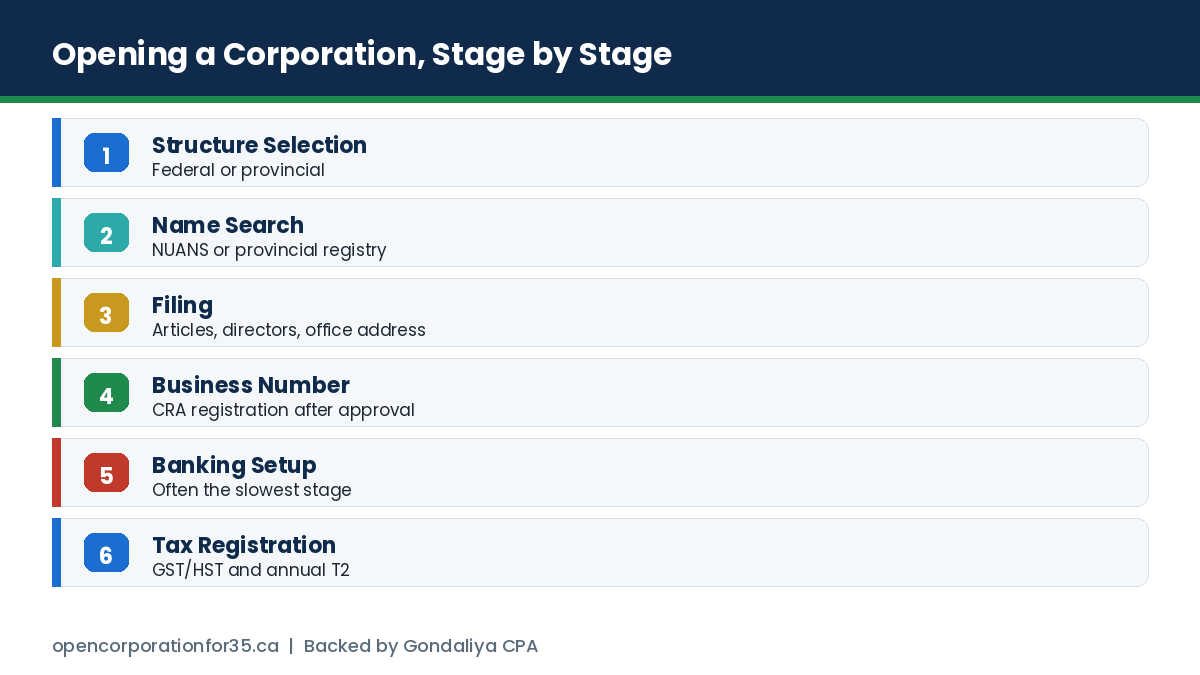
Structure Selection
Stage 1
Picking the right corporate structure is the first thing for foreign entrepreneurs who want to incorporate Canada foreigners. Most non-residents pick a standard corporation because it offers flexibility and looks good to others.
- Federal Incorporation lets you work in all provinces with just one registration.
- Provincial Incorporation limits your business to one province but can have easier local rules.
Non-residents can open corporation Canada non resident without needing permanent residency (PR). The trick is choosing federal or provincial incorporation based on what fits your business best.
Name Search
Stage 2
You need to do a name search before you file papers. This makes sure your company name is unique and follows Canadian rules. It matters whether you pick federal incorporation vs provincial incorporation.
- Federal companies use NUANS reports (that’s Newly Upgraded Automated Name Search).
- Provincial companies use name searches through their province’s registry.
Getting this done right stops delays when filing and protects your brand from the start.
Filing
Stage 3
Filing means sending in all your documents, either online or by mail, depending on where you’re registering:
- Federal filings go through Corporations Canada.
- Provincial filings depend on the province’s system, like Ontario Business Registry.
Foreign business Canada owners need to give articles of incorporation, details about directors, and a registered office address. Non-residents don’t need PR but must follow director residency rules if those apply—some provinces let you use nominee directors for this.
Business Number (BN)
Stage 4
Once your company is approved, you have to get a Business Number (BN) from the CRA. This number helps with taxes and government stuff. The BN covers:
- Corporate income tax
- GST/HST accounts
- Payroll deductions if you hire workers
CRA registration Canada requires forms depending on what your business does—like sales that have GST/HST or if you have employees. Even if you don’t have a physical office, non-resident corporations often register for GST/HST if they sell taxable goods or services here.
| Step | Description |
|---|---|
| Obtain BN | Register with CRA after incorporation |
| Register GST/HST | Required if revenue passes $30K CAD annually |
| Other Accounts | Payroll or import/export accounts if needed |
Rules can change so check with official Canadian sources before starting.
Banking Setup
Stage 5
Opening bank accounts can be tricky for foreign businesses in Canada. How to open a Canadian bank account as a non-resident depends on each bank’s rules but usually needs:
- Corporate papers like your certificate of incorporation
- Proof of ID for directors and shareholders
- A Canadian address or virtual office sometimes required by banks
- Passing anti-money laundering checks
Some banks let you start remotely; others want someone there in person at first. Planning this early helps avoid waiting before using your funds after incorporating.
Tax Registration
Stage 6
Corporate taxes apply to non-resident corporations in Canada only on income earned inside the country:
- Income Tax: Non-resident companies pay taxes only on money made in Canada.
- GST/HST Registration: If sales go over $30,000 in 12 months, you must register for GST/HST—even without PR.
- Filing Requirements: You file yearly returns with CRA showing earnings that are taxed under Canadian law no matter where you live.
Knowing these rules helps keep you legal and manage taxes correctly under current laws.
| Registration Type | When Required | Notes |
|---|---|---|
| Corporate Income Tax | On Canadian-source income | File T2 return every year |
| GST/HST | Revenue > $30K CAD | Applies even if no physical presence |
Always check CRA websites or official sources before taking action.
This simple overview shows how foreign investors can open corporation canada non resident businesses step-by-step. You don’t need permanent residency just to set up here in 2026+. From picking structure through banking and tax registrations, it keeps things easy and clear.
Start the bank application the day the incorporation certificate arrives rather than waiting until you need the account. That single change in sequencing saves more time than anything else on this list.
Final Summary
Final Summary
Summary
You can open a corporation in Canada even if you’re not a resident. You don’t need permanent residency (PR) or Canadian citizenship to set up a company here. This makes it easier for foreign business owners who want to work in Canada.
Many people want to open a Canada company without PR. The process lets you handle most things remotely, with clear steps to follow. You can pick federal incorporation if you want to do business all across Canada. Or you can choose provincial incorporation if your focus is on one area.
Here are some benefits of incorporating in Canada:
- Access to a strong economy
- Better trust from customers and partners
- Simple rules to follow
Foreign businesses in Canada can register easily. You get a Business Number from the CRA and sign up for GST/HST if needed. Some provinces ask for at least one director who lives in Canada. But many allow nominee directors or let you use virtual offices instead.
Overall, incorporate Canada foreigners find good options with flexible rules for international entrepreneurs. Check official government sites because rules can change.
Additional FAQs on Incorporating in Canada as a Non-Resident
Additional FAQs on Incorporating in Canada as a Non-Resident
More FAQ
What is a nominee director and why might I need one?+
A nominee director acts as a local director when provinces require Canadian residency. This person holds legal responsibility but follows owners’ instructions.
What services do nominee director providers offer?+
Nominee director services provide qualified local directors to meet legal rules. They handle compliance while letting you retain control.
What are registered agent services and do I need one?+
A registered agent receives official documents for your corporation. Many provinces and federal law require having one with a physical Canadian address.
How do compliance and reporting work for non-resident corporations?+
You must file annual returns, corporate taxes, and keep records. Compliance includes yearly filings to Corporations Canada or provincial registries.
What is the annual return to Corporations Canada or provincial registry?+
This return updates your company info yearly. It keeps your corporation in good standing and avoids penalties or dissolution.
How important is renewal and maintenance for my corporation?+
Renewal includes paying fees, updating records, and filing reports. Regular maintenance protects your company’s legal status.
What are the key business structure options for foreign entrepreneurs in Canada?+
Common structures include corporations, partnerships, and sole proprietorships. Most non-residents choose corporations for liability protection.
What corporate recordkeeping must I maintain as a non-resident corporation owner?+
You must keep minute books, bylaws, share registers, and resolutions. Proper records support legal compliance and tax filings.
How long does the incorporation process take including name search and approval?+
Name search with NUANS takes 1–3 days; full incorporation usually completes within 1–3 weeks depending on jurisdiction.
What documents are required for incorporation involving foreigners?+
You need Articles of Incorporation, NUANS name search report, ID copies for directors, consent forms, and proof of address.
Why is the Business Number (BN) necessary after incorporation?+
The BN identifies your company with CRA for taxes, payroll, GST/HST accounts, and government programs.
Essential Points on Canadian Corporate Tax & Banking for Non-Residents
Essential Points on Canadian Corporate Tax & Banking for Non-Residents
Tax & Banking
- Canadian Corporate Tax Overview: Non-resident corporations pay tax only on income sourced in Canada. Rates vary by province. Annual filing with CRA is mandatory.
- GST/HST Registration Thresholds: You must register if sales in Canada exceed $30,000 CAD in 12 months. Registration helps collect federal/provincial sales tax legally.
- Canadian Banking Challenges: Banks have strict anti-money laundering checks that can complicate account opening for foreigners without local presence.
- Opening Canadian Bank Account Remotely: Some banks accept online applications but require full ID verification and corporate documents before approval.
- Anti-Money Laundering Requirements: Banks demand detailed identity checks and proof of business activity under government regulations.
- Physical Presence for Banking: Many banks expect at least one visit by directors or shareholders to open an account; exceptions are limited.
- Use of Virtual Offices in Canada: Virtual offices provide a local address needed for incorporation and banking without renting physical space.
Benefits & Practical Aspects of Incorporating as a Non-Resident
Benefits & Practical Aspects of Incorporating as a Non-Resident
Benefits
- Benefits of Incorporating Canada Non Resident: Access to Canadian market, limited liability protection, credibility with clients, and tax advantages through trade agreements.
- Limited Liability Protection: Incorporation separates personal assets from business debts protecting owners from financial risks.
- Cost-Effective Setup: Compared to other countries, Canada offers affordable fees and straightforward procedures to incorporate remotely.
- Market Access Through Canadian Corporation: Your company can use Canada’s trade networks across North America and beyond easily.
- Credibility of Canadian Corporation: A registered Canadian entity builds trust with customers, suppliers, banks, and investors worldwide.
- Payments and Tax Advantages: Corporations benefit from lower tax rates on profits retained or reinvested compared to personal income tax rates.
The credibility point is real and often underrated. A Canadian corporate entity changes how suppliers and payment processors treat a business, sometimes more than the tax position does.
Federal vs Provincial Incorporation – Detailed Differences
Federal vs Provincial Incorporation – Detailed Differences
In Detail
| Feature | Federal Incorporation | Provincial Incorporation |
|---|---|---|
| Name Protection | Protects your name across all provinces | Name protected only within that province |
| Director Residency | No mandatory local directors required | Usually requires at least one resident director |
| Filing Requirements | More frequent filings including annual returns | Fewer filings; often less paperwork |
| Fees | Higher initial fees | Lower initial fees |
| Jurisdiction Coverage | Operates legally nationwide | Limited to one province |
Choose federal if you plan cross-country growth; provincial suits localized businesses wanting simpler upkeep.
Common Mistakes in Incorporation by Non-Residents & How to Avoid Them
Common Mistakes in Incorporation by Non-Residents & How to Avoid Them
Avoid These
- Ignoring nominee director requirements leads to rejected applications.
- Skipping proper NUANS name searches causes delays due to duplicate names.
- Neglecting corporate recordkeeping increases risk of fines or disputes.
- Overlooking GST/HST registration triggers penalties once revenue exceeds threshold.
- Using inadequate registered agents risks missed legal notices.
- Not preparing documents properly slows incorporation timeline.
- Underestimating banking hurdles delays access to funds.
- Assuming no annual returns cause no issues leads to legal problems later.
Avoid these mistakes by consulting experts early and following guidelines carefully.
Step-by-Step Process Overview: Incorporation Timelines Detailed
Step-by-Step Process Overview: Incorporation Timelines Detailed
Timelines
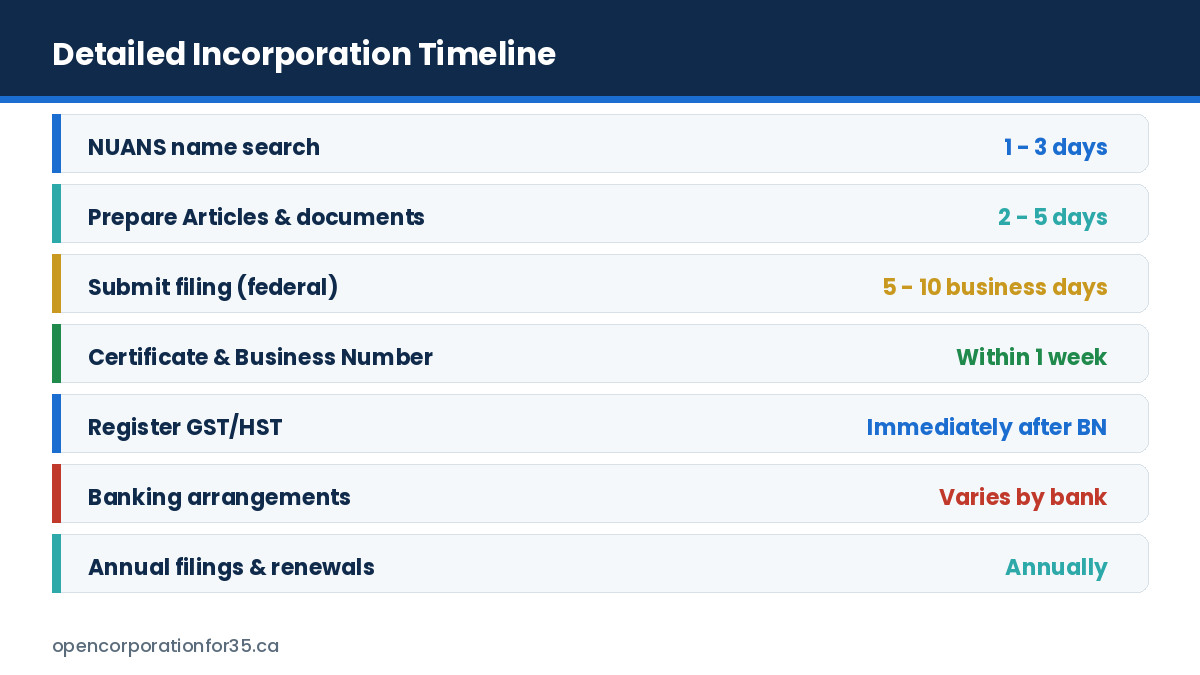
- Conduct NUANS name search (1–3 days).
- Prepare Articles of Incorporation & documents (2–5 days).
- Submit filing online or by mail (5–10 business days federally).
- Receive incorporation certificate & get Business Number from CRA (within 1 week).
- Register GST/HST if needed based on sales projections (immediately after BN).
- Set up banking arrangements including ID verification (varies by bank).
- Maintain annual filings & renewals per jurisdiction rules annually.
Following these steps ensures smooth setup while managing timelines effectively.
Professional Guidance on Incorporating Without PR: How Open Corporation For $35 Supports Foreign Owners
Professional Guidance and Quick Reference
Guidance
The residency question is the wrong thing to worry about. Ownership carries no residency test at all. What actually needs deciding is the jurisdiction, because that determines the director rules you will live with, and the registered office address, because that is what gets filings rejected.
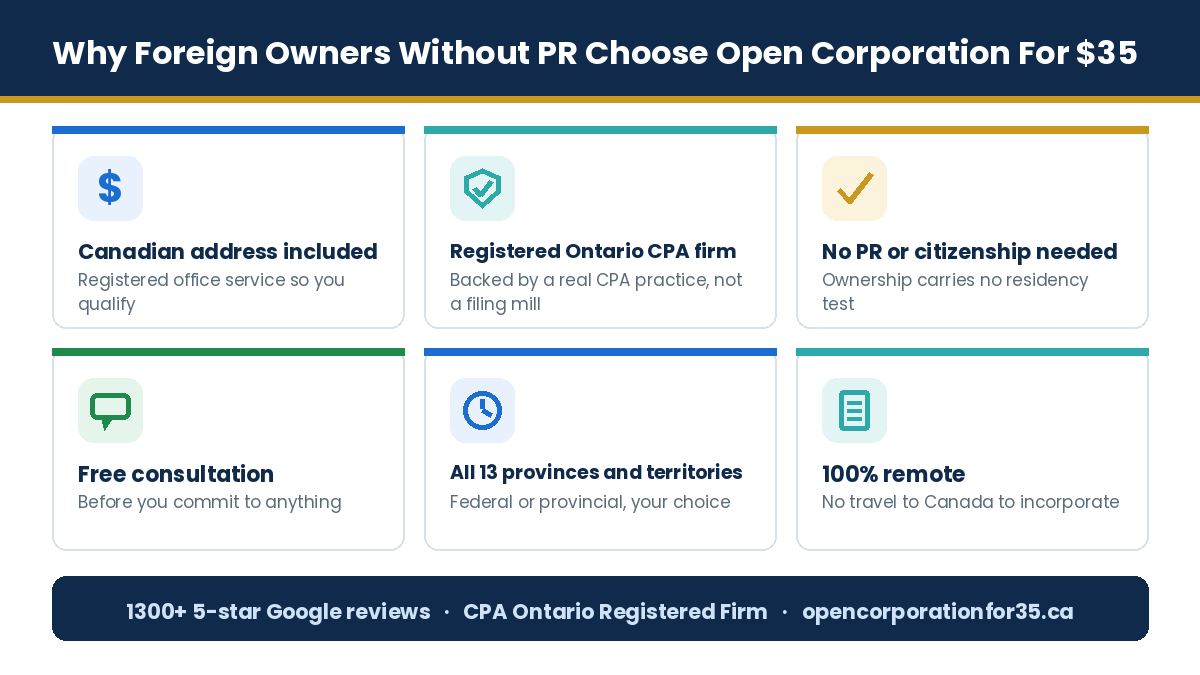
Open Corporation For $35, backed by Gondaliya CPA, handles the whole chain in one pass: the name search, the incorporation filing, the registered office address, the Business Number and the program accounts.
Everything is done remotely. No travel to Canada is required to incorporate or register.
Quick Answers: Key Numbers & Concepts at a Glance
At a Glance
- PR or citizenship required: No
- Maximum foreign share ownership: 100%
- GST/HST threshold: $30,000 CAD over 12 months
- NUANS name search: 1 to 3 days
- Document preparation: 2 to 5 days
- Federal filing: 5 to 10 business days
- Full incorporation: 1 to 3 weeks
- Incorporation service fees: $200 to $1,000 CAD
- Annual compliance: $20 to $100 CAD
- Virtual office: $50 to $150 CAD per month
Who This Is For / Not For
Fit Check
- For: Foreign entrepreneurs without PR or citizenship who want a Canadian company, owners choosing between federal and provincial registration, anyone needing a Canadian registered office address, and businesses selling into Canada above the GST/HST threshold.
- Not For: People hoping a company will support an immigration application, since it grants no status, and businesses in restricted sectors such as telecommunications that carry foreign ownership limits.
People Also Ask
Quick Answers
Does owning a Canadian company give me the right to live or work here?+
No. Company ownership grants no immigration status of any kind. Work permits and visas are handled entirely separately through immigration authorities.
Can I be the sole director and shareholder from abroad?+
You can hold all the shares from anywhere. Whether you can be the only director depends on the jurisdiction’s residency rule, which is worth checking before you choose where to incorporate.
Is a nominee director risky?+
A nominee carries the same legal duties and liabilities as any other director. Use a written agreement setting out the scope, and treat the arrangement as a legal relationship rather than a formality.
Glossary of Key Terms
Plain-English Definitions
- Permanent residency (PR): Immigration status allowing you to live in Canada. Not needed to own a company.
- Registered office: The official street address of the corporation in its jurisdiction.
- Nominee director: A director appointed to satisfy a residency requirement or preserve privacy.
- Registered agent: A party that receives official documents on the corporation’s behalf.
- NUANS: The name search report confirming your proposed name is available.
- Articles of Incorporation: The founding document setting out share structure and directors.
- Business Number (BN): The nine-digit CRA identifier every tax account attaches to.
- KYC: Know Your Customer, the identity checks banks apply before opening an account.
- Minute book: The corporate record holding bylaws, share registers and resolutions.
- Annual return: The yearly filing that keeps the corporation in good standing.
Stop worrying about residency and start with the jurisdiction. Choose it by where you will trade and what director rule you can meet, secure a real street address before filing, and open the bank application the day the certificate arrives. Those three decide how quickly you can actually trade.
No-PR Incorporation Readiness Check
This quick self-check flags which parts of your setup need attention. Please answer the six questions below.
No-PR Incorporation Readiness Check
Six quick questions on your plans. No fee quoted.
Points to review:
This is a general prompt, not tax or legal advice or a quote. Your position depends on your full facts, so for a real review please book a free consultation.
Want a checklist to work from? Please download our free no-PR incorporation checklist before your consultation.
Schedule a free consultation to open a corporation for $35.
Name search, incorporation, registered office address, CRA Business Number and program accounts, all set up together and handled entirely remotely. No PR or citizenship required.
What to Send Us
Send us your preferred company name, the province or provinces you will trade in, whether any director lives in Canada, and whether you need a Canadian address. We will confirm the right jurisdiction and handle the whole registration remotely.
Published: May 20, 2026 · Last updated: May 20, 2026
Editorial policy: Our content is prepared by our team and reviewed by Sharad Gondaliya, CPA, and we update it as incorporation rules, fees and CRA thresholds change.
Disclaimer: This article is educational information only and is not tax, legal, or financial advice. Fees, thresholds and processing times change, and outcomes depend on your specific facts. Please consult a CPA before acting.