
How Do I Register My Business in Canada as a Non-Resident?
TLDR:
How to register business Canada non resident and Canada business registration foreigner is made straightforward with Open Corporation for $35, providing a full overview of obtaining a Canadian business number and meeting filing obligations. This resource offers clear instructions for foreigners to start and maintain their business registration in Canada smoothly.
Quick Summary
A non-resident can register and own a Canadian business without living here. What decides the shape of the setup is the jurisdiction you file in, whether anyone on the board lives in Canada, and which CRA program accounts your activity actually triggers. Please note the Business Number does not arrive automatically with the certificate.
| Aspect | Details |
|---|---|
| The registration | Name approval, articles of incorporation, then a Business Number. |
| The board | 25% resident Canadian directors federally, no residency rule in Ontario. |
| The CRA accounts | RC for corporate tax, RT for GST/HST, RP for payroll, RM for import and export. |
| The ongoing work | Annual return with the registry and the T2 with the CRA, every year. |
Reading time: 24 minutes.
Table of Contents
- When a Business Number (BN) is Required for Non-Residents
- Differences Between Resident and Non-Resident Business Registration in Canada
- How to Register a Business as a Non-Resident Doing Business in Canada
- Step-by-Step Guide to Registering Online with Business Registration Online (BRO)
- Alternative Methods for Business Registration If Unable to Use BRO
- Program Accounts That Require Separate Registration Outside BRO
- Registering for Specific Accounts Such As Luxury Tax, GST/HST in Quebec, and Digital Services Tax
- Overview of Import/Export Program Accounts and Their Registration Process
- Important Information on Session Timeouts and Service Availability
- Guidelines for Non-Residents Setting Up Different Business Formats in Canada
- Comparison of Business Formats Available to Non-Residents
- Factors Affecting Choice of Business Format for Non-Resident Entrepreneurs
- Overview of Offshore Company Options and Business Activities Outside Canada
- Summary of Double Tax Exemption Tax Treaties Applicable to Foreign Businesses
- Obtaining a Canadian Business Number (BN) as a Non-Resident
- Steps for Resident and Non-Resident Importers to Register with CBSA
- Requirements for Non-Resident Importer (NRI) Registration
- CARM Portal Registration and Verification Procedures for Importers
- Security Requirements Effective April 2025 for Importers Operating in Canada
- Situations Where an Existing Business Number May Already Exist
- Access and Usage Guidelines for Business Registration Online (BRO)
- Mailing or Faxing Form RC1 as an Alternative Registration Method
- Next Steps After Business Registration: Compliance, Filing, and Reporting Obligations
- Important Alerts and Notices for Non-Residents Registering a Business in Canada
- Contact and Support Options for Business Registration Assistance
- Frequently Asked Questions (FAQs)
- Professional Guidance and Quick Reference
The Numbers That Matter
This article covers Canada, with Ontario and Toronto context, and assumes a non-resident registering or incorporating a Canadian business. Government fees, thresholds and residency rules are set by the registries and by the CRA, and they change. This is educational information only and not tax, legal, or financial advice. Please confirm your own position with a CPA before acting.
When a Business Number (BN) is Required for Non-Residents
When a Business Number (BN) is Required for Non-Residents
The Basics
If you’re a non-resident planning to register a business in Canada, you’ll need a Business Number (BN). This number is a unique ID that helps you deal with the Canada Revenue Agency (CRA) and other government offices. You must get a BN if you want to do business in Canada. It lets you open accounts for taxes and other programs.
When do non-residents need a BN?
- If your business collects GST/HST or pays payroll taxes.
- When you import goods into Canada or export them out.
- If your corporation files corporate tax returns like T2.
Getting your BN makes sure you follow Canadian rules and run your business more smoothly.
Overview of CRA Program Accounts Relevant to Non-Resident Businesses
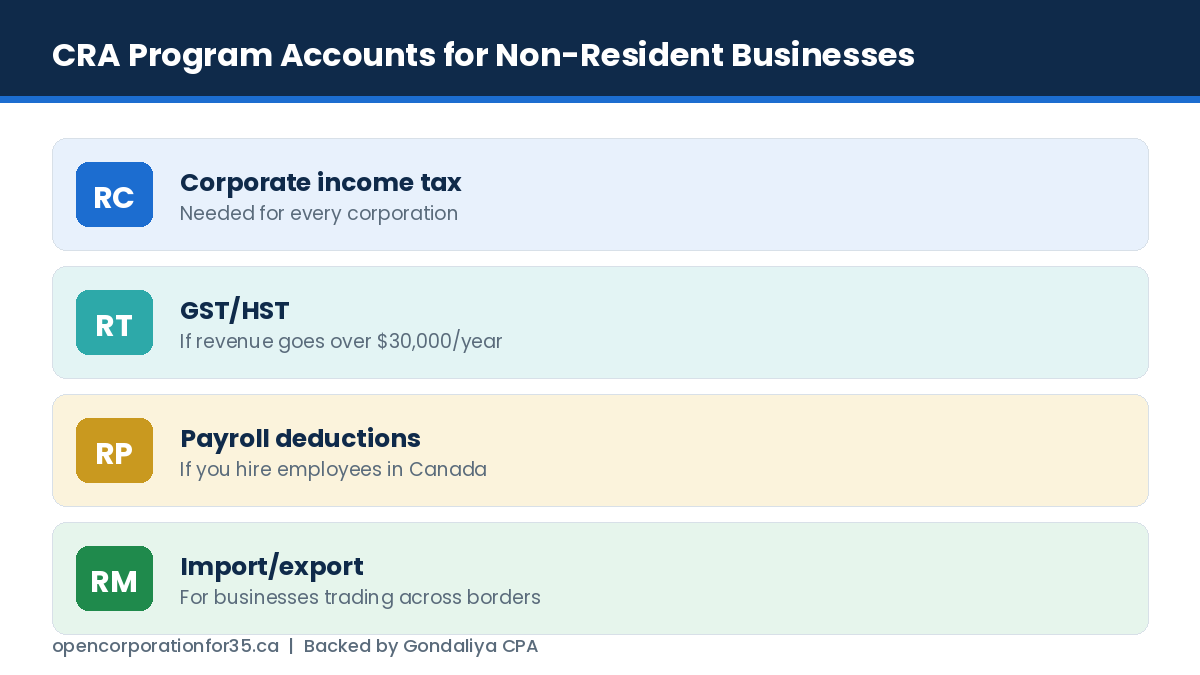
When a non-resident registers a business, the CRA often creates several program accounts under their Business Number. Here are the main ones:
| Account Type | Purpose | When Needed |
|---|---|---|
| RC | Corporate income tax | Needed for every corporation |
| RT | GST/HST | If revenue goes over $30,000/year |
| RP | Payroll deductions | If you hire employees in Canada |
| RM | Import/export | For businesses trading across borders |
GST/HST Small Supplier Threshold
The GST/HST small supplier rule says if your taxable sales pass $30,000 over four quarters, you have to register for GST/HST. Then, you must charge these taxes on sales where it applies.
How Does a Non-Resident Get a CRA Business Number and Program Accounts?
- Fill out Form RC1 – Request for a Business Number.
- Send some ID documents.
- Submit online or mail it to the CRA.
The process is usually fast but may need extra papers if you’re foreign-owned.
The question we are asked most often on a first call is whether a Business Number comes automatically with incorporation. It does not. The certificate and the BN are two separate steps with two separate authorities, and owners who assume otherwise usually discover the gap when they try to open a bank account.
Differences Between Resident and Non-Resident Business Registration in Canada
Differences Between Resident and Non-Resident Business Registration in Canada
Key Differences
There are some clear differences when residents and non-residents register businesses here:
- Director Residency Rules: Residents have more leeway with director residency. But federal corporations need 25% of directors to live in Canada. Some provinces, such as Manitoba and Saskatchewan, also require Canadian directors, so where you register matters.
- Address Needs: Every business must have an official address inside its province or territory. Foreign addresses don’t count as registered offices.
- Tax Rules: Both resident and non-resident companies pay corporate taxes, but non-residents might face extra withholding tax on dividends from Canadian earnings because of Regulation 105.
Knowing these differences can save time and headaches later on.
Understanding the Definition of Non-Residents for Business Purposes
In Canadian business law, “non-residents” are people or companies who don’t live in Canada but want to do business here without setting up a physical office beyond what’s needed by law.
Can a Non-Resident Register a Business in Canada Without Living Here?
Yes! Foreigners can own shares in Canadian companies with no residency or citizenship limits. But they must follow rules about directors depending on the company type—like corporation or partnership.
What Should a Non-Resident Prepare Before Registering a Business in Canada?
Before signing up:
- Pick a name that fits Corporations Canada or ISED rules exactly.
- Decide your business type (corporation vs sole proprietorship) and know what that means for liability and taxes.
- Gather ID papers like passports plus proof of address when needed—even though it won’t replace having a registered office here!
Being ready helps you avoid delays and meet all legal requirements for joining Canada’s market space.
The registered office address is where most first attempts fail. Owners abroad reach for the address they already have, and a foreign address or a post office box is refused by the registry every time. Sorting the address before filing saves a rejected submission.
How to Register a Business as a Non-Resident Doing Business in Canada
How to Register a Business as a Non-Resident Doing Business in Canada
Getting Started
Registering a business Canada non resident is doable, but you need to know the rules first. You don’t have to live in Canada to start. Just pick the right business type and where you want to register. The process usually includes getting your name approved, filing incorporation papers, naming directors, and opening tax accounts with the CRA.
Non-residents often pick federal or provincial incorporation. Services like Open Corporation For $35 make this easier. Some rules apply though:
- At least one director may need to be a Canadian resident (this depends on where you register).
- You must have a real address in Canada for your registered office.
- Register for CRA accounts like GST/HST if your business sells taxable goods or services.
Following these steps keeps your business legal and helps you tap into Canada’s stable economy.
Eligibility Criteria for Non-Resident Online Business Registration
Canada lets foreigners register businesses online, even if they’re not citizens or residents. You can handle Canada business registration foreigner tasks through federal or provincial sites as long as you meet local rules.
Here’s what you need:
- No need to live in Canada or be a citizen to own shares.
- Director residency rules differ: federally (under CBCA), 25% of directors must live in Canada; some provinces don’t require this.
- You need a valid Canadian registered office address.
- Certain professional businesses might need extra approvals from licensing bodies.
So yes, a non-resident can register a business in Canada without living here if these rules are followed and you use the right platforms.
Owners who choose the jurisdiction before checking the director residency rule almost always have to revisit the decision. Deciding who will sit on the board first, and then choosing where to incorporate, is the order that avoids a continuance later.
Key Stat: There is no restriction on foreign ownership of a Canadian corporation. A non-resident can hold every share. The rule people mistake for an ownership limit is the director residency requirement, and it applies to the board rather than the shareholders.
Step-by-Step Guide to Registering Online with Business Registration Online (BRO)
Step-by-Step Guide to Registering Online with Business Registration Online (BRO)
The Steps
BRO is an online portal that makes it easier for non-residents to register their businesses federally or provincially from anywhere.
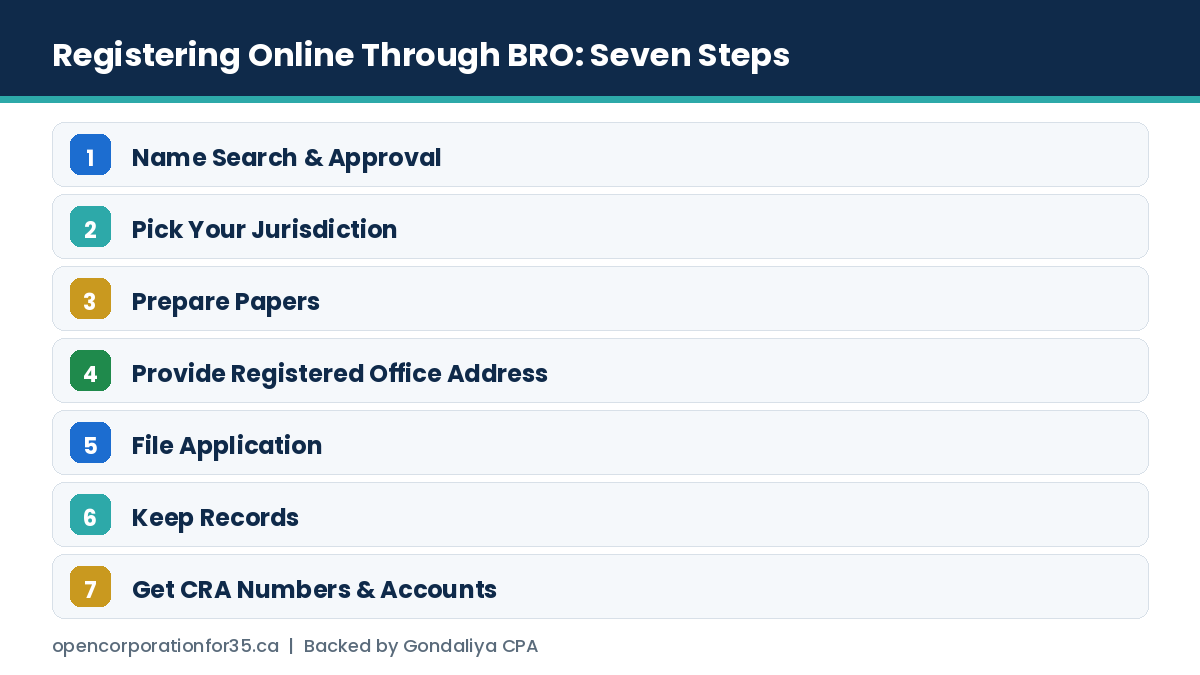
- Name Search & Approval: Run a NUANS report on BRO or through other providers to check if your name is unique.
- Pick Your Jurisdiction: Choose federal incorporation (CBCA) or provincial options like Ontario’s OBCA based on director residency needs and market scope.
- Prepare Papers: Create articles of incorporation showing share structure, directors, and officers info.
- Provide Registered Office Address: This must be a physical location in Canada; PO Boxes won’t work.
- File Application: Submit electronically through BRO with government fees (federal is $200).
- Keep Records: Set up internal share registers and maintain records as required by law.
- Get CRA Numbers & Accounts: Apply at the same time for GST/HST and payroll accounts if needed.
Federal vs Provincial Incorporation for Non-Residents — Which Should You Choose?

| Factor | Federal (CBCA) | Ontario (OBCA) |
|---|---|---|
| Director Residency | At least 25% Canadian residents | No residency rule |
| Name Protection | Across all of Canada | Only within Ontario |
| Extra-provincial Filing | Needed outside your province | Not needed inside Ontario |
| Cost | $200 filing fee | $360 filing fee |
Summary: Federal works well if you want national reach but needs resident directors. Ontario suits fully foreign-owned companies without residency requirements.
Sign-In Requirements and Accessing BRO for Non-Residents
Non-residents must create secure sign-in credentials for BRO, often using ID issued outside Canada if possible.
- Use internationally accepted ID numbers where possible.
- Verify your identity with documents matching shareholder or director info during setup.
Once logged in:
You can apply for your CRA business number online. This includes program accounts like corporate income tax (RC) and GST/HST (RT).
If you register for GST/HST as a non-resident in Canada, you might have to pay security deposits depending on how much you sell here per Regulation 105.1
The step that stalls owners abroad is identity verification rather than the filing itself. Getting the credentials in place a week ahead, while the documents are still to hand, turns a multi-day exercise into a single sitting.
Alternative Methods for Business Registration If Unable to Use BRO
Alternative Methods for Business Registration If Unable to Use BRO
Alternatives
Options Comparison Table
| Method | Who It Fits | Pros | Cons |
|---|---|---|---|
| DIY | Simple sole proprietorships | Cheapest | Risky mistakes |
| Lawyer | Complex cross-border setups | Legal advice + custom help | Expensive |
| CPA / Filing Service | Foreign small businesses | Flat fees + expert help | Costs more than DIY |
Using CPA services like Open Corporation For $35 offers a good balance: expert help without big fees. This reduces common mistakes by first-timers registering from abroad.
What Does Registering a Business in Canada Cost for a Non-Resident?
Our flat service fee including HST is $35 plus government fees that change by province:
Costs may include:
- Federal vs Provincial filing fees
- Named vs numbered corporation charges
- NUANS name search (~$20)
- Registered office rental (~$100/year)
- Extra-provincial registrations ($50-$150 each)
- Public transparency registry setup
- Corporate tax filing extras
Contact us for clear pricing based on your needs.
^1: See CRA Guidance on Regulation 105.
Owners comparing providers usually compare the service fee alone. The figure that actually differs between quotes is what sits underneath it, the government fee, the name search and the address, so we set all of them out before anyone commits.
Register your Canadian business from anywhere
Same-day federal or provincial incorporation, instant NUANS name search, a registered office address that meets registry rules, and CRA account setup, all backed by a CPA firm. Please book a free consultation.
Program Accounts That Require Separate Registration Outside BRO
Program Accounts That Require Separate Registration Outside BRO
Separate Signup
If you’re a non-resident registering a business in Canada, you get a Business Number (BN) from the Canada Revenue Agency (CRA). But hold on, some program accounts linked to that BN don’t register automatically through the Business Registry Online (BRO). You have to sign up for them separately.
These program accounts include payroll deductions, import/export accounts, GST/HST accounts, and other special tax programs. Just registering your business federally or provincially doesn’t cover these. Each has its own rules and signup steps. For example:
- Payroll Deductions Account (RP): You need this if you hire employees in Canada.
- GST/HST Account (RT): Required if your taxable sales go over certain limits or if you want to register voluntarily.
- Import/Export Account (RM): Needed for businesses dealing with cross-border goods.
Knowing which accounts apply to your business helps you stay legal after finishing your business registration Canada non resident steps[1].
The payroll account is the one that gets missed. A first Canadian hire is often made months after incorporation, by which point nobody remembers that the RP account was never opened, and the first remittance is already late.
Registering for Specific Accounts Such As Luxury Tax, GST/HST in Quebec, and Digital Services Tax
Registering for Specific Accounts Such As Luxury Tax, GST/HST in Quebec, and Digital Services Tax
Specific Taxes
Some taxes call for separate registration beyond basic CRA accounts. Non-residents should pay close attention to these during setup.
GST/HST Small Supplier Threshold
A non-resident must register for GST/HST if taxable revenues from Canadian sources pass $30,000 in four straight calendar quarters[2]. If below that, registration is optional.
When Does a Non-Resident Business Have to Register for GST/HST in Canada?
You must register once you start doing business or selling taxable goods or services in Canada. The CRA expects quick registration after hitting those thresholds[3].
Other taxes needing separate registration include:
- Luxury Tax: On some expensive goods; needs its own CRA account.
- Quebec Sales Tax (QST): If you work specifically in Quebec, register with Revenu Québec.
- Digital Services Tax: Foreign digital service providers may face new federal rules requiring separate registrations.
Foreign owners setting up must keep these in mind for smooth compliance[4].
| Program Account | Purpose | When Required |
|---|---|---|
| RT – GST/HST | Collecting goods & services tax | Pass small supplier threshold / voluntary |
| RP – Payroll Deductions | Employee source deductions | Hiring employees |
| RM – Import/Export | Customs duties & trade handling | Doing imports or exports |
| Luxury Tax | Tax on luxury goods | Selling high-value products |
Quebec catches people out more than any other province. Owners assume a federal GST/HST account covers the whole country, and it does not cover QST, which is administered separately by Revenu Québec.
Overview of Import/Export Program Accounts and Their Registration Process for Non-Resident Businesses
Overview of Import/Export Program Accounts and Their Registration Process for Non-Resident Businesses
Import & Export
Non-resident companies involved in importing or exporting need an RM account with the CRA along with their BN. This lets them clear customs and pay duties legally at Canadian borders.
Here’s how it works:
- Apply separately online or by phone after getting your BN.
- Give details about your import/export activities.
- Provide extra documents like importer numbers or permits depending on what you trade.
You can’t get this just by filing corporate registrations. It’s not automatic at incorporation either[5]. Missing the RM account can cause shipment delays and fines under customs law.
Many foreign-owned small businesses registered through Open Corporation For $35 get help securing these program accounts quickly after registration. This keeps things running smoothly across places like Ontario and Toronto[6].
The RM account is usually requested the week a first shipment is already in transit. Opening it at incorporation costs nothing extra and removes the risk of goods sitting at the border while an account is set up.
Important Information on Session Timeouts and Service Availability for Online Registrations
Important Information on Session Timeouts and Service Availability for Online Registrations
Practical Warning
When registering a business Canada non resident online using sites like Open Corporation For $35, watch out for session timeouts and service hours.
Government portals like Corporations Canada’s system time out after about 20 minutes of no activity to keep data safe[7]. If your session expires:
- You lose all info entered so far.
- You must start again with tasks like NUANS name searches.
- Delays happen that might push back same-day processing.
To avoid this: have all documents ready before starting; save your work often; use steady internet; reach out quickly if problems pop up[8].
Open Corporation For $35 offers help during weekends and evenings plus quick replies so non-residents can finish their incorporation online without trouble[9].
Time zones make the timeout worse than it sounds. An owner filing at the end of their own working day is often filing overnight in Canada, so a session that drops takes a full day to recover rather than an hour.
[1]:
Canada.ca – Business Number
[2]:
CRA – Small Supplier Status
[3]:
CRA – When To Register
[4]:
Revenu Québec – QST Registration
[5]:
CRA – Importer Exporter Number
[6]:
Internal client onboarding data — Open Corporation For $35
[7]:
Corporations Canada Filing System User Guide 2026 Update
[8]:
Government of Canada IT Security Guidelines
[9]:
Open Corporation For $35 Support Policy
Guidelines for Non-Residents Setting Up Different Business Formats in Canada
Guidelines for Non-Residents Setting Up Different Business Formats in Canada
Structures
If you’re a non-resident, you can still register business Canada non resident without being a citizen or living here. The kind of business you pick changes how you register, follow rules, and pay taxes. You can pick from sole proprietorships, partnerships, corporations, or branches of foreign companies. Each one has different rules about who runs it, where the main office is, and how to set up accounts with the CRA.
Most non-residents prefer to register a corporation because it limits personal risk and looks better to banks and clients in Canada. But if you want something smaller and simpler, a sole proprietorship or partnership might work better.
Knowing how to register business Canada non resident means picking a structure that fits your plans. You also have to follow federal or provincial rules for registering. Doing this right helps avoid problems later on.
Almost everyone who arrives asking about a sole proprietorship ends up incorporating instead, and the reason is rarely tax. It is that Canadian banks and Canadian customers deal more readily with a corporation than with a foreign individual.
Comparison of Business Formats Available to Non-Residents: Limited Partnerships, Extra-Provincial Registrations, Canadian Corporations, and LLCs
Comparison of Business Formats Available to Non-Residents: Limited Partnerships, Extra-Provincial Registrations, Canadian Corporations, and LLCs
Comparison
Canada doesn’t have LLCs like the U.S., so foreigners usually pick between federal or provincial incorporation or extra-provincial registration if they work in several provinces.
Here’s a quick look:
Limited Partnership (LP)
Format 1
- Some partners have limited liability; one partner must have full liability.
- Foreigners can set these up provincially.
- Not very common for non-residents.
- Fees vary by province ($100–$300).
Extra-Provincial Registration
Format 2
- For businesses from one province wanting to work in another.
- Required when crossing provincial lines.
- Fees range around $200–$400 per province.
Canadian Corporation
Format 3
- Separate legal entity; can be federal (CBCA) or provincial (like Ontario’s OBCA).
- Foreigners can incorporate.
- Director residency rules differ: federally at least 25% must be Canadian residents; some provinces require majority residents; others don’t require any.
- Federal fee is $200 plus extra service charges.
LLC Equivalent
Format 4
- No exact match in Canada.
- Foreign LLCs often register as branches or create local corporations.
- Branch registration involves different tax and treaty rules.
- Fees vary depending on registration type.
Choosing between federal and provincial incorporation often depends on director residency rules and where you want protection of your company name. Remember to register extra-provincially if your business works outside its original province. Fees change depending on the province.
American owners are the ones most often surprised here. They arrive expecting to form a Canadian LLC, and the conversation has to start with the fact that the format does not exist in Canada at all.
Factors Affecting Choice of Business Format for Non-Resident Entrepreneurs
Factors Affecting Choice of Business Format for Non-Resident Entrepreneurs
Decision Framework
Deciding if a non-resident should use a sole proprietorship or incorporate depends on things like personal risk, taxes, banking needs, costs, and future plans.
Look at this table:
| Factor | Sole Proprietorship | Corporation |
|---|---|---|
| Liability | You are fully responsible | Liability is limited |
| Taxes | Pay personal income tax | File separate corporate returns |
| Banking | Need personal credit history | Have corporate bank accounts |
| Owners | Usually one | Can have multiple shareholders |
| Costs | Low setup cost | Higher setup and yearly fees |
In general, incorporating gives better protection if you plan bigger operations here. It does cost more upfront though.
Also note: GST/HST registration kicks in after certain sales levels if incorporated. Sole proprietors often qualify as small suppliers and skip registering unless sales grow enough.
Banking is the factor owners weight lowest and regret most. A corporation opens a Canadian account far more easily than a foreign individual does, and that single practical point often decides the structure.
Overview of Offshore Company Options and Business Activities Outside Canada
Overview of Offshore Company Options and Business Activities Outside Canada
Offshore
Sometimes non-residents use offshore companies alongside their Canadian operations through branches or subsidiaries.
A branch lets a foreign company do business here without forming a new company in Canada. But it still needs to file reports locally and often extra-provincial registrations if active. This may trigger permanent establishment risks—meaning taxes—unless tax treaties help reduce them.
Offshore companies that operate outside Canada face no special incorporation limits but can’t just hide behind those setups when working inside Canada. Canadian law requires disclosing who owns these companies for anti-money laundering reasons.
Even if an offshore firm stays abroad physically, authorities want transparency about its real owners under new regulations.
The branch route looks simpler on paper and rarely is. Once activity in Canada is real, the reporting and the permanent establishment question arrive together, and a Canadian subsidiary is usually the cleaner structure.
Summary of Double Tax Exemption Tax Treaties Applicable to Foreign Businesses
Summary of Double Tax Exemption Tax Treaties Applicable to Foreign Businesses
Treaties
If you’re a foreign owner doing business in Canada, double tax treaties matter a lot. They stop you from paying taxes twice—once here and once back home. These deals affect things like withholding tax rates on interest or dividends sent out of Canada under Regulation 105.
Non-resident GST/HST registration depends on whether you sell goods or services above certain thresholds inside Canada. Registering helps recover some taxes paid (input tax credits), which lowers your overall costs here.
Once registered, you need to file corporate tax returns (T2), no matter if you make profits or not. Your tax depends on whether you have permanent establishment status here—basically a fixed place of business triggering local tax duties.
You’ll also need to handle withholding correctly according to treaties so you don’t overpay at source.
Getting advice early can help sort out these complex laws versus international agreements designed to prevent double taxation for foreign businesses working in Canada.
Treaty relief is claimed, not granted automatically. Owners who assume the lower rate applies by default are the ones who find the full rate was withheld at source and now has to be recovered on a return.
- https://www.ic.gc.ca/eic/site/cd-dgc.nsf/eng/home
- ServiceOntario – Ontario Business Registry
- CPA Ontario – Corporate Structures Guide
- CRA – GST/HST Small Supplier Threshold
- Corporations Act – Extra-provincial Registration Requirements
- FINTRAC Guidance – Offshore Entities Transparency Rules
- Government of Canada’s Beneficial Ownership Regulations
- Department Of Finance – International Tax Treaties List
- CRA Regulation 105 Withholding Taxes Overview
- CRA – GST/HST Registration Criteria For Non-Residents
- CPA Professional Standards On Cross-Border Input Credits
- Income Tax Act Section 150(1) Filing Obligations
- OECD Model Treaty Commentary On Permanent Establishment
- Schedule 91 Treaty Positions And Reporting Requirements
- Gondaliya CPA Consultation Notes On Cross-Border Compliance
Obtaining a Canadian Business Number (BN) as a Non-Resident
Obtaining a Canadian Business Number (BN) as a Non-Resident
Business Number
If you want to register business Canada non resident style, the first step is to get a Canadian Business Number (BN). This BN is a nine-digit code that the Canada Revenue Agency (CRA) gives to each business. It helps you deal with federal, provincial, and municipal governments without hassle.
Non-residents can apply for a BN after they incorporate or register their business in Canada. The BN lets you open accounts for:
- corporate income tax (RC),
- GST/HST (RT),
- payroll deductions (RP),
- and import/export programs (RM).
You need to provide company details like the legal name, where it was incorporated, an address in Canada, details of directors, and the fiscal year-end. Without a BN, you cannot file taxes or open CRA program accounts.
For those who want Canada business registration foreigner options, getting the BN early helps avoid problems with CRA reporting later on. There are services that assist non-residents to get this done smoothly.
Source: CRA – Business Number Program
Files where the fiscal year-end has already been decided move straight through. Files where it has not are the ones that stall, because the date affects every filing deadline that follows and cannot be picked casually.
Steps for Resident and Non-Resident Importers to Register with Canada Border Services Agency (CBSA)
Steps for Resident and Non-Resident Importers to Register with Canada Border Services Agency (CBSA)
CBSA
Both resident and non-resident importers must register with CBSA before bringing goods into Canada. This registration is needed to join customs programs like CARM — Canada’s new digital platform replacing old systems.
Here’s how you register:
- Get your Canadian Business Number from CRA.
- Apply online on the CBSA website or use the CARM Portal.
- Provide importer details: legal entity type, contact info, authorized reps.
- Send documents that prove your identity and business legitimacy.
Non-residents might face extra checks but follow similar steps once they have a BN under their Canadian corporation or branch.
Registering on time avoids customs delays that could mess up your supply chain or cause fines.
Source: CBSA – Importer Registration
The sequence matters more than the paperwork. The BN has to exist before CBSA registration can begin, so owners who start at the border end up going back to the CRA first and losing a week.
Requirements for Non-Resident Importer (NRI) Registration Including Additional Documentation
Requirements for Non-Resident Importer (NRI) Registration Including Additional Documentation
NRI
If you’re doing business registration Canada non resident style and want to be a Non-Resident Importer (NRI), you must meet some special rules beyond normal importer registration:
- Have a valid Canadian Business Number tied to an active company or branch.
- Show incorporation papers proving foreign ownership.
- Name an agent living in Canada who handles customs if you don’t have a local office.
- Provide notarized power of attorney so someone in Canada can act for you.
Sometimes you’ll also need financial statements showing you can pay your bills or security deposits based on CBSA’s risk check.
These rules make sure importing without being physically in Canada stays legal and safe.
Source: CBSA – NRI Guidelines
The notarized power of attorney is the item that adds weeks, because it has to be executed and notarised wherever the owner actually lives. Starting it early runs it in parallel with everything else rather than at the end.
CARM Portal Registration and Verification Procedures for Importers
CARM Portal Registration and Verification Procedures for Importers
CARM
The CARM Portal makes registering as an importer easier — even if you’re a non-resident with a business registered outside Canada but working here.
To register:
- Make an account on the CARM Portal using your BN from CRA.
- Verify your profile by confirming ID with government-issued documents plus proof you control imported goods.
- Link all related accounts like GST/HST RT if your sales in Canada cross certain limits.
- Keep info updated about directors, addresses, or ownership changes fast to stay compliant.
This online system cuts down mistakes common when foreign-owned businesses try to manage different agencies on their own after figuring out how to register business canada non resident operations properly.
Source: Government of Canada’s CARM Overview
Portal profiles go stale quickly. A director change or an address change that is not carried into CARM is the sort of mismatch that surfaces at the worst possible moment, which is when a shipment is already at the border.
Security Requirements Effective April 2025 for Importers Operating in Canada
Security Requirements Effective April 2025 for Importers Operating in Canada
Security Rules
Starting April 2025, new security rules will affect importers working in Canada — especially non-residents setting up via canada company registration foreigner processes:
- You must submit stronger security clearances before shipments release. This includes background checks on key people controlling your company if it’s registered outside Canada.
- You’ll need financial security deposits covering possible duties and taxes owed at entry.
- Automated risk assessments built into CARM will watch compliance live.
- If you don’t follow these rules, import privileges may be paused until problems get fixed.
These measures aim to protect Canada’s borders from illegal trade while letting legit foreign investors operate within the country’s rules.
Source: CBSA Notice – Security Measures Update April 2025
Security deposits are the line item foreign owners least expect in a landed-cost calculation. Building the figure into the budget before the first shipment avoids a cash squeeze in the first trading month.
Situations Where an Existing Business Number May Already Exist for Your Business
Situations Where an Existing Business Number May Already Exist for Your Business
Check First
If you’re a non-resident wanting to register business Canada non resident, first check if your business already has a Business Number (BN) from the Canada Revenue Agency (CRA). Sometimes, your foreign company might have a BN if it registered for GST/HST, payroll, import/export, or income tax in Canada before. This can happen when one company runs several branches or subsidiaries across different provinces.
Using the same BN stops you from registering twice and makes managing your CRA accounts easier. But you need to verify this with the CRA by giving your legal business name and other info. If you’re unsure, it’s smart to get help from a professional who can tell if your foreign-owned business needs a new BN or not.
Key source: Canada.ca – Registering for a Business Number
Duplicate Business Numbers are more common than owners expect, usually created years earlier for a single GST/HST registration nobody remembers. Checking first is a short call and it prevents a tangle that takes far longer to unwind.
Access and Usage Guidelines for Business Registration Online (BRO) for Non-Residents
Access and Usage Guidelines for Business Registration Online (BRO) for Non-Residents
Using BRO
Canada’s Business Registration Online (BRO) lets non-residents register their business without being in the country. When figuring out how to register business Canada non resident, keep these tips in mind:
- Have your ID documents ready.
- BRO handles federal incorporation and program accounts like GST/HST.
- You must use a valid Canadian address—usually through registered office services—since foreign addresses won’t work.
- BRO gives instant confirmation but doesn’t replace provincial registration where needed.
Non-residents will find BRO easy to use but might need extra documents for identity checks due to cross-border rules.
Reference: Corporations Canada – Using BRO
Instant confirmation gets read as the end of the process. It is not. Provincial registration, where it applies, is a separate filing, and owners who stop at the federal confirmation are the ones who find a gap months later.
Mailing or Faxing Form RC1 as an Alternative Registration Method
Mailing or Faxing Form RC1 as an Alternative Registration Method
Form RC1
If online registration feels tricky or you can’t use it, mailing or faxing Form RC1 works well when registering business Canada non resident.
Form RC1 is the official form to get a new Business Number plus GST/HST or payroll accounts. When you send it by mail or fax:
- Fill out all parts clearly.
- Attach papers that prove your identity and right to act for the company.
- Use certified mail or courier so you can track it.
This method takes longer—usually 2–4 weeks—but works if you want paper records or no internet access.
Source: CRA Form RC1 Instructions
The paper route is chosen far more often than it needs to be, usually because an identity check failed online. Fixing the identity documents is normally faster than waiting out the postal timeline.
Next Steps After Business Registration: Compliance, Filing, and Reporting Obligations
Next Steps After Business Registration: Compliance, Filing, and Reporting Obligations
After Registration
Once you know how to register business Canada non resident, don’t stop there. You need to keep following rules after registration. Here’s what comes next:
- Annual Returns: File these with Corporations Canada or your province on time every year.
- Corporate Taxes: Send T2 income tax returns within six months after your fiscal year ends, even if you didn’t earn money (CRA T2 Guide).
- GST/HST: If your non-resident business sells over $30,000 CAD in any calendar quarter, register for GST/HST (Small Supplier Threshold).
Failing to comply can cause fines of up to $250 per day plus interest on owed taxes. Keep good records at your Canadian registered office so you get notices on time from agencies like ISC and CRA.
Registration is treated as the finish line and it is the starting line. The corporations that run into trouble are almost always the ones where nobody was given ownership of the annual return and the T2 on the day the certificate arrived.
Important Alerts and Notices for Non-Residents Registering a Business in Canada
Important Alerts and Notices for Non-Residents Registering a Business in Canada
Alerts
Non-residents should watch out for some big changes affecting their Canadian businesses:
Starting January 2026, new rules tighten withholding tax under Regulation 105. They affect payments Canadian companies make to non-resident contractors doing work here. Be sure you follow these rules when making contracts and paying (CRA Notice).
If you incorporate federally under CBCA, at least 25% of directors must be Canadian residents unless the province says otherwise (like BC). This rule affects which province foreigners pick for incorporation (Corporation Act Updates 2026).
Knowing these alerts helps prevent rejected filings because of director rules or unexpected withholding taxes that could hurt cash flow after registration.
Rejected filings on director grounds are entirely preventable and still happen every year. Confirming the board against the rule for the chosen jurisdiction takes a minute and saves the fee and the re-filing.
Contact and Support Options for Business Registration Assistance
Contact and Support Options for Business Registration Assistance
Support
Open Corporation For $35 provides help especially for foreign entrepreneurs figuring out how to register business Canada non resident. Their flat fee covers:
- Same-day federal/provincial incorporation
- Instant NUANS name search reports
- Registered office/address solutions that meet registry rules
- CRA account setup including GST/HST registration
They are backed by a licensed Ontario CPA firm who offers free consultations before and after registration — all included in the $35 service fee incl HST.
Contact us today at 647‑212‑9559 | info@gondaliyacpa.ca | Visit: opencorporationfor35.ca/contact-us/
Time zones are the practical reason owners abroad choose us. Evening and weekend availability in Toronto lines up with a working morning in much of Europe and Asia, which is when most of these questions actually get asked.
Frequently Asked Questions (FAQs)
Frequently Asked Questions (FAQs)
FAQ
What are the key steps to register a business in Canada as a non-resident?+
Choose a business structure, get name approval via NUANS, prepare incorporation documents, file federally or provincially, appoint directors, and obtain a CRA Business Number.
How does the resident Canadian director requirement affect non-resident founders?+
Federal corporations under CBCA require at least 25% of directors to be Canadian residents. Some provinces have no such rule. This influences where you incorporate.
What is the federal incorporation fee (CBCA) for non-residents?+
The federal incorporation fee is $200. Additional fees apply for NUANS name search and registered office services.
What is the validity period of a NUANS name search?+
NUANS reports are valid for 90 days. You must complete your incorporation within this time to keep your chosen name.
When must a non-resident file the T2 corporate tax return?+
The T2 corporate tax return is due within six months after your fiscal year-end, regardless of profit or loss.
What are extra-provincial registration fees?+
If you operate in provinces other than where you incorporated, you must register extra-provincially. Fees vary by province, typically between $50 and $400.
How do business structures differ for non-residents?+
Sole proprietorships offer simple setup but no liability protection. Corporations limit liability but cost more and need compliance. Partnerships vary by type and liability exposure. Branches are extensions of foreign companies with specific tax rules.
How do ownership eligibility rules apply to foreigners?+
Foreigners can fully own Canadian corporations with no citizenship or residency restrictions on shareholders.
Why choose federal vs provincial incorporation as a non-resident?+
Federal offers nationwide name protection but requires resident directors. Provincial incorporation may have no residency rules but limited regional coverage.
How does carrying on business in Canada affect registration?+
“Carrying on business” triggers registration requirements including BN acquisition and possible extra-provincial filings depending on activities and locations.
Two questions dominate every enquiry: whether a foreigner can own the company outright, and whether a Canadian director is needed. The answers are yes to full ownership, and it depends entirely on the jurisdiction you choose.
Essential Points on Compliance and Registrations for Non-Resident Businesses
Quick Reference
- Non-residents must maintain a registered Canadian office address; PO Boxes are not accepted.
- Annual returns are mandatory; late filings incur penalties.
- Minute books must be kept up to date for corporate records.
- CRA program accounts like GST/HST (RT) require separate registrations post-incorporation when thresholds are met.
- Regulation 105 withholding tax rules apply to payments made to non-resident contractors from January 2026 onward.
- Extra-provincial registrations increase compliance costs if operating across provinces.
- Open Corporation For $35 provides professional filing services that minimize risks compared to DIY approaches.
Choosing Your Registration Partner: CPA vs Lawyer vs DIY
Decision
- DIY registration suits simple businesses but risks errors that cause delays or fines.
- Lawyers provide legal advice tailored for complex cross-border setups but charge high fees.
- CPAs or specialized filing services like Open Corporation For $35 offer affordable expertise ensuring smooth compliance without excessive costs.
Key Deliverables from Open Corporation For $35 Non-Resident Registration Service
What You Get
- Same-day incorporation federally or provincially with full compliance checks.
- Instant NUANS name search reports included at no extra cost.
- Registered office address solutions that meet provincial requirements.
- Setup of CRA Business Number and relevant program accounts like GST/HST if applicable.
- Ongoing support for annual filings, tax return deadlines, and regulatory updates affecting foreign-owned companies.
Understanding Liability Exposure & Banking for Non-Resident Businesses
Liability
Corporations limit owners’ personal liability, protecting personal assets from business debts or lawsuits. Sole proprietors face unlimited liability risks but simpler banking needs. Corporations enhance credibility with Canadian banks enabling better access to credit and corporate accounts essential for growth.
How Director Residency Ratio Influences Incorporation Options
Director Ratio
Federal CBCA rules require 25% Canadian resident directors; Ontario has none, allowing full foreign ownership of directors there. This ratio impacts whether you choose federal or provincial incorporation based on your director availability in Canada.
Overview of ISC Register Transparency Requirements
Transparency
Non-resident businesses must disclose beneficial owners as per Industry Supervision Commission (ISC) transparency laws to prevent money laundering and fraud risks in Canada’s corporate registry systems.
Glossary of Important Terms
Plain-English Definitions
- BN: Business Number issued by CRA for tax identification.
- NUANS: Name search report verifying uniqueness nationwide or provincially.
- CBCA: Canada Business Corporations Act governing federal corporations.
- OBCA: Ontario Business Corporations Act governing Ontario incorporations.
- Regulation 105: Tax withholding rules applying to payments to non-residents.
Risk Warning: The payroll account is the one that gets missed. A first Canadian hire is often made months after registration, by which point nobody remembers the RP account was never opened, and the first remittance is already late.
Professional Guidance on Business Registration: How Open Corporation For $35 Supports Non-Residents
Professional Guidance and Quick Reference
Guidance
Registering from outside Canada is a sequencing problem rather than a form problem. The filing itself is quick. Choosing the jurisdiction against your board, arranging a registered office the registry will accept, and opening the right CRA accounts in the right order is the work that decides how long the whole thing takes.
Open Corporation For $35 is backed by Gondaliya CPA, which means your registration, your CRA accounts and your tax filings sit with one team rather than three providers who never speak to each other. We run the name search, file the registration, open the Business Number and the program accounts you need, and send you the confirmations for your records.
Our team works to current registry and CRA practice and builds each filing around your own facts rather than a template. Whether you are registering federally for national reach or provincially to keep it simple, we confirm the position before anything is submitted.
Quick Answers: Key Numbers & Concepts at a Glance
At a Glance
- Our service fee: $35 flat, including HST
- Federal filing fee: $200 under the CBCA
- Director residency, federal: At least 25% resident Canadians
- Director residency, Ontario: No residency rule
- GST/HST threshold: $30,000 over four quarters
- NUANS validity: 90 days
- T2 deadline: Six months after the fiscal year end
- Registered office: Physical Canadian address, no PO boxes
- Program accounts: RC, RT, RP and RM, opened separately
- Extra-provincial: Required in each additional province
Who This Is For / Not For
Fit Check
- For: Non-residents registering or incorporating a Canadian business, owners who need CRA program accounts arranged for them, businesses importing into or exporting out of Canada, and anyone weighing federal against provincial registration.
- Not For: Anyone expecting registration to grant a work permit or residency, corporations already registered that only need annual filings, and businesses with no Canadian activity at all.
People Also Ask
Quick Answers
Does the Business Number come with incorporation?+
No. The certificate and the Business Number are two separate applications to two separate authorities. Owners who assume otherwise usually discover the gap at the bank.
Can a foreigner own the whole company?+
Yes. Full foreign ownership of shares is permitted. The rules that vary between jurisdictions apply to directors rather than shareholders.
Do I need a GST/HST account straight away?+
Only once you pass the small supplier threshold, though registering voluntarily lets you recover input tax credits from the first invoice if you have Canadian costs.
Glossary of Key Terms
Plain-English Definitions
- Business Number: The CRA identifier that all tax accounts attach to.
- RC account: The corporate income tax account.
- RT account: The GST/HST account.
- RP account: The payroll deductions account.
- RM account: The import and export account.
- NUANS: The name search report checking your proposed name against existing names.
- CBCA: The Canada Business Corporations Act, governing federal corporations.
- OBCA: The Ontario Business Corporations Act, governing Ontario corporations.
- Registered office: The official Canadian address used for legal service and registry notices.
- Extra-provincial registration: Registration in a province other than the one you incorporated in.
Choose the jurisdiction from where your customers are, settle the board against the residency rule before you file, arrange a Canadian registered office first, and open the CRA accounts the week the certificate is issued. Those four decisions set how smoothly the first year runs.
Non-Resident Registration Readiness Check
This quick self-check flags which parts of your Canadian registration need attention. Please answer the six questions below.
Non-Resident Registration Readiness Check
Six quick questions on your plans. No fee quoted.
Points to review:
This is a general prompt, not tax or legal advice or a quote. Your position depends on your full facts, so for a real review please book a free consultation.
Next Steps After Registration
What Comes Next
After registering your business:
- Obtain all required CRA accounts timely (GST/HST, payroll).
- File annual returns with your registry jurisdiction on schedule.
- Prepare T2 tax returns each fiscal year’s end promptly.
- Monitor changes in residency laws or taxation impacting your business operations.
- Use professional help like Open Corporation For $35’s CPA team to stay compliant effortlessly.
Want a checklist to work from? Please download our free non-resident business registration checklist before your consultation.

Expert help registering your business as a non-resident
For expert help registering your business as a non-resident in Canada, contact Open Corporation For $35 at info@gondaliyacpa.ca or call 647‑212‑9559 today!
Next Steps
Send us the country you live in, the province you plan to operate in, and whether you will be hiring or importing, and we will confirm exactly which registrations and CRA accounts you need before you file anything. If our content helps, please add opencorporationfor35.ca as a preferred source on Google.
Published: July 27, 2026 · Last updated: July 27, 2026
Editorial policy: Our content is prepared by our filing team and reviewed by Sharad Gondaliya, CPA, and we update it as registry requirements, fees and compliance rules change.
Disclaimer: This article is educational information only and is not tax, legal, or financial advice. Fees, deadlines and residency rules change, and outcomes depend on your specific facts. Please consult a CPA before acting.