
How to Get a CRA Business Number as a Non-Resident in Canada
Obtaining a CRA business number non resident Canada is essential for foreign companies doing business in Canada and can be easily completed with Open Corporation for $35. Our expert guidance helps non-residents register their Canadian business number and manage CRA program accounts, ensuring compliance with non-resident registration requirements and security enquiries.
Quick Summary
The Business Number is a single nine-digit identifier that every CRA program account attaches to. You do not need to live in Canada, hold permanent residency, or have a SIN to get one for your corporation. What decides how smoothly it goes is having the incorporation done first, then choosing the right program accounts at registration rather than adding them later.
| Aspect | Details |
|---|---|
| The number | A nine-digit BN issued by the CRA, used across every federal program. |
| The form | Business Registration Online, or Form RC1 by mail or fax. |
| The accounts | GST/HST, payroll deductions and corporate income tax, plus specialised ones. |
| The timing | One to three business days online; up to two weeks by mail. |
Reading time: 29 minutes.
Table of Contents
- Overview of Canadian Business Numbers for Non-Resident Corporations
- Key Questions for Non-Residents Opening a Corporation in Canada
- Eligibility and Ownership for Non-Resident Corporations in Canada
- Federal vs. Provincial Incorporation: Differences for Non-Residents
- Canada Business Number Registration Requirements for Foreign Companies
- The Business Number Registration Process
- Step-by-Step Corporation BN Canada Process for Foreign Businesses
- How to Get a CRA BN from Abroad: Remote Setup Options
- Registering CRA Program Accounts for Non-Resident Corporations
- Core CRA Account Setup for Online Registration
- Specialized Program Accounts Requiring Separate Registration
- Important Considerations for Underused Housing Tax and Global Minimum Tax
- CRA Business Registration Online vs Mail/Fax for Non-Residents
- Using the Non-Resident Business Registration Online Form
- Mail or Fax Registration With Form RC1
- Costs Associated with Registering a Non-Resident Corporation in Canada
- Avoiding Common Mistakes in Non-Resident Business Registration
- Understanding Non-Resident Tax Account Canada Setup
- Benefits of Obtaining a CRA Business Number as a Foreign Company
- What Happens After You Register Your Business Number?
- Benefits of Obtaining a CRA Business Number (Expanded)
- What Happens After You Register Your Business Number (Expanded)
- Frequently Asked Questions for Opening a Corporation in Canada
- Article Summary: Securing Your CRA Business Number
- FAQs on CRA Business Number for Non-Resident Corporations in Canada
- Professional Guidance and Quick Reference
The Numbers That Matter
This article covers Canada, with Ontario and Toronto context, and assumes a corporation owned from outside Canada that needs a CRA Business Number. Fees, thresholds, processing times and program rules are set by the CRA and the provinces, and they change. This is educational information only and not tax, legal, or financial advice. Please confirm your own position with a CPA before acting.
Overview of Canadian Business Numbers for Non-Resident Corporations
Overview of Canadian Business Numbers for Non-Resident Corporations
The Basics
If your company is from another country and wants to work in Canada, you’ll need a CRA business number. This number comes from the Canada Revenue Agency (CRA) and helps you handle taxes and follow rules. For non-resident corporations, getting this number is a key step.
Canada uses a business identification number for many things, like federal and provincial registrations. The CRA gives these numbers to make sure businesses follow Canadian tax laws. Non-residents have some special rules when signing up their corporation.
When a Foreign Company Needs a Canadian Business Number
Foreign companies that want to do business in Canada must register in the right place—either at the federal or provincial level. This foreign corporation registration lets businesses formed outside Canada operate here legally.
You need a Canadian business number if you:
- Do business activities in Canada
- Hire workers or contractors
- Open bank accounts
Knowing these rules helps avoid problems and makes running your business easier.
Defining a Non-Resident Business for CRA Purposes
The CRA says a non-resident business is one that isn’t physically in Canada but does business here. These companies may need different types of accounts depending on what they do:
- Non-resident Corporation Registration: Lets foreign companies get legal status in Canada
- Non-resident GST Account: Needed if you sell taxable goods or services worth more than $30,000 yearly
- CRA Tax Accounts for Non-Residents: Help handle taxes on money made from Canadian sources
This info shows what counts as a non-resident business and what tax duties come with it.
Key Stat: One nine-digit BN carries every federal program account you will ever open. The GST/HST, payroll and corporate tax accounts are extensions of the same number rather than separate registrations, which is why getting the BN right first matters.
The most common misunderstanding is that the BN is something you apply for before incorporating. It is the other way round. The corporation has to exist first, because the BN attaches to a legal entity.
Key Questions for Non-Residents Opening a Corporation in Canada (FAQ Overview)
Key Questions for Non-Residents Opening a Corporation in Canada (FAQ Overview)
Questions
Many people opening a corporation from outside Canada ask similar questions:
- What are the eligibility rules?
- Can I start a corporation remotely?
- Do I need nominee directors?
- Is a Social Insurance Number (SIN) required?
- How does having a temporary SIN affect getting a BN?
- Which government agency handles this?
- How long does the process take?
These questions help foreign entrepreneurs figure out what to expect before they register their corporation in Canada.
Eligibility and Ownership for Non-Resident Corporations in Canada
Eligibility and Ownership for Non-Resident Corporations in Canada
Eligibility
Non-residents can set up a business in Canada, but some rules apply. You need to know what these rules are before registering a foreign company or getting a CRA business number as a non-resident.
Can Non-Residents Incorporate a Business in Canada?
Yes, non-residents can start corporations either federally or provincially in Canada without being permanent residents. This lets international business owners create Canadian companies from anywhere.
Here are some key points:
- Every business needs a Canada business number for non residents. This number acts like your tax ID and links you to program accounts.
- You can do remote incorporation online or through agents without visiting Canada.
- The system allows for easy international business registration so foreign investors can have legal status in Canada.
This setup makes it simple to join the Canadian market while following the necessary laws.
Understanding Shareholder, Director, and Residency Rules for Foreign Owners
Canada has rules about who can be directors and shareholders in companies. They mostly focus on where directors live but are flexible with ownership:
- Some provinces require at least one director to be a resident Canadian, but federal rules allow all directors to be non-residents. This is called nominee director requirements Canada.
- A nominee director can stand in if local residency is needed by provincial law.
- There are no limits on foreign ownership; non-resident shareholders can own all shares.
Foreign-owned companies must keep good records and follow reporting rules under the Canada Business Corporations Act or provincial laws.
Ownership and directorship get confused constantly. There is no limit at all on who can own the shares. The residency question only ever touches the board, and even there the rules differ by jurisdiction.
Federal vs. Provincial Incorporation: Differences for Non-Residents
Federal vs. Provincial Incorporation: Differences for Non-Residents
Comparison
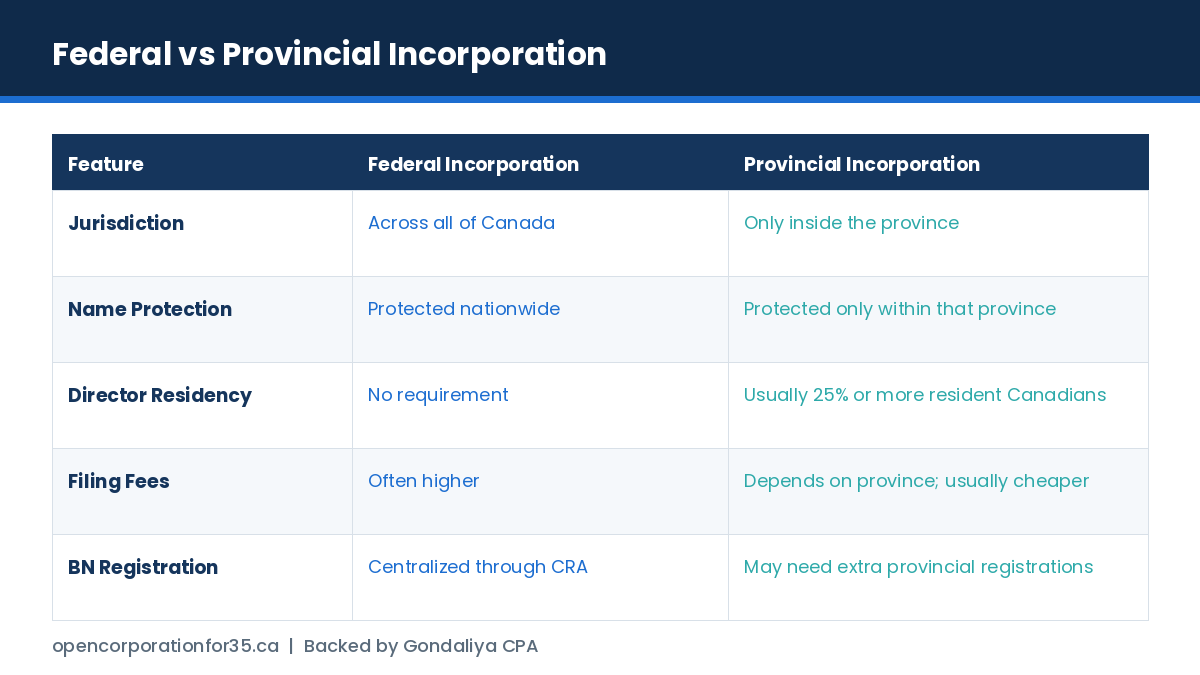
| Feature | Federal Incorporation | Provincial Incorporation (Ontario/BC/Alberta) |
|---|---|---|
| Jurisdiction | Across all of Canada | Only inside the province |
| Name Protection | Protected nationwide | Protected only within that province |
| Director Residency Requirement | No requirement | Usually 25% or more directors must be resident Canadians |
| Filing Fees | Often higher | Depends on the province; usually cheaper |
| Business Number Registration | Centralized through CRA | May need extra provincial registrations |
For example, if you incorporate in Ontario, you get a federal BN plus other numbers for Ontario taxes. Knowing these differences helps avoid surprises later.
Canada Business Number Registration Requirements for Foreign Companies
Canada Business Number Registration Requirements for Foreign Companies
Requirements
You must register for a CRA business number when you start doing taxable activities like selling goods with GST/HST or running payroll—even if you’re outside Canada.
| Requirement | Details & Considerations |
|---|---|
| Form RC1 Request for Business Number | The official form you file electronically |
| Program Accounts | GST/HST account if selling taxable goods or services |
| Corporate Tax ID | Given once your BN is approved |
| Temporary SIN & BN | Sometimes available during setup |
You fill out corporate details like your legal name, address (can be an agent’s), fiscal year-end, type of business, and contact info. After approval—which takes a few days—you get a nine-digit BN used for income tax, payroll deductions, and other programs.
CRA’s website offers clear guides under “government business services canada” with steps tailored to foreign businesses setting up their tax accounts remotely.
The Business Number Registration Process
The Business Number Registration Process
Process
If you’re a non-resident corporation doing business in Canada, you need a CRA business number (BN). This nine-digit number helps you deal with the Canada Revenue Agency (CRA) for taxes and other rules. It covers things like corporate income tax, GST/HST, payroll deductions, and more.
To get a BN, you must give info about your company. This includes your legal name, address (even if it’s outside Canada), and details about your directors or officers. You don’t have to be a Canadian permanent resident to register. But you do need to provide valid ID and contact info.
You can register your BN online using the CRA’s Business Registration Online service. Or you can send your application by mail or fax with Form RC1. Sometimes, a temporary Social Insurance Number (SIN) is issued too if individuals in your company need it for payroll.
The CRA incorporation number is just another name for the BN. It’s your main ID for all federal programs. The corporation BN Canada process makes sure you follow the rules while managing your taxes from outside Canada.
Step-by-Step Corporation BN Canada Process for Foreign Businesses
Step-by-Step Corporation BN Canada Process for Foreign Businesses
Step by Step
Here’s how foreign businesses register for a corporation BN in Canada:
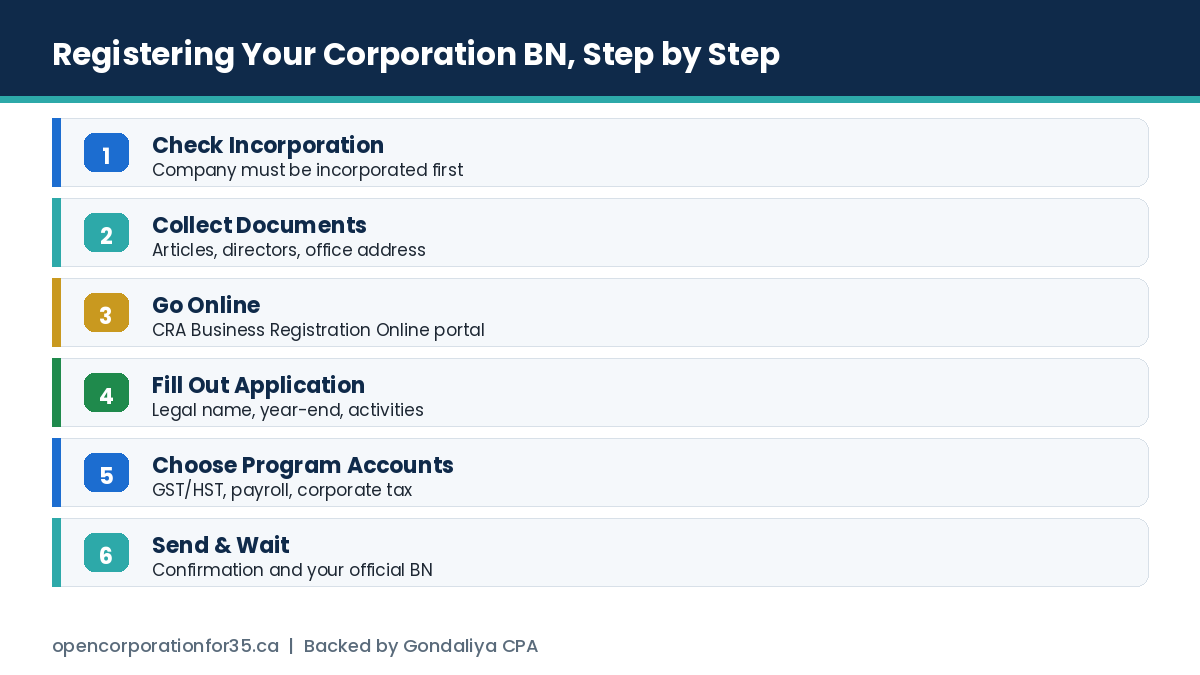
- Check Incorporation
Make sure your company is incorporated in Canada either federally or provincially before applying. - Collect Documents
Get articles of incorporation, director/officer info, registered office address (can be outside CA), and contact details ready. - Go Online
Use the CRA’s Business Registration Online portal to apply remotely without Canadian residency. - Fill Out Application
Enter your legal name, fiscal year-end, types of activities in Canada, and other required info correctly. - Choose Program Accounts
Pick accounts like GST/HST or payroll deductions depending on what your business will do in Canada. - Send & Wait
Submit online or by mail/fax with Form RC1. You’ll get confirmation and your official BN in a few days or weeks based on method used.
This way helps non-residents get into the Canadian market legally and smoothly from anywhere.
Step five is where time gets lost. Choosing the program accounts during the initial registration takes minutes. Adding one afterwards means a separate request and another wait.
How to Get a CRA BN from Abroad: Remote Setup Options
How to Get a CRA BN from Abroad: Remote Setup Options
Remote
You don’t have to be in Canada to get a CRA BN. No permanent resident status needed! Here are some remote setup choices:
- Online Application: Fastest way. Submit right through government websites.
- Mail or Fax With Form RC1: Good if you need to send extra documents; slower processing.
- Using Agents: Some third-party services help non-residents with accurate and timely filing.
Remote incorporation lets global businesses set up Canadian entities while staying wherever they want.
Registering CRA Program Accounts for Non-Resident Corporations
Registering CRA Program Accounts for Non-Resident Corporations
Accounts
After getting your business number as a non-resident corporation, you’ll want these program accounts:
- GST/HST Account: Needed if you expect over $30,000 CAD yearly taxable sales. This lets you collect sales taxes.
- Payroll Deductions Account: Required if hiring employees working inside Canada. Covers income tax withholding plus CPP/EI.
- Corporation Income Tax Account: Links automatically with your main BN. Use it when filing corporate tax returns showing taxable income earned here.
Each account needs activation during registration or later through My Business Account.
Core CRA Account Setup for Online Registration (GST/HST, Payroll, Corporation Income Tax)
Core CRA Account Setup for Online Registration (GST/HST, Payroll, Corporation Income Tax)
Core Accounts
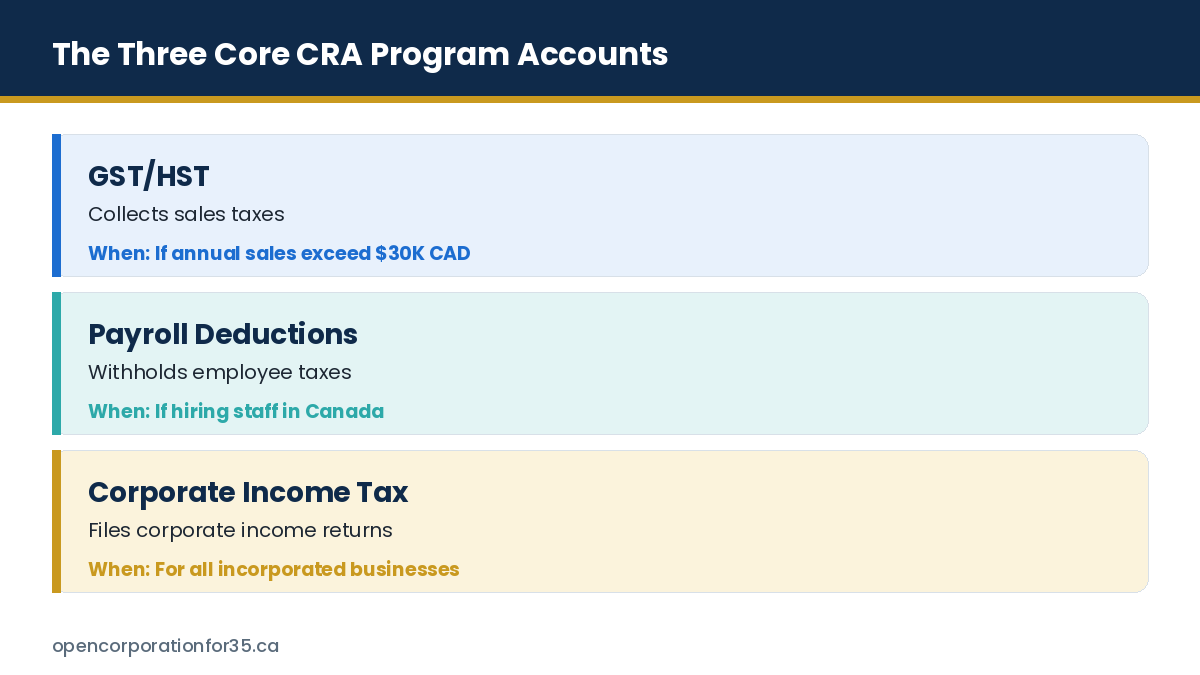
| Program Account | What It Does | When You Need It |
|---|---|---|
| GST/HST | Collects sales taxes | If annual sales exceed $30K CAD |
| Payroll Deductions | Withholds employee taxes | If hiring staff in Canada |
| Corporate Income Tax | Files corporate income returns | For all incorporated businesses |
During registration:
- Choose accounts based on what you’ll do
- Give financial estimates when asked
- Confirm who will handle filings
This saves problems later from missing registrations.
Specialized Program Accounts Requiring Separate Registration (Import/Export Excise Tax Digital Services Tax)
Specialized Program Accounts Requiring Separate Registration (Import/Export Excise Tax Digital Services Tax)
Specialized
Some activities need special program accounts beyond basics:
- Import/Export Account: For trading goods across borders that need customs paperwork.
- Excise Duty Account: If dealing with products like alcohol or tobacco that have excise taxes.
- Digital Services Tax (DST): Applies since 2024 for foreign digital service providers who pass revenue limits offering services remotely into Canada.
These require separate applications after getting your main BN.
Important Considerations for Underused Housing Tax (UHT) and Global Minimum Tax (GMT)
Important Considerations for Underused Housing Tax (UHT) and Global Minimum Tax (GMT)
UHT & GMT
If non-resident corporations own residential property in Canada, watch out for these new taxes:
- The Underused Housing Tax (UHT) targets vacant homes held by non-residents starting 2023.
- The Global Minimum Tax (GMT) aims at large multinational companies’ minimum tax rates worldwide, including Canadian subsidiaries.
Knowing these rules helps avoid surprise charges when running businesses remotely here.
Risk Warning: The Underused Housing Tax carries a filing obligation even where no tax is payable, and the penalty for a late return applies to a nil filing. Non-resident corporations holding Canadian residential property should treat it as a separate annual deadline.
CRA Business Registration Online vs Mail/Fax for Non‑Residents
CRA Business Registration Online vs Mail/Fax for Non‑Residents
Online vs Mail
Non-resident companies can register two ways:
Online Benefits:
- Faster — often same-day approval
- Instant email with assigned BN
- Upload supporting documents easily
Mail/Fax Using Form RC1:
- Needed when original signed documents are required
- Takes longer because it’s manual processing
- Good if dealing with complex cases involving many jurisdictions
Pick based on how fast you want it versus what paperwork is needed.
Online is right for almost every case we handle. The mail route is worth it only where a bank or a registry has specifically asked for a signed paper trail, which is rarer than people expect.
Using the Non‑Resident Business Registration Online Form for Foreign Companies
Using the Non‑Resident Business Registration Online Form for Foreign Companies
Online Form
Canada’s online form helps create a full business profile easily. You enter:
- Legal names exactly as on incorporation papers
- Codes describing what business activities happen inside Canada—even if run overseas
This cuts down errors new registrants make and links directly to GST/HST sign-up once info passes checks.
Mail or Fax Registration With Form RC1 When To Use This Method
Mail or Fax Registration With Form RC1 When To Use This Method
Form RC1
Form RC1 (“Request For Business Number”) is handy when electronic filing isn’t enough:
- Complex ownership needing notarized signatures
- Cases where banks want paper proof
- Multi-account activations needing attachments
Usually:
| Situation | What To Do |
| Simple sole proprietorship | Use online portal |
| Complex ownership/multi signatories | Mail/fax Form RC1 |
Always check current CRA rules before sending forms since policies may change now and then.
Costs Associated with Registering a Non-Resident Corporation in Canada
Costs Associated with Registering a Non-Resident Corporation in Canada
Costs
Registering a non-resident corporation in Canada comes with some costs you should know about. These costs fall into three groups: government fees, service fees, and ongoing costs.
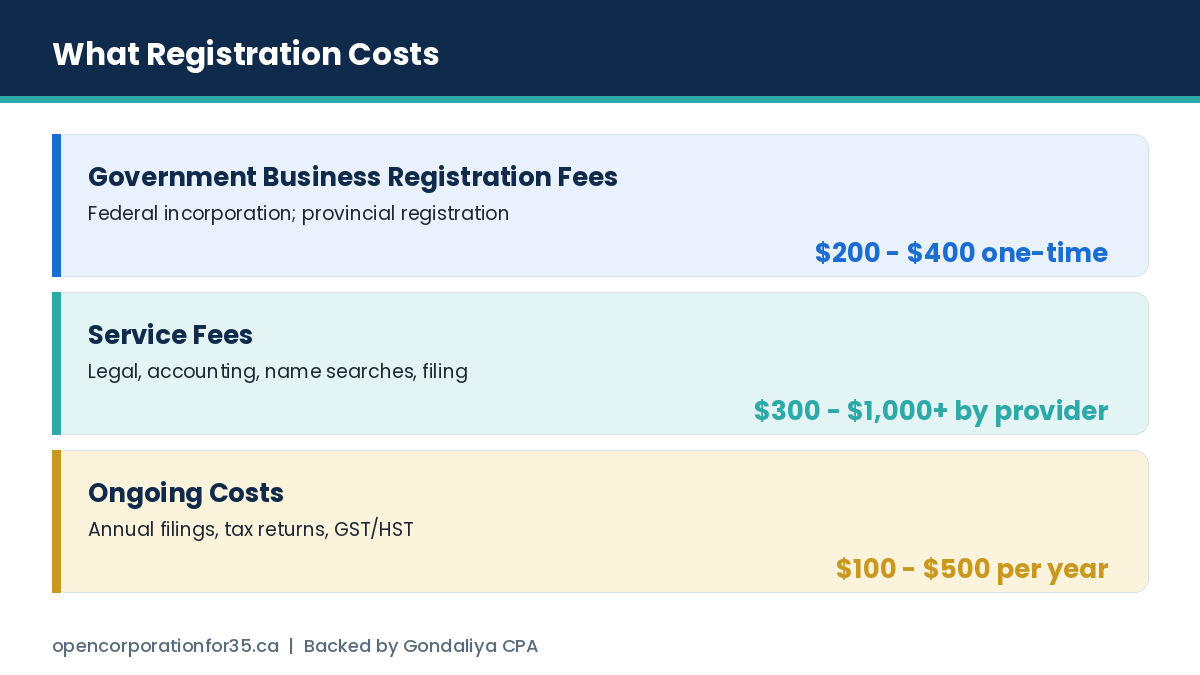
| Type of Cost | Examples | Estimated Fees (CAD) |
|---|---|---|
| Government Business Registration Fees | Federal incorporation fee; provincial registration fees (if needed) | $200–$400 one-time |
| Service Fees | Legal help; accounting; name searches; filing support | $300–$1,000+ varies by provider |
| Ongoing Costs | Annual filings; tax returns; GST/HST payments | $100–$500 per year |
Government Business Registration Fees
The biggest cost is government business registration fees. Usually, federal incorporation costs about $200 CAD. If you also register provincially, expect extra fees. These charges vary by province and are required.
Service Fees
Many non-residents hire pros to handle tricky steps. Services include NUANS name searches and filing paperwork online. These fees can add up but help avoid errors.
Ongoing Costs
Once registered, your company will have ongoing costs like yearly returns and tax filings for GST/HST and payroll. You should plan to spend about $100 to $500 each year for these.
Avoiding Common Mistakes in Non-Resident Business Registration
Avoiding Common Mistakes in Non-Resident Business Registration
Mistakes
Registering a business as a non-resident can be tricky. Many make mistakes that slow down or block approval.
Frequent Errors for Non-Residents
Watch Out
- Using an address not accepted by Canadian rules.
- Confusing federal and provincial incorporation options.
- Missing important documents like director consent forms.
- Not setting up CRA accounts on time, risking penalties.
- Assuming nominee directors are always needed without checking.
Strategies to Avoid Them
Fixes
Here’s how to avoid common mistakes non-resident business registration:
- Double-check your address meets government standards.
- Pick federal or provincial incorporation based on where you plan to work.
- Gather all required documents before you apply.
- Set up CRA tax accounts right after you get your BN number.
- Talk to experts if you’re unsure about nominee director rules.
The address is the single most common rejection we see. A registered office has to be a real street address in the jurisdiction of incorporation, and a post office box will not clear the check.
Understanding Non-Resident Tax Account Canada Setup
Understanding Non-Resident Tax Account Canada Setup
Tax Accounts
If you own a foreign company in Canada, you must set up certain tax accounts with the CRA right away.
Corporate Income Tax Obligations for Foreign-Owned Companies
All companies in Canada pay corporation income tax on income made inside Canada. Setting up a corporate tax account helps report and pay these taxes through the CRA.
GST/HST Registration Requirements
If your sales inside Canada go over CAD 30,000 in a year, you need to register for GST/HST. This applies even if you live outside Canada since the rule depends on sales inside the country.
Payroll Deductions Responsibilities
If your company hires workers in Canada, it must open a payroll deductions account with the CRA. This allows your business to withhold income tax and contributions like EI and CPP from employees’ paychecks.
Getting these CRA tax accounts set up quickly helps avoid fines and keeps your foreign-owned Canadian corporation compliant.
Get your BN and program accounts opened together
Incorporation, CRA Business Number, and the GST/HST, payroll and corporate tax accounts set up in one pass, entirely remotely. Please book a free consultation.
Benefits of Obtaining a CRA Business Number as a Foreign Company in Canada
Benefits of Obtaining a CRA Business Number as a Foreign Company in Canada
Benefits
- Legal Recognition: Your company gains official status recognized by Canadian governments at all levels.
- Simplified Compliance: One BN covers different tax programs like corporate income tax, GST/HST, and payroll deductions. This makes dealing with authorities easier.
- Access To Banking & Financial Services: Banks often require a BN before opening accounts for foreign companies operating remotely.
- Enhanced Credibility: It shows customers and suppliers that your business follows Canadian rules.
What Happens After You Register Your Business Number?
What Happens After You Register Your Business Number?
Next Steps
Navigating Canadian Banking For Non‑Resident Corporations
Opening bank accounts can be tough due to strict rules against money laundering. Some banks require visiting branches in person even though remote setups exist online. Banks ask for detailed documents proving ownership plus ID checks designed to protect privacy while meeting compliance.
Maintaining Your CRA Business Profile Setup And Compliance
You must keep your CRA business profile updated. Report changes like new owners or contact info fast through official channels. This helps avoid legal or operational trouble over time.
Seeking Professional Assistance And Confirming With Government Authorities
The whole process—from applying to staying compliant—can get complicated. It’s smart to get advice from pros who know international incorporations well. Also, confirm details on government websites or offices since no guarantees exist for approvals, fees, banking access, or taxes beyond this information.
Benefits of Obtaining a CRA Business Number as a Foreign Company in Canada
Benefits of Obtaining a CRA Business Number as a Foreign Company in Canada
Benefits in Detail
Getting a CRA business number non resident Canada matters if you’re a foreign company wanting to do business here. This number, also called the Canadian corporation number or business identification number, is your key ID with the Canadian government.
It lets you sign up for important tax accounts like GST/HST, payroll, and corporate income tax. Without it, you can’t meet your Canadian tax obligations for non-resident corporations properly. The CRA uses this number to track your tax info and communications.
Registering your foreign company in Canada means the government recognizes your business officially. It also helps you work with suppliers and customers who want proof you’re following rules.
Having this number makes opening a bank account easier for companies outside Canada. It helps set up a non-resident GST account so you can collect and pay taxes the right way.
In short, getting a CRA business number offers:
- Legal recognition under Canadian federal rules
- Access to tax registrations like corporate income tax and payroll
- Easier banking for foreign businesses
- Assurance that you’re following Canadian tax reporting
These points help keep your operations running smooth without risking penalties or issues with taxes.
What Happens After You Register Your Business Number
What Happens After You Register Your Business Number
Next Steps in Detail
After you finish your foreign company registration Canada, some key things happen to keep your business in good standing.
Nominee Directors in Canada
Some provinces want at least one director who lives in Canada. Though not always needed federally, many non-residents choose nominee directors to handle local requirements or privacy concerns. Just make sure it fits provincial laws.
Business Number Maintenance
You must update your BN when things change—like addresses or adding new accounts such as payroll. Keeping info current avoids fines and missed messages from the CRA.
CRA Business Profile Setup Canada
Setting up your full CRA profile online lets you file taxes electronically and manage payments without going anywhere physically. This step is great when you’re managing things from abroad.
Ongoing Costs & Compliance Requirements Non-Resident Corporations
Non-resident companies face yearly fees like filing returns federally or provincially, paying accountants if needed, and handling audits or cross-border tax checks.
You need to meet all deadlines from the CRA and any provinces where you do business to avoid trouble down the road.
Navigating Canadian Banking for Non-Resident Corporations
Opening a business bank account Canada non-resident isn’t always simple but it’s necessary after getting your BN. Banks ask for:
- Incorporation documents tied to your BN
- ID that meets anti-money laundering rules
- Clear details about who owns the company since banks watch foreign owners carefully
Some banks offer services made for international clients but might require you show up in person before opening an account.
Knowing these rules early helps avoid money flow problems when you start operating here.
Maintaining Your CRA Business Profile Setup and Compliance
Foreign-owned companies must follow Canadian corporate rules even if run remotely:
- File annual reports with accurate info on directors and shareholders
- Submit corporate income tax returns on time as required by CRA
- Keep detailed records showing income and expenses linked to your BN
- Watch law changes affecting foreign businesses—they happen often
- Reply quickly if government auditors ask questions after reviews
Missing these can lead to fines or freezes on your accounts, which hurt both money access and reputation.
Seeking Professional Assistance and Confirming with Government Authorities (Disclaimer)
Because international business registration is tricky — especially differences between federal vs provincial setups — it’s smart to get professional advice before moving forward.
Check with official government sources about:
- Current registration rules
- Eligibility based on location
- Changes in policies about taxes or non-resident status
This info doesn’t guarantee approval nor cover every case, including fees or bank decisions made by others involved.
For exact guidance matching official laws, talk to licensed experts and contact government offices that handle corporate registrations directly.
Banking is the step that catches foreign owners out, not the BN. The number itself arrives quickly. Getting a Canadian bank to open an account for a company whose owners are all abroad takes considerably longer.
Frequently Asked Questions for Opening a Corporation in Canada as a Non-Resident
Frequently Asked Questions for Opening a Corporation in Canada as a Non-Resident
FAQ
Is a Social Insurance Number (SIN) Required for Non-Resident BN Registration?+
You don’t usually need a valid Social Insurance Number (SIN) to register a CRA business number (BN) if you’re a non-resident corporation. But if an individual acts for the company and deals with the CRA, having a SIN can make things easier.
Some non-residents get temporary SINs that start with 9 or 0. These happen under special cases like work or study permits. These temp SINs don’t stop you from registering your BN but must be valid if used during the process.
If you don’t have any SIN, that’s okay — your company can still get a BN. You’ll just need other ID documents about the corporation. It’s smart to check the latest rules with government offices before starting.
What is the Corporation BN Canada Process Timeline?+
Getting your Canadian Business Number after incorporation takes different times depending on how you apply:
- Online: Usually done in 1–3 business days.
- Phone or Mail: Can take up to two weeks since someone handles it manually.
- Federal vs Provincial: Federal incorporations often get BNs faster because they use one central office.
If you send all paperwork right, expect your CRA business number within about a week. Sometimes, delays happen if they need to check more info.
How Does Remote Setup for a Canadian Company Work for Non-Residents?+
You can set up a Canadian company without going there physically if you’re a non-resident. Here’s how it works:
- Pick federal or provincial incorporation based on what fits your business.
- Search company names online to see what’s available.
- Submit incorporation papers electronically via official portals or authorized providers.
- Register for CRA accounts, including your Business Number, online or by phone.
- Name directors who follow legal rules; sometimes nominee directors help where allowed.
Remote setup cuts travel costs and helps keep everything legal while working from outside Canada.
What is the Role of a Nominee Director in Canada?+
A nominee director is someone chosen to act as director when owners want privacy or aren’t residents where needed.
- Not needed federally but some provinces like Ontario require at least one resident director.
- They have the same legal duties as normal directors.
- They help foreign owners meet local rules without living there themselves.
Be careful when choosing nominees — make sure you have clear agreements about their role and risks since they act officially for your company.
What are the Tax Implications for a Non-Resident Corporation in Canada?+
Non-resident corporations in Canada face some tax duties:
- File annual income tax returns that show all income from Canadian activities.
- Pay federal corporate tax plus any provincial taxes where registered or operating.
- Register GST/HST accounts if sales go over $30,000 CAD yearly in provinces that charge it.
To register taxes, use your CRA Business Number tied to programs like GST/HST and payroll if needed.
Knowing these rules early avoids fines and keeps things smooth with the CRA.
How to Address Banking Requirements as a Non-Resident Business Owner?+
Opening bank accounts in Canada from outside is tricky but possible:
- Find banks used to working with non-resident clients who offer international services.
- Get ready with documents like incorporation certificates, CRA BN letters, ID/passports, sometimes credit info.
- Some banks want you in person; others let you open accounts via video calls plus mailed notarized papers depending on their rules.
Starting banking early helps pay bills and handle payroll connected to GST/HST under your BN account.
What are the Key Documents Needed for Non‑Resident CRA Business Number Registration?+
| Document | Why You Need It |
|---|---|
| Certificate/Articles of Incorporation | Proof company legally exists |
| Completed Form RC1 | Official form asking for BN |
| Valid Government-issued ID | Shows who is applying |
| Name Search Report | Confirms business name is unique |
| Corporate Resolution Authorizing Application | Shows applicant has authority |
Use CRA’s online portal once these are ready; it speeds things up if done right according to their checklist.
Can I Register A GST/HST Account As A Foreign Owner Operating A Canadian Business?+
Yes, foreign owners with taxable Canadian businesses must register GST/HST accounts once revenue passes $30,000 CAD over four quarters in provinces like Ontario or BC.
Keep in mind:
- Filing rules depend on how much money you make
- Payroll BNs connect back into main BNs for easy reports
- Late registration may cause audits or penalties
Register soon after checking if what you sell counts as taxable under CRA rules.
What is a Business Identification Number (BIN) in Canada For Foreign Entities?+
In Canada, “Business Identification Number” means the same as “Business Number” from CRA—a unique nine-digit code given when you register your business. It tracks taxes like GST/HST and payroll deductions.
Foreign businesses get BINs formatted just like local ones so they fit into Canada’s tax system easily.
For questions on BINs call Canada Revenue Agency.
Are There Ongoing Compliance Requirements For A Non Resident Business After BN Registration?+
Yes—non-resident corporations must keep up with rules such as:
- Filing annual returns with ownership updates and financial reports per jurisdiction
- Paying taxes on time—corporate income tax, GST-HST, payroll contributions
- Keeping good records ready if audited
Missing deadlines can lead to penalties and hurt future dealings with banks or government offices.
Check governance laws regularly especially those aimed at foreign-owned companies throughout your business life here.
How Do Federal And Provincial Incorporations Differ In Practice For No Residents?+
| Aspect | Federal Incorporation | Provincial Incorporation |
|---|---|---|
| Where It Works | Across all provinces | Mostly inside registering province |
| Name Rights | Protected nationwide | Protected locally |
| Residency Rules | Usually none federally | Some provinces require resident directors* |
| Fees | Often higher | Usually lower |
*Example: Ontario needs at least one director living there while Alberta doesn’t require this. Choose based on where you’ll do most business and costs.
What If I Have A Temporary Sin Starting With 9 For Cra Business Registration?+
Temporary SINs starting with “9” are for people allowed limited stays like workers or students—not permanent residents.
For CRA registrations:
- Holders can act individually though this does not change corporate application criteria
- Make sure all forms match your current valid documents so no delays happen
Always check Service Canada guidance before proceeding because policies around temporary SINs may change.
What Is The CA Company Tax Id For A Foreign Owner?+
The main tax ID used by foreign owners running Canadian companies is their CRA Business Number along with program IDs like:
- GST/HST account numbers
- Payroll account numbers
This system makes filing taxes easier between businesses and government offices when handling cross-border issues.
Keep copies safe and talk with accountants familiar with international tax matters.
Can I Register A Corporate BN In Ontario As A No Resident?+
Yes—you can get corporate BNs after incorporating either directly through Ontario government websites or federally then extra-provincially registered in Ontario later.
Ontario wants at least one resident director but doesn’t stop non-residents from owning shares or getting BNs as long as filings are done properly.
Article Summary: Securing Your CRA Business Number as a Foreign Company
Article Summary: Securing Your CRA Business Number as a Foreign Company
Summary
Registering your Canadian business number lets you access several federal programs like GST/HST and payroll even when running things abroad without being permanent residents.
Careful steps cut risks tied to delays or banking troubles while keeping compliance easier during operations regulated under Canada’s rules for foreign businesses.
FAQs on CRA Business Number for Non-Resident Corporations in Canada
FAQs on CRA Business Number for Non-Resident Corporations in Canada
More FAQ
What is Form RC1, and how do I use it to apply for a Canada Business Number?+
Form RC1 is the official request form to apply for a CRA business number. You must complete and submit it online, by mail, or fax to register your non-resident corporation with the CRA.
How can I maintain my CRA business number after registration?+
You should update your business information promptly, including address or ownership changes. Regularly renew registrations and file required tax returns to keep your BN active.
Is a Social Insurance Number (SIN) linked to obtaining a CRA business number?+
A SIN is not required for registering a BN. However, having a valid SIN helps if individuals in your corporation interact directly with the CRA for payroll or tax purposes.
How do GST/HST and payroll accounts work for foreign owners in Canada?+
Foreign owners must register separate GST/HST and payroll program accounts linked to their main BN if they exceed sales thresholds or hire employees in Canada.
What is the difference between federal and provincial corporate BN registration in Ontario?+
Federal registration covers all provinces with no residency director rules. Ontario’s provincial registration requires at least one resident director and involves additional filings.
How do I set up my CRA business profile online in Canada as a non-resident?+
Use the CRA’s Business Registration Online portal to create and manage your business profile. This platform lets you file returns, pay taxes, and update information remotely.
What costs should I expect during non-resident corporate BN registration?+
Expect government fees between $200-$400, plus service charges from $300 upward for legal or agent support. Annual compliance costs range from $100 to $500.
Can I open a Canadian bank account as a non-resident after getting my BN?+
Yes, but banks require proof of incorporation, CRA BN documents, valid ID, and may request an in-person visit or notarized paperwork due to compliance rules.
Essential Points on Non-Resident Corporation Registration & Compliance
Checklist
- Business Number Application: Use Form RC1 or online portals to submit applications for your Canadian BN efficiently.
- CRA Contact: Reach out via official phone lines or websites for urgent help or clarifications.
- Tax Account Setup: Register necessary program accounts such as GST/HST and payroll based on your Canadian activities.
- No Permanent Residency Required: Non-residents can complete all registration steps remotely without needing PR status.
- Ownership & Directors: Ensure compliance with nominee director requirements depending on federal or provincial jurisdiction.
- Federal vs Provincial Differences: Choose incorporation type considering fees, residency rules, and operational reach.
- Ongoing Compliance: Stay current with filings, payments, and business information updates to avoid penalties.
- Digital Services Tax Suspension: Keep informed on current DST regulations affecting foreign digital businesses operating in Canada.
- Paper Forms Availability: Some complex cases require submitting paper forms like Form RC1 by mail or fax.
- Maintain Privacy: Use nominee directors or virtual office addresses where allowed to protect personal data.
- Cost-Effective Solutions: Consider using services like Open Corporation for streamlined registration at low cost.
- Important Documents Required: Have incorporation certificates, completed forms, valid IDs, and resolutions ready before applying.
- Banking Needs: Prepare detailed documentation to meet anti-money laundering checks when opening Canadian bank accounts.
- Tax Filing Deadlines: Adhere strictly to federal and provincial corporate tax deadlines specific to non-resident corporations.
- Government Business Registration Fees: Budget properly for initial registration and annual renewal expenses.
- CRA Business Number Reactivation: Understand procedures if your BN becomes inactive due to missed filings or inactivity.
- Canada Post Mail Service Impact: Stay updated on postal disruptions affecting form deliveries or correspondence from CRA.
- Program Account Restrictions: Certain accounts may have eligibility limits; confirm before applying.
- Representative RepID Use: Appoint authorized representatives using RepIDs for managing your CRA accounts securely.
- Business Name Search Importance: Verify name availability before registering to avoid delays and rejections.
Appointing a representative with a RepID is the step most owners skip and later wish they had done. Without it, every CRA query has to route through the director personally, which is slow from another time zone.
Professional Guidance on the CRA Business Number: How Open Corporation For $35 Supports Foreign Companies
Professional Guidance and Quick Reference
Guidance
The Business Number itself is the easy part. What decides whether the first year runs smoothly is the order of operations: incorporate first, then register the BN with every program account you will actually need, then appoint a representative so the CRA can be dealt with from abroad.
Open Corporation For $35, backed by Gondaliya CPA, handles that whole chain in one pass, so the incorporation, the BN, the GST/HST and payroll accounts and the corporate tax account are all set up together rather than bolted on one at a time.
Everything is done remotely. No travel to Canada is required at any stage.
Quick Answers: Key Numbers & Concepts at a Glance
At a Glance
- BN length: Nine digits
- Online processing: One to three business days
- Mail or phone processing: Up to two weeks
- GST/HST threshold: $30,000 CAD in annual taxable sales
- Federal incorporation fee: About $200 CAD
- Government fees overall: $200 to $400 one-time
- Service fees: From $300 upward
- Ongoing annual costs: $100 to $500
- Registration form: Form RC1, or Business Registration Online
- SIN needed: No, not for the corporation itself
Who This Is For / Not For
Fit Check
- For: Foreign owners who have incorporated in Canada and now need a BN, companies about to hire or sell in Canada, businesses needing a Canadian bank account, and anyone adding a GST/HST or payroll account to an existing BN.
- Not For: Companies with no Canadian activity at all, and anyone who has not yet incorporated, since the corporation must exist before the BN can attach to it.
People Also Ask
Quick Answers
Can I get a BN before incorporating?+
No. The BN attaches to a legal entity, so the incorporation has to be completed first. That is why we handle both together.
Do I need a Canadian address for the BN?+
The mailing address can be outside Canada, but the registered office of the corporation must be a real street address in the jurisdiction of incorporation.
What if I do not reach the $30,000 GST/HST threshold?+
Registration is optional below the threshold, though voluntary registration lets you recover input tax credits on Canadian purchases. It is worth modelling before deciding.
Glossary of Key Terms
Plain-English Definitions
- Business Number (BN): The nine-digit CRA identifier every program account attaches to.
- Program account: A specific CRA account, such as GST/HST or payroll, added onto the BN.
- Form RC1: The Request for a Business Number form, used by mail or fax.
- Business Registration Online: The CRA portal for registering a BN electronically.
- My Business Account: The CRA portal for managing accounts and filings after registration.
- RepID: The identifier that lets an authorized representative deal with the CRA on your behalf.
- Nominee director: A director appointed to satisfy a residency requirement or preserve privacy.
- NUANS: The name search report confirming your proposed corporate name is available.
- Registered office: The official street address of the corporation in its jurisdiction.
- Extra-provincial registration: Registering a federally incorporated company to operate in a specific province.
Incorporate first, open every program account you will need in the same registration, use a real street address for the registered office, and appoint a representative with a RepID before you need one. Those four turn a multi-week back and forth into a few days.
CRA Business Number Readiness Check
This quick self-check flags which parts of your registration need attention. Please answer the six questions below.
CRA Business Number Readiness Check
Six quick questions on your setup. No fee quoted.
Points to review:
This is a general prompt, not tax or legal advice or a quote. Your position depends on your full facts, so for a real review please book a free consultation.
Want a checklist to work from? Please download our free CRA Business Number checklist before your consultation.
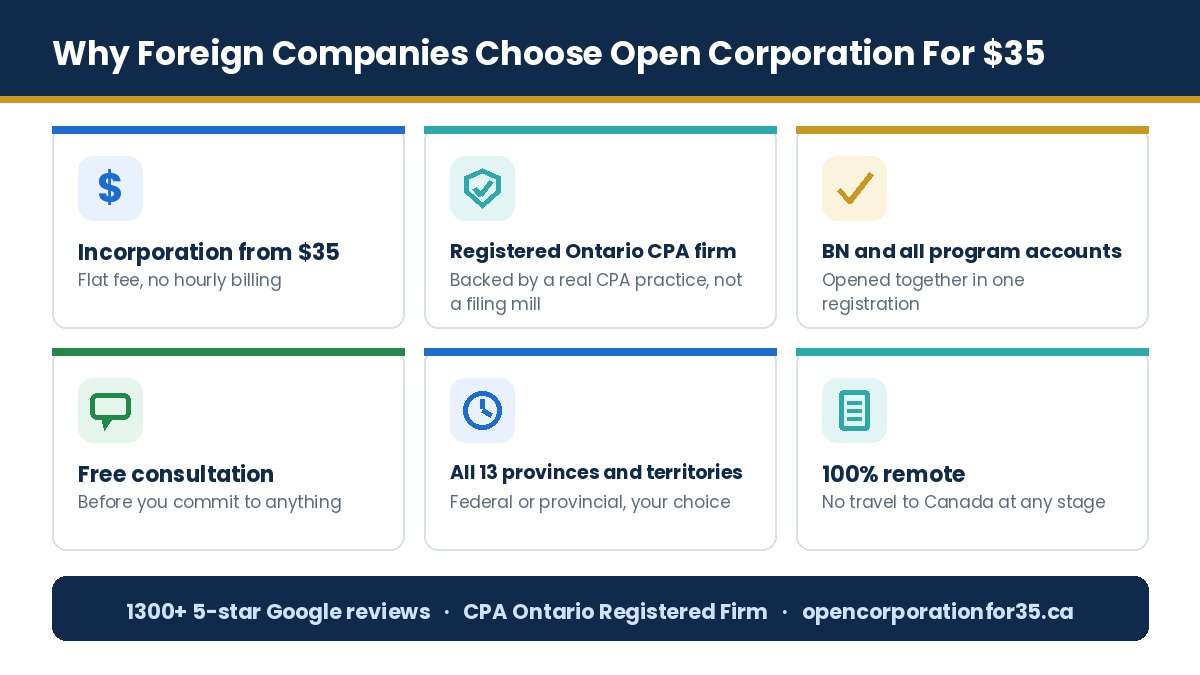
Get your CRA Business Number sorted
Incorporation, Business Number registration, and every program account you need, opened together and handled entirely remotely for non-resident owners. Please book a free consultation.
What to Send Us
Send us your certificate of incorporation, the province you incorporated in, whether you will be selling or hiring in Canada, and a contact address. We will confirm which program accounts you need and register them together with your BN.
Published: June 1, 2026 · Last updated: June 1, 2026
Editorial policy: Our content is prepared by our team and reviewed by Sharad Gondaliya, CPA, and we update it as CRA registration rules, fees and thresholds change.
Disclaimer: This article is educational information only and is not tax, legal, or financial advice. Fees, thresholds and processing times change, and outcomes depend on your specific facts. Please consult a CPA before acting.