
How to Open a Corporation in Canada as a Foreigner: Complete Guide for Non-Residents
Open corporation Canada foreigner options allow non residents to start business Canada non resident with ease by meeting CRA incorporation requirements and understanding foreign ownership tax rules. This includes managing Canada company registration non resident steps, non resident Canada tax obligations, and choosing between federal vs provincial incorporation.
Quick Summary
A foreigner can own and run a Canadian corporation without permanent residency and without living here. What shapes the setup is the jurisdiction you file in, whether anyone on the board lives in Canada, and whether you have a registered office address the registry will accept. Please note incorporation is separate from any immigration programme.
| Aspect | Details |
|---|---|
| The ownership | No permanent residency required. Foreign shareholders face no ownership cap in most sectors. |
| The structure | Corporation, partnership or limited partnership. Canada does not recognise the US-style LLC. |
| The filing | Articles of incorporation, then a Business Number and CRA program accounts. |
| The ongoing work | Annual returns with the registry and a T2 with the CRA, every year. |
Reading time: 26 minutes.
Table of Contents
- Understanding Non-Resident Business Ownership in Canada
- Choosing the Right Business Structure for Foreigners
- Corporation vs Partnership vs LLC: Options for Foreign Entrepreneurs
- Federal Incorporation vs Provincial Incorporation: Comparison and Benefits
- Extra-Provincial Registration for Foreign Businesses Expanding into Canada
- Requirements for Nominee Directors and Shareholders in Canadian Corporations
- Step-by-Step Process to Incorporate a Business as a Foreigner in Canada
- Overview of Federal and Provincial Corporate Tax Obligations
- GST/HST Registration and Filing Requirements for Foreign-Owned Businesses
- Understanding Canadian Tax Treaties and Double Taxation Exemption
- Filing Corporate Returns (T2) and Maintaining Financial Records
- Common Compliance Issues and Ongoing Reporting Requirements
- Legal Considerations and Business Operations for Non-Resident Owners
- Support Resources and Next Steps for Foreign Entrepreneurs
- Frequently Asked Questions
- Professional Guidance and Quick Reference
The Numbers That Matter
This article covers Canada, with Ontario and Toronto context, and assumes a foreign owner who wants to incorporate without permanent residency. Government fees, thresholds and residency rules are set by the registries and by the CRA, and they change. This is educational information only and not tax, legal, or financial advice. Please confirm your own position with a CPA before acting.
Understanding Non-Resident Business Ownership in Canada
Understanding Non-Resident Business Ownership in Canada
The Basics
What Does It Mean to Be a Non-Resident Business Owner in Canada
Being a non-resident business owner means you can set up and run a company in Canada without having permanent residency. Foreign entrepreneurs can start businesses if they meet certain rules.
To be eligible, you usually need to show plans for doing business in Canada. Important things include having a registered office address there and naming at least one director who lives in Canada or meets nominee director rules. These rules help keep Canadian corporate governance on track while letting foreigners own companies.
Overview of Canadian Business Structures Available to Non-Residents
If you’re a non-resident, you can pick from several business structures: corporations, partnerships, and LLCs. Each has its own pros and cons:
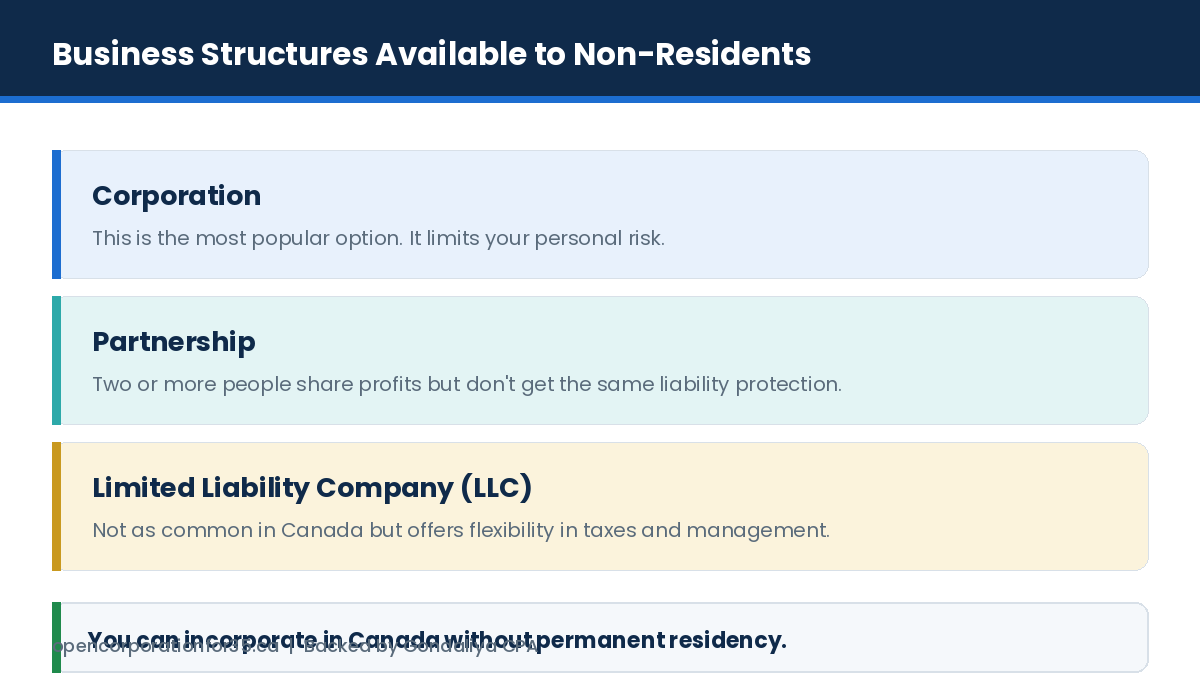
- Corporation: This is the most popular option. It limits your personal risk.
- Partnership: Two or more people share profits but don’t get the same liability protection.
- Limited Liability Company (LLC): Not as common in Canada but offers flexibility in taxes and management.
Foreign owners can choose any based on what fits their goals and how much risk they want to take.
Key Legal Definitions: Non-Resident, Foreign Owner, and Incorporation
It helps to understand these terms before you start:
- Non-Resident: Someone who doesn’t live permanently in Canada but wants to do business there.
- Foreign Owner: A person or group outside Canada who owns part or all of a Canadian company.
- Incorporation: The legal process of registering your business as its own entity under Canadian laws.
Knowing these helps with CRA incorporation requirements and makes sure your paperwork goes smoothly.
Impact of Residency Status on Business Registration and Operations
If you’re not a permanent resident, some things change when registering your business:
- You might face limits on certain industry licenses.
- Opening bank accounts could be tricky; some banks ask for proof of residency.
- You’ll likely need nominee directors because at least one director must live in Canada by law.
Starting a business remotely from abroad isn’t easy but it’s possible. You can reach Canada’s market without being physically present at first if you handle these details right.
The first question from almost every foreign founder is whether permanent residency is needed. It is not. Ownership and immigration are separate tracks, and treating them as one leads to plans built on a wrong footing.
Key Stat: There is no cap on foreign ownership of a Canadian corporation in most sectors. A non-resident can hold every share. The rule people mistake for an ownership limit applies to directors, and it varies by jurisdiction.
Choosing the Right Business Structure for Foreigners
Choosing the Right Business Structure for Foreigners
Structure
Picking the right business structure matters a lot when you’re a foreigner setting up in Canada. It shapes your taxes, who’s liable, how you run things, and what rules you must follow. Foreign ownership Canada company options vary. Different legal structures have pros and cons that non-residents should know about.
You’ll mostly see corporations, partnerships, or limited liability companies (LLCs). LLCs work great in the U.S., but Canada doesn’t fully recognize them. Instead, foreigners usually go with corporations or limited partnerships here.
American owners are the ones most often surprised here. They arrive expecting to form a Canadian LLC, and the conversation has to start with the fact that the format is not recognised the way it is at home.
Corporation vs Partnership vs LLC: Options for Foreign Entrepreneurs
Corporation vs Partnership vs LLC: Options for Foreign Entrepreneurs
Comparison
Corporations are popular among foreign entrepreneurs. They offer limited liability and make raising money easier. A standard Canadian corporation non-resident lets foreign shareholders own shares without living in Canada. But it must follow Canadian shareholder rules.
Partnerships come as general or limited types:
- A limited partnership Canada non-resident has at least one general partner managing the business and carrying full liability.
- Other partners have liability limited to what they invest.
- Watch Canadian business partnership rules because all partners could be on the hook if things aren’t set up right.
Canada doesn’t officially recognize LLCs like the U.S., but some provinces allow similar setups through extra-provincial registration or joint ventures acting like LLCs.
On taxes:
- Corporations pay corporation income tax Canada on their profits.
- Partnerships pass income straight to partners who report it on their returns.
Foreigners should note some provinces require resident directors but don’t usually limit how many foreign shareholders can hold shares.
Owners who arrive asking about a partnership almost always end up incorporating instead, and the reason is rarely tax. It is that Canadian banks and Canadian customers deal more readily with a corporation.
Federal Incorporation vs Provincial Incorporation: Comparison and Benefits
Federal Incorporation vs Provincial Incorporation: Comparison and Benefits
Jurisdiction
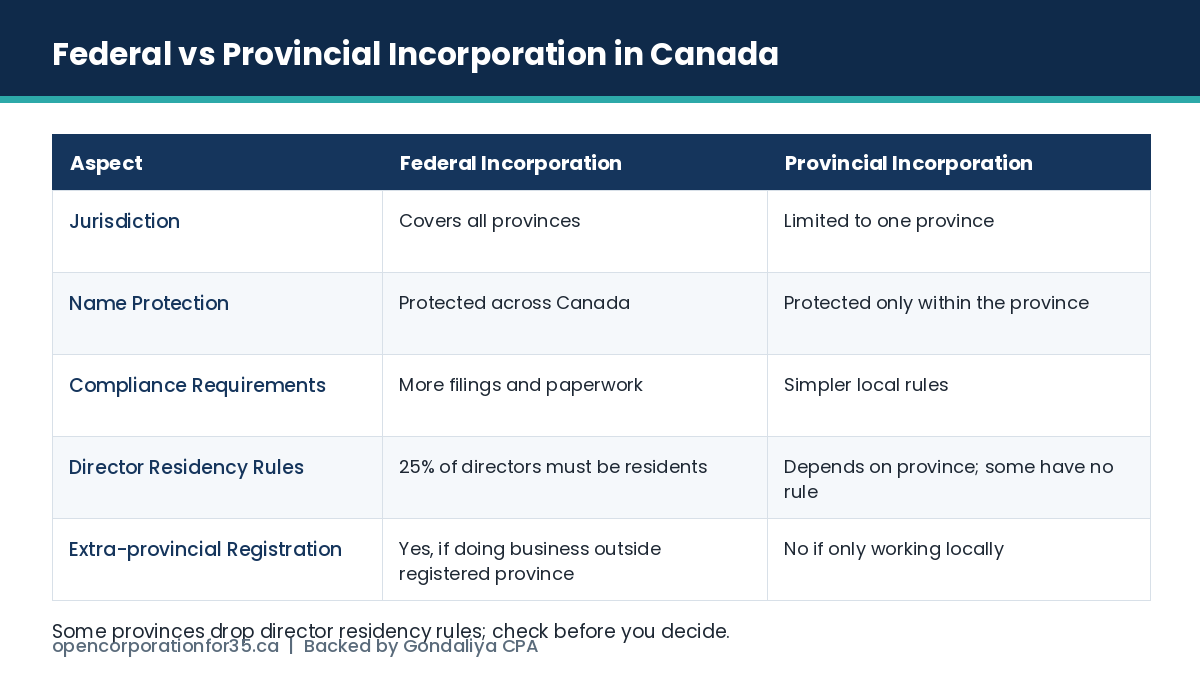
| Aspect | Federal Incorporation Canada | Provincial Incorporation Canada |
|---|---|---|
| Jurisdiction | Covers all provinces | Limited to one province |
| Name Protection | Protected across Canada | Protected only within the province |
| Compliance Requirements | More filings and paperwork | Simpler local rules |
| Director Residency Rules | 25% of directors must be residents* | Depends on province; some have no rule |
| Extra-provincial Registration Required? | Yes, if doing business outside registered province | No if only working locally |
*Some provinces drop director residency rules; check before you decide.
Federal incorporation helps if you want to work nationwide or plan to expand later. Provincial incorporation may cost less if you just want to stay local at first.
Founders reach for federal because it sounds bigger. The better question is where the first ten customers will be, and that single answer settles the jurisdiction faster than any comparison table.
Extra-Provincial Registration for Foreign Businesses Expanding into Canada
Extra-Provincial Registration for Foreign Businesses Expanding into Canada
Extra-Provincial
If your company is set up outside Canada but wants to do business inside, you probably need extra-provincial registration Canada. This lets your existing company operate legally in a new province without creating a new corporation.
Whether you own shares directly or through another company, this registration covers licensing and tax duties linked to branches or subsidiaries inside Canada.
For example:
- A U.S.-based company selling in Ontario registers extra-provincially there.
- Branch registration differs from starting a subsidiary because branches are part of your original company instead of separate entities.
The branch route looks simpler on paper and rarely is. Once activity in Canada is real, the reporting and the permanent establishment question arrive together, and a Canadian subsidiary is usually the cleaner structure.
Requirements for Nominee Directors and Shareholders in Canadian Corporations
Requirements for Nominee Directors and Shareholders in Canadian Corporations
Nominees
Canadian law sometimes says at least one director must live in certain areas depending on where you incorporated.
To fix this from afar:
- Many foreign owners pick nominee directors — people who officially represent shareholders but don’t run day-to-day stuff.
Nominee director requirements vary but usually include:
- Formal consent via signed papers
- Knowing basic duties under Canadian law
- Not just figureheads; they should perform simple governance tasks
Nominee shareholders can hold shares during setup phases too, but real ownership stays clear due to CRA rules against money laundering.
Knowing nominee director requirements keeps your company in good shape while letting non-residents manage things remotely.
This gives a basic look at picking legal structures made for foreigners starting companies in Canada without permanent residency. Always double-check official rules before moving forward since laws change often.
A nominee director is a real director with real statutory duties, not a name on a form. Founders who treat the arrangement casually are the ones renegotiating it later under pressure.
Step-by-Step Process to Incorporate a Business as a Foreigner in Canada
Step-by-Step Process to Incorporate a Business as a Foreigner in Canada
The Steps
Preparing Necessary Documentation for Incorporation
If you want to open corporation Canada foreigner style, you’ll need to gather some key documents first. Even if you don’t have PR, you can still incorporate Canada without PR by sending the right paperwork. Here’s what you usually need:
- Articles of Incorporation: This is the main document that says your company’s name, purpose, how shares are set up, and any limits.
- Business Registration Documents: These forms depend on whether you’re incorporating federally or provincially.
- Officer Roles Information: You must provide details about your company’s directors and officers. Some provinces ask for at least one director who lives in Canada. Federal incorporation doesn’t have this rule.
Having all this ready helps things move faster. But rules can change depending on where you register, so double-check with official sources.
Registering for a Business Number (BN) and CRA Program Accounts
Once your company is incorporated, you must register for a Business Number (BN) with the Canada Revenue Agency (CRA). The BN is your company’s tax ID for many programs.
Foreign owners should register their CRA business number foreign owner accounts to follow Canadian tax rules. Here are some main accounts linked to the BN:
- GST/HST Registration: Needed if your sales in Canada go over $30,000 CAD per year or if you choose to register voluntarily.
- Payroll Deductions Account: Required if you hire workers in Canada.
- Other tax accounts based on what your business does.
Registering early stops problems and keeps you legal from day one.
How to Complete Federal and Provincial Incorporation Applications
Deciding between federal vs provincial incorporation Canada depends on what kind of business you want:
| Aspect | Federal Incorporation | Provincial Incorporation |
|---|---|---|
| Jurisdiction | Covers whole country | Only valid in one province |
| Name Protection | Protects name across all provinces | Name protected just inside that province |
| Resident Director Rule | No Canadian resident director needed | Some provinces require one Canadian resident |
| Filing Fees | Usually costs more | Generally cheaper |
Federal incorporation benefits include wider name protection and simpler expansion across provinces without new registrations. To apply:
- Pick the jurisdiction that fits your needs.
- Fill out the right forms as per government instructions.
- Send in your application online or by mail with payment.
Check current rules before submitting because they change sometimes.
Setting Up a Canadian Business Address and Banking for Non-Residents
You must have a valid Canadian business address when registering—that’s called the registered office address Canada law needs for official mail.
Many non-residents use virtual office services. These give real physical addresses but let you work from anywhere.
Opening a corporate bank account in Canada foreign owners find tricky due to strict laws against money laundering. Still, big banks will often open accounts after checking your ID and incorporation papers.
Having a local address helps show clients or suppliers that you’re serious and meets legal needs too.
Timelines and Costs Involved in Incorporation Without Permanent Residency
If you don’t have permanent residency, incorporating usually takes about 1 to 4 weeks. This depends on whether you pick federal or provincial incorporation and how complete your paperwork is.
Here’s a rough idea of costs involved:
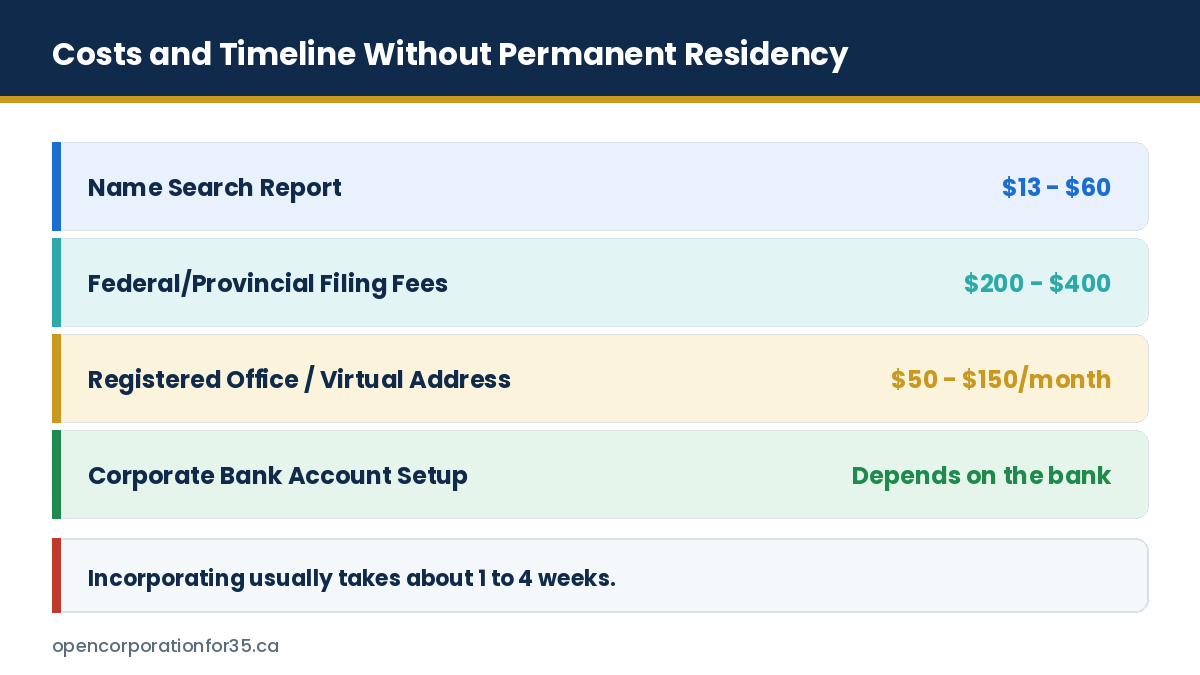
| Expense Type | Estimated Cost Range (CAD) |
|---|---|
| Name Search Report | $13 – $60 |
| Federal/Provincial Filing Fees | $200 – $400 |
| Registered Office / Virtual Address Services | $50 – $150/month |
| Corporate Bank Account Setup Fees | Depends on the bank |
Remember, extra costs like accounting or legal advice may come up if needed but aren’t required right away.
Disclaimer: Always check info directly from official government sites before moving forward because rules about non-resident incorporations can change anytime. This guide just gives basic info; no promises on approval times, fees staying the same, bank approvals, or taxes are made here.
Rejections almost never come from anything complicated. It is a passport scan cropped at the edge, a missing signature, or an address that does not match the proof supplied. Checking those three clears most of the risk.
Incorporate in Canada without permanent residency
Same-day federal or provincial incorporation, instant NUANS name search, a registered office address that meets registry rules, and CRA account setup, all backed by a CPA firm. Please book a free consultation.
Overview of Federal and Provincial Corporate Tax Obligations
Overview of Federal and Provincial Corporate Tax Obligations
Corporate Tax
If you want to open a corporation in Canada as a foreigner, you’ll need to know the tax rules. Canadian corporations pay corporation income tax on the money they make here. Foreign companies follow these rules too but also face extra steps for non-residents.
Federal incorporation lets you operate across Canada with one set of rules. That makes tax filing easier with the Canada Revenue Agency (CRA). Provincial incorporation means your company is registered in only one province. This can change your tax rates and what reports you must file.
For corporate governance, non-residents usually must have at least one director living in Canada if they incorporate provincially. Federal rules differ but sometimes allow nominee directors. You must follow both federal and provincial laws on annual filings, financial disclosures, and shareholder meetings.
Non-resident businesses should track where they do business carefully. Provincial taxes might apply based on where you work or have economic ties. Talking to Canadian legal or accounting experts helps avoid mistakes with these complex rules.
Key points:
- Corporation income tax applies to all Canadian companies
- Federal incorporation covers all provinces under one system
- Provincial incorporation limits business to that province
- Non-resident directors usually needed for provincial corporations
- Compliance includes filings, meetings, and disclosures
- Track business locations for provincial tax duties
Owners assume provincial tax follows the province they incorporated in. It follows where the business actually operates, which is a different question entirely and the one worth settling early.
GST/HST Registration and Filing Requirements for Foreign-Owned Businesses
GST/HST Registration and Filing Requirements for Foreign-Owned Businesses
GST/HST
Foreign-owned businesses in Canada must register for GST/HST if their taxable sales from Canadian sources pass CAD 30,000 yearly. This rule applies no matter where the owners live.
Once registered, businesses charge GST/HST on sales in participating provinces. They file returns with CRA regularly—quarterly or yearly depending on revenue size.
Even foreign companies without a permanent office may need GST/HST accounts. This is true if they sell digital goods or services used in Canada. If you don’t register when required, CRA can fine you and add interest on unpaid taxes.
Knowing the registration thresholds helps you avoid unnecessary paperwork while staying legal when sales grow.
Remember:
- Must register if taxable revenues exceed CAD 30,000
- File GST/HST returns regularly (usually quarterly or yearly)
- Collect GST/HST on sales in provinces that use it
- Digital services sold to Canadians may require registration
- Penalties apply for late or missing registration
Digital sellers are the ones caught out most often. A software or subscription business with no Canadian office can still cross the threshold, and the obligation follows the customer rather than the company.
Understanding Canadian Tax Treaties and Double Taxation Exemption
Understanding Canadian Tax Treaties and Double Taxation Exemption
Treaties
Canada has many tax treaties with other countries. These agreements stop double taxation for foreign businesses earning money here.
A mutual tax treaty decides which country gets to tax certain income—like business profits or dividends—to avoid taxing the same money twice.
To use treaty benefits, submit proof of your home country residency when filing taxes in Canada. This might lower withholding taxes or remove them altogether.
Treaties follow global standards like those from the OECD’s Model Tax Convention. Getting advice from experts can help avoid errors that raise your taxes unnecessarily when opening a corporation as a non-resident.
In short:
- Tax treaties prevent paying taxes twice
- Treaties decide taxing rights between countries
- Submit residency proof to claim treaty benefits
- Benefits can reduce or remove withholding taxes
Treaty relief is claimed, not granted automatically. Owners who assume the lower rate applies by default are the ones who find the full rate was withheld at source and now has to be recovered on a return.
Filing Corporate Returns (T2) and Maintaining Financial Records
Filing Corporate Returns (T2) and Maintaining Financial Records
T2 Returns
All Canadian corporations—including foreign-owned ones—must file a T2 corporate income tax return every year. It doesn’t matter if your business made money or lost it.
The T2 form shows income earned from Canadian activities plus allowed deductions based on whether you incorporated federally or provincially.
Keeping clear bookkeeping records helps prepare the T2 easily. It also readies you for CRA audits if they ask for proof later on.
Online filing through CRA’s portals is now standard and handy, especially if you manage your company remotely without a physical office here.
Professional bookkeeping is smart to avoid common problems like currency conversion errors or missing data. Many foreign owners find this helpful since cross-border transactions are common with US and Canada trade ties under agreements like NAFTA/USMCA.
Main takeaways:
- File T2 return annually regardless of profit/loss
- Report income and deductions by incorporation type
- Keep accurate financial records for audit readiness
- Use CRA online portals to file returns easily
- Consider professional bookkeeping for complex transactions
Currency handling is where cross-border books go wrong most often. Transactions recorded in a foreign currency without a consistent conversion policy create work at year end that nobody budgeted for.
Common Compliance Issues and Ongoing Reporting Requirements
Common Compliance Issues and Ongoing Reporting Requirements
Compliance
Many businesses face compliance risks without proper knowledge of ongoing obligations. Maintaining compliance means meeting all legal requirements linked to your company’s structure and officer roles like CEO or CFO in Canada.
Regular tasks include filing annual reports, holding meetings, updating shareholders, and keeping financial statements ready. Ignoring these can lead to penalties or loss of good standing with authorities.
Officers should understand their responsibilities clearly since laws apply equally whether owners are local or foreign residents.
Failing to meet reporting duties can hurt reputation and slow down operations significantly over time.
To keep things straight:
- Stay current with annual reports and financial disclosures
- Officers must know their duties inside out
- Regular meetings with shareholders are mandatory
- Missing deadlines invites fines and other issues
Following these basic rules helps keep your business legal and running smoothly while building trust with partners and regulators alike.
Risk Warning: A dormant corporation still files. Owners who pause a venture assume the filings pause with it, and the default notice goes to a registered office nobody is checking. That is how an idle company ends up struck from the register.
The corporations that stay in good standing are not the ones with the best records. They are the ones where a named person owns the deadline. Where nobody owns it, it is missed eventually.
Legal Considerations and Business Operations for Non-Resident Owners
Legal Considerations and Business Operations for Non-Resident Owners
Legal
Canadian Business Laws Applicable to Foreign-Owned Corporations
Foreigners can open corporation Canada foreigner without permanent residency. But they must follow Canadian business laws carefully. Foreign ownership rules Canada allow most sectors to have non-resident shareholders. Still, some fields like banking, telecom, or cultural businesses have limits or need government OK. Canadian corporate governance for non residents says you need at least one Canadian resident director in provinces like Ontario or British Columbia. Federal incorporations don’t have this rule.
Business compliance Canada means you must follow federal and provincial rules. This includes filing reports every year and having a registered office address where your company is incorporated. You also must keep up with tax reporting duties. Knowing these rules helps avoid fines or even shutting down your company.
Intellectual Property Protection and Legal Contracts for Foreign Businesses
Protecting intellectual property matters when you open corporation Canada foreigner. You should register trademarks, patents, or copyrights with the Canadian Intellectual Property Office (CIPO). This keeps your brand safe under the law. Getting business legal consultation Canada helps you understand your legal duties under corporate governance Canada standards.
Contracts must be written clearly with Canadian laws in mind for foreign-owned companies. Make sure contracts cover things like dispute settlement and say which courts handle problems—ideally Canadian ones. Also, follow consumer protection laws when needed.
Risks and Limitations of Operating a Corporation Without PR Status
You can incorporate Canada without PR status, but there are some limits. Some industries block non-permanent residents because of security or economic reasons. For example, real estate brokerage licenses often need permanent residency.
Permanent resident requirements Canada business get tougher when applying for certain permits or government contracts that prefer locals. Banks might be hard to work with if you don’t have PR status because they check immigration status carefully.
Non-resident owners may find it harder to get loans or credit from Canadian banks compared to people living here permanently.
Business Immigration Options Related to Start-Up Visa and Self-Employed Programs
Canada has business immigration pathways that connect owning a business to living here permanently. The start-up visa Canada program is for innovative entrepreneurs ready to grow their businesses here. To join, you need backing from special organizations that support your plan plus meet language and fund rules.
The self-employed program Canada suits people skilled in cultural work or farming, not typical corporations—but it might fit depending on your background.
These programs go beyond just starting a company; they can lead to permanent residence based on your entrepreneurial efforts inside Canada’s economy.
Practical Guidance for Managing Cross-Border Canada-US Business Activities
Cross border Canada US business needs care because tax systems and rules differ between countries. Cross-border taxation Canada US treaties help avoid double taxes by deciding how income splits based on residency rules from CRA and IRS.
Canadian cross-border taxation means you may need GST/HST accounts if sales pass certain levels in either country. Customs duties also matter if shipping goods physically across the border.
Keeping clear records of all deals helps with audits by both CRA and U.S authorities if needed — this cuts risk of penalties while running business in both countries.
Disclaimer: Always confirm current legal requirements directly from official government sources before proceeding.
The sector check is the one owners skip. Most industries are open to foreign ownership, but a licensed field such as brokerage or a regulated sector can stop a plan late, and it takes minutes to confirm at the start.
Support Resources and Next Steps for Foreign Entrepreneurs
Support Resources and Next Steps for Foreign Entrepreneurs
Support
Accessing Professional Legal and Accounting Assistance in Canada
If you want to open an account or start a business in Canada, getting legal and accounting help is key. Business legal assistance in Canada can guide you through rules about nominee director requirements and Canadian corporate governance. You might need an attorney in Canada to help with incorporation and shareholder agreements. Corporate bookkeeping Canada services keep your financial records tidy for tax filings. Some companies offer nominee director services if you can’t find local directors easily. Getting advice early helps you avoid mistakes and fines.
Tools and Services to Facilitate Remote Incorporation and Business Management
You can incorporate remotely without going to Canada. The online registration process lets you register online fast. Remote setup tools make things easier by letting you sign documents remotely. Mail forwarding services give you a business address, which the CRA often requires. These tools save time and let you manage your business from anywhere, without breaking any rules.
Contact Information for Government Resources and CRA Support
To know about CRA incorporation requirements Canada, check official government sites like Corporations Canada or your provincial registry. They tell you how to get a CRA business number foreign owner status, GST/HST registration, and what tax rules apply. Always confirm details with the government authority since rules can change. Use these trusted sources to avoid surprises.
Encouragement to Initiate Incorporation Process with Expert Consultation
Starting a company means knowing startup costs Canada incorporation fees upfront. You don’t need permanent residency but must meet eligibility criteria. Consulting experts helps with paperwork and understanding service availability. Experts can spot common errors before officials review your application.
Summary of Key Points and Recommendations for Starting a Business as a Foreigner in Canada
To start right, follow clear business incorporation steps and get all registrations like the BN done first. Maintain compliance by meeting legal obligations such as tax filings on time. Operate within Canadian laws, complete all reporting carefully, and ask professionals when unsure. Always check info with government authorities since this advice doesn’t cover every possible fee or guarantee approval.
Founders who bring an adviser in at the filing stage save money. Those who bring one in after the first missed deadline spend it. The difference is rarely the complexity of the structure, it is simply when the conversation happened.
Frequently Asked Questions
Frequently Asked Questions
FAQ
What forms must I file to incorporate a business as a foreigner in Canada?+
You need to file Articles of Incorporation and relevant business registration documents. Forms vary by federal or provincial jurisdiction.
How do I submit an incorporation application if I am outside Canada?+
You can submit online, by mail, or sometimes by fax. Check the registry’s accepted submission methods.
Do foreign-owned businesses need CRA program accounts?+
Yes, registering for GST/HST, payroll, or import-export accounts is required if your activities meet thresholds.
What if I am unable to register online for Canadian business incorporation?+
You may send applications by mail or fax. Contact the registry for alternative options.
Is a business number (BN) mandatory for foreigners forming a company in Canada?+
Yes, BN registration with CRA is essential for tax and program accounts.
How do I fill out incorporation forms correctly as a non-resident?+
Complete all sections accurately, especially director and shareholder info. Use official guides or professional help.
Can I avoid nominee director requirements when incorporating federally?+
Federal incorporation does not require Canadian resident directors but some provinces do.
What are the common compliance risks for foreign-owned Canadian corporations?+
Missing filings, incorrect tax payments, and ignoring director residency rules pose major risks.
When are filing deadlines for corporate returns and GST/HST submissions?+
T2 returns are due six months after fiscal year-end; GST/HST depends on reporting frequency.
Is service availability consistent for remote incorporation in Canada?+
Most government services offer online access but outages or maintenance downtime can occur occasionally.
Two questions dominate every enquiry from abroad: whether permanent residency is needed, and whether a Canadian director is required. The answers are no to residency, and it depends entirely on the jurisdiction you choose.
Essential Steps to Maintain Compliance as a Foreign Business in Canada
Compliance Checklist
- Understand your legal obligations under Canadian corporate governance.
- File annual reports and corporate tax returns on time.
- Keep accurate financial records and support documentation.
- Register all required CRA program accounts promptly.
- Ensure nominee directors meet legal standards if needed.
- Comply with GST/HST rules including registration and filing.
- Update registered office and contact information regularly.
- Monitor provincial vs federal compliance differences carefully.
- Be aware of session timeout during online application processes.
- Prepare to pay applicable fees including filing and registration charges.
- Hire qualified legal or accounting professionals when necessary.
- Use virtual office services to maintain a valid Canadian address if abroad.
- Track changes in business licensing requirements per province.
- Obtain necessary permits before conducting specific types of business.
- Register for excise duty or insurance premium tax accounts if applicable.
Quick Facts About Tax Filing and Program Accounts for Foreign Corporations
Quick Facts
- Non-resident tax filing Canada requires annual T2 returns regardless of profit status.
- GST/HST registration thresholds apply equally to foreign-owned entities selling in Canada.
- Payroll accounts must be opened if you hire employees within Canada territory.
- Digital economy tax Canada affects online goods and services sales by foreign businesses.
- Import-export program Canada manages customs duties and related tax obligations.
How to Navigate Business Banking and Registered Agent Services
Banking
- Corporate bank account Canada foreign owners must provide proper identification and proof of incorporation.
- Registered agent Canada services help manage official correspondence efficiently from abroad.
Understanding Nominee Roles and Corporate Governance Requirements
Nominees
- Nominee director significance lies in meeting residency rules while enabling remote control of the company.
- Nominee shareholder Canada arrangements help protect ownership structures during setup phases without violating regulations.
Benefits of Tax Treaties and Avoiding Double Taxation
Treaties
- Tax treaty Canada foreign business agreements reduce withholding taxes on dividends, interest, and royalties.
- Submitting proof of foreign residency allows your company to benefit from mutual tax treaty provisions.
- This reduces overall tax burdens through applicable exemptions or lower rates.
Professional Guidance for Foreign Owners: How Open Corporation For $35 Supports Non-Residents
Professional Guidance and Quick Reference
Guidance
Incorporating from outside Canada is a sequencing problem rather than a form problem. The filing itself is quick. Choosing the jurisdiction against your board, arranging a registered office the registry will accept, opening the CRA accounts in the right order, and starting the bank conversation early is the work that decides how long the whole thing takes.
Open Corporation For $35 is backed by Gondaliya CPA, which means your incorporation, your CRA accounts and your tax filings sit with one team rather than three providers who never speak to each other. We run the name search, file the articles, register the Business Number and GST/HST where needed, and send you the certificate and confirmations for your minute book.
Our team works to current registry and CRA practice and builds each filing around your own facts rather than a template. Whether you are incorporating federally for national reach or provincially to keep it simple, we confirm the position before anything is submitted.
Quick Answers: Key Numbers & Concepts at a Glance
At a Glance
- Permanent residency: Not required to incorporate
- Foreign ownership: No cap in most sectors
- Name search report: CAD 13 to 60
- Filing fees: CAD 200 to 400, federal or provincial
- Registered office or virtual address: CAD 50 to 150 a month
- Incorporation timeline: About 1 to 4 weeks
- Director residency, federal: 25% of directors must be residents
- GST/HST threshold: CAD 30,000 in taxable sales
- T2 corporate return: Filed yearly, profit or loss
- LLC: Not recognised in Canada the way it is in the US
Who This Is For / Not For
Fit Check
- For: Foreign owners who want a Canadian corporation without permanent residency, founders comparing a subsidiary against extra-provincial registration of an existing company, owners who need a registered office and CRA accounts arranged for them, and anyone weighing federal against provincial incorporation.
- Not For: Anyone expecting incorporation to grant residency or a work permit, businesses in restricted sectors such as banking or brokerage where residency rules bite, and owners who want a US-style LLC rather than a corporation.
People Also Ask
Quick Answers
Can a foreigner own 100% of a Canadian corporation?+
Yes, in most sectors. There is no general cap on foreign shareholding. Restrictions apply in specific regulated fields such as banking, telecom and some cultural industries.
Do I need to visit Canada to incorporate?+
No. The name search, the filing and the CRA registration are all done online. Banking is the one step that may still require a branch visit.
Can I set up a Canadian LLC?+
No. Canada does not have the US-style LLC. Foreign owners typically incorporate a Canadian corporation or use a limited partnership instead.
Glossary of Key Terms
Plain-English Definitions
- Non-resident: Someone who does not live permanently in Canada but wants to do business here.
- Articles of incorporation: The document creating the corporation and setting out its name, purpose and share structure.
- Registered office: The official Canadian address where legal documents are served.
- Nominee director: A resident appointed as a formal director to satisfy a residency rule, without taking ownership.
- Business Number: The CRA identifier that all tax accounts attach to, including GST/HST and payroll.
- Extra-provincial registration: Registration allowing a company to operate in a province other than where it was formed.
- Limited partnership: A structure with at least one general partner carrying full liability and others limited to their investment.
- T2: The corporate income tax return, due six months after the fiscal year end.
- CIPO: The Canadian Intellectual Property Office, where trademarks and patents are registered.
- Permanent establishment: A fixed place of business in Canada that triggers Canadian tax on the profits attributable to it.
Pick the jurisdiction from where your customers are, settle the board against the residency rule before you file, arrange a Canadian registered office first, and open the CRA accounts the week the certificate is issued. Those four decisions set how smoothly the first year runs.
Foreign Owner Incorporation Readiness Check
This quick self-check flags which parts of your Canadian setup need attention. Please answer the six questions below.
Foreign Owner Incorporation Readiness Check
Six quick questions on your plans. No fee quoted.
Points to review:
This is a general prompt, not tax or legal advice or a quote. Your position depends on your full facts, so for a real review please book a free consultation.
Want a checklist to work from? Please download our free foreign owner incorporation checklist before your consultation.
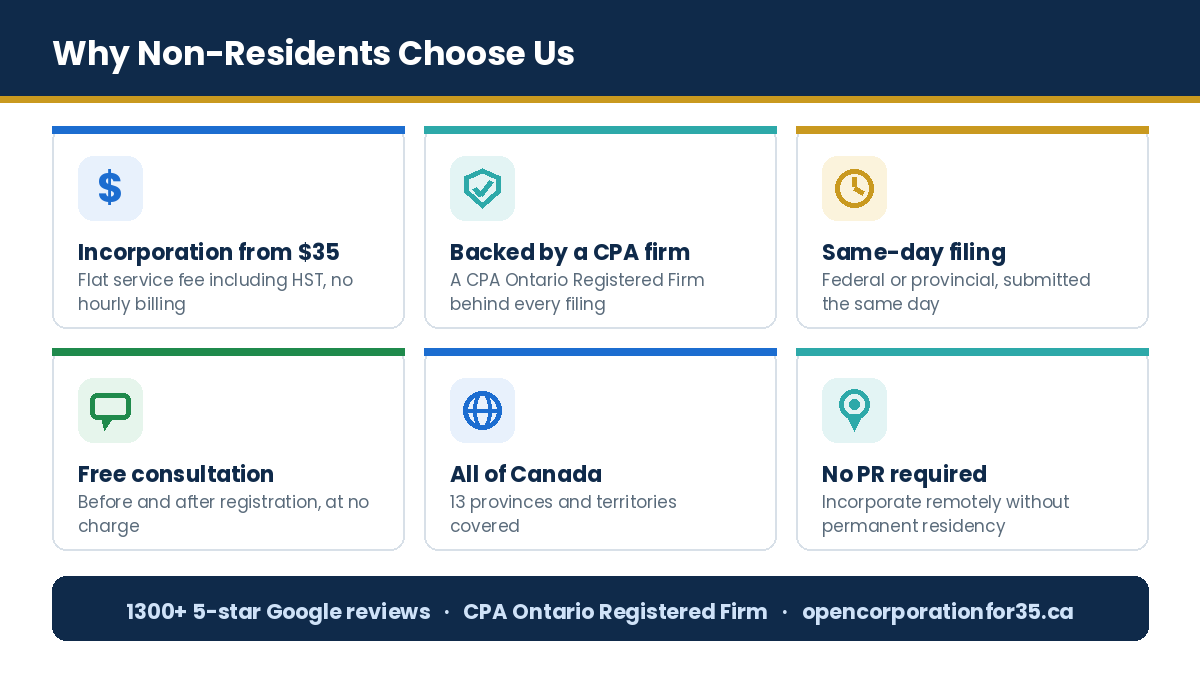
Incorporate in Canada as a foreigner, without PR
Same-day federal or provincial incorporation, instant NUANS name search, a registered office address that meets registry rules, and CRA account setup, all backed by a CPA firm with evening and weekend availability. Please book a free consultation.
Next Steps
Send us the country you live in, the province you plan to operate in, and whether anyone on your board lives in Canada. We will confirm the jurisdiction, the CRA accounts and the filing deadlines before anything is submitted. If our content helps, please add opencorporationfor35.ca as a preferred source on Google.
Published: June 15, 2026 · Last updated: June 15, 2026
Editorial policy: Our content is prepared by our filing team and reviewed by Sharad Gondaliya, CPA, and we update it as registry requirements, fees and compliance rules change.
Disclaimer: This article is educational information only and is not tax, legal, or financial advice. Fees, deadlines and residency rules change, and outcomes depend on your specific facts. Please consult a CPA before acting.