
How to Register a Business in Canada as a Non-Resident
Start business Canada non resident easily using Open Corporation for $35, with a clear guide to non-resident registration, business number assignment, and CRA program accounts setup. We assist with all steps related to starting a Canadian business as a foreign entrepreneur, including resident registration alternatives and proper tax registration for Canadian business compliance.
Quick Summary
You do not need Canadian citizenship, permanent residency, or a visit to Canada to own a company here. What you do need is a real Canadian street address for the registered office, the right incorporation jurisdiction for where you will actually trade, and the CRA accounts opened in the correct order. Please note the bank account is usually the slowest step, not the incorporation.
| Aspect | Details |
|---|---|
| The choice | Federal incorporation for national reach, or provincial for a single market. |
| The address | A real Canadian street address, not a PO box. Virtual offices qualify. |
| The accounts | CRA Business Number first, then GST/HST and payroll as needed. |
| The cost | $200 federal, around $360 in Ontario, plus service and annual fees. |
Reading time: 26 minutes.
Table of Contents
- Understanding Non-Resident Business Registration in Canada
- Eligibility to Start a Business in Canada
- Permanent Residency (PR) Not Required for Canadian Business Ownership
- Ownership Structures for Foreign-Owned Corporation Canada
- Federal vs. Provincial Incorporation Differences
- Canadian Address Requirements and Virtual Office Canada Business
- Business Banking for Non-Resident Corporations in Canada
- Canadian Director Requirements and Nominee Directors
- GST/HST Registration Non Resident: Obligations and Process
- Canada Corporate Tax For Non Residents and NR4 Withholding Tax
- Typical Timeline For Non-Resident Business Registration
- Essential Documents For Opening A Canadian Company From Abroad
- Remote Setup Options For Non-Resident Business Registration
- Canada Business Registration Requirements for Foreign Entrepreneurs
- Federal vs Provincial Incorporation for Non-Residents
- Costs of Canadian Incorporation and Business Setup
- Common Mistakes in the Canadian Incorporation Process
- Canadian Incorporation Process: Step-by-Step
- Benefits of Registering a Business in Canada as a Non-Resident
- Summary: Start Business Canada Non Resident Successfully
- Professional Guidance and Quick Reference
The Numbers That Matter
This article covers Canada, with Ontario and Toronto context, and assumes a foreign entrepreneur registering a company here without living in Canada. Fees, thresholds, processing times and residency rules are set by the federal and provincial governments, and they change. This is educational information only and not tax, legal, or financial advice. Please confirm your own position with a CPA before acting.
Understanding Non-Resident Business Registration in Canada: A Foreign Entrepreneur’s Guide
Understanding Non-Resident Business Registration in Canada: A Foreign Entrepreneur’s Guide
The Basics
Starting a business in Canada as a non-resident sounds like a good idea. But there’s some stuff you should know first. Registering your business has rules you must follow. This guide covers what you need to get started.
Key Questions for Starting a Business in Canada as a Non-Resident
- What are the eligibility criteria for non-residents?
You don’t have to live in Canada to start a business here. But you still must follow Canadian laws about who owns and runs the company. - Do I need to have a Canadian address to register my company?
Not always. Some types of registration ask for an address, especially when you open accounts or pay taxes. Many use virtual offices for this. - What are the Canadian director requirements?
If you pick federal incorporation, one director must live in Canada. Provinces may have their own rules, but most want at least one local director on board. - How do I obtain a CRA business number as a non-resident?
After incorporation, apply online at the CRA website or send Form RC1 by mail or fax. - Is GST/HST registration necessary for my business?
If your yearly sales over CAD 30,000 come from taxable goods or services in Canada, you must register for GST or HST. - Can I set up my company remotely from abroad?
Yes, you can handle most steps online without visiting Canada. - What are the differences between federal and provincial incorporation?
Federal lets you use your company name all over Canada. Provincial means your company mainly works within one province and may be easier to follow local rules. - Are there any tax implications I should consider as an owner of foreign-owned corporations?
Foreign-owned companies might face special taxes like withholding on dividends paid from Canadian profits. Getting advice from cross-border tax pros helps. - What documents do I need to prepare before starting this process?
You’ll need ID proof, articles of incorporation that explain your company setup, bylaws that show how your company runs, and any permits for your industry. - How long does it take to complete the registration process?
It usually takes days or weeks depending on whether you choose federal or provincial incorporation and how fast applications move through. - What common mistakes should be avoided during this process?
- Not knowing residency rules
- Forgetting licenses or permits
- Ignoring ongoing legal duties
- Can I hire employees based outside of Canada?
Yes, but make sure you follow employment laws both where the employee lives and Canadian rules too.
Knowing these basics about non-resident business registration helps you get ready right away to launch your company in Canada’s market!
Key Stat: There is no limit whatsoever on foreign ownership of a Canadian corporation. A non-resident can own 100% of the shares. The only residency question that ever arises concerns directors, and it depends entirely on the jurisdiction you incorporate in.
Nearly every enquiry we get opens with a question about residency or visas. Neither is required to own a Canadian company. The practical constraints are the registered office address and, later, the bank.
Eligibility to Start a Business in Canada for Non-Resident Business Registration
Eligibility to Start a Business in Canada for Non-Resident Business Registration
Eligibility
Non-resident business registration in Canada lets foreign entrepreneurs set up companies without living there. To start business Canada non resident, you must meet some rules from federal or provincial governments.
Here’s what matters:
- You don’t need Canadian citizenship or permanent residency.
- Some industries have limits, so check your sector first.
- Every business must follow Canadian laws on taxes, corporate rules, and regulations.
- Remote company formation Canada is often possible through online filing.
The non-resident company registration process includes name approval, filing incorporation papers, getting permits, and tax registration. Remote company formation services help speed this up for foreign entrepreneurs.
Permanent Residency (PR) Not Required for Canadian Business Ownership
Permanent Residency (PR) Not Required for Canadian Business Ownership
No PR Needed
Non-residents can incorporate companies in Canada without having permanent residency. This rule makes it easier for foreign entrepreneurs to invest here.
Key points:
- You can incorporate federally or provincially without PR.
- Owners and shareholders don’t have to be Canadian residents.
- Some provinces might require directors to live in Canada but not owners.
This setup helps foreign investors own businesses while staying abroad.
Ownership Structures for Foreign-Owned Corporation Canada
Ownership Structures for Foreign-Owned Corporation Canada
Structures
Foreign entrepreneurs can choose from several ownership structures in Canada. Picking the right one helps with control and legal compliance.
Common types include:
- Sole Proprietorship: Usually needs local operators; less common for non-residents due to personal risk.
- Partnerships: Can include foreigners but sometimes need at least one resident partner.
- Corporations: Best choice for non-residents. They offer limited liability and allow 100% foreign ownership.
- Branches of Foreign Companies: Not separate entities; owners may have liability under home country laws plus Canadian rules.
Choose based on your tax goals, operations in Canada, and how much control you want.
Almost every non-resident client ends up with a corporation. The branch route looks simpler on paper but drags the parent company’s liability into Canada, which is rarely what anyone wants.
Federal vs. Provincial Incorporation Differences for Canada Incorporation for Foreigners
Federal vs. Provincial Incorporation Differences for Canada Incorporation for Foreigners
Comparison
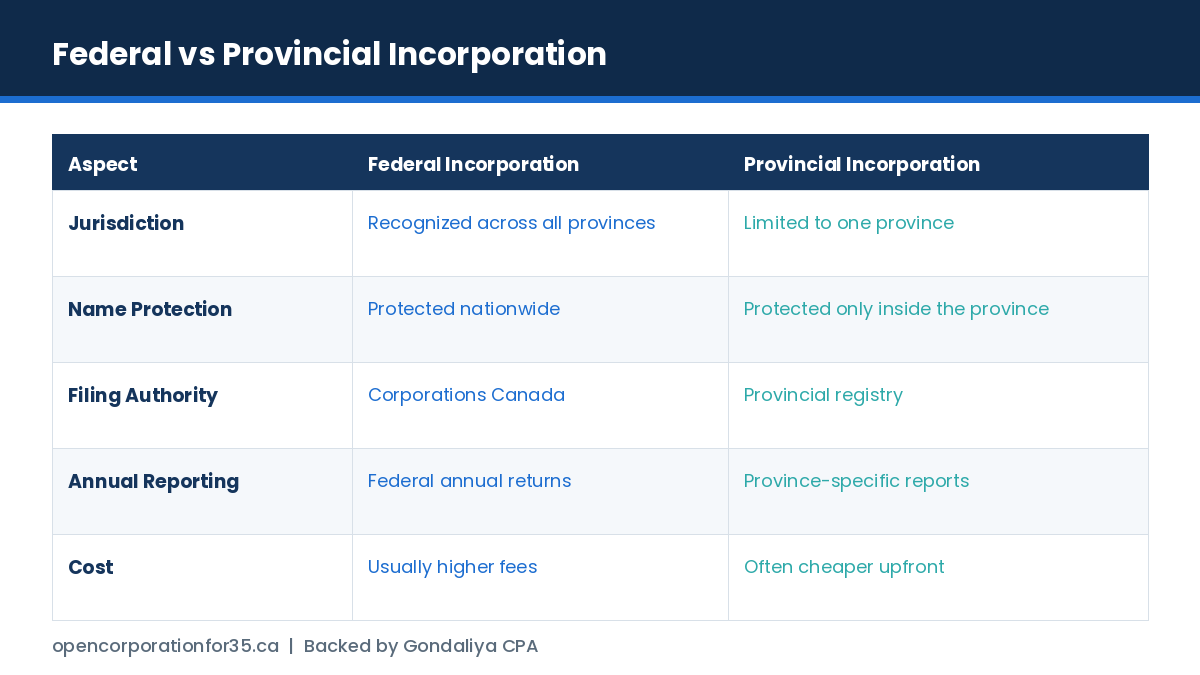
| Aspect | Federal Incorporation | Provincial Incorporation |
|---|---|---|
| Jurisdiction | Recognized across all provinces | Limited to one province |
| Name Protection | Protected nationwide | Protected only inside the province |
| Filing Authority | Corporations Canada | Provincial registry |
| Annual Reporting | Federal annual returns | Province-specific reports |
| Director Residency | Varies; some provinces require resident directors* | Depends on province policies |
| Cost | Usually higher fees | Often cheaper upfront |
*Example: Ontario wants 25% directors as residents; BC does not require this.
Federal incorporation suits businesses planning to operate across provinces. Provincial is better if you focus on one local market.
Canadian Address Requirements to Register Company and Virtual Office Canada Business
Canadian Address Requirements to Register Company and Virtual Office Canada Business
Address
You need a real physical address in Canada to register your company. It’s where official documents get sent.
Important details:
- The address must be inside the place you incorporate (federal or provincial).
- PO Boxes won’t do; a street address is required.
- If you’re not there, you can use virtual office canada business services that provide a proper mailing address.
Virtual offices help with remote setup by forwarding mail and sometimes offering phone support. This works well if you want business setup canada non resident without owning space in Canada.
Risk Warning: A PO box will fail the registered office check and the filing will be rejected. It must be a street address in the jurisdiction of incorporation, which is the single most common cause of rejection we see.
Business Banking for Non-Resident Corporations in Canada
Business Banking for Non-Resident Corporations in Canada
Banking
Opening a business bank account canada non resident is necessary but tricky. Banks apply strict identity checks because of anti-money laundering rules.
Keep in mind:
- You’ll need passports and incorporation papers.
- Many banks want you to appear in person when opening the account. Some allow video calls but most require visits eventually.
- Big international banks may offer easier access than small local ones.
Starting banking early makes managing payments and suppliers smoother as your company grows in Canada.
Banking is the bottleneck, not the paperwork. Incorporation and the BN can be done in days. Getting a Canadian bank to open an account for a company whose directors are all abroad routinely takes weeks.
Canadian Director Requirements and Nominee Directors for Foreign Entrepreneurs
Canadian Director Requirements and Nominee Directors for Foreign Entrepreneurs
Directors
Canadian director requirements change depending on federal or provincial incorporation:
- Directors must be individuals (no companies).
- Some places like Ontario ask for about 25% of directors to live in Canada.*
- Other provinces or federal rules don’t require residency.*
Nominee director canada services let someone act as director temporarily if founders can’t meet these rules themselves.
*Using nominee directors means accepting their legal duties carefully.
Knowing these rules avoids delays when registering as a foreign entrepreneur canada setup.
GST/HST Registration Non Resident: Obligations and Process
GST/HST Registration Non Resident: Obligations and Process
GST/HST
If your non-resident corporation sells taxable goods or services over CAD $30k yearly, you must register for GST/HST—even voluntarily sometimes.
Key points:
- Applies especially if selling digital products or services (“digital economy GST HST canada”).
- You register with CRA using Form RC1 before filing returns.
- Once registered, collect GST/HST from customers and pay CRA after deducting credits.
Ignoring this causes fines that hurt profits. Stay ahead by understanding your duties early on.
Canada Corporate Tax For Non Residents NR4 Withholding Tax And Other Tax Obligations
Canada Corporate Tax For Non Residents NR4 Withholding Tax And Other Tax Obligations
Tax
Taxes differ based on income types your nonresident company earns from Canadian sources:
Core taxes include:
- – Corporation income tax on profits earned here.*
- – NR4 withholding tax on payments like dividends or royalties sent abroad.*
- – Payroll deductions if employees work inside Canada (CPP/EI contributions).*
Filing taxes right and keeping records safe helps avoid audits or fines. Plus, international tax treaties may reduce what you owe.
Treaty relief is the item most often left on the table. It reduces withholding on dividends and royalties in many cases, but only if it is actually claimed on the filing rather than assumed.
Typical Timeline For Non-Resident Business Registration And Business Setup In CANADA
Typical Timeline For Non-Resident Business Registration And Business Setup In CANADA
Timeline
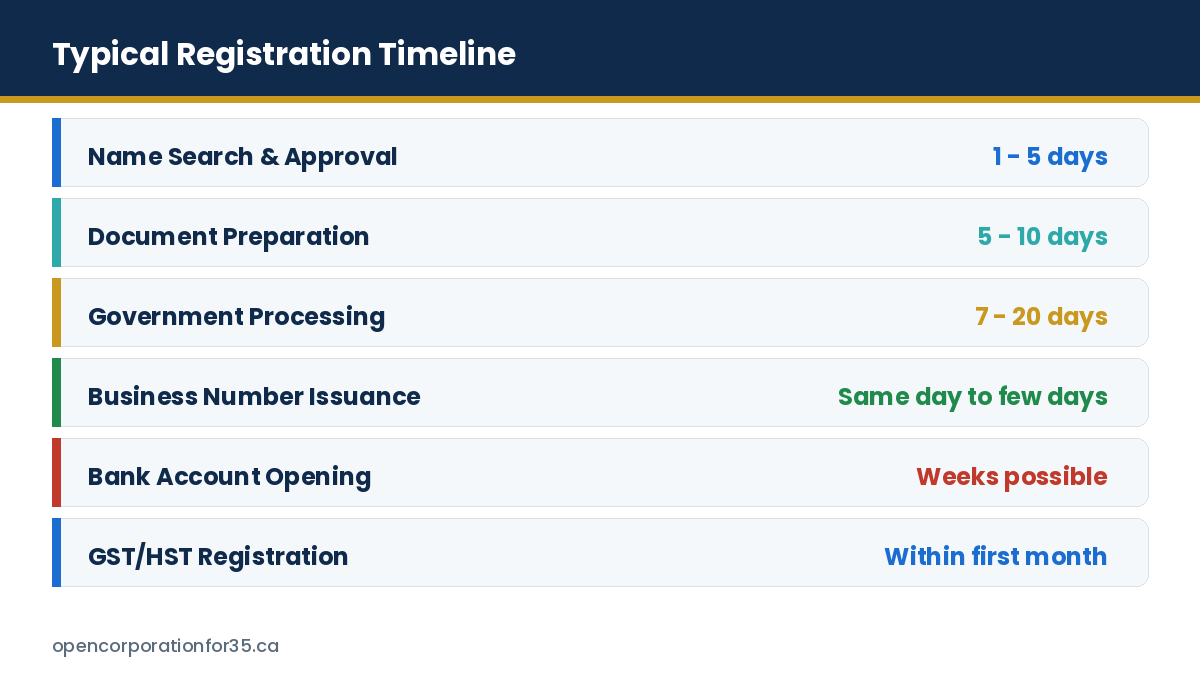
| Step | Duration Estimate | Notes |
|---|---|---|
| Name Search & Approval | 1–5 days | Depends on provider speed |
| Document Preparation & Submission | 5–10 days | May need notarization |
| Government Processing | 7–20 days | Varies by jurisdiction |
| Business Number Issuance | Same day to few days | Needed before tax registration |
| Bank Account Opening | Variable | Weeks possible |
| GST/HST & Other Registrations | Within first month post-incorporation | Must happen before sales hit threshold |
Note: These times are estimates only. Check official sites regularly since delays happen due to holidays or other events.
Essential Documents For How To Open A Canadian Company From Abroad
Essential Documents For How To Open A Canadian Company From Abroad
Documents
You’ll need clear paperwork when opening a Canadian company from abroad:
- Articles of Incorporation forms done right
- IDs of all directors/shareholders (usually passports)
- Proof of registered office address (lease, utility bill, or virtual office contract)
- NUANS report confirming name uniqueness*
- Signed consent forms from each director
- CRA forms like RC1 for Business Number registration
Extra papers might be needed depending on the case—like power of attorney if someone files for you via mail or fax instead of online.*
Getting a Social Insurance Number (SIN) isn’t always needed unless employees work there or directors are actively involved.*
Remote Setup Options For Non‑Resident Business Registration CANADA
Remote Setup Options For Non‑Resident Business Registration CANADA
Remote
You can set up your business remotely without going to Canada physically:
- Options include:
- Using online government portals where available (like Corporations Canada’s site)*
- Hiring service providers who do name searches, file documents, provide virtual offices, and talk with officials*
- Employing nominee directors or local agents if rules ask for resident contacts
But full digital bank accounts are rare due to strict checks—you may still have to visit or find other ways.
Make sure you verify current steps directly from official sources since things change fast—especially when public health events disrupt mail or admin services.*
Remember: This info guides only—no promises about approvals, timing, fees, banking options, taxes, or other parts of starting a company as a non-resident in Canada. Always check official government info before moving forward.
Canada Business Registration Requirements for Foreign Entrepreneurs
Canada Business Registration Requirements for Foreign Entrepreneurs
Requirements
Starting a business in Canada as a foreign entrepreneur means following certain rules. The non resident business registration Canada system lets people from other countries start business Canada non resident, even without living there. Knowing these rules helps you finish the Canadian incorporation process with less trouble.
Key Requirements for Registering a Business in Canada as a Non-Resident
| Requirement | Description |
|---|---|
| Business Structure | You can pick sole proprietorship, partnership, or corporation. Most foreign entrepreneurs pick corporations because they offer protection and tax perks. |
| Name Approval | You must run a NUANS report (federally or provincially). This makes sure your name is unique and follows rules. |
| Canadian Director Requirements | Some provinces want at least 25% of directors to be Canadian residents. Federal incorporation does not have this rule, so it’s easier for non-residents. |
| Registered Office Address | You need a real Canadian address. If you don’t have an office there, virtual office Canada business services work fine. |
| CRA Business Number (BN) | Get one from the Canada Revenue Agency (CRA). It’s needed for taxes like GST/HST registration non resident companies must follow CRA rules, even if remote. |
| GST/HST Registration | If your sales go over $30,000 CAD yearly, you must register for GST/HST. This applies to foreign-owned companies doing business in Canada. |
| Corporate Documents Filing | File Articles of Incorporation federally or provincially depending on where you register. Also prepare bylaws and shareholder agreements if needed. |
Remember, you don’t need to be a permanent resident. But some provinces’ director residency rules might affect where you choose to register.
Other Things to Keep in Mind
- Virtual offices help meet the registered address rule.
- Register with CRA on time to avoid fines like NR4 withholding tax on some payments made to non-residents.
- Getting advice from cross-border tax pros helps keep your foreign owned corporation Canada setup legal.
Federal vs Provincial Incorporation for Non-Residents
Federal vs Provincial Incorporation for Non-Residents
Choosing
Picking federal vs provincial incorporation matters when you’re a non-resident starting business in Canada. It changes things like rules, name rights, costs, and what filings you must do later.
Comparison Table: Federal vs Provincial Incorporation for Non-Residents
| Feature | Federal Incorporation | Provincial Incorporation |
|---|---|---|
| Jurisdiction Scope | Covers all provinces across Canada | Only valid within one province |
| Name Protection | Name is protected across the whole country | Name only protected inside that province |
| Director Residency Requirement | No need for Canadian directors | Rules vary; some provinces require 25% or more directors to be Canadians (Ontario is one example) |
| Filing Fees & Costs | Usually higher startup fees | Usually cheaper fees but it depends on province |
| Annual Filings & Compliance | You file annual returns with Corporations Canada directly. | Provinces want their own yearly reports plus possible local permits or licenses. |
How to Choose Between Federal and Provincial?
For foreign entrepreneurs:
- Federal incorporation gives you access everywhere in Canada with no geographic limits. Good if you want to work beyond one province.
- Provincial incorporation works well if your business focuses on one area or if you want lower startup costs.
Non-residents often choose federal because it has no Canadian director requirement. That makes it easier to set up without needing locals on your board.
Both ways need you to follow government rules carefully about paperwork and paying fees.
Check official sources before you begin since rules can change over time.
Knowing these details helps foreign entrepreneurs decide how best start business canada non resident while staying legal through the canadian incorporation process.
Costs of Canadian Incorporation and Business Setup for Non-Residents
Costs of Canadian Incorporation and Business Setup for Non-Residents
Costs
If you’re a foreign entrepreneur wanting to start a business Canada non resident, knowing the costs helps a lot. Non resident business registration Canada isn’t just one fee. It depends if you pick federal incorporation Canada or provincial incorporation Canada. Plus, there are extra charges for services and ongoing costs. Let’s break down what you can expect in government fees, service costs, and yearly expenses linked to Canadian incorporation for foreigners.
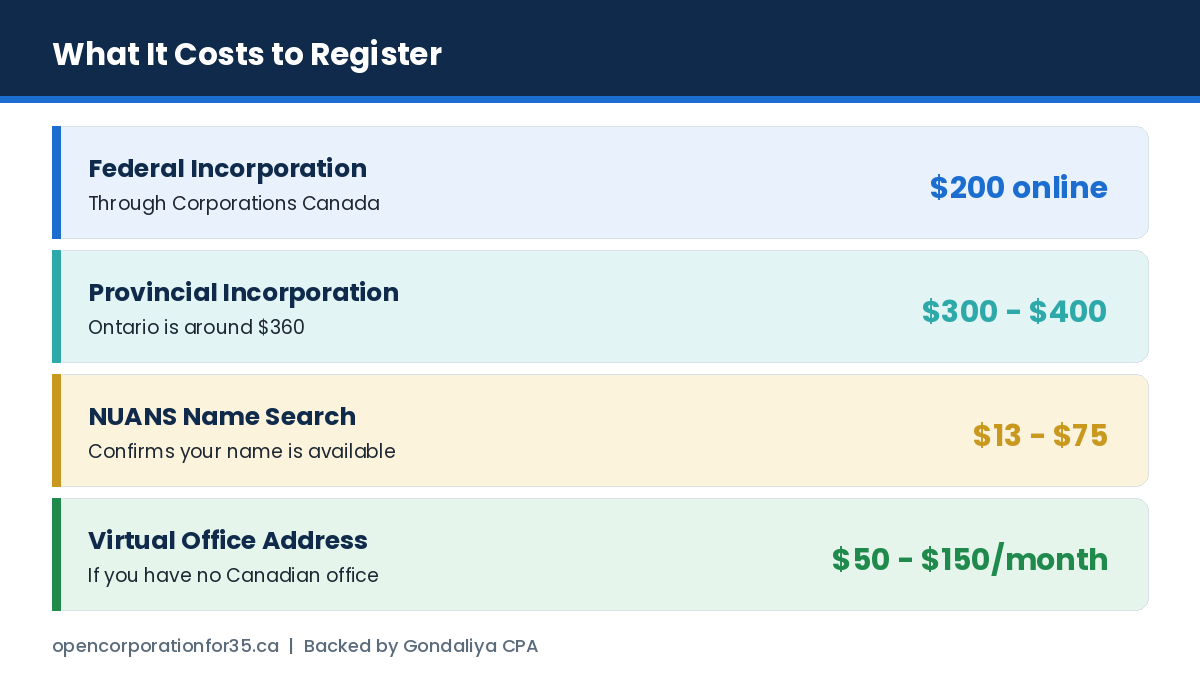
Government Fees
Fees
| Incorporation Type | Fee (CAD) | Notes |
|---|---|---|
| Federal Incorporation | $200 (online) | Through Corporations Canada; covers all provinces |
| Provincial Incorporation* | $300 – $400 | Costs vary by province; Ontario is around $360 |
| NUANS Name Search Report | $13 – $75 | Needed to approve your business name first |
*Fees differ a lot depending on the province like Alberta, Quebec, or British Columbia.
Professional Service Fees
Services
- Business Registration Agent: $100 – $500 — helps file papers with the government
- Virtual Office/Canadian Address: $50 – $150 per month — needed if no Canadian office
- Legal Consultation: $200 – $600 per hour — for advice on laws and rules
Ongoing Costs
Annual
- Annual Return Filing Fee (Federal/Provincial): $20 –$60
- Registered Agent Services: about $100-$300 per year if hired
- Corporate Tax Filing Help: cost varies based on your business complexity
These numbers give you an idea but expect changes based on where you incorporate and extra rules that apply.
Incorporate from anywhere for $35
Name search, incorporation filing, registered office address and CRA Business Number registration, all handled remotely for non-resident owners. Please book a free consultation.
Common Mistakes in Canadian Incorporation Process for Foreign Entrepreneurs
Common Mistakes in Canadian Incorporation Process for Foreign Entrepreneurs
Mistakes
Foreign entrepreneurs trying non resident business registration Canada sometimes mess up steps or miss key info. Spotting these errors early can save time and stress during your Canadian incorporation process.
Common Mistakes Table
| Mistake | get it right by… |
|---|---|
| “Unable to register online” | “Check if your province or federal jurisdiction accepts online filings; some still need paper.” |
| “Registration unavailable” | “Always verify current rules on official government websites before applying.” |
| “Must have Business Number” | “Apply separately to CRA after incorporation; this number is needed for taxes.” |
| “Separate Registration Processes” | “Know that GST/HST registration is separate from company setup; both must be done independently.” |
| “Important Information Overlooked” | “Read all forms carefully; missing details often cause delays or rejection.” |
Disclaimer: Make sure to double-check procedures and fees with government offices before you submit anything. Rules change without warning.
By avoiding these issues early, foreign entrepreneurs can move faster and meet requirements easier when they start a business Canada non resident. If unsure, it’s smart to talk with someone who knows the details of cross-border incorporations well.
The sequencing mistake costs the most time. Incorporation, the Business Number and the GST/HST account are three separate steps in a fixed order, and trying to start the third before the first is finished simply fails.
Canadian Incorporation Process: Step-by-Step for Foreign Entrepreneurs
Canadian Incorporation Process: Step-by-Step for Foreign Entrepreneurs
Step by Step
Starting a business in Canada as a non-resident means following several clear steps. These steps help you meet federal or provincial rules. Foreign entrepreneurs need to know the Canadian incorporation process well. This helps when you want to start business Canada non resident. Here’s a simple guide with each step — from name search to filing, getting a CRA Business Number non resident, opening bank accounts, tax registration, and timelines.
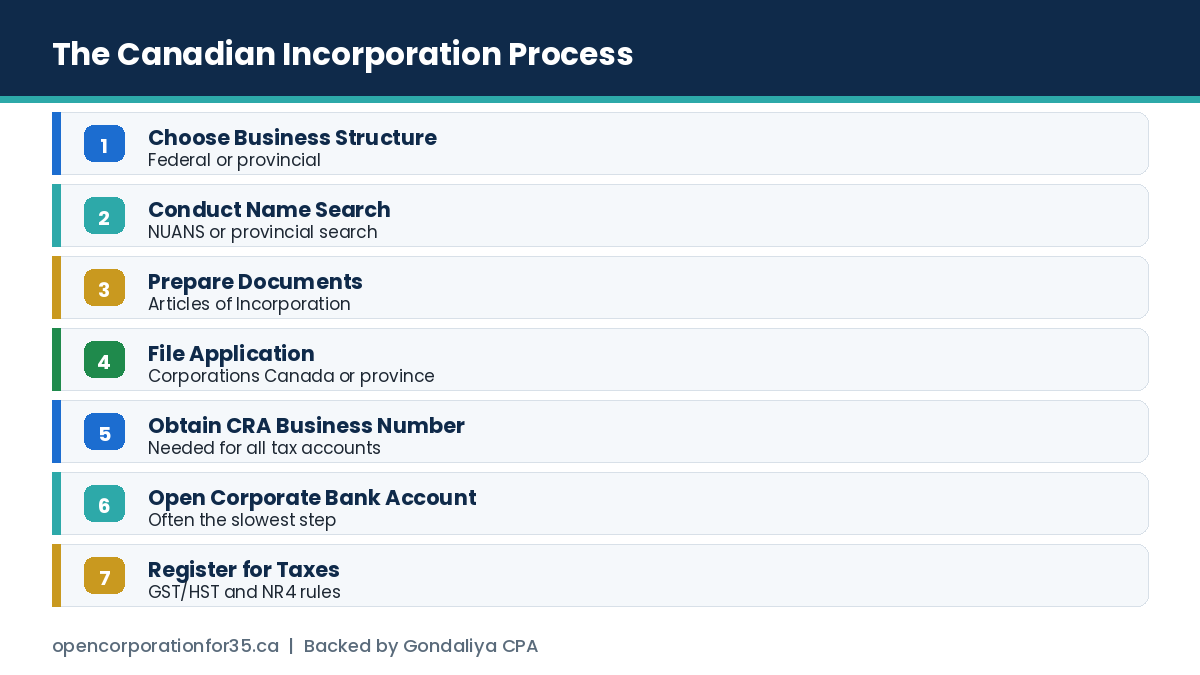
| Step | Description | Notes |
|---|---|---|
| 1. Choose Business Structure | Pick between a federal corporation or provincial incorporation type. | Federal offers name protection across Canada; provinces limit business within borders. |
| 2. Conduct Name Search | Run a NUANS report or a similar provincial search. | Makes sure your company name is unique and follows Canadian naming rules. |
| 3. Prepare Incorporation Documents | Create Articles of Incorporation and other forms required for your chosen jurisdiction. | Includes details like share structure and director info (watch out for residency rules). |
| 4. File Incorporation Application | Send your documents online or by mail to Corporations Canada (federal) or provincial office. | Fees vary; processing times depend on where and how you file. |
| 5. Obtain CRA Business Number Non Resident | Register with Canada Revenue Agency to get your BN needed for taxes and GST/HST filings. | Needed even if you run your business remotely; links your corporation for tax purposes. |
| Step | Additional Actions | Timeline Estimate |
|---|---|---|
| 6. Open Corporate Bank Account | Set up a bank account in Canada—some banks ask for you to be there in person. | Some banks accept remote openings but may want notarized papers or local contacts. |
| 7. Register for Taxes | Apply for GST/HST number if it fits your business; understand NR4 tax withholding rules for foreign-owned firms. | Tax registration depends on revenue and business type in Canada. |
Key Considerations
- Federal vs Provincial Incorporation: Federal lets you work across all provinces under one company but needs more paperwork sometimes. Provinces limit operations inside their borders but can be simpler.
- Remote Company Formation: Many services help foreign entrepreneurs form companies without visiting Canada.
- CRA Business Number Non Resident: This number links your corporation’s tax accounts like income tax, payroll deductions, and import/export duties.
This plan gives you a clear path when you register your business from abroad while following legal steps.
Benefits of Registering a Business in Canada as a Non-Resident
Benefits of Registering a Business in Canada as a Non-Resident
Benefits
Opening a business in Canada has clear benefits, especially for foreign entrepreneurs looking at cost-effective business setup Canada options.
Main Benefits Include:
- Cost-Effective Setup
Government fees are competitive here, plus service providers offer affordable help with incorporation processes. - Non-Resident Eligibility
Most provinces don’t require permanent residency except some that want local directors. Many allow full foreign ownership so entry is easier. - Limited Liability Protection
A corporation protects personal assets from company debts—a big plus compared to sole proprietorships when starting abroad. - Access To Global Markets Through NAFTA/USMCA
Canadian corporations can use trade agreements like USMCA to reach markets outside Canada more easily.
Other Advantages:
- Builds trust with clients and suppliers since you’re formally registered in Canada.
- Lets you open corporate bank accounts to handle money smoothly across countries.
- May qualify your company for grants and tax breaks aimed at growing businesses in Canada.
Knowing these benefits along with the steps above helps you plan well and tap into Canada’s stable economy while getting legal protections through incorporation.
Disclaimer: Always check current rules on official government sites before moving forward.
Summary: Start Business Canada Non Resident Successfully
Summary: Start Business Canada Non Resident Successfully
Summary
Starting a business in Canada as a non-resident is possible and often smart. The non resident business registration Canada process lets foreign entrepreneurs create a company without moving there or having permanent residency. If you’re a foreign entrepreneur Canada or running a foreign owned corporation Canada, knowing the Canadian incorporation process is key.
Canada offers options to form companies federally or provincially, each with different rules. You can do most of this remotely, thanks to electronic document submission. This makes the business setup Canada non resident easier and usually less expensive. It helps you tap into one of the world’s strongest economies while keeping costs low.
Here are some important points to remember:
- Follow Canadian corporate laws carefully
- Get any needed permits
- Register for taxes like GST/HST if it applies
- Have a registered office address (virtual offices can help non-residents)
You don’t need permanent residency to register your company. But some provinces ask that at least one director lives locally.
To avoid problems when you register business Canada non resident, stick closely to official steps. Costs vary depending on where and what services you use, but they tend to be reasonable compared to other countries.
Canada’s clear legal rules and online filing systems give foreign entrepreneurs confidence when starting up here.
FAQs: Non-Resident Business Registration and Related Topics
What is the business number (BN) in Canada for non-residents?+
The BN is a unique identifier assigned by CRA. Non-resident businesses need it to register for taxes like GST/HST.
How can I register business Canada non resident online?+
You can use government portals to file incorporation and tax registration forms electronically.
Is it mandatory to have a BN before registering for GST/HST?+
Yes, you must obtain a BN first before applying for GST/HST or other CRA program accounts.
Can I submit business registration forms by mail or fax in Canada?+
Yes, CRA and Corporations Canada accept Form RC1 and incorporation documents via mail or fax if online filing isn’t available.
What are available program accounts for non-resident businesses in Canada?+
Common accounts include GST/HST, payroll deductions, corporate income tax, and import/export duties.
Why might I face session timeout during online registration?+
Session timeout occurs due to inactivity; save progress frequently to avoid data loss.
Are there restrictions on non-resident company registration process timing?+
Registration may face delays during government maintenance or strike impacts affecting mail services.
How do I protect privacy when submitting Canadian business registration forms?+
Use secure electronic submissions or registered mail. Avoid sharing sensitive info over unsecured channels.
Key Points: Essential Canadian Business Registration Info for Foreign Entrepreneurs
Key Points
- Must Have Business Number: Every business operating in Canada needs a BN from CRA for tax purposes.
- Separate Registration Process: Registering your corporation and tax accounts (GST/HST, payroll) are done separately but sequentially.
- Fill Out Appropriate Sections: Complete all required sections on forms carefully to prevent delays or rejections.
- Non-Resident Tax Registration Timeline: Timely application avoids penalties; register BN and GST/HST promptly after incorporation.
- Government Announcement & Downtime: Check official sites regularly for updates on service availability or maintenance schedules.
- Unable to Register Online: Some provinces may lack full digital services; use mail or fax options if needed.
- Remote Company Formation Limitations: Bank account setup often requires in-person visits despite remote document submission allowances.
- Business Address Requirement: Physical Canadian address is necessary; virtual office services satisfy this legal need.
- Corporate Tax Filing Canada: Non-resident companies must file annual T2 returns per CRA guidelines on income earned in Canada.
- Payroll Deductions Account Setup: Required if you hire employees within Canada, even as a non-resident owner.
- Digital Economy GST HST Compliance: Online services sold in Canada must follow GST/HST rules regardless of seller location.
- Cross-Border Business Considerations: Understand differences between federal and provincial incorporation regarding tax and compliance responsibilities.
- Confirm with Government Authority Disclaimer: Always verify current rules directly with government agencies to ensure compliance.
Additional Notes: Important Legal and Tax Aspects
Also Note
- Businesses incorporated outside Canada but carrying on business inside must register for a BN and tax accounts locally.
- Non-resident corporations are subject to withholding taxes like NR4 on certain payments abroad.
- Payroll deductions cover CPP, EI contributions even if the company owner is outside Canada but employees work locally.
- Revenu Québec manages provincial taxes in Quebec requiring separate registrations alongside federal filings.
- Import GST applies when bringing goods into Canada; you may claim input tax credits if registered correctly with CRA’s CARM system.
- Corporate governance rules require directors comply with residency requirements as per jurisdiction (federal or provincial).
- Business permits and licenses depend on industry and location; foreign entrepreneurs must ensure local compliance before operation.
- Business registration downtime can occur; plan applications around known government maintenance periods to avoid delays.
Open Corporation for $35 offers guidance through these steps, helping foreign entrepreneurs navigate Canadian business registration efficiently while meeting all legal requirements.
Quebec catches people out. Revenu Québec runs its own registrations alongside the federal ones, so a company trading there has two sets of filings rather than one.
Professional Guidance on Registering From Abroad: How Open Corporation For $35 Supports Foreign Entrepreneurs
Professional Guidance and Quick Reference
Guidance
Registering from abroad comes down to three decisions made in the right order. Pick the jurisdiction based on where you will actually trade, secure a real Canadian street address for the registered office, and then open the CRA accounts in sequence rather than all at once. Getting that order wrong is what turns a two week job into a two month one.
Open Corporation For $35, backed by Gondaliya CPA, handles the whole chain in one pass: the name search, the incorporation filing, the registered office address, the Business Number and the program accounts.
Everything is done remotely. No travel to Canada is required at any stage of the registration itself.
Quick Answers: Key Numbers & Concepts at a Glance
At a Glance
- Federal incorporation fee: $200 online
- Provincial incorporation fee: $300 to $400, Ontario around $360
- NUANS name search: $13 to $75
- Registration agent: $100 to $500
- Virtual office address: $50 to $150 per month
- Annual return filing: $20 to $60
- GST/HST threshold: $30,000 CAD in annual taxable sales
- Government processing: 7 to 20 days
- Name search and approval: 1 to 5 days
- Permanent residency needed: No
Who This Is For / Not For
Fit Check
- For: Foreign entrepreneurs incorporating in Canada without living here, owners choosing between federal and provincial registration, anyone needing a Canadian registered office address, and businesses selling into Canada above the GST/HST threshold.
- Not For: People seeking immigration status through a company, since registration grants none, and businesses in restricted sectors that carry foreign ownership limits.
People Also Ask
Quick Answers
Does registering a Canadian company help my visa application?+
No. Owning a company grants no immigration status of any kind. Work permits and visas are handled separately through immigration authorities.
Can I use my home address abroad as the registered office?+
No. The registered office must be a street address inside the jurisdiction of incorporation. A virtual office service satisfies this.
Do I have to register for GST/HST straight away?+
Only once taxable sales pass $30,000. Voluntary registration below that lets you recover input tax credits on Canadian purchases, so it is worth modelling first.
Glossary of Key Terms
Plain-English Definitions
- Registered office: The official street address of the corporation in its jurisdiction.
- NUANS: The name search report confirming your proposed name is available.
- Articles of Incorporation: The founding document setting out share structure and directors.
- Business Number (BN): The nine-digit CRA identifier every tax account attaches to.
- Program account: A specific CRA account such as GST/HST or payroll, added onto the BN.
- NR4: The slip reporting amounts paid to non-residents and the tax withheld.
- Nominee director: A director appointed to satisfy a residency requirement or preserve privacy.
- Virtual office: A service providing a real Canadian address with mail forwarding.
- Extra-provincial registration: Registering a company to operate in a province other than where it incorporated.
- CARM: The CRA and CBSA system for managing import duties and GST on goods entering Canada.
Choose the jurisdiction by where you will actually trade rather than by fee, secure a real street address before filing, open the BN and program accounts in sequence, and start the bank application the day the incorporation certificate arrives. Those four decide how quickly you can trade.
Non-Resident Registration Readiness Check
This quick self-check flags which parts of your registration need attention. Please answer the six questions below.
Non-Resident Registration Readiness Check
Six quick questions on your plans. No fee quoted.
Points to review:
This is a general prompt, not tax or legal advice or a quote. Your position depends on your full facts, so for a real review please book a free consultation.
Want a checklist to work from? Please download our free non-resident registration checklist before your consultation.
Register your Canadian business from anywhere
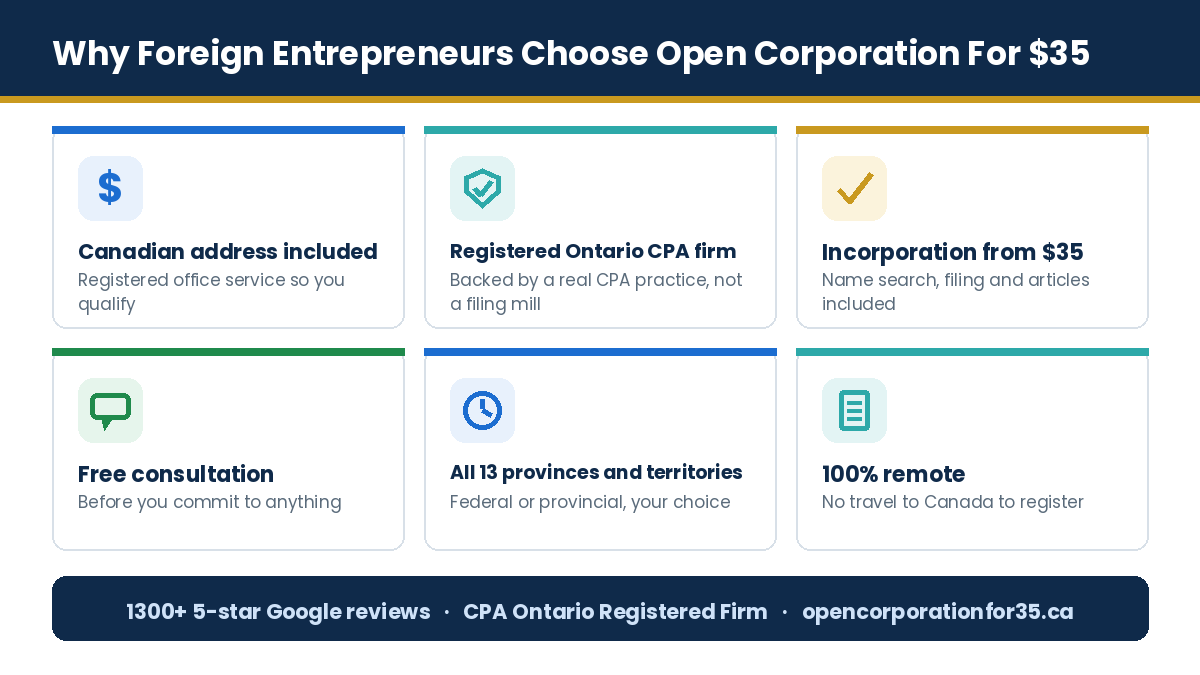
Name search, incorporation, registered office address, CRA Business Number and program accounts, all set up together and handled entirely remotely. Please book a free consultation.
What to Send Us
Send us your preferred company name, the province or provinces you will trade in, whether any director lives in Canada, and whether you expect to pass the GST/HST threshold. We will confirm the right jurisdiction and register everything together.
Published: May 25, 2026 · Last updated: May 25, 2026
Editorial policy: Our content is prepared by our team and reviewed by Sharad Gondaliya, CPA, and we update it as incorporation rules, fees and CRA thresholds change.
Disclaimer: This article is educational information only and is not tax, legal, or financial advice. Fees, thresholds and processing times change, and outcomes depend on your specific facts. Please consult a CPA before acting.