
Step-by-Step: How to Open a Corporation in Canada for Non-Residents
Incorporate Canada step-by-step with Gondaliya CPA’s guide for non-resident company setup, providing clear instructions on the process to start your Canadian company from abroad. This blog post covers registering a corporation and offers practical advice for a smooth Canada company setup in 2026.
Quick Summary
The sequence matters more than any single step. Name search, then articles, then the CRA Business Number, then banking, then the tax accounts. Doing them out of order is what causes most delays. Please note the director residency rule differs between federal and provincial, and settling that before you file decides whether you need a nominee at all.
| Aspect | Details |
|---|---|
| The order | Structure, name, filing, Business Number, banking, taxes. |
| The choice | Federal for national reach, provincial for one market. |
| The timeline | Roughly one to three weeks end to end. |
| The catch | Compliance does not stop at registration; annual filings follow. |
Reading time: 24 minutes.
Table of Contents
- Introduction to Incorporate Canada Step-by-Step
- Non-Resident Incorporation Process in Canada
- Choosing the Right Business Structure
- Step-by-Step Guide to Start Company Canada
- Canada Company Setup Essentials
- Post-Incorporation Compliance and Support
- FAQs on Incorporate Canada Step-by-Step
- Professional Guidance and Quick Reference
The Numbers That Matter
This article covers Canada, with Ontario and Toronto context, and assumes a foreign entrepreneur incorporating here without living in Canada. Fees, thresholds, processing times and director residency rules are set by the federal and provincial governments, and they change. This is educational information only and not tax, legal, or financial advice. Please confirm your own position with a CPA before acting.
Introduction to Incorporate Canada Step-by-Step
Introduction to Incorporate Canada Step-by-Step
The Basics
Starting a company in Canada is a good choice for non-residents who want to grow their business. The non-resident incorporation process lets people from other countries set up a legal company in Canada. This opens doors to a strong economy and many market chances worldwide. Services like Open Corporation For $35 make Canada company setup easy and affordable.
Overview of Incorporating a Company in Canada
Non-residents can open corporations in Canada. You can pick between federal or provincial incorporation. Both have different rules and benefits.
Federal vs Provincial Incorporation for Non-Residents
You can choose:
- Federal Incorporation: Lets your company operate all over Canada under one name.
- Provincial Incorporation: Limits you mostly to one province but may fit your needs better.
Neither option needs you to have permanent residency or a visa just to start the company.
Importance of Understanding the Step-by-Step Process
Knowing each step on how to start company Canada helps you avoid mistakes and follow the law right.
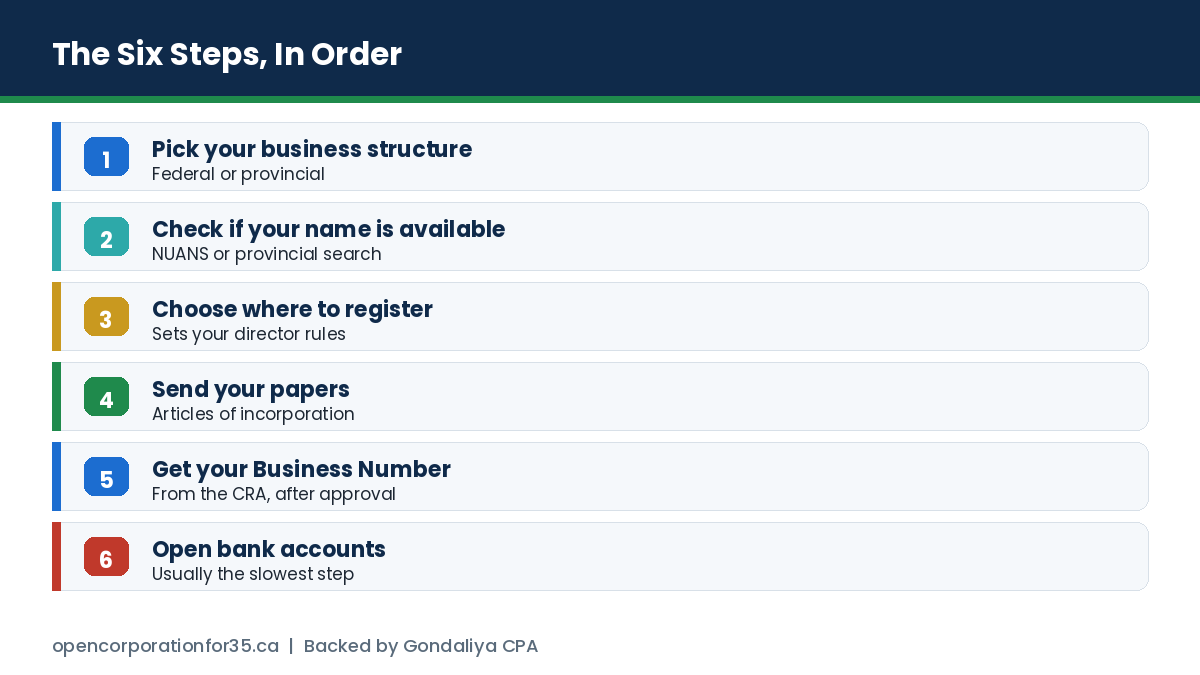
Here’s the usual order:
- Pick your business structure.
- Check if your name is available.
- Choose where you want to register.
- Send your papers to the right office.
- Get your business number from CRA (Canada Revenue Agency).
- Open bank accounts for your company money.
Doing these steps right keeps things simple and clear.
Benefits of Incorporating in Canada for Non-Residents
Here are some reasons why foreign entrepreneurs like starting companies in Canada:
- Canada’s legal system is stable and protects businesses well.
- A Canadian company looks good worldwide and builds trust with partners.
- You get easy access to big markets, including the US, thanks to trade deals like USMCA.
- The tech scene in Canada supports new businesses with many resources.
- You don’t need PR or a visa just to start a company here, which makes it simpler for foreigners.
Understanding these points helps non-residents decide if they want to build their business in Canada. Platforms like Open Corporation For $35 make this whole process cheaper and easier with just $35 plus government fees.
Key Stat: Ownership carries no residency test at all. A non-resident can hold 100% of the shares. The only residency question concerns directors, and it applies federally at 25% while several provinces have no requirement.
Non-Resident Incorporation Process in Canada
Non-Resident Incorporation Process in Canada
Eligibility
Starting a company in Canada as a non-resident is pretty straightforward. You just need to follow some clear steps. Knowing how to incorporate Canada step-by-step helps you avoid confusion and meet all rules. This guide shows the main parts of the non-resident incorporation process. It also explains what you must do to start your company in Canada.
Eligibility Criteria for Non-Resident Incorporation
Can a non resident open a corporation in canada? Yes, you can. You don’t need permanent residency or a visa just to start a company Canada. Foreign entrepreneurs and digital entrepreneurs can create corporations federally or provincially. The choice depends on your needs.
Here are key points:
- No PR or Visa Required: You don’t have to hold permanent residency or get a visa only to set up your business.
- Foreign Entrepreneurs Welcome: People from outside Canada can fully own their companies.
- Digital Entrepreneurs Friendly: Founders working remotely with SaaS, e-commerce, or tech businesses find it easier here.
Rules may change, so check with the right Canadian office before you start.
Required Documentation for Non-Residents
To finish the non-resident incorporation process well, you must give correct and full documents. These papers prove your business follows federal or provincial laws during setup.
You will need:
- Name Search Report: A name search (like NUANS) makes sure your company’s name is unique in that area.
- Articles of Incorporation: These papers say how your company is built and must be approved by the government.
- Incorporator Information: Info about who forms the corporation.
- Registered Office Address: A real address inside your chosen province or federally is needed. Sometimes virtual offices work but check first.
- Director Information: Names and addresses of directors at start-up time—see residency rules below.
If your paperwork is wrong or missing stuff, it will slow down approval a lot. Check everything twice before sending it in.
Legal Considerations and Compliance for Non-Resident Owners
Non-residents have special legal things to watch out for when they set up companies here. These affect how your business runs and what rules you follow after.
Director Residency Requirements
Canada wants at least 25% of directors to live in Canada under federal law. But some provinces, like British Columbia, do not ask for this rule. Make sure you know which rule fits where you incorporate because it changes who can be director right away.
Nominee Directors
If you don’t meet residency needs yourself, you can pick nominee directors who live in Canada. They act for the owners but don’t change who owns the company.
Maintaining Corporate Records
All businesses must keep records such as:
- Minute book with meetings and decisions,
- Lists of shareholders,
- Copies of articles of incorporation,
These files help if tax audits come or if legal issues happen later.
| Legal Aspect | Requirement/Consideration | Notes |
|---|---|---|
| Director Residency | At least 25% Canadian residents federally | Some provinces don’t require this |
| Nominee Directors | Allowed if residency rule not met | Must follow owner’s instructions |
| Minute Book Maintenance | Keep proper records | Includes minutes and resolutions |
| Registered Office Address | Real physical address required | Virtual offices allowed with limits |
Knowing these rules early stops problems later when starting a company in Canada as a foreign entrepreneur.
This short guide covers important parts of how to incorporate Canada step-by-step if you are not living here. It fits global founders wanting affordable ways like Open Corporation For $35’s service to set up fast.
Settle the director residency question before you choose the jurisdiction, not after. Picking somewhere with no requirement removes the nominee cost permanently, whereas discovering it later means paying that fee every year.
Choosing the Right Business Structure
Choosing the Right Business Structure
Structure
Picking the right business structure matters a lot when you incorporate Canada step-by-step. It changes how you handle taxes, legal rules, and day-to-day work. If you’re a non-resident who wants to start company Canada projects or do a smooth Canada company setup, knowing your options makes the non-resident incorporation process easier.
Types of Business Structures Available in Canada
Canada has several ways to set up a business that fit different needs. Foreign entrepreneurs and digital founders have some good choices. Each type affects your taxes, risks, and how you run things:
- Sole Proprietorship: One person owns it. Simple to start but you carry all the risk.
- Partnership: Two or more people share ownership. They share skills but also risks unless it’s a limited partnership.
- Corporation (Federal or Provincial): A separate legal entity. It protects your personal assets and works well for growth.
- Cooperative: Owned by members who want shared benefits instead of big profits.
Most non-residents wanting to open corporation for $35 using services like Open Corporation For $35 prefer corporations. They offer trust and room to grow.
Advantages and Disadvantages of Each Structure

| Business Structure | Advantages | Disadvantages |
|---|---|---|
| Sole Proprietorship | Easy to set up; you control everything | You face unlimited personal risk |
| Partnership | Share skills and resources | You share liabilities; possible conflicts |
| Corporation | Protects your personal assets; easier funding | More rules to follow; costs can be higher |
| Cooperative | Members have equal say; focuses on community | Not common choice for tech startups |
For SaaS founders and tech startups who want to expand into Canada without physical offices, corporations work well. They support payments worldwide (like Stripe), look professional to clients, and simplify CRA rules.
Non-resident incorporation process favors corporations too. They allow 100% foreign ownership with no need for Canadian residency or visas.
How to Select the Best Structure for Your Business Goals
Choosing between federal incorporation under the Canada Business Corporations Act (CBCA) or provincial options depends on your plans:
Federal Incorporation (CBCA)
Federal
- Protects your business name across all provinces
- Good if you want to operate all over Canada
- Recognized around the world which helps reputation
- You file articles federally
Provincial Incorporation Example – British Columbia
Provincial
- Best if your business stays mainly in one province
- Sometimes cheaper fees than federal route
- Processing speed varies by province
When deciding during your incorporate Canada step-by-step process:
- Think about where your customers live
- Check if national brand protection matters
- Compare costs including ongoing paperwork
- Stay updated since rules can change
Both federal and provincial choices help start company Canada projects well. The main difference is how far your business will reach and admin details like name searches or filing articles of incorporation Canada papers.
Understanding this makes sure you pick a structure that fits what you want long term while making non-resident incorporation process smoother with affordable services starting at just $35 plus fees.
Step-by-Step Guide to Start Company Canada
Step-by-Step Guide to Start Company Canada
Step by Step
Starting a company in Canada is easier when you know the steps. If you’re not a resident, the non-resident incorporation process might seem tricky at first. But breaking it down into simple parts helps. This guide shows you how to start company Canada the right way, with clear instructions on the Canada step-by-step setup.
Name Reservation and Approval Process
First, pick your company’s name. You need to check if it’s available and approved before going further.
- Usually, a NUANS name search is needed for federal incorporations.
- The NUANS system checks your chosen name against other registered names to avoid copying.
- Some provinces use their own name searches instead of NUANS.
- Name approval can take 1 to 3 business days, but sometimes longer.
Doing this early stops any problems later when you file your incorporation papers.
Here’s what you do:
- Pick a unique corporate name. Avoid common or simple words.
- Run a NUANS or provincial name search based on where you want to register.
- Get official approval confirming your name is okay to use.
Filing Articles of Incorporation
Next, you file your articles of incorporation. This step makes your business official under Canadian law.
The papers must include:
- Your legal company name
- Address for your main office
- How shares are divided (types and classes)
- Details about directors
- Any special rules for your company
You file these either federally with Corporations Canada or through the province where you want to set up.
Keep in mind:
- All details should match the approved name search.
- Online filing is often quicker and easier.
Check current rules because they can change anytime.
Obtaining Necessary Licenses and Permits
After incorporation, get any licenses or permits needed for your business type and place.
- Business registration in Canada may require municipal business licenses if you operate locally.
- Some industries need special permits before starting work (like food or transport).
Register early to avoid fines and run your company legally in Canada.
Look up local government sites after registering federally or provincially. They will tell you what permissions you need based on your business activities.
Setting Up Corporate Records and Bylaws
Once incorporated, keep good records. A corporate minute book holds all important papers proving you follow the rules.
The book usually has:
- Articles of Incorporation
- Corporate bylaws that show how your company runs
- Meeting minutes from shareholders or directors
- Register of shareholders
Using simple Corporate Minute Book Templates helps keep things neat and legal.
Good record keeping protects directors and helps when tax authorities review your business.
| Document Type | Purpose | Importance |
|---|---|---|
| Articles of Incorporation | Creates the company officially | Must be filed |
| Corporate Bylaws | Sets company rules | Guides decisions |
| Meeting Minutes | Notes decisions by directors/shareholders | Shows governance |
| Shareholder Register | Lists owners of shares | Keeps ownership clear |
Taking these steps carefully makes it possible for non-residents to start a company in Canada without stress. For fast help at low cost, services like Open Corporation offer support designed for foreign entrepreneurs wanting simple pricing and quick service.
Risk Warning: The registered office must be a real street address inside the jurisdiction of incorporation. A PO box will get the filing rejected, which is the most common cause of delay we see on remote applications.
Canada Company Setup Essentials
Canada Company Setup Essentials
Essentials
Starting a company in Canada as a non-resident takes some careful steps. The non-resident incorporation process can seem tricky but breaks down easily. You first pick whether to set up a federal or provincial corporation. Each one fits different business needs and places you want to work.
You’ll need to check if your chosen company name is free by doing a name search, like using NUANS. This avoids conflicts with names already used.
Next, you file incorporation papers with the right government office. That usually means sending in articles of incorporation and some other forms depending on where you set up.
Once done, get your Canadian business number from the CRA. You need this number for taxes and dealing with government programs.
Setting up a Canada company setup also means opening a corporate bank account made for foreign owners. Banks ask for extra checks when you’re not a resident, so expect more steps here.
Follow these steps carefully to start your business without delays or extra fees.
Opening a Corporate Bank Account
Opening a Canadian business bank account comes after incorporating. You can use services like Open Corporation For $35 to help get started cheap.
A corporate bank account keeps your personal and business money separate. It also makes managing money easier.
Non-residents have more rules when opening accounts because banks watch out for fraud. You usually need ID like passports, proof of address (sometimes virtual office addresses count), and incorporation papers from Canada.
Bank account setup fees differ between banks. Some charge $5 to $30 monthly plus transaction costs. Some banks waive fees if you keep minimum balances or bundle services.
Picking the right bank matters for smooth payments. Many Canadian banks work well with global platforms like Stripe, which helps digital businesses handle payments easily.
Registering for Taxes and GST/HST
Registering your corporation for taxes starts with getting a Business Number (BN) from the CRA. Then you register for GST/HST if your sales pass $30,000 CAD in four quarters.
The GST/HST registration guide shows when you must sign up. If your sales hit the limit, you register unless small supplier rules apply.
You also must file tax returns every year for income earned federally and provincially based on your incorporation type.
Keep good records of invoices and receipts all year long to stay clear of penalties from late or wrong filings.
Understanding Employer Obligations If Hiring Employees
If you hire people in Canada under your company setup, know your employer duties well.
You have ongoing filing requirements like sending payroll deductions (taxes withheld), paying Employment Insurance premiums, and making sure workers’ compensation rules are followed by province.
Keep employee files safe too—contracts, timesheets—stored in the corporate records book made when setting up the company.
Here’s what employers must do:
- Payroll deductions remittance: Income tax + EI premiums withheld (monthly/quarterly)
- Workers’ compensation: Pay per provincial rules (varies)
- Employee records management: Keep contracts & timesheets safe (ongoing)
- Annual T4 filing: Summarize employee pay & deductions (yearly)
Missing these can cause fines or hurt your reputation with workers and clients.
Hiring Professionals Like Accountants and Lawyers
You can handle much of incorporate Canada step-by-step yourself using online tools like Open Corporation For $35. But getting experts is smart if things get tricky with taxes or laws across provinces or federally.
Gondaliya CPA offers CPA services in Canada focused on foreign entrepreneurs. They provide help without high fees common at traditional law firms or CPAs elsewhere.
Here’s when hiring pros helps:
- Accountant (CPA): For tax advice and reports before filing returns
- Lawyer: To review legal documents or sort shareholder issues
- Incorporation service provider (like Open Corporation For $35): For fast low-cost basic setups early on
Getting trusted experts early stops costly mistakes later and frees founders to grow their business instead of wrestling with paperwork alone.
Banking is consistently the slowest part of the sequence, not the filing. Start that application the day the certificate arrives rather than waiting until you actually need the account.
Run the whole sequence in one pass
Name search, articles of incorporation, registered office address, CRA Business Number and program accounts, handled remotely for non-resident owners. Please book a free consultation.
Post-Incorporation Compliance and Support
Post-Incorporation Compliance and Support
Compliance
After you set up your company in Canada, keeping up with post-incorporation compliance matters a lot. The non-resident incorporation process doesn’t stop once you register. You must handle things like income tax filing obligations, keeping your corporate records in order, and following the rules that apply to your business. If you skip these, your company might face penalties or even get dissolved by authorities.
Income Tax Filing Obligations
All Canadian corporations must file income tax returns every year with the Canada Revenue Agency (CRA). This rule applies no matter where you live. If your corporation is federal, it reports worldwide income. If provincial, it reports taxable income in that province. The deadline comes six months after your fiscal year ends.
If you miss the deadline, CRA charges penalties and interest fees. Foreign owners starting company Canada businesses should watch these dates closely. Keeping good financial records throughout the year helps a lot.
Check CRA rules often because they can change without much notice.
Maintaining Corporate Records Properly
Canadian law says you must keep certain documents well organized. One key part is the corporate minute book. This book holds papers like articles of incorporation, bylaws, resolutions by shareholders, meeting minutes from directors, share registers, and other filings required by law.
Having an updated minute book makes audits easier and keeps your business running smoothly. Many companies use record-keeping templates made just for Canadian firms to stay organized.
If you don’t keep good records, you risk getting notices for not following rules or having trouble proving decisions made by your corporation later.
| Document Type | Purpose | Importance |
|---|---|---|
| Articles of Incorporation | Legal base for your corporation | Must have |
| Corporate Minute Book | Logs meetings and resolutions | Needed for compliance |
| Shareholder Register | Tracks who owns shares | Required by law |
| Financial Statements | Annual reports used for tax filing | Helps with CRA submissions |
Available Support Services from Gondaliya CPA
Handling Canadian compliance can be tricky for non-residents after they incorporate Canada step-by-step. Gondaliya CPA gives basic support as part of their incorporation service. They help with first filings and preparing documents right.
You can also get professional consultations from Gondaliya CPA tailored to your needs. These include advice on bookkeeping setup and tax planning ideas that fit Canadian laws (but they don’t give specific tax advice). They help with managing ongoing reporting duties too.
This mix offers foreign entrepreneurs clear help without pushy sales or high prices. It’s made to suit those starting company Canada setups remotely and affordably.
Tips for Maintaining Good Standing and Compliance in Canada
To keep good standing in Canada, watch out for all filing duties from federal or provincial offices:
- File annual returns on time according to your area’s deadlines.
- Update all corporate records when directors or shareholders change.
- Submit GST/HST returns if registered.
- Renew any required business licenses.
- Stay updated on laws that affect corporations by checking official government sites regularly.
Ignoring these can cause administrative dissolution — a removal from the register that stops legal business operations until fixed. Fixing this often costs extra time and money.

| Requirement | Frequency | Why It Matters |
|---|---|---|
| Annual Return Filing | Every year | Keeps company active |
| Corporate Minute Updates | After meetings | Keeps governance records correct |
| Tax Return Submission | Every year | Prevents penalties |
| Business License Renewal | Varies | Keeps legal permission valid |
Following these steps carefully after completing your non-resident incorporation process helps avoid confusion or extra costs. Pairing an affordable service like Open Corporation For $35 with expert options from Gondaliya CPA sets your Canadian company on a solid path without stress.
Administrative dissolution creeps up on dormant companies. Owners stop trading, assume there is nothing to file, and later find the corporation struck off with reinstatement costing more than the annual returns would have.
FAQs on Incorporate Canada Step-by-Step & Non-Resident Incorporation Process
FAQs on Incorporate Canada Step-by-Step
FAQ
FAQs on Incorporate Canada Step-by-Step & Non-Resident Incorporation Process
What is the typical timeline for non-resident incorporation in Canada?+
The incorporation process usually takes 1 to 3 weeks. Using a fast turnaround service like Open Corporation For $35 can speed this up.
Can I use a virtual office address for my registered office in Canada?+
Yes, many provinces allow virtual office addresses for registration but check specific rules to avoid issues.
What are common mistakes non-residents make during incorporation?+
Common errors include incorrect documentation, ignoring director residency rules, and missing name search steps.
Do I need a nominee director if I am a non-resident?+
Nominee directors are required only if you do not meet the 25% Canadian residency director requirement federally. Some provinces waive this.
How does hiring employees affect my compliance obligations?+
Employers must remit payroll deductions monthly or quarterly and file T4 annually. Also, pay employment insurance premiums per provincial rules.
What fees should I expect for nominee director and registered office services?+
Nominee director service fees vary but typically start around $100/month. Registered office service costs differ by provider and location.
Can Canadian corporations use Stripe and other global payment platforms?+
Yes, Canadian corporations commonly use Stripe for seamless global payment processing, which supports digital business growth.
Additional Key Points on Non-Resident Incorporation & Canada Company Setup
Key Points
- Affordable Pricing & Basic Included Support: Services like Open Corporation For $35 offer low-cost packages that include essential filing support without hidden fees.
- Detailed Pricing Comparison: Compare traditional law firms/CPAs vs online incorporation providers to find the best balance of cost and speed.
- Remote Incorporation Process: Many services allow full remote company setup without physical presence in Canada.
- Corporate Minute Book Templates: Use templates to keep records organized, including meeting minutes and shareholder registers.
- Non-Resident Incorporation Timelines: Understand that government processing times vary; expedited options reduce waiting periods.
- Ongoing Compliance Risks: Failure to file annual returns or maintain records may lead to administrative dissolution of your company.
- Employment Insurance Premiums & Payroll Deductions Remittance: Comply with monthly/quarterly tax remittances when hiring Canadian employees.
- T4 Filing Requirement: File T4 forms annually summarizing employee income and deductions for CRA compliance.
- Small Supplier Rule Impact: If your sales remain below $30,000 CAD over four quarters, you may delay GST/HST registration under this rule.
- Financial Statements for Tax Filing: Maintain accurate financial reports yearly to support corporate tax returns and audits.
- Tax Planning-Focused Businesses: Engage professionals early for strategies to optimize tax liabilities legally in Canada.
- Hiring Professionals Benefits: Accountants and lawyers reduce risks related to tax filings, legal compliance, and corporate governance issues.
- Suggested Slug: incorporate-canada-non-resident-company-guide-2026
- Internal Link Suggestions: Link to posts on “Canada Business Number Registration,” “Corporate Bank Account Setup,” “Federal vs Provincial Incorporation,” and “Canadian Payroll Compliance.”
- Schema Recommendations: Use Article schema with FAQ structured data to enhance search visibility for this content.
Professional Guidance on the Incorporation Sequence: How Open Corporation For $35 Runs It
Professional Guidance and Quick Reference
Guidance
The order is the whole job. Name search before articles, articles before the Business Number, Business Number before the program accounts, and the bank application started the moment the certificate lands. Running these in parallel is what turns a two week job into a two month one.
Open Corporation For $35, backed by Gondaliya CPA, handles the whole chain in one pass: the name search, the incorporation filing, the registered office address, the Business Number and the program accounts.
Everything is done remotely. No travel to Canada is required to incorporate or register.
Quick Answers: Key Numbers & Concepts at a Glance
At a Glance
- PR or visa required: No
- Maximum foreign share ownership: 100%
- Federal director residency: 25% resident Canadians
- British Columbia director residency: None
- Name approval: 1 to 3 business days
- Full incorporation: 1 to 3 weeks
- GST/HST threshold: $30,000 CAD over four quarters
- Corporate tax return deadline: Six months after fiscal year end
- Bank monthly fee: $5 to $30 plus transaction costs
- Nominee director: From around $100 per month
Who This Is For / Not For
Fit Check
- For: Foreign founders incorporating remotely, SaaS and e-commerce owners wanting a Stripe-compatible entity, anyone choosing between federal and provincial registration, and owners who need the CRA accounts opened in the right order.
- Not For: People hoping a company will support an immigration application, since it grants no status, and businesses in regulated sectors that carry foreign ownership limits.
People Also Ask
Quick Answers
Which step should I start first?+
The jurisdiction decision, before anything is filed. It sets your director residency obligation, your fees and your name protection scope, and changing it later means incorporating again.
Can I skip the name search and use a numbered company?+
Yes. A numbered corporation skips the name search entirely and is quicker and cheaper. You can register a trading name separately later if you want a brand.
What happens if I never trade through the company?+
The filings still apply. A dormant corporation must file its annual return and its corporate tax return, and skipping them risks the company being struck off the register.
Glossary of Key Terms
Plain-English Definitions
- NUANS: The name search report confirming your proposed name is available.
- Articles of Incorporation: The founding document setting out share structure and directors.
- Registered office: The official street address of the corporation in its jurisdiction.
- Incorporator: The person or party who files to form the corporation.
- Nominee director: A director appointed to satisfy a residency requirement.
- Minute book: The corporate record holding bylaws, resolutions and share registers.
- Business Number (BN): The nine-digit CRA identifier every tax account attaches to.
- Small supplier: A business below the GST/HST threshold that may delay registering.
- T4: The annual slip summarising employee pay and deductions.
- Administrative dissolution: Removal from the register for missed filings.
Decide the jurisdiction first, secure a real street address before filing, run the steps strictly in order, and start the bank application the day the certificate arrives. Then diarise the annual return and the corporate tax return, because compliance is where most remote owners come unstuck.
Incorporation Sequence Readiness Check
This quick self-check flags which parts of the sequence need attention. Please answer the six questions below.
Incorporation Sequence Readiness Check
Six quick questions on your plans. No fee quoted.
Steps to review:
This is a general prompt, not tax or legal advice or a quote. Your position depends on your full facts, so for a real review please book a free consultation.
Want a checklist to work from? Please download our free incorporation sequence checklist before your consultation.

Schedule a free consultation today to get expert guidance on opening your Canadian corporation as a non-resident for just $35 and ensure a smooth, compliant setup from start to finish.
Name search, articles, registered office address, CRA Business Number and program accounts, all set up together and handled entirely remotely.
What to Send Us
Send us your preferred company name, whether any director lives in Canada, the province or provinces you will trade in, and whether you will hire here. We will confirm the jurisdiction and run the whole sequence in the right order.
Published: April 20, 2026 · Last updated: April 20, 2026
Editorial policy: Our content is prepared by our team and reviewed by Sharad Gondaliya, CPA, and we update it as incorporation rules, fees and CRA thresholds change.
Disclaimer: This article is educational information only and is not tax, legal, or financial advice. Fees, thresholds and processing times change, and outcomes depend on your specific facts. Please consult a CPA before acting.