
How Do I Set Up Payroll for a Canadian Corporation as a Non-Resident?
TLDR: To set up payroll Canada non resident for a foreign owned company, it is essential to manage payroll taxes Canada, deductions, and timely payroll remittance Canada under CRA guidelines. Gondaliya CPA supports non resident business payroll needs by simplifying payroll services and ensuring accurate payroll setup for Canadian corporations with non-resident owners.
Quick Summary
A non-resident owner can run Canadian payroll, but the obligations start the day the first employee works in Canada rather than when it becomes convenient. What decides the outcome is having the RP account open before the first pay run, deducting the right amounts, and remitting on time. Please note source deductions are held in trust, which is why the CRA treats late remittances more seriously than most other filings.
| Aspect | Details |
|---|---|
| The account | A CRA Payroll (RP) account attached to your Business Number, opened before anyone is paid. |
| The deductions | Income tax, CPP and EI, plus provincial levies such as Ontario EHT. |
| The relief | Form RC473 certification, or a Regulation 102 waiver, applied for in advance. |
| The risk | Penalties from 5% plus daily interest, and director liability that reaches outside Canada. |
Reading time: 27 minutes.
Table of Contents
- Payroll Account Registration for Non-Resident Corporations in Canada
- Payroll Withholding Obligations for Non-Resident Employers
- Payroll Withholding Relief and Exemption Certifications
- Income Tax and Filing Obligations for Non-Resident Corporations
- Withholding Taxes on Services and Other Payments to Non-Residents
- Support, Resources, and Compliance for Non-Resident Payroll Management
- Frequently Asked Questions
- Choosing the Right Payroll Partner as a Non-Resident Owner
- Professional Guidance and Quick Reference
The Numbers That Matter
This article covers Canada, with Ontario and Toronto context, and assumes a Canadian corporation with non-resident owners paying people who work in Canada. Contribution rates, thresholds, withholding rates and remittance deadlines are set by the CRA and the provinces, and they change every year. This is educational information only and not tax, legal, or financial advice. Please confirm your own position with a CPA before acting.
Payroll Account Registration for Non-Resident Corporations in Canada
Payroll Account Registration for Non-Resident Corporations in Canada
Registration
Registering a Payroll Account for Foreign Owned Companies
If you run a foreign-owned company and want to pay employees in Canada, you have to register a payroll account with the Canada Revenue Agency (CRA). This is true even if you don’t live in Canada. Your corporation must open a CRA Payroll (RP) Account to follow Canadian rules.
Requirements to Register a Payroll Deductions Account with CRA
You need to get your CRA Payroll Account (RP) ready before paying anyone. Here’s what you need:
- Business Number (BN): You must have this federal number first.
- Authorized Representative: If you can’t do the paperwork yourself from outside Canada, pick someone who can handle it for you. This person talks with CRA and sends forms on your behalf.
Online Registration Process for Non-Resident Businesses
It’s easier to register online. You can use these options:
- Business Registration Online: The CRA website lets you apply here fast.
- Phone or Mail: Call or mail the application to the CRA’s RP program if that works better.
Make sure all your details are correct before sending anything in.
Alternative Registration Methods for Non-Resident Corporations
Can’t register online? No problem. Try these ways instead:
- CRA Authorization Form: Fill out this form if you want a CPA or agent in Canada to manage registration for you.
- Mail Application: Send your forms by regular mail if electronic methods don’t work for you.
These options let non-resident companies comply even from far away.
Business Number (BN) and Its Role in Payroll Registration
The Business Number (BN) is a must-have ID from the federal government. You need it before signing up for payroll accounts with the CRA. Without a BN, paying employees and handling taxes is not possible. Get this number early when setting up your business to avoid delays later on.
Following these steps carefully helps non-resident owners set up payroll without issues under Canadian law.
The RP account is the step owners discover late, usually the week they want to run the first pay run. It attaches to a Business Number that has to exist first, so a hire made on short notice can push the first pay date back.
Key Stat: Source deductions are held in trust for the Crown rather than owed as an ordinary debt. That is why a late remittance carries director liability that follows the director personally, even when they live outside Canada.
Payroll Withholding Obligations for Non-Resident Employers
Payroll Withholding Obligations for Non-Resident Employers
Withholding
Overview of payroll withholding requirements for non-residents
Non-resident employers with Canadian corporations have to follow payroll withholding rules. The corporation must deduct and send source deductions on pay given to employees in Canada. This includes income tax, Canada Pension Plan (CPP) contributions, and Employment Insurance (EI) premiums — unless some exemptions apply.
Regulation 102 sets a flat 15% withholding rate on certain payments to non-residents. This happens if the non-resident has no permanent establishment in Canada or lacks CRA certification. Mostly, this rule covers passive income like interest or royalties. But it can also affect some employment-related payments without proper certification.
Canadian payroll foreign owners need to know these rules apply even if they live outside Canada. Registering properly and following the law helps avoid penalties and keeps things legal under Canadian tax law.
Federal and provincial payroll deductions: Income tax, CPP, and EI considerations
Canadian corporations must withhold federal and provincial income taxes based on where the employee works. They use the latest TD1 forms for this.
For 2026:
- CPP Contribution Rate: Employees pay 5.95% on earnings up to $68,700.
- Additional CPP (CPP2): Only in Quebec; rates are set by Retraite Québec.
- EI Premium Rate: Employers pay 1.63%, multiplied by 1.4.
Employers also think about provincial taxes like Ontario’s Employer Health Tax (EHT). Ontario exempts companies paying less than $490,000 total wages in 2026 from EHT. Other provinces have similar levies.
Payroll deductions include what employees pay from their paycheck plus what employers add when they send payments.
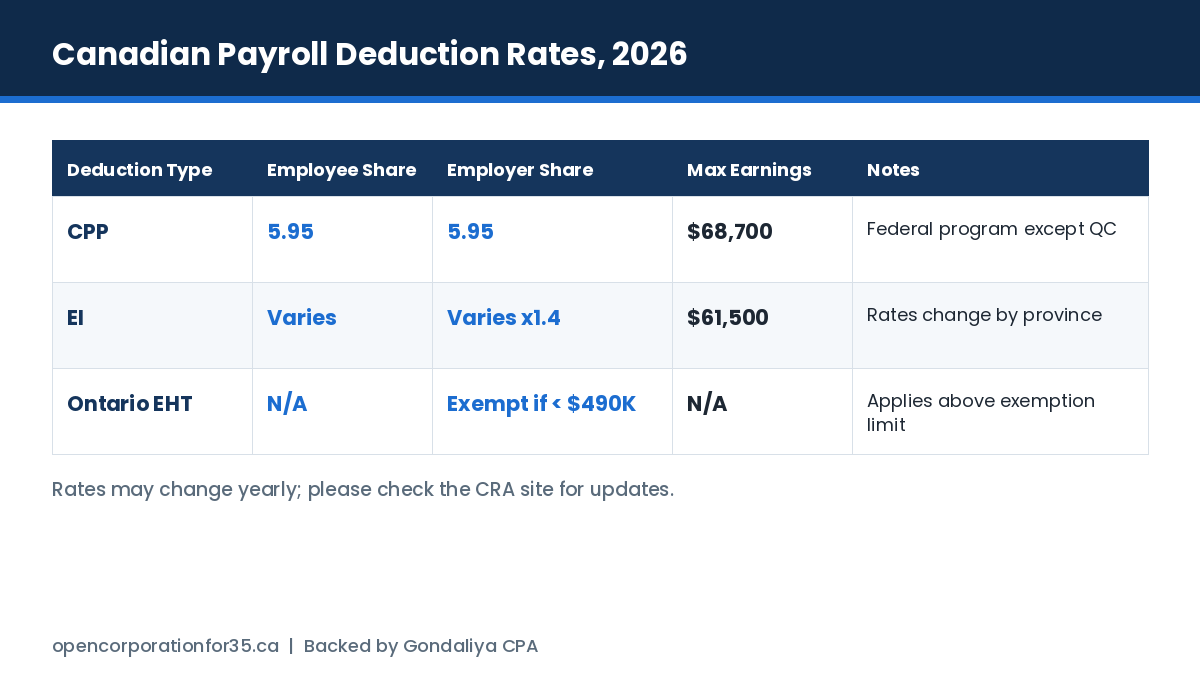
| Deduction Type | Employee Share (%) | Employer Share (%) | Max Earnings ($) | Notes |
|---|---|---|---|---|
| CPP | 5.95 | 5.95 | $68,700 | Federal program except QC |
| EI | Varies* | Varies* ×1.4 | $61,500 | Rates change by province |
| Ontario EHT | N/A | Exempt if < $490K | N/A | Applies above exemption limit |
*Rates may change yearly; check CRA site for updates.
Employer responsibilities for withholding taxes on remuneration in Canada
Non-resident corporations must open a CRA Payroll Program Account before paying employees in Canada. They must calculate deductions right, take money from gross paychecks (even for directors), and send payments on time based on their remitter type.
The RC473 form lets some foreign employers skip Regulation 102 withholding if they prove they follow rules well. Processing this form can take several weeks.
Remitter thresholds decide if a company files monthly or quarterly returns. Missing deadlines brings penalties starting at five percent plus daily interest.
Risks include calling workers contractors without T4 forms or not sending deducted amounts on time. These cause audits and can hold directors responsible—even if they live outside Canada.
Payroll withholding from first day of employment in Canada
You must start payroll deductions right away when an employee begins working in Canada—even if the owner lives abroad. To do this right, open an RP account with your business number before you give any paycheques.
Remittance schedules depend on your remitter type:
- Regular remitters: Pay within three business days after month-end.
- Quarterly remitters: Pay within one month after quarter-end.
Missing these deadlines leads to penalties that grow over time, including fines plus interest.
If a non-resident owner pays themselves salary, withholdings apply as usual. But dividends don’t require standard payroll deductions—they might have other reporting rules though (see related section).
Key exemptions from payroll withholding for non-resident employees
Some payments from Canadian corporations to non-residents get reduced or no withholding under Regulation 102 if supported by proper documents like RC473 certification from CRA.
Examples:
- Fees earned outside Canada usually don’t need CPP or EI contributions.
- Tax treaties might lower income tax rates with waiver requests where allowed.
If you don’t get this certification, the flat 15% Regulation 102 deduction applies right away until fixed.
Knowing these exemptions helps foreign-owned companies avoid mistakes early on while staying compliant.
Risk Warning: Calling a worker a contractor to avoid opening an RP account is the single most expensive mistake we see. If the CRA reclassifies them, the corporation owes both halves of CPP and EI plus the unremitted tax, with penalties and interest on top.
Owners paying themselves a salary often assume it sits outside payroll because they are the shareholder. It does not. A salary to a non-resident owner carries the same deductions as a salary to anyone else.
- CRA – Payroll Deductions Online Calculator
- CRA – Regulation No.102
- CRA – CPP Contribution Rates & Maximums
- CRA – EI Premium Rates & Multipliers
- Ontario Ministry Finance – Employer Health Tax Information
- CRA – Registering Your Business Number Accounts
- Form RC473 – Non Resident Employer Certification Application Guide
- CRA – Source Deduction Remittance Deadlines & Penalties
- Director Liability Guidelines – CRA Compliance Manual PSM00101 Part IV Section C(12)
- Service Canada – Record Of Employment Filing Requirements
- Tax Treaties Database – Government Of Canada International Tax Agreements
Payroll Withholding Relief and Exemption Certifications
Payroll Withholding Relief and Exemption Certifications
Relief
When foreign owners run Canadian payroll, they must follow strict rules about source deductions. But non-resident corporations can sometimes skip or reduce these tax holds using certifications like the Non-Resident Employer Certification (RC473) or Regulation 102 waivers. These help lower or remove income tax taken from paychecks for non-resident workers while still following Canada Revenue Agency (CRA) rules.
Income Tax Payroll Waiver through Non-Resident Employer Certification (NREC)
The Non-Resident Employer Certification (RC473) lets eligible foreign-owned companies skip income tax withholding on pay to some non-resident employees working temporarily in Canada. This shows CRA that the employer fits their rules and allows payroll without automatic tax deductions under Regulation 102.
To apply, employers send Form RC473 with proof that they qualify. It usually takes four to six weeks to process but can be longer if CRA is busy or paperwork isn’t complete[1]. Even with approval, employers still have to pay other deductions like CPP and Employment Insurance unless these are exempt too.
This waiver works well when foreign owners hire staff who don’t become full-time residents but do work physically inside Canada. It helps cash flow by delaying income tax payment until employees file their yearly returns.
Criteria and Application Process for NREC
If a non-resident corporation wants to set up payroll in Canada using NREC, it must meet certain requirements:
- The worker is a non-resident doing temporary work in Canada.
- The company doesn’t have a permanent business presence beyond limited tasks.
- Employment contracts clearly explain terms that follow cross-border laws.
- Forms like SIN applications and TD1s are filled out right.
Here’s how employers apply:
- Fill out Form RC473 from the CRA site[2].
- Send documents proving employee status, contract terms, length of stay, and why withholding would be unfair at first.
CRA checks each application closely. Missing info means delays. Employers should wait for official CRA approval before applying this exemption.
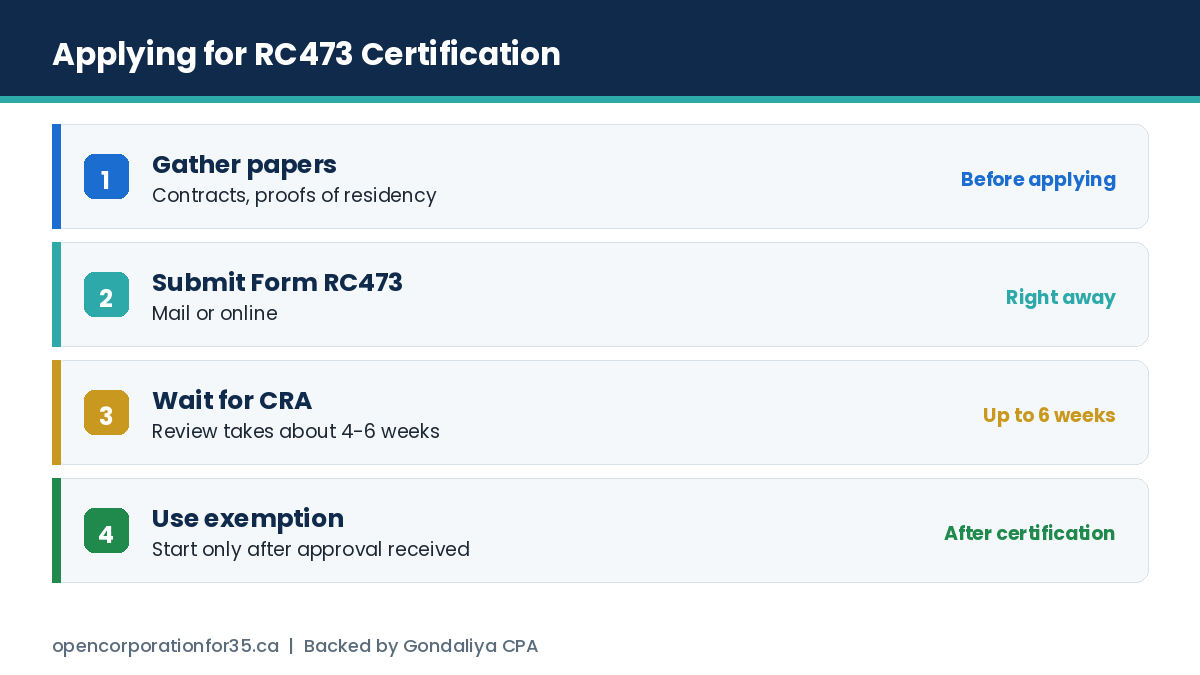
| Step | What to Do | When to Do It |
|---|---|---|
| Gather papers | Contracts, proofs of residency | Before applying |
| Submit Form RC473 | Mail or online | Right away |
| Wait for CRA | Review takes about 4–6 weeks | Up to 6 weeks |
| Use exemption | Start only after approval received | After certification |
Regulation 102 Waiver: Eligibility and Implications
Regulation 102 says employers must withhold 15% tax on wages paid to non-residents unless they have an NREC certificate[3]. If no waiver exists, employers have to deduct this tax upfront even if treaties reduce it later.
To get a waiver, companies must show:
- Employee stays in Canada are short-term,
- Income gets reported correctly under tax treaties,
- There’s no risk of unpaid taxes.
If granted, this removes immediate withholding but does not cancel CPP/EI payments or provincial taxes where those apply.
Ignoring these rules can lead to fines and interest charges. Directors may also face penalties—even if they live outside Canada[4].
Bottom line: Apply early for NREC certificates to avoid unnecessary cash flow problems caused by Regulation 102 withholding during payroll for Canadian companies owned by foreigners.
Social Security Tax Exemption Certificates and Their Relevance to Payroll
Foreign-owned companies running Canadian payroll need to think about social security agreements. These affect pension payments like CPP/QPP versus the home country’s system[5].
Canada has deals with many countries that let workers temporarily assigned here avoid paying into both pension systems at once. They need certificates proving coverage under their home plan instead of Canada’s CPP/EI programs.
Without these certificates:
- Employers must deduct employee shares plus match employer contributions toward CPP/QPP.
- Mistakes can lead to reassessments and extra penalties, raising costs a lot.
These certificates deal with social security taxes specifically—not income taxes—and complement income tax waivers[6].
Interaction Between Tax Treaties and Payroll Withholding Exemptions
Tax treaties shape how payments from foreign-owned companies get taxed depending on where recipients live. For example:
Regulation 105 requires a higher flat rate (around 25%) withheld on fees paid overseas—like director fees paid abroad[7].
But,
Treaty day count tests check if people qualify as residents with treaty benefits based on how many days they work inside or outside Canada each year[8].
Employers handling Canadian payroll for foreign owners need to know these details well because wrong classification leads to audits, back taxes, and fines[9].
Understanding these rules helps cut lawful withholding while staying fully compliant across different countries involved.
The RC473 timing is what catches people out. Four to six weeks means applying before the assignment starts, not after the first pay run, because the exemption cannot be applied retroactively to pay already made.
Income Tax and Filing Obligations for Non-Resident Corporations
Income Tax and Filing Obligations for Non-Resident Corporations
Filing
Non-resident corporations that do business in Canada have to follow special rules about income tax and payroll. Foreign owners handling Canadian payroll non resident matters need to know these rules well. This helps avoid penalties and keeps things running smooth with the CRA.
T2 Corporation Income Tax Return Filing Requirements for Foreign Owned Companies
Foreign-owned companies in Canada must file a T2 Corporation Income Tax Return every year. This form shows the company’s income, deductions, and taxes owed in Canada, no matter where the owners live. The rule stands even if the company loses money or has zero taxable income.
Here’s what you need to keep in mind:
- File the T2 return within six months after the fiscal year ends.
- Report all income linked to Canadian operations.
- Foreign ownership doesn’t change this requirement.
Filing on time helps you stay clear of CRA penalties tied to payroll for non resident corporation Canada.1
Use of Schedule 97 for Reporting Income Types of Non-Resident Corporations
Schedule 97 is for non-resident corporations to report Canadian-source income that faces Part XIII withholding tax. It adds details to the main T2 return about interest, dividends, rents, royalties, and fees paid or received.
If you’re dealing with Canadian payroll foreign owner issues:
- Schedule 97 shows which payments need withholding under Regulation 102 or others.
- Filling it out right helps with proper source deductions for employees who may be non-residents.
This schedule supports setting up payroll Canada non resident correctly by separating wages from passive investment income.2
Schedule 20 Part XIV: Additional Tax Obligations Under Canadian Law
Schedule 20 covers extra taxes under Part XIV on some payments involving non-resident entities. This includes withholding on pension contributions (CPP/CPP2), insurance premiums, and other employment-related payments.
Keep these points in mind:
- Employers with payroll Canada non resident must apply correct withholding rates as per Regulation 102.
- Not deducting can lead to unpaid taxes plus fines.
Review Schedule 20 carefully when you set up payroll Canada non resident so you meet all tax duties.3
Reporting Dispositions of Taxable Canadian Property and Certificates of Compliance
When a non-resident company sells taxable Canadian property like real estate or shares, there are extra reporting steps. These go beyond normal corporate filings but affect total tax responsibility.
You must:
- File Form T2062 or T2062A to notify CRA about selling taxable Canadian property.
- Get certificates of compliance proving proper withholding was done on sale proceeds.
These tasks tie back indirectly to payroll Canada non resident because good tax records keep your whole financial picture clean.4
Requirements for Information Returns Related to Payroll and Corporate Taxation
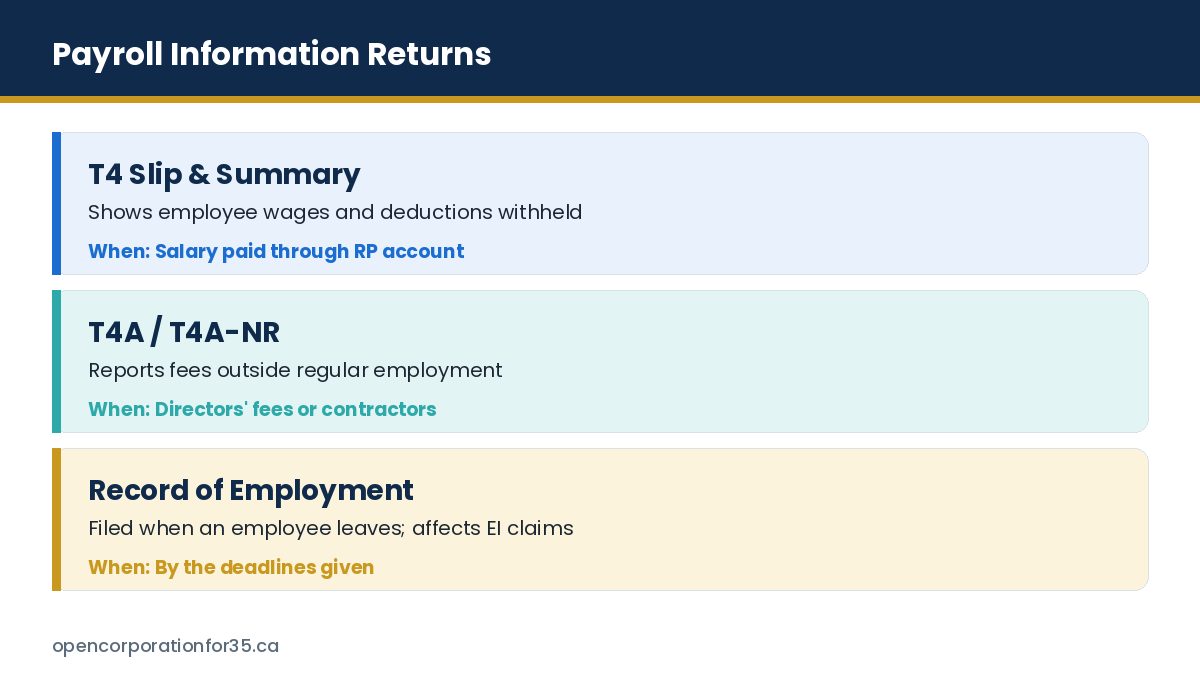
| Information Return | Purpose | When Required |
|---|---|---|
| T4 Slip & Summary | Shows employee wages & deductions withheld | Needed if salary paid through Payroll account RP |
| T4A / T4A-NR | Reports fees outside regular employment | Used for directors’ fees or contractors |
| Record of Employment (ROE) | Filed when an employee leaves; affects EI claims | Must file by deadlines given |
Sending these on time meets CRA rules around canadian payroll foreign owner duties. Skipping them risks audits, fines, and more checks on employer remittances and taxes.5
- [^1]: CRA – Filing your T2 Corporation Income Tax Return
- [^2]: CRA – Schedule 97 – Statement Of Amounts Paid Or Credited To Non‑Residents
- [^3]: CRA – Part XIII Withholding Taxes
- [^4]: CRA – Dispositions Of Taxable Canadian Property By Non‑Residents
- [^5]: CRA – Employer’s Guide – Payroll Deductions And Remittances (PD7A)
The T2 is due whether or not the corporation traded. Owners who wound down Canadian activity but left the company registered still owe the return, and the penalty accrues on a nil filing just the same.
Withholding Taxes on Services and Other Payments to Non-Residents
Withholding Taxes on Services and Other Payments to Non-Residents
Part XIII
When a Canadian company pays non-resident owners or contractors, it must follow withholding tax rules. Paying non-resident employees or subcontractors for work done in Canada usually means you need a payroll deduction account. This lets the company hold back taxes and send them to the CRA on time. Doing this keeps things legal and avoids fines.
Payroll Deduction Account Necessity for Payments to Non-Resident Employees and Subcontractors
If you pay a non-resident employee working inside Canada, you have to open a CRA payroll deduction account (RP account). This account helps deduct income tax, CPP, EI premiums, and other source deductions from their pay.
For non-resident subcontractors, things change. If you pay over $15,000 a year, you might need to withhold tax under Part XIII of the Income Tax Act. They don’t count as employees, so no RP account is needed, but withholding still applies.
Here’s what matters about RP accounts:
- You must open one when hiring any employee in Canada.
- Without it, the CRA can charge extra taxes, interest, and penalties.
- It covers residents and non-residents alike.
Part XIII Withholding Tax on Passive Income and Service Payments
Part XIII controls tax withholding on payments like dividends, interest, rent, and service fees paid to non-residents by Canadian entities.
If a Canadian company owned by foreigners pays for services (like consulting) without employment ties, it usually must withhold 15% tax. Treaties can lower this rate sometimes.
Note this differs from regular payroll taxes because:
- No CPP or EI contributions apply here.
- You must send withheld money using special forms like NR4 slips at year-end.
Part XIII.1 Tax for Authorized Foreign Banks and Related Payroll Considerations
Foreign banks running branches in Canada have specific payroll rules under Part XIII.1 that affect investment income from Canadian sources.
Though mainly aimed at banks—not normal companies—it means foreign-owned businesses with payroll should check if these special rules matter.
Payroll teams should look out for payments connected indirectly to such activities when handling pay for foreign bank-related employees.
Compliance Requirements for Withholding Tax on Services Rendered in Canada
Companies hiring non-residents to provide services in Canada face some rules:
- Figure out if workers are employees or independent contractors.
- Get an RP account if they work physically in Canada.
- Apply Regulation 102 when paying non-employees inside provinces like Ontario—this usually means 15% federal withholding on gross pay.
- Try to get waivers with Form RC473; otherwise stick to standard withholding rates.
If these rules are ignored, the CRA can audit and demand unpaid taxes plus fines that range from 10% up to 20%.
Businesses should have clear policies to deduct taxes properly before paying anyone taxable.
Procedures for Payroll Remittance and Reporting of Withheld Amounts
- Send Payments On Time: Employers must send withheld amounts plus employer contributions by due dates depending on remitter type. Monthly deadlines get faster if you owe over $25K per quarter.
- File Returns: Regularly file PD7A statements showing all deducted sums. Also submit T4/T4 Summary slips after the year ends with correct wage info.
- Provide Correct Slips: For contractors paid without employment status but subject to withholding, file T4A-NR slips reporting gross pay and withheld tax by February 28 next year.
Companies handling payroll for non resident corporation canada benefit from expert help to avoid mistakes during setup and ongoing management.
- 1: CRA – Employer’s Guide – Payroll Deductions
- 2: Income Tax Act – Section 212(1)
- 3: CRA – Filing NR4 Information Return
- 4: Canada Revenue Agency – Foreign Bank Branch Rules
- 5: Ibid
- 6: CRA Penalties & Interest – Failure To Remit Source Deductions
- 7: CRA Remitter Types & Due Dates
- 8: PD7A Statement Of Account For Current Source Deductions
- 9: T4A-NR Information Return Guide
The employee against contractor question is decided by how the work is actually controlled, not by what the agreement says. A contract calling someone a contractor carries very little weight if the day to day arrangement looks like employment.
Text CTA:
Need expert help setting up compliant payroll setup canada non resident? Contact Gondaliya CPA today at 647‑212‑9559 or info@gondaliyacpa.ca for your free consultation tailored specifically toward payroll for non resident corporation canada.
Support, Resources, and Compliance for Non-Resident Payroll Management
Support, Resources, and Compliance for Non-Resident Payroll Management
Support
Handling payroll for a non-resident corporation in Canada can be tricky. Foreign owners need clear info on CRA rules and withholding laws like Regulation 102. This helps avoid fines and headaches. Here, you’ll find the key support and advice for setting up payroll right and keeping it running smoothly.
Accessing CRA Guides, Forms, and Technical References for Non-Resident Payroll
The Canada Revenue Agency (CRA) offers useful guides and forms just for non-resident employers who want to set up payroll in Canada. Important stuff includes:
- CRA Payroll Program Account Registration: You must open an RP (Payroll) account tied to your business number before paying workers or directors[1].
- Forms TD1 (Federal/Provincial): These forms tell you how much tax to deduct based on employee credits[2].
- Non-Resident Employer Certification (Form RC473): Needed if you want to ask for a waiver on some source deductions under Regulation 102[3].
- Technical Bulletins on Withholding Taxes: The CRA has detailed info about withholding rules under Regulations 102 & 105[4].
You can find all these on the official Canada.ca site. Using these guides keeps your payroll legal and fits the special needs of foreign owners.
Best Practices for Maintaining Payroll Compliance for Foreign-Owned Corporations
Foreign-owned companies running Canadian payrolls have to stick to CRA rules carefully. That means registering on time, sending payments when due, calculating deductions correctly, and keeping good records.
Here’s what you should do:
- Sign up for a CRA RP account as soon as you hire or pay anyone in Canada.
- Use correct tax rates—Regulation 102’s withholding rate is 15% in 2026, mostly on payments outside normal employee pay[5].
- Get valid Social Insurance Numbers (SINs) from everyone paid.
- Send your remittances by your assigned deadlines; missing dates leads to penalties.
- Keep detailed records of pay periods, taxable benefits, and yearly T4 slips.
Following these steps lowers your chance of audits and keeps your non resident corporation Canada-wide on the right side of the law.
| Best Practice | Why It Matters | Source |
|---|---|---|
| Register RP Account On Time | Required before paying anyone | CRA Guide RC4110 |
| Use Correct Deduction Rates | Avoid overpaying or underpaying taxes | CRA Reg. 102 Notice |
| Collect SIN & TD1 Forms | Confirms employee identity; sets tax credits | Service Canada |
| Meet Remittance Deadlines | Prevents late filing penalties | PD7A Filing Rules |
Stick to these and your Canadian payroll stays solid no matter where your company is based.
Gondaliya CPA Recommendations for Accurate Payroll Setup and Management
Gondaliya CPA says it’s best to plan well and get help when setting up Canadian payroll as a foreign owner:
- Know who the employer really is—corporation or individual.
- Work with CPAs who understand cross-border issues like director fees versus salaries.
- Use software that works with QuickBooks or Xero but still double-check manually.
- Open a Canadian bank account to make electronic payments easier and timely.
- Review compensation plans often with updates like CPP changes coming in 2026[6].
- Do regular audits yourself or hire experts who know trust accounts well.
Doing this cuts down errors common among newcomers handling tricky international payroll rules.
Contact Information and Expert Support for Payroll Registration and Compliance
If you need help with things like Form RC473 submissions or want to know how long processing takes, expert advice makes a big difference:
Contact Gondaliya CPA:
Phone: 647‑212‑9559
Email: info@gondaliyacpa.ca
We speed up registrations in all provinces. Processing time usually runs from two to six weeks depending on your paperwork[7]. We also guide you on what proof the CRA needs so you get approvals faster without extra delays.
Getting professional help reduces risks of missing deadlines or misinterpreting rules that hurt your chances of getting relief under the law.
Payroll Withholding Relief Provisions Under Recent Legislation and Employer Protections
Recent changes let some non-resident employers get relief from full source deductions by submitting Form RC473 waivers[8].
Here’s what stands out:
- The Regulation 102 withholding rate stays at 15%, mainly where no waiver applies[5].
- Certified employers can hold back less tax if they prove they won’t miss payments[8].
- There are protections that keep directors living outside Canada safe from personal liability if they follow rules carefully[9].
Knowing this helps foreign-owned businesses handle cash flow better while staying legal with employee pay reporting across Canada.
- [1]: CRA – Opening a Business Number
- [2]: CRA – TD1 Personal Tax Credits Return
- [3]: CRA – Non Resident Employer Certification Form RC473
- [4]: CRA – Technical Information Bulletin IT‐533R3
- [5]: Canada Gazette Part II – Regulations Amending Income Tax Regulations re Regulation 102 Rate Effective January 2026
- [6]: CPP Contribution Rates & Maximum Pensionable Earnings – Effective Jan 2026
- [7]: Internal experience data; average processing time varies per case complexity
- [8]: CRA Guidance on Waiver Applications Under Regulation 102
- [9]: Director Liability Guidelines – Source Deductions Trust Accounts Examination Manual
A Canadian bank account is technically optional and practically essential. Remittance deadlines are tight enough that an international transfer arriving a day late turns a compliant payroll into a penalty.
Frequently Asked Questions
Frequently Asked Questions
FAQ
How Often Must a Canadian Corporation Remit Source Deductions?+
Canadian corporations must remit source deductions based on their assigned remitter type. Regular remitters pay within three business days after month-end. Quarterly remitters pay within one month after quarter-end. Missing deadlines triggers penalties and interest.
What Are the Payroll Rules When the Employee Is Not a Resident of Canada?+
Non-resident employees require payroll deductions for income tax, CPP, and EI unless exemptions apply. Employers must register for a CRA payroll account and withhold accordingly from the first day of employment in Canada.
Employee or Independent Contractor – Why Does It Matter for a Foreign Owner?+
Classification affects payroll obligations. Employees need source deductions and T4 slips. Contractors require Part XIII withholding tax and T4A-NR slips. Misclassification risks audits and penalties.
What Provincial Payroll Registrations Apply Beyond the CRA?+
Some provinces require extra payroll registrations like Ontario’s Employer Health Tax (EHT). These depend on total payroll amounts and vary by province. Foreign-owned companies must check provincial requirements alongside CRA registration.
What Are the Steps to Set Up Payroll in Canada as a Non-Resident?+
First, get a Business Number (BN). Then register for a CRA Payroll Account (RP account). Collect employee SINs and TD1 forms. Calculate source deductions correctly. Finally, remit on time and file year-end returns.
Do You Need a Canadian Bank Account to Run Payroll?+
While not mandatory, a Canadian bank account simplifies electronic payments and remittances to the CRA. It speeds up processing and helps meet tight remittance deadlines efficiently.
What Are the Year-End Payroll Filings for a Canadian Corporation?+
Employers must file T4 slips and summaries for employees. For contractors or non-resident payments, file T4A or T4A-NR slips. Record of Employment (ROE) is needed when an employee leaves affecting EI claims.
What Happens If a Non-Resident-Owned Corporation Misses Payroll Remittances?+
The CRA imposes penalties starting at 5% plus daily interest on late payments. Continued failure can trigger audits, fines, and director liability even if directors reside outside Canada.
Does Being on a Canadian Payroll Give You a Work Permit or Immigration Status?+
No. Payroll status does not grant work permits or change immigration status. Foreign owners must obtain proper visas separately to work legally in Canada.
What Does Payroll Setup and Processing Cost for a Non-Resident-Owned Corporation?+
Costs vary by service provider but typically include setup fees plus monthly charges per employee. Professional firms like Gondaliya CPA offer tailored packages to optimize costs while ensuring compliance.
Payroll Route: DIY vs Software Alone vs CPA-Managed Payroll – Which Fits?+
DIY suits small operations with simple needs but risks errors. Software automates calculations but needs oversight. CPA-managed payroll offers expert compliance support for complex foreign ownership structures.
How Do We Set Up and Run Payroll for Non-Residents at Open Corporation For $35?+
Open Corporation offers streamlined payroll services including CRA registrations, remittance management, and year-end filings at an affordable flat fee with expert guidance from Gondaliya CPA.
What Deliverables Do You Get With Our Non-Resident Payroll Service?+
You receive CRA registration support, accurate calculation of deductions, timely remittances, preparation of T4/T4A slips, Regulation 102 waiver assistance, and ongoing compliance monitoring.
What Are the Risks, Compliance Issues, and Prevention Controls?+
Risks include incorrect deductions, late remittances, misclassification of workers, and missing waivers like RC473. Prevention involves timely registrations, accurate recordkeeping, expert reviews, and using certified professionals like Gondaliya CPA.
What Should a Non-Resident Prepare Before Setting Up Canadian Payroll?+
Prepare your Business Number (BN), employee Social Insurance Numbers (SIN), contracts clearly defining roles, TD1 forms for tax credits, proof of residency status if claiming exemptions, and select an authorized representative if abroad.
How Does Payroll Differ Across the 10 Industries We Serve?+
Payroll rules vary by industry due to union agreements, benefit plans, overtime rules, and provincial levies. Gondaliya CPA customizes payroll processes to fit each industry’s unique regulations while maintaining CRA compliance.
The immigration question comes up in almost every enquiry. Being on a Canadian payroll proves nothing about status, and a non-resident owner drawing a salary still needs the right permit before performing work inside Canada.
Choosing the Right Payroll Partner as a Non-Resident Owner
Choosing the Right Payroll Partner as a Non-Resident Owner
Choosing
- Assess expertise in non-resident Canadian payroll regulations.
- Verify experience with Regulation 102 waivers & Form RC473 applications.
- Ensure clear communication about deadlines & filings.
- Look for integration with accounting software you use.
- Choose firms offering transparent pricing without hidden fees.
- Confirm availability of ongoing support post setup.
- Prioritize partners who provide comprehensive compliance checks.
- Consider reputation backed by proven client success stories.
- Ask about handling provincial payroll taxes beyond federal obligations.
- Opt for providers familiar with cross-border taxation complexities.
- Select firms with bilingual support if needed.
- Ensure data security standards meet Canadian privacy laws.
- Seek partners who simplify year-end reporting processes.
- Verify ability to assist with audits or CRA inquiries promptly.
- Prefer firms offering flexible service plans scalable to growth.
- Choose providers that deliver clear documentation & training materials.
- Confirm responsiveness during peak filing periods.
- Assess capacity to handle multiple jurisdictions if applicable.
- Select partners integrating well with your financial operations software.
- Ensure accessibility via multiple communication channels (phone/email).
For reliable assistance with payroll Canada non resident matters contact Gondaliya CPA today at 647‑212‑9559 or info@gondaliyacpa.ca.
Ask any prospective provider who signs the remittance and who carries the liability if it is late. The answer separates a payroll bureau from a firm that stands behind the filing.
Professional Guidance on Non-Resident Payroll: How Gondaliya CPA Supports Foreign-Owned Corporations
Professional Guidance and Quick Reference
Guidance
Non-resident payroll is a sequencing problem before it is a calculation problem. The Business Number has to exist before the RP account, the RP account before the first pay run, and the RC473 application before the assignment starts. Get that order wrong and the deductions are already late by the time anyone notices.
Gondaliya CPA handles the whole sequence in one place, so the registrations, the deduction calculations, the remittances and the year-end slips are done by the same team. That matters most on source deductions, because they are held in trust and the liability reaches directors personally.
We work to current CRA rates and thresholds and confirm your remitter type before the first pay run rather than after the first penalty.
Quick Answers: Key Numbers & Concepts at a Glance
At a Glance
- Regulation 102 withholding: 15% flat rate
- Regulation 105 withholding: Around 25% on fees paid overseas
- CPP rate: 5.95% each side, on earnings to $68,700
- EI premium: 1.63%, multiplied by 1.4 for employers
- EI maximum earnings: $61,500
- Ontario EHT exemption: Payroll under $490,000
- Regular remitter deadline: Three business days after month-end
- Quarterly remitter deadline: One month after quarter-end
- Late remittance penalty: From 5% plus daily interest
- RC473 processing: Usually four to six weeks
Who This Is For / Not For
Fit Check
- For: Foreign-owned Canadian corporations about to hire their first employee here, non-resident owners paying themselves a salary, companies sending staff to work temporarily in Canada, and anyone who needs an RP account and a remittance schedule set up correctly.
- Not For: Businesses with no one performing work inside Canada, owners taking dividends only rather than salary, and anyone hoping payroll registration will support an immigration application.
People Also Ask
Quick Answers
Can I pay myself dividends instead and skip payroll?+
Dividends avoid source deductions but carry their own withholding and reporting, and they are paid from after-tax profit. The choice between salary and dividends should be modelled rather than assumed.
What happens if I open the RP account after the first pay run?+
The obligation started with the first day of work, so the deductions are already late. Register and remit as soon as possible, because the penalty grows with the delay.
Does the RC473 certification remove all deductions?+
No. It addresses income tax withholding under Regulation 102. CPP and EI still apply unless a separate exemption or a social security agreement certificate covers them.
Glossary of Key Terms
Plain-English Definitions
- RP account: The CRA payroll program account attached to your Business Number.
- Source deductions: Income tax, CPP and EI withheld from pay and held in trust for the CRA.
- Regulation 102: The rule requiring withholding on employment payments to non-residents.
- Regulation 105: The rule requiring withholding on fees for services performed in Canada by non-residents.
- RC473: The Non-Resident Employer Certification application that can waive Regulation 102 withholding.
- Remitter type: The CRA classification that sets how often you must remit.
- PD7A: The statement of account showing current source deductions.
- T4A-NR: The slip reporting fees and withholding for non-resident contractors.
- ROE: The Record of Employment filed when an employee leaves, used for EI claims.
- Director liability: Personal responsibility for unremitted source deductions, which applies regardless of where the director lives.
Open the RP account before the first pay date, settle the employee against contractor question in writing, apply for RC473 before the assignment starts rather than after, and hold a Canadian bank account so remittances land on time. Those four decide whether the first year is routine or expensive.
Non-Resident Payroll Readiness Check
This quick self-check flags which parts of your payroll setup need attention. Please answer the six questions below.
Non-Resident Payroll Readiness Check
Six quick questions on your setup. No fee quoted.
Points to review:
This is a general prompt, not tax or legal advice or a quote. Your position depends on your full facts, so for a real review please book a free consultation.
Want a checklist to work from? Please download our free non-resident payroll checklist before your consultation.

Set up Canadian payroll the right way
RP account registration, correct deduction calculations, remittances filed on your schedule, RC473 waiver support and year-end T4 and T4A-NR slips, all from Open Corporation For $35, backed by a Registered Ontario CPA firm. Please book a free consultation.
What to Send Us
Send us your Business Number, the province your employees will work in, the first pay date you have in mind, and whether anyone is on temporary assignment from abroad. We will confirm your RP account status, your remitter type and whether an RC473 application is worth making, before the first pay run.
Published: August 24, 2026 · Last updated: August 24, 2026
Editorial policy: Our content is prepared by our payroll team and reviewed by Sharad Gondaliya, CPA, and we update it as CRA rates, thresholds and remittance rules change.
Disclaimer: This article is educational information only and is not tax, legal, or financial advice. Contribution rates, thresholds and deadlines change every year, and outcomes depend on your specific facts. Please consult a CPA before acting.