
How to Open a Canadian Business Bank Account as a Non-Resident
Canada business bank account foreign owner guide: opening corporate accounts from abroad, beneficial ownership, and compliance with Bank Act rules
Open Corporation for $35 is a department of Gondaliya CPA. For foreign owners looking to open a Canada business bank account foreign owner, understanding beneficial ownership, GST/HST registration, and Bank Act compliance is essential. Open Corporation simplifies accessing Schedule I and II banks or credit unions while ensuring proper filing of CRA program accounts, business numbers, and banking resolutions for smooth onboarding from abroad.
Quick Summary
The corporation holds the account, not you. Incorporation takes a day; the bank account is where non-residents lose weeks. Anyone holding 25% or more must be named, the registered office must be a real Canadian address, and the documents must match the register exactly.
| Aspect | Details |
|---|---|
| Who holds the account | The corporation, not the individual owner. |
| Beneficial ownership | Anyone with 25% or more must be identified. |
| Registered office | Must be a real Canadian address, not a foreign one. |
| The slow step | Bank onboarding, not incorporation. |
Reading time: 28 minutes.
Table of Contents
- Understanding Business Banking for Non-Residents
- Key Requirements for Foreign Owners
- Beneficial Ownership and Banking Regulations
- Choosing the Right Financial Institution
- Bank Act Account Rules for Foreign-Owned Businesses
- Step-by-Step Guide to Opening from Abroad
- Preparing Essential Documentation
- In-Person versus Remote Onboarding
- Complying with Tax Obligations
- Registered Office and Corporate Registry Accuracy
- Challenges Faced by Non-Residents
- How Open Corporation for $35 Supports You
- Summary of Key Steps
- Frequently Asked Questions
- Professional Guidance and Quick Reference
The Numbers That Matter
This article covers Canada, with Ontario and federal context, for owners living outside Canada. All figures are in Canadian dollars. Bank onboarding policies, FINTRAC guidance and OSFI expectations change, and each institution applies its own risk appetite on top of the rules. Nothing here is a commitment that any bank will approve an application. This is educational information only and not tax, legal, or financial advice.
Understanding Business Banking for Non-Residents in Canada
Understanding Business Banking for Non-Residents
The Basics
Opening a Canadian business bank account as a non-resident can feel tricky. But knowing the main differences and rules helps a lot. This guide breaks down what foreign owners need to know about banking in Canada.
Key Differences Between Resident and Non-Resident Business Banking
Resident and non-resident business banking are not the same. A non resident business bank account Canada lets you open an account without living in the country. Still, banks ask more questions and want more documents from non-residents.
Here’s what changes:
- Non-residents must prove their identity with extra documents.
- Banks check ownership carefully because of rules about money laundering.
- You might face longer approval times and stricter rules.
These points help if you want to open Canadian business bank account non resident and avoid surprises.
Overview of Banking Needs for Foreign-Owned Corporations
Foreign companies need special banking services when setting up in Canada. They usually want:
- To handle Canadian dollars easily for local business.
- Simple ways to get paid by Canadian clients.
- A local bank account to build trust with suppliers or partners.
If you want to open business account Canada from abroad, it’s smart to know the legal steps and practical stuff before you start.
Incorporation is the easy half. We file the company in a day, and then the bank takes four to eight weeks because identity verification for someone outside Canada is a manual review at almost every institution. Owners who plan around the filing date rather than the account date get caught out.
Key Requirements for Opening a Canadian Business Bank Account as a Foreign Owner
Key Requirements for Foreign Owners
Requirements
To open a business bank account as a foreign owner, banks expect certain documents and steps.
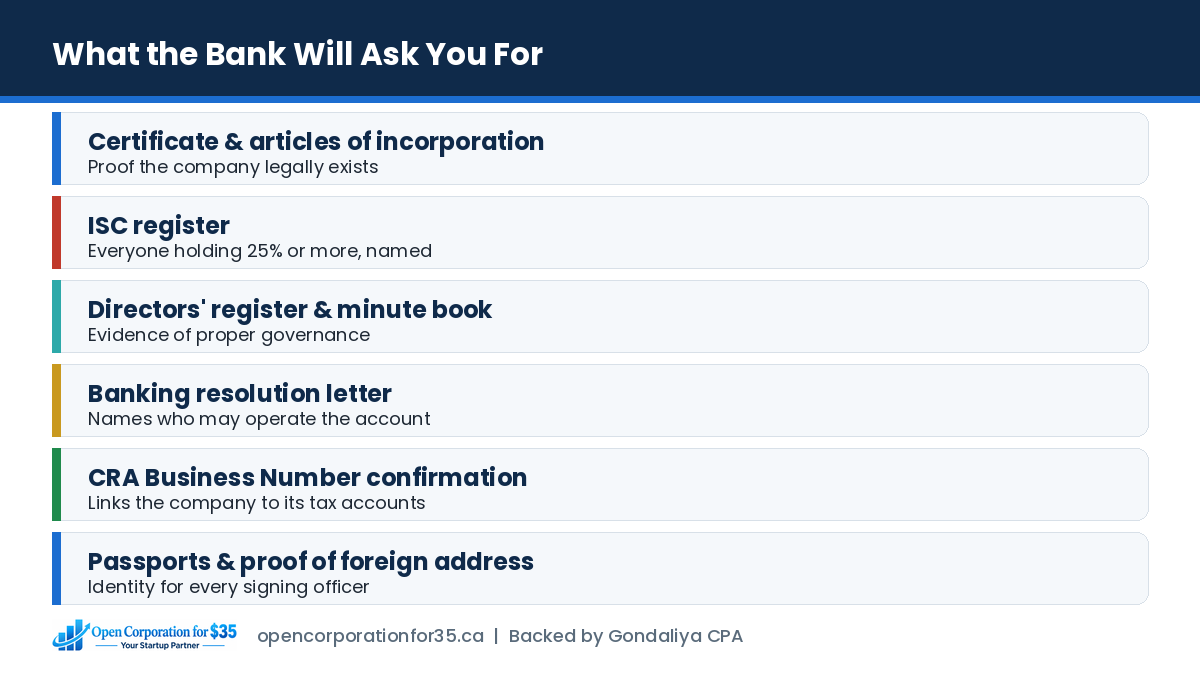
Minimum Documentation and Legal Prerequisites
Banks usually ask for:
- Certificate of Incorporation Canada
- Articles of Incorporation Canada
- ISC register beneficial owners showing who owns the company
These prove your company is real and follow Canadian rules.
Role of Business Registration and Incorporation
Your choice between federal or provincial incorporation matters. It affects your banking options.
- Federal vs Provincial incorporation canada each has pros and cons.
- Federal gives wider recognition across provinces but has more rules.
- Provincial (like OBCA vs CBCA) is easier in one area but might limit expansion.
Pick wisely before trying to open accounts or apply for loans.
Overview of Beneficial Ownership and Compliance with Canadian Banking Regulations
Beneficial Ownership and Banking Regulations
Ownership
Canada wants banks to know who really owns businesses. This helps stop illegal money activities.
Beneficial Ownership Definition and Significance
Beneficial ownership means people who own 25% or more shares must be named clearly. Banks require this under FINTRAC rules. If you own ≥25%, you must disclose it when opening accounts.
Anti-Money Laundering and Due Diligence Requirements
Banks watch out for money laundering risks closely. They screen owners against Politically Exposed Persons (PEP) lists too. These checks follow FINTRAC compliance rules canada banks strictly enforce.
The Role of FINTRAC Identification and ISC Register in Account Opening
FINTRAC
FINTRAC helps banks confirm who you are when you apply for an account in Canada.
Understanding FINTRAC’s Role in Identity Verification
FINTRAC’s identity verification process canadian banks follows includes checking ID carefully before approving accounts. It’s part of national anti-money laundering laws called PCMLTFA.
Use of the ISC (Information Services Corporation) Register
The ISC register directors shareholders list shows official info about company owners over time. Banks use this data to verify beneficial owners during account opening steps.
Risk Warning: The article expands ISC as “Information Services Corporation”, which is a Saskatchewan registry service provider. In the beneficial ownership context ISC means Individuals with Significant Control, and the ISC register is a register the corporation prepares and keeps itself under the CBCA and OBCA. Two different things share the acronym, and the wrong one is used throughout. This needs correcting everywhere it appears.
Insights into Federal and Provincial Incorporation Impacting Banking Eligibility
Choosing the Right Financial Institution
Institutions
Where you incorporate affects which banks will accept your application.
Distinctions Between Federal and Provincial Incorporation
Federal cbca vs ontario obca impact on banking eligibility can be big:
- Provincial vs federal corporation benefits canada differ by coverage area and rules.
- OBCA versus CBCA jurisdictional differences affect governance too.
Impact on Bank Account Eligibility and Options
Banks look at your incorporation type before approving accounts. Extra-provincial registration necessity may come into play if you operate outside your home province. Proper registration boosts chances to open accounts smoothly.
Choosing the Right Financial Institution: Schedule I & II Banks, Credit Unions, and Payment Service Providers
Options
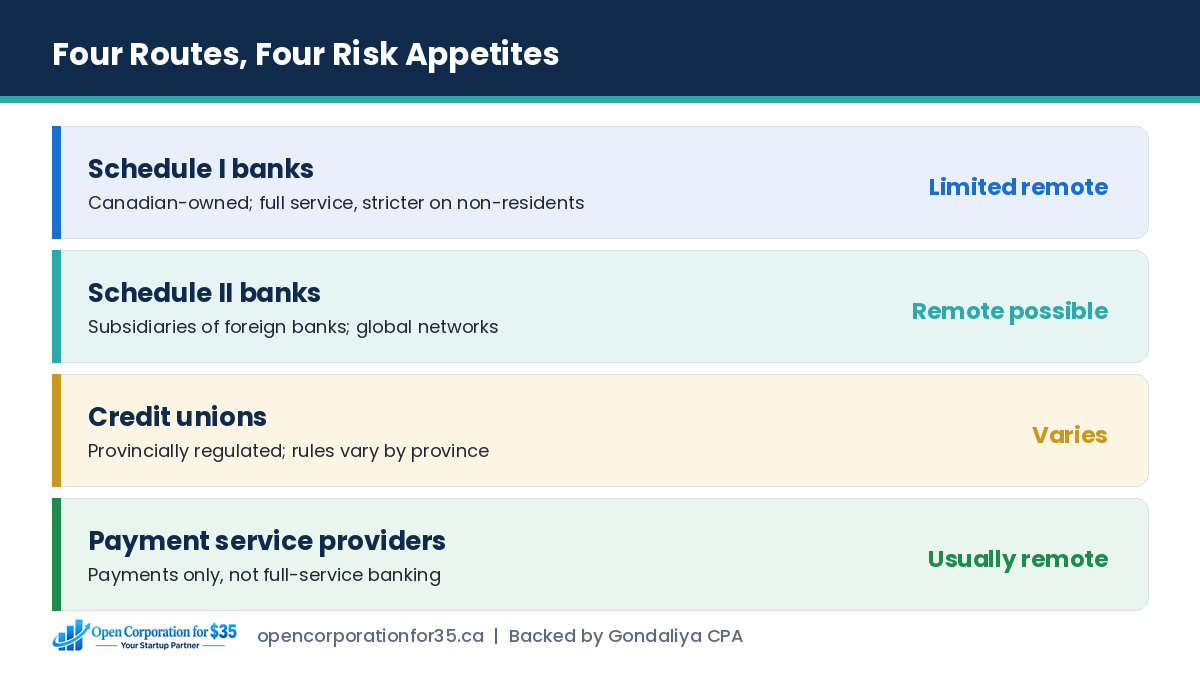
Picking the right financial institution matters a lot when you want to open a Canadian business bank account non resident. Canada has different types of institutions for foreign owners. Each comes with its own rules and perks.
Schedule I banks are Canadian-owned banks approved by the Bank Act. They offer full banking services but can be strict when dealing with non-resident businesses. This is because they follow tight rules and manage risks carefully.
Schedule II banks are branches or subsidiaries of foreign banks in Canada. They might feel more familiar or flexible for international clients. Still, they must obey Canadian rules about who owns the company and who controls it.
Credit unions are local cooperative banks regulated by provinces. They sometimes give friendlier service and lower fees. But each province has its own rules about allowing non-resident companies.
Lastly, payment service providers (PSPs) offer another choice if regular banks don’t fit your needs. PSPs handle payments but don’t provide full banking services. They must follow anti-money laundering laws but work differently than Schedule I or II banks.
Knowing these options helps foreign owners find the best fit when applying for a canada business bank account foreign owner status.
Differences between Schedule I and II Banks
Schedule I and II banks have key differences that matter if you want to open business account Canada from abroad:
- Ownership: Schedule I banks are owned in Canada; Schedule II are tied to foreign parents.
- Clients: Schedule II often serve more international customers linked to their global network.
- Rules: Both follow OSFI and Bank Act regulations but may have different steps for non-residents.
- Access: Some Schedule II banks might let you apply from outside Canada easier.
These points affect how fast you open accounts, what papers you need, and how the bank watches your activity later.
Advantages of Credit Unions and Alternative Banking Providers
If you want a non resident business bank account Canada, credit unions have some perks:
- More flexible since local members run them
- Lower fees than big national banks sometimes
- Services aimed at local businesses or groups
- Residency rules may be easier to meet
Payment service providers also help by letting you handle money online without visiting a branch or giving tons of documents like big banks want.
Comparing Corporate Bank Account Options for Non-Resident Businesses in Canada
| Feature | Schedule I Banks | Schedule II Banks | Credit Unions | Payment Service Providers |
|---|---|---|---|---|
| Regulatory Oversight | OSFI / Bank Act | OSFI / Bank Act | Provincial regulators | FINTRAC / PCMLTFA |
| Suitability for Foreign Owners | Moderate | Higher | Variable | High |
| Remote Onboarding Availability | Limited | Possible | Varies | Usually available |
| Full-Service Banking | Yes | Yes | Often | No |
| International Transaction Support | Comprehensive |
Risk Warning: The last row of this table has only one of four cells filled. International transaction support is listed as “Comprehensive” for Schedule I banks and left blank for the other three, so the row reads as incomplete rather than as a comparison. Please complete it or remove the row.
So, your choice depends on what your business needs most—big firms may like schedule I/II’s network while new businesses might prefer credit unions or PSPs at first.
Account Types and Their Suitability for Foreign Owners
Foreign owners usually pick from these main corporate accounts:
- Operating Accounts: Used daily for bills, payroll, and cash flow—important no matter where you live.
- Savings Accounts: Less common; some banks limit foreigners’ access here.
- Merchant Accounts: Needed if you take credit cards in stores or online; often linked to payment processors following tax rules.
Non resident business bank account canada requests tend to focus on operating accounts first since they handle core business moves in places like Ontario where Open Corporation costs $35.
Overview of Required Features for International Transactions
To open an open business account canada from abroad, look for features made for cross-border deals:
- Handle multiple currencies or convert money easily
- Send wire transfers while following anti-fraud laws (FINTRAC)
- Online banking accessible from anywhere
- Work with global accounting tools like QuickBooks
Banks vary a lot here. Check these features before applying so you avoid slowdowns during identity checks.
Understanding the Bank Act Account Rules Relevant to Foreign-Owned Businesses
Bank Act Account Rules for Foreign-Owned Businesses
Bank Act
The Bank Act sets rules that all federally regulated Canadian banks must follow. It covers verifying who owns a company, keeping records safe, disclosing who controls more than 25%, screening politically exposed persons (PEPs), and checking sanctions lists.
For cases needing canada business bank account foreign owner:
- Banks must verify identity carefully based on updated FINTRAC rules coming in 2026,
- Keep records securely for required times,
- Can refuse service if compliance fails,
- Watch transactions regularly based on risk levels,
These steps keep things clear and reduce risks connected to international corporate banking.
Summary of Bank Act Compliance
Canadian law requires all financial institutions to follow ID checks under the Bank Act plus new FINTRAC rules starting in 2026. This means confirming directors’ identities via official lists and getting shareholder info showing real control above 25%.
Not following this can block applications or cause legal trouble affecting both banks and customers inside Canada’s system.
Restrictions and Allowances for Non-Resident Business Entities
Canada lets anyone incorporate without citizenship limits but sets some conditions:
- You must have an office address inside the province or territory
- Provinces differ on director residency; Ontario lets most directors live outside
- Extra-provincial registration is needed if doing business across provinces
- High-risk industries face more checks during sign-up
These rules balance openness with protecting Canada’s financial system.
Importance of Entity Identification, Directors, and Shareholder Structure For Account Approval
Banks check company validity by verifying incorporation papers plus director/shareholder lists that name people holding big stakes (usually 25% or more).
This info helps stop fraud by making sure fund controllers match real owners—key when trying to open canadian business bank account non resident.
Verification Of Directors And Officers
Directors
Verification means checking IDs issued by governments plus registry data confirming directors’ appointments and current roles as recorded provincially (Ontario Business Registry) or federally (Corporations Canada/ISED).
Banks also screen PEPs since officers with public jobs abroad raise risks related to reputation inside Canada.
Shareholder Disclosures In The Onboarding Process
Shareholders
Shareholders owning 25% or more counts as beneficial owners who must disclose their identities during application along with proof like share certificates or register extracts showing exact ownership percentages matching public filings via ISC registers.
This transparency stops misrepresentation which can delay approvals until issues clear according to strict federal AML/CFT rules enforced after 2026.
Key Stat: The register of individuals with significant control is not a public filing you look up. The corporation creates and maintains it, and the bank asks you to produce it. If yours does not exist yet, that is the item that stalls the application, not the passport copies.
Step-by-Step Guide to Opening a Canadian Business Bank Account from Abroad
Step-by-Step Guide to Opening from Abroad
The Steps
Opening a business account Canada from abroad takes some planning. Non-residents can open Canadian business bank accounts, but they need to follow certain steps.
- Incorporate Your Canadian Corporation
You can choose Ontario or federal incorporation. Get your articles of incorporation, certificate, and corporate profile ready. - Gather Corporate Records
Collect documents like the ISC register (which lists beneficial owners), directors’ register, minute book, and the banking resolution letter. - Register for a Business Number (BN) with CRA
You can apply online or by mail. This gets you your BN and program accounts such as GST/HST if needed. - Prepare Identification Documents
Make sure you have passports and other IDs for all signing officers and anyone who owns 25% or more of shares. - Confirm Registered Office Address in Canada
You must have a physical registered office address in Canada. Foreign addresses alone won’t work. - Select Institution Category
Decide if you want to use Schedule I banks, subsidiaries of foreign banks (Schedule II), credit unions, or regulated payment service providers based on your business. - Submit Application Package Remotely or In-Person
Some banks let you apply remotely with FINTRAC-compliant methods; others may require you to be there in person. - Complete Compliance Questions & Beneficial Ownership Disclosure
Provide detailed ownership info as FINTRAC requires disclosure for owners with 25% or more shares to avoid delays. - Activate Online Banking & Set Up Payment Rails
After approval, set up authorized signatories and link electronic payment methods tied to CRA program accounts.
Preparing Essential Documentation Including Business Number and GST/HST Registration
Preparing Essential Documentation
Documents
If you’re a non-resident owner, you’ll need several documents before applying for a Canada business bank account foreign owner status:
- Certificate of Incorporation & Articles: Proof from Ontario Business Registry or Corporations Canada.
- Corporate Profile & ISC Register: Shows current directors and big shareholders.
- Directors’ Register & Minute Book: Proves proper governance.
- Banking Resolution Letter: Lets certain officers operate the account.
- Business Number (BN) Confirmation: From CRA; needed for tax filings.
- GST/HST Registration Certificate: Needed if sales pass $30,000 CAD yearly; sometimes non-residents need security deposits.
- Passports/Secondary ID: Official photo IDs for identity checks.
- Proof of Foreign Residential Address: Bills or official papers showing where you live outside Canada.
- Registered Office Confirmation: Letter proving you have a real address inside Canada.
You must list beneficial owners carefully following FINTRAC rules. Missing this can cause refusals.
How to Manage Banking Resolutions and Shareholder Approvals for Non-Resident Corporations
A banking resolution letter states who can act for the company’s bank accounts:
- The board approves specific officers as signers.
- It may also state transaction limits.
- Shareholders sometimes approve new directors who handle banking.
Good governance helps speed things up during onboarding:
| Document Type | Purpose | When Needed |
|---|---|---|
| Banking Resolution | Authorize signers | Before applying |
| Shareholder Approval | Confirm director appointments | If there are changes |
| Board Meeting Minutes | Record banking decisions | For audits |
Keep your records updated to avoid problems during compliance checks.
Navigating In-Person Requirements versus Remote Account Onboarding Procedures
In-Person versus Remote Onboarding
Onboarding
Canadian banks differ on whether they allow remote onboarding or need you to travel for opening accounts.
In-Person Attendance
In Person
Some banks require visiting their branch in Canada because of strict KYC rules under OSFI regulations. They may ask for biometric checks plus document review.
Remote Onboarding
Remote
Other banks allow video calls with certified documents following FINTRAC’s identification rules. Sometimes agents with power-of-attorney handle things physically if you can’t come yourself—but this depends on bank policy.
Which route works depends on:
- The type of bank you pick
- Risk levels assigned to your industry
- How complete your documents are
Check with the bank before starting.
Strategies for Smooth Payment-Processor Onboarding and CRA Program Accounts Setup
To use your Canadian business account well, set up CRA program accounts first and then connect payment processors:
- Get your BN first—it covers payroll deductions (RP), GST/HST (RT), import/export duties (RM).
- Register for the programs needed:
- GST/HST registration means you must charge taxes properly;
- Payroll accounts are required if you have employees in Canada.
- Keep accurate records that sync with popular accounting tools like QuickBooks or Xero used by accountants helping non-residents.
- Work closely with your bank’s compliance team and payment processor reps to ensure KYC info matches perfectly. This avoids delays caused by mismatched data during cross-border setups.
This way, you keep things moving smoothly while staying within reporting rules.
Complying with Tax Obligations: T2 Filing, Part XIII Withholding, and Permanent Establishment Considerations
Complying with Tax Obligations
Tax
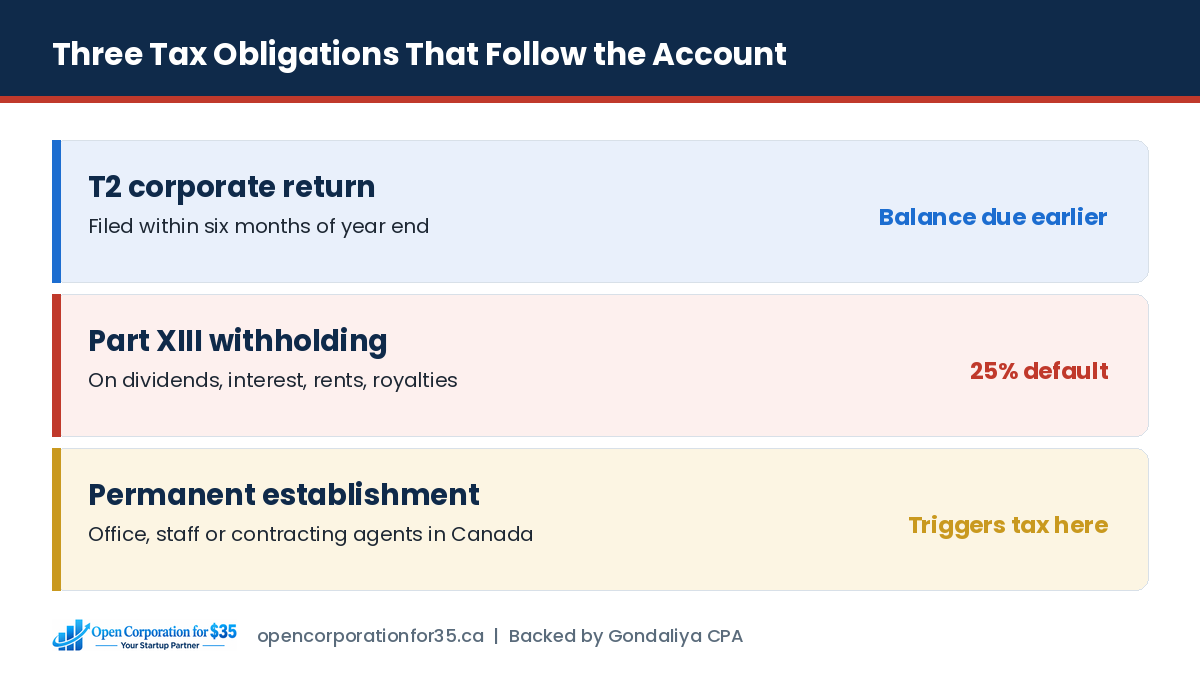
If you’re a non-resident corporation with a Canadian business bank account, you have tax duties to meet. Every year, your company must file the T2 corporate income tax return within six months after your fiscal year ends. It doesn’t matter if you make money in Canada or not. Missing this can cause penalties and interest charges.
Part XIII withholding tax applies when non-residents get certain passive income from Canada. This includes dividends, interest, rents, or royalties. The default rate is 25%, but tax treaties might lower that amount. You need to withhold correctly and pay on time to avoid trouble.
Permanent establishment (PE) status decides if your foreign-owned SMB has enough presence in Canada to pay corporate taxes here. Things like having an office, staff, agents who can sign contracts, or big economic activity count toward PE. This affects both federal and provincial taxes.
Don’t forget about CRA program accounts. They help you handle payroll deductions (RP), GST/HST collections (RT), import/export duties (RM), and other taxes linked to your business activities. Opening these accounts soon after incorporation keeps your banking smooth and compliant.
Here’s a quick list to remember:
- File T2 annually within six months
- Apply Part XIII withholding tax on passive income
- Check if your business counts as a Permanent Establishment
- Open required CRA program accounts quickly
Risk Warning: The six-month figure is the filing deadline only. Any balance of tax owing is due earlier, and interest runs from that earlier date. This distinction matters more for non-residents, who often assume a single deadline covers both. Please state the payment date separately wherever the T2 deadline appears.
Cross-Border Tax Implications for Foreign-Owned SMBs Operating in Canada
Foreign owners opening a Canada business bank account face special cross-border tax rules. You need to understand how Part XIII withholding tax works when your Canadian subsidiary or branch pays distributions.
Opening a business account from abroad means you should know how treaties affect withholding rates on dividends or interest. These treaties differ a lot between countries. So, ask advisors who know both places well.
The type of financial institution—Schedule I banks or regulated payment providers—may watch transactions differently but won’t change your tax responsibilities.
Keeping clear records of who owns what is important too. It helps meet FINTRAC rules about beneficial ownership and supports correct CRA filings tied to foreign ownership info.
Key points:
- Watch Part XIII withholding on payments to foreign owners
- Learn treaty rules before opening accounts from abroad
- Different institutions monitor transactions differently
- Keep detailed ownership records for FINTRAC and CRA
Maintaining Registered Office and Corporate Registry Data Accuracy in Ontario and Federal Jurisdictions
Registered Office and Corporate Registry Accuracy
Registry
You must have a valid registered office address in the place where you incorporated before opening any non resident business bank account Canada-wide. This address is where legal papers go and where you keep corporate records.
If you incorporate online canada non resident using platforms like Open Corporation for $35, you’ll provide this address upfront. Whether you register in Ontario under OBCA or federally through Corporations Canada/ISED, keeping your registry info current avoids delays during bank checks.
Banks want to see updated articles of incorporation, directors’ registers showing beneficial owners owning 25%+, minute books with resolutions authorizing signers—all linked to the registered office on file.
If you don’t update changes fast enough, banks might reject your applications during their due diligence reviews under OSFI rules effective 2026.
Quick checklist:
- Have a valid registered office address before banking
- Provide registered office confirmation when incorporating online canada non resident
- Keep corporate data updated at Ontario Business Registry or Corporations Canada
- Make sure banking documents link back to the registered office address
- Update changes promptly to avoid rejection
Managing Extra-Provincial Registration and Ongoing Corporate Compliance Requirements
Extra-provincial registration is needed if your federally incorporated company runs operations outside its home province. For example, having branches in Alberta or British Columbia while being incorporated elsewhere. Without this registration, you can’t legally do business there or open local bank accounts for those provinces.
Canadian corporate compliance 2026 rules require annual returns filed through ServiceOntario’s Ontario Business Registry for OBCA companies or Corporations Canada’s system for CBCA firms. These returns confirm director details stay correct along with updated shareholder info that supports beneficial ownership checks per FINTRAC requirements.
You also need to renew CRA program accounts yearly if your revenues reach GST/HST remittance thresholds or if you hire locally. Missing these could disrupt electronic fund transfers linked to your Canadian business bank account opened from abroad.
Here’s what you should do:
- Register extra-provincially when operating outside home province
- File annual returns via relevant provincial/federal portals by 2026 deadlines
- Keep director and shareholder info up-to-date for FINTRAC rules
- Renew CRA program accounts based on revenue and payroll status
- Avoid gaps that could affect banking or funds transfers
Get the corporate package banks actually ask for
Incorporation from $35 plus HST and government fees, an Ontario registered office address, the ISC register and CRA accounts prepared. Please book a free consultation.
Challenges Faced by Non-Residents When Opening Business Bank Accounts in Canada
Challenges Faced by Non-Residents
Challenges
Opening a Canadian business bank account as a non-resident is not simple. Banks ask for strict ID checks under FINTRAC rules. They want to confirm who owns the business and if it really exists. Non-residents face problems like not having a Canadian address or trouble sending documents from far away. Each bank has different rules, which makes things harder.
Many foreign owners find proof of identity and residency confusing. Banks often want local directors or signing officers. If you don’t have them, your application might get stuck. Some banks worry about risks in certain industries or countries because of money laundering rules. This can cause delays or rejections when trying to open accounts from abroad.
People applying for a non resident business bank account Canada must deal with all these issues while following banking laws and tax rules. Knowing these challenges before you try to open business accounts Canada from abroad helps you prepare better.
Practical Solutions to Overcome Common Barriers in International Business Banking
Foreign owners looking to open canadian business bank account non resident should gather all needed papers carefully. You need:
- Certified copies of your incorporation certificates
- Articles of incorporation
- Corporate profiles from the ISC register
- Minutes showing board resolutions for banking signatories
- Passports of anyone owning 25% or more shares (per FINTRAC)
- Proof of your foreign home address
Hiring experts who know Canadian banking rules makes this easier. Some banks accept remote onboarding using digital ID checks that meet OSFI rules, but not all banks agree on this. Schedule I banks might be stricter than credit unions.
Choosing Ontario incorporation under OBCA is helpful since it explains director residency better than federal CBCA rules. Also, having a registered office in Canada is required by law and helps get approval faster.
Tell the bank clearly about how you will use the account and where your funds come from. This lowers their risk worries during checks. Also, set up your CRA tax accounts early so tax filings and payments run smoothly once your account is ready.
Risk Management and Compliance Best Practices for Foreign Owners
In Canada, beneficial ownership disclosure means you must name everyone who owns 25% or more of the company. Banks follow strict KYC (Know Your Customer) checks based on FINTRAC rules. They watch accounts regularly after opening to spot any illegal activity like money laundering.
Foreign owners must keep up-to-date records of directors and shareholders through ISC. Not telling full ownership info can cause delays or even rejections because banks see higher risks.
Canadian banking compliance non resident steps include checking government IDs plus other proofs like utility bills that show you live outside Canada but have legal ties through registered offices.
Risk controls do not stop after you open the account. Companies must have clear internal rules about who can sign on the account, shown with formal board meeting minutes. Keep your info in line with Corporations Canada or Ontario Business Registry, CRA registrations, and what the bank knows about your business.
How Open Corporation for $35 Supports Non-Resident Entrepreneurs with Banking and Incorporation Services
How Open Corporation for $35 Supports You
Our Service
Open Corporation for $35 offers a low-cost online service to help non-residents incorporate their businesses in Canada. They file companies same-day under OBCA or federal law, keeping non-resident needs in mind.
Their CPA backed incorporation canada process includes free advice on tricky areas like beneficial ownership disclosure, setting up registered offices (including Toronto options), registering with CRA before applying for bank accounts, and preparing documents that meet 2026 FINTRAC ID standards.
They guide clients through each step—from forming the company to delivering complete corporate records ready for banks—helping avoid common mistakes many foreign founders make when going alone.
Contact info@gondaliyacpa.ca or call 647-212-9559 any day 9:00 AM – 8:30 PM Toronto time for a free chat about opening Canadian business bank accounts as a non-resident entrepreneur.
Summary of Key Steps to Secure a Canadian Business Bank Account for Foreign Owners
Summary of Key Steps
Summary
Opening a Canadian business bank account as a non-resident takes some work. The corporation holds the account, not the owner. If you want to open business account Canada from abroad, start by incorporating your company federally or provincially—Ontario is often preferred.
You’ll need to get corporate records like articles of incorporation and the certificate of incorporation. Also, register for CRA program accounts such as GST/HST if your business requires it.
Next, prepare an ISC register showing who owns 25% or more of the company—that’s a FINTRAC rule. You must also provide ID like passports and proof of your foreign address. A registered office in Canada is required; you can’t just use a foreign address.
Some banks offer remote onboarding but it depends on their risk rules. Some want you there in person; others accept verified electronic ID under FINTRAC rules coming in 2026. Having a full banking package ready—like resolutions naming signing officers—helps speed things up.
Applications for non resident business bank account Canada often slow down due to missing documents or unclear money sources. Follow these steps and you’ll be ready to apply confidently at Schedule I banks, credit unions, or regulated payment services.
Benefits of Using Professional Assistance to Streamline Account Opening and Compliance
Foreign owners find professional help useful when opening Canadian business bank accounts. CPA-backed incorporation services know the tricky details about entity IDs, beneficial ownership at 25%, and compliance rules set by OSFI and FINTRAC starting 2026.
Experts cut down mistakes that cause delays—like registry info errors or missing CRA registrations. They also help decide whether to incorporate under Ontario’s OBCA or federal CBCA laws, depending on what fits best for non-residents.
They assist with putting together banking documents that match what institutions expect. Banks’ policies vary across Schedule I banks, foreign bank subsidiaries (Schedule II), credit unions, and money services businesses, so guidance matters.
Professional advice clears up questions about transaction flows needed during onboarding forms. They keep filings up-to-date after your account opens. This support smooths your access to remote business bank account Canada options following new rules for non resident corporation banking everywhere.
Encouraging Action: Begin Your Non-Resident Business Banking Setup Today
Open Corporation for $35 offers affordable CPA-backed help designed just for non-residents wanting a Canadian corporate bank account from abroad. You can incorporate online Toronto fast with flat fees starting at $35 plus HST—no surprise charges here.
We file same-day, give instant NUANS reports, and provide registered office/address services needed by banks before applying for your non resident business bank account Canada.
You get free CPA consultations all along—from first steps through making your ISC register to registering CRA program accounts—which lowers common delays other places cause.
Start now. Get your Canadian company set up legally with expert help made for foreign-owned businesses that need secure access to Canada’s financial system from afar.
Additional Resources and Continuous Support for Business Banking Needs in Canada
After opening your Canadian business bank account, you must keep up with beneficial ownership disclosures at 25% as FINTRAC updates rules in 2026. Keep good records in the ISC register and file annual returns via Ontario Business Registry or Corporations Canada depending on where you incorporated.
Keep your CRA program accounts active if they apply—things like payroll deductions (RP), GST/HST (RT), import/export numbers (RM). Even if you mostly work overseas, this helps stay on top of tax rules from CRA updated yearly.
For ongoing help beyond setup—including bookkeeping advice compatible with QuickBooks or Xero—you can turn to teams focused on non-resident corporation banking needs across all provinces including Ontario’s framework under OBCA laws.
Remember, home-country reporting or exchange control rules are outside our area; check with licensed advisors where you live for those matters.
Sharad Gondaliya, CPA (Canada & USA), has over 10 years helping many Canadian business owners.
FAQs on Opening a Canadian Business Bank Account as a Non-Resident
Frequently Asked Questions
FAQ
What is the role of the Banking Resolution Letter in account opening?+
The Banking Resolution Letter authorizes specific officers to manage corporate bank accounts. It defines who can sign and transact on behalf of the company.
Why are Board Meeting Minutes important for foreign-owned businesses?+
Board Meeting Minutes record official decisions about banking, governance, and director approvals. Banks review these to confirm proper internal controls.
How does Politically Exposed Persons (PEP) screening affect account approval?+
Banks screen owners and officers against PEP lists to manage risk. PEP status may require additional documentation or delay approvals.
What is the significance of OSFI and Bank Act compliance?+
OSFI oversees financial institutions under the Bank Act. Compliance ensures banks follow anti-money laundering rules and identity verification standards.
Can a power-of-attorney help in opening an account remotely?+
Yes, a trustee or mandated agent with power-of-attorney can represent you to submit documents or complete KYC steps if the bank allows.
What CRA program accounts are essential for non-resident corporations?+
Program accounts RC (Payroll), RT (GST/HST), RP (Payroll deductions), and RM (Import/Export) must be registered early for tax compliance.
How does Part XIII withholding tax apply to foreign-owned companies?+
Part XIII tax applies on passive Canadian income paid to non-residents, such as dividends or interest, generally at 25%, but may be reduced by treaties.
Why is extra-provincial registration required?+
Extra-provincial registration is mandatory when doing business outside your incorporation province. It enables legal operations and local banking access.
Risk Warning: The CRA program account answer labels RC as “Payroll” and RP as “Payroll deductions”, listing payroll twice and omitting corporate income tax. RC is the corporate income tax account; RP is payroll deductions. The step-by-step section earlier in this article has it right. Please correct the FAQ to match.
Key Compliance and Operational Points for Non-Resident Business Banking in Canada
Key Points
- Maintain an updated Canadian registered office address through a reliable service provider.
- Ensure ISC register beneficial ownership disclosure matches all documents exactly.
- Use CPA-backed flat-fee packages for seamless incorporation plus compliance consulting.
- Coordinate closely with bank AML officers during onboarding for smooth approvals.
- Prepare shareholder approval and Board Meeting Minutes before applying to avoid bottlenecks.
- Screen directors and shareholders for sanctions or PEP hits before submission to prevent delays.
- Keep corporate governance records updated in Corporations Canada or Ontario Registry portals.
- Use accounting tools like QuickBooks or Xero integrated with CRA program accounts.
- Monitor ongoing compliance including GN26 FINTRAC updates effective 2026 thoroughly.
- Plan around T2 corporate tax filing deadline six months after fiscal year-end strictly.
Additional Considerations for Efficient Foreign-Owned Corporate Banking
Extras
- Opt for Schedule II banks if you need easier remote onboarding aligned with global banking networks.
- Be aware that money services businesses (MSBs) provide limited services but often allow quick setups.
- Verify source of funds clearly during application as institutional rules require transparency.
- Understand that internal bank processes might include ongoing monitoring beyond initial KYC steps.
- Use Interac e-Transfer and EFT wisely for low-cost domestic payments from your business account.
Contact Open Corporation for $35 at info@gondaliyacpa.ca or call 647-212-9559 for expert help setting up your Canadian business bank account remotely with full regulatory support across 13 provinces and territories covered.
Professional Guidance on Non-Resident Banking: How Open Corporation For $35 Helps
Professional Guidance and Quick Reference
Guidance
The account belongs to the corporation, so the bank is really assessing the company: does it exist, who controls it, and does every document tell the same story. Mismatches between the register, the articles and the application are what stall files, not the fact that you live abroad.
Open Corporation For $35, backed by Gondaliya CPA, incorporates the company, prepares the register of individuals with significant control, provides the Ontario registered office and registers the CRA accounts before you approach a bank.
Everything is done remotely, across all 13 provinces and territories.
Quick Answers: Key Numbers & Concepts at a Glance
At a Glance
- Account holder: The corporation, not the individual
- Beneficial ownership threshold: 25% or more
- Registered office: Real Canadian street address required
- Part XIII default rate: 25%, reducible by treaty
- T2 filing: Six months after fiscal year end
- Balance owing: Due earlier than the filing date
- GST/HST threshold: $30,000 in sales
- CRA accounts: RC corporate tax, RT GST/HST, RP payroll, RM import/export
- Institution types: Schedule I, Schedule II, credit unions, PSPs
- Realistic timeline: Weeks, not days, for onboarding
Who This Is For / Not For
Fit Check
- For: Founders abroad who have incorporated or are about to, businesses invoicing Canadian customers, and owners whose first application was declined for documentation reasons.
- Not For: Anyone expecting an account to open in days, and anyone unwilling to disclose beneficial ownership, since that disclosure is not optional.
People Also Ask
Quick Answers
Can I be refused even with perfect documents?+
Yes. Banks apply their own risk appetite on top of the legal requirements, and some decline whole categories of non-resident applicant. A refusal is not necessarily a document problem, so ask what the reason was and try a different institution type.
Should I try a payment provider instead of a bank?+
They open faster and suit early-stage operations, but they are not full-service banks. Check whether deposits are protected and whether the provider supports the payroll and tax remittances you will need.
Does having a Canadian director help?+
It is not legally required in Ontario, but in practice some banks are more comfortable with a resident signing officer. That is a bank policy preference rather than a corporate law requirement.
Glossary of Key Terms
Plain-English Definitions
- Beneficial owner: A person with 25% or more ownership or control.
- ISC register: The register of individuals with significant control, kept by the corporation.
- FINTRAC: Canada’s financial intelligence unit, which sets identification rules.
- PCMLTFA: The federal anti-money-laundering statute FINTRAC administers.
- OSFI: The regulator supervising federally regulated financial institutions.
- Schedule I bank: A Canadian-owned domestic bank.
- Schedule II bank: A Canadian subsidiary of a foreign bank.
- PEP: A politically exposed person, subject to enhanced screening.
- Banking resolution: The board document naming who may operate the account.
- Part XIII: Withholding tax on passive Canadian income paid abroad.
Incorporate first, build the complete document package including the ISC register, register the CRA accounts, then approach the bank. Expect weeks rather than days, and apply to more than one institution type in parallel if timing matters.
Non-Resident Banking Readiness Check
This quick self-check flags what to sort before you apply. Please answer the six questions below.
Non-Resident Banking Readiness Check
Six quick questions on your application. No approval implied.
Points to review:
This is a general prompt, not legal or financial advice, and not a prediction that any bank will approve your application.
Want a checklist to work from? Please download our free non-resident banking checklist before your consultation.
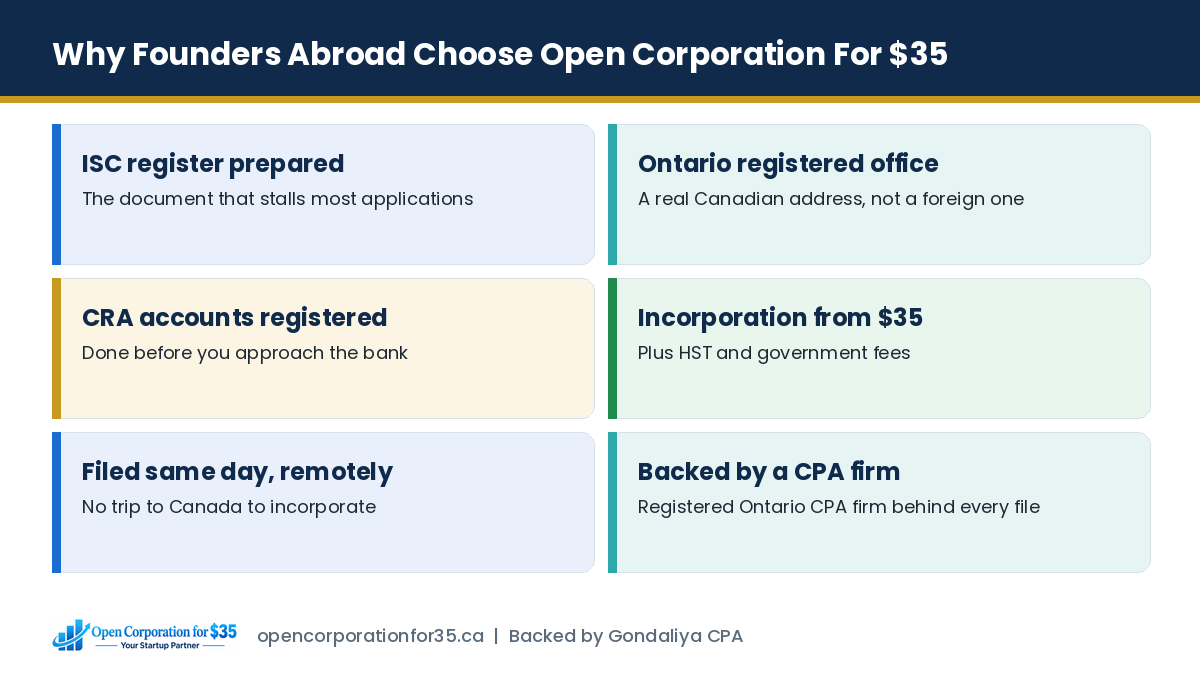
Arrive at the bank with everything they ask for
Incorporation from $35 plus HST and government fees, ISC register prepared, Ontario registered office, and CRA accounts registered. Please book a free consultation.
What to Send Us
Send us where each director and shareholder lives, the ownership percentages, whether you already have a Canadian address, and your target date for the account. We will tell you what is missing before a bank does.
Published: September 8, 2025 · Last updated: September 8, 2025
Editorial policy: Our content is prepared by our team and reviewed by Sharad Gondaliya, CPA, and we update it as FINTRAC guidance, OSFI expectations and CRA requirements change.
Disclaimer: This article is educational information only and is not tax, legal, or financial advice, and is not a recommendation of any financial institution. Account approval is at each institution’s discretion. Please consult a CPA before acting.
Open Corporation for $35 is a department of Gondaliya CPA.
Operated by WealthBamboo Inc. Parent firm Gondaliya CPA Professional Corporation, CPA Ontario firm registration 61330051. Xero Partner Award Winner 2026. 1300+ five-star Google reviews. 30-day money-back guarantee and 60-day fee-matching policy. Phone 647-212-9559, email info@gondaliyacpa.ca, open 9:00 AM to 8:30 PM Monday to Sunday. Payment by Interac e-Transfer to info@gondaliyacpa.ca only, security question “Not Applicable” as auto-deposit is enabled. Card is also accepted.