
When Does Incorporating Actually Save Tax in Canada?
Incorporating Save Tax and Corporation Tax Savings in Canada: When to Incorporate with Open Corporation for $35
Open Corporation for $35 is a department of Gondaliya CPA. TLDR: Incorporating save tax is a key benefit many Canadian entrepreneurs seek, and knowing when to incorporate can maximize your corporation tax savings with Open Corporation for $35. Understanding incorporation tax savings in Canada helps you plan effectively to reduce your overall tax burden and grow your business smartly.
Quick Summary
Most of what incorporation gives you is deferral, not saving. You pay the low corporate rate now and the personal tax later when the money comes out. The real, permanent saving only shows up if profits genuinely stay in the company, or on an eventual sale through the capital gains exemption.
| Aspect | Details |
|---|---|
| What you actually get | Deferral in most cases, not a permanent saving. |
| Ontario small business rate | 12.2% combined, on the first $500,000. |
| When it stops working | If you draw out every dollar you earn. |
| The permanent win | Capital gains exemption on a qualifying sale. |
Reading time: 26 minutes.
Table of Contents
- What Incorporating Means and How It Saves Tax
- When to Incorporate: Key Timing Factors
- Federal versus Provincial Incorporation
- Step-by-Step Guide to Incorporating
- Tax Benefits of Incorporation in Canada
- Advantages and Considerations
- Assessing if Incorporation is Right for You
- Additional Resources and Next Steps
- Frequently Asked Questions
- Key Points on Tax Planning and Compliance
- Professional Guidance and Quick Reference
The Numbers That Matter
This article uses Ontario rates and federal rules for 2026, in Canadian dollars. Corporate and personal rates, the passive income rules, TOSI and the capital gains exemption all change, sometimes mid-year, and the right answer depends entirely on your own numbers. This is educational information only and not tax, legal, or financial advice. Please speak with a CPA about your own situation before incorporating.
Incorporating in Canada: What It Means and How It Can Save You Tax
What Incorporating Means and How It Saves Tax
The Basics
Incorporating in Canada means making your business a separate legal entity. This lets your business own stuff, owe money, and do deals on its own. One big plus is incorporation tax savings. Corporations often pay less tax than individuals do on their income.
Canadian-controlled private corporations (CCPCs) get a special tax break called the small business deduction (SBD). It lowers the federal tax rate on active business income up to $500,000. For example, in Ontario, the combined rate can be as low as 9% in 2026. This gives you chances for solid corporation tax savings, especially if you make a moderate profit.
Risk Warning: The combined Ontario rate is stated here as 9%. That is the federal small business rate on its own. Ontario adds 3.2%, so the combined figure is 12.2%, which is what the rest of this article uses. Please correct this sentence, because a reader comparing 9% against their personal rate is working from a number that is too low.
Also, incorporating lets you keep some earnings inside the company instead of taking all profits as personal income right away. This way, you can pay less tax now by saving or reinvesting money without immediate personal tax.
The question we are really answering is not “should I incorporate” but “how much will you leave in the company”. An owner drawing every dollar out to live on gets almost nothing from the rate difference, because the dividend tax on the way out closes the gap. The owner who leaves $80,000 a year inside gets a genuine benefit. Same business, opposite answer.
When to Incorporate: Key Factors for Timing Your Incorporation
When to Incorporate: Key Timing Factors
Timing
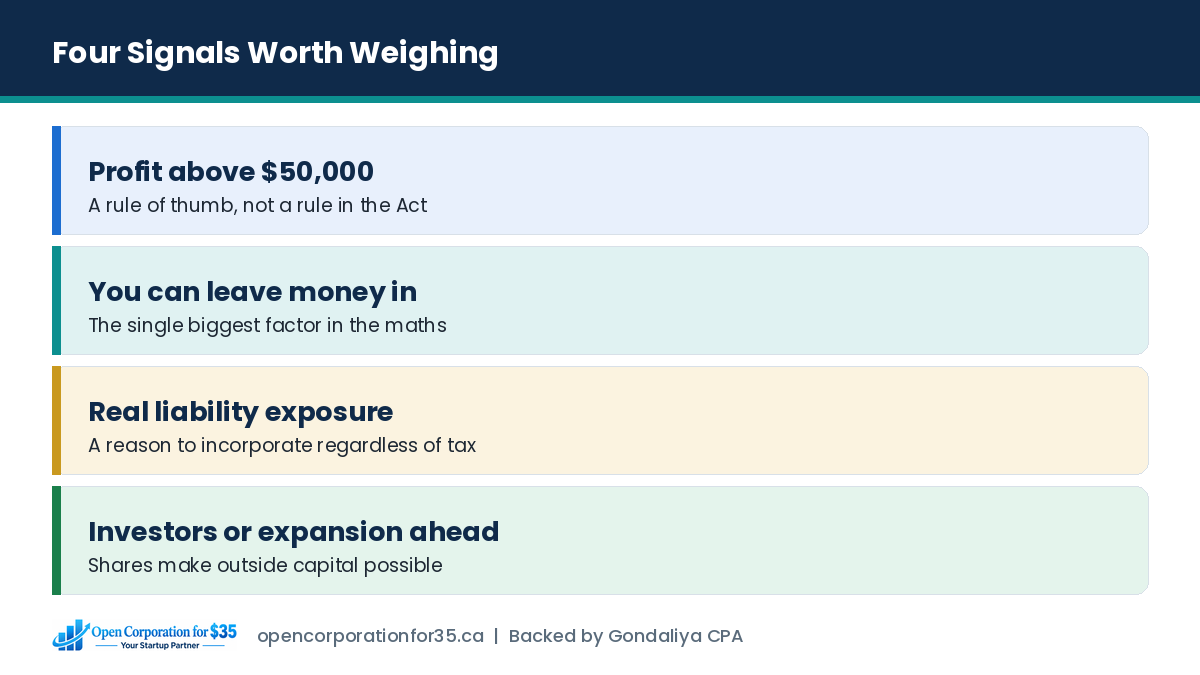
Knowing when to incorporate depends on several things:
- Your profits are usually over $50,000 a year.
- You don’t need all your profits personally at once and want to grow your business.
- Your business risks could put your personal money on the line.
- You plan to expand or bring in investors soon.
Thinking about these points helps you figure out if incorporating save tax makes sense for you. Also, it shows if incorporation fits your bigger plans.
Key Stat: The $50,000 figure is a rule of thumb, not a threshold in the Income Tax Act. What decides it is the gap between your personal marginal rate and 12.2%, multiplied by the profit you genuinely leave in the company, set against roughly $1,000 to $2,000 a year of extra compliance. A business earning $120,000 that spends all of it personally can still be worse off incorporated.
Federal vs Provincial Incorporation: Choosing the Best Option for Your Business
Federal versus Provincial Incorporation
Jurisdiction
When looking at incorporation tax savings Canada, consider federal and provincial routes:
Federal Incorporation
Nationwide
- Gives your business recognition across Canada.
- Usually easier to manage if working in many provinces but still follows rules from where you operate.
Provincial Incorporation
Local
- Matches rules better for local markets.
- Fees may be lower but rules change a lot between places like Ontario, BC, or Alberta.
Your choice depends on whether you want to work nationwide or just nearby. Both choices affect how you plan taxes and run your corporation.
By checking these factors with an eye on tax advantages, you can pick what suits your financial goals under Canadian law best.
Jurisdiction has almost no effect on the tax outcome. Federal and Ontario corporations are taxed the same way, and a federal corporation operating in Ontario still files an Ontario return. Choose on director residency, name protection and where you operate, not on tax.
Step-by-Step Guide to Incorporating Your Business
Step-by-Step Guide to Incorporating
The Steps
Starting a corporation in Canada can help you save on taxes. But knowing when to incorporate matters a lot. Incorporation lets your business pay tax at lower corporate rates instead of personal ones. Still, this depends on how much profit you make and what you do with those earnings. This guide breaks down the steps for incorporating your business while focusing on how incorporating save tax and incorporation tax savings Canada work.
Naming a Corporation: Requirements and Best Practices
Picking a name for your corporation is important. The law says your name must be unique and not confusing. You also need to use words like “Limited,” “Incorporated,” or their short forms (Ltd., Inc.).
Here are some tips:
- Get a NUANS name search report to check if the name is free.
- Don’t use names that seem linked to the government or certain professions unless you’re allowed.
- Choose a name that matches your brand and is easy to remember.
Using services like Open Corporation for $35 helps you follow these naming rules quickly. It can also help with corporation tax savings by avoiding delays.
Legal Entity Creation: What Incorporation Establishes
When you incorporate, your business becomes its own legal person. This means:
- It can sign contracts, own property, and be sued on its own.
- Owners usually only risk what they invested; they aren’t personally responsible for company debts.
- Your corporation may qualify as a Canadian-controlled private corporation (CCPC). This matters because it opens up small business tax breaks, which help with incorporation tax savings.
You should think about when to incorporate based on these protections and possible tax benefits in places like Ontario. Talking to a CPA can help decide if it fits your plan depending on profits and future growth.
Filing Requirements and Corporate Compliance Overview
Once you use Open Corporation for $35 or similar services, some rules kick in right away:
- You have to file annual corporate tax returns (T2) within six months after your year ends.
- Keep proper records like minute books for meetings and decisions.
- Register GST/HST if your revenue passes certain limits.
These rules come with costs but help keep your CCPC status intact, which is needed for lower federal small business taxes. If you pay yourself salaries, you must handle payroll deductions like CPP too—this changes how much personal versus corporate tax you owe.
Risk Warning: The six-month figure is the filing deadline only. A CCPC’s balance of tax is due three months after year end, and interest runs from that earlier date. This article repeats the six-month figure four times without ever mentioning the payment date, so a new incorporator could pay months late while believing they were on time. Please add the payment date at each mention.
If you don’t follow these rules, penalties can erase any incorporation save tax benefits you hoped for across Canada. It’s smart to get advice so you don’t miss deadlines or make mistakes.
For questions about timing your incorporation or maximizing corporation tax savings under current laws, call us at 647-212-9559 or email info@gondaliyacpa.ca. Open Corporation for $35 is part of Gondaliya CPA, offering affordable online solutions across provinces including Ontario, where local expertise helps entrepreneurs make smart moves.
Tax Benefits of Incorporation in Canada
Tax Benefits of Incorporation in Canada
The Benefits
Starting a corporation in Canada can save you taxes, but it depends on your situation. Corporation tax savings happen mostly because corporations pay lower tax rates. Also, you can keep money inside the company to grow it. Still, incorporation tax savings Canada vary based on how much profit you make, what you spend money on, and how you take income out.
How Incorporating Provides Tax Advantages for Small Businesses
Small businesses that are Canadian-controlled private corporations (CCPCs) get special tax breaks. They pay less corporate tax thanks to the small business deduction (SBD). This applies to business income up to $500,000 CRA. In Ontario, the combined small business tax rate is about 12.2% for 2026 — that’s around 3.2% provincial plus 9% federal.
When you incorporate, you might lower your personal taxes by leaving some profits inside the company. Those profits get taxed at the lower corporate rate instead of your higher personal income rate right away. This can be helpful if you want to use that money later or reinvest it.
Keep in mind though, this usually only delays paying full personal taxes until you take money out as salary or dividends. Plus, running a corporation costs more and adds paperwork.
Comparing Corporate Tax Rates and Personal Income Tax Rates
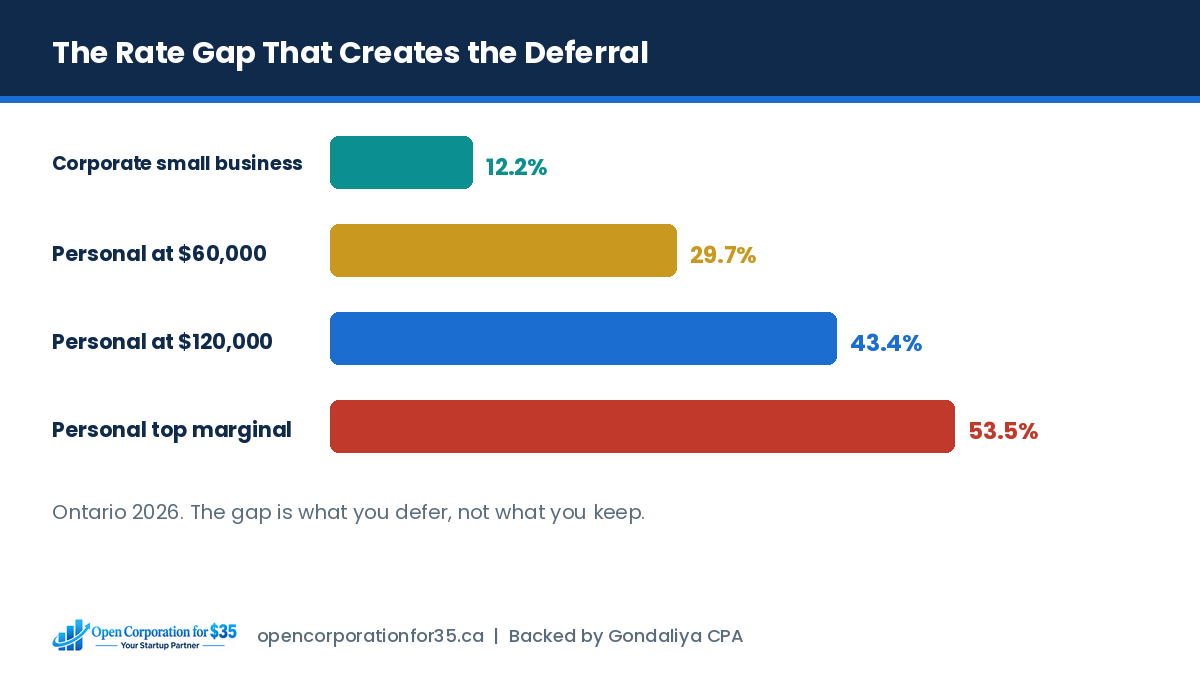
The Federal Small Business Deduction cuts federal corporate tax from 15% down to 9%. Ontario adds about 3.2% on top of that for eligible businesses. So, total corporate tax hits roughly 12.2%.
When the company pays out dividends, things get trickier. Dividends get “grossed up” by 38% for eligible dividends. Then, dividend tax credits apply to reduce personal tax Finance Canada. This system tries to balance taxes so income isn’t taxed twice too harshly.
Here’s a quick look at rates:
- Federal Small Business Rate: 9%
- Ontario Small Business Rate: 3.2%
- Combined Corporate Rate: 12.2%
- Dividend Gross-Up (Eligible): 38%
- Dividend Tax Credit (Eligible): 15%
Risk Warning: This section mixes up the two dividend types, and it matters. Income taxed at the small business rate comes out as non-eligible dividends, which carry a 15% gross-up and a much smaller dividend tax credit. The 38% gross-up and the larger credit shown here belong to eligible dividends, which come from income taxed at the general rate. Applying eligible-dividend mechanics to small business income overstates the credit and understates the personal tax on withdrawal, which is the exact calculation this article exists to help a reader make.
These numbers help explain how corporation and personal taxes connect but don’t match perfectly because of timing and regional rules.
Income Deferral Strategies Using a Corporation
One big reason people incorporate is to defer income taxes. Corporations pay less tax on profits than individuals do on high earnings. So, by keeping earnings in the company, you delay paying higher personal rates.
But remember: deferral isn’t a permanent saving. You will owe personal taxes later when you withdraw funds as salary or dividends CRA. The retained earnings inside your corporation can grow after-tax, helping your business expand without immediate big personal taxes.
Income Splitting: Rules and Opportunities Under TOSI
You might wonder if you can split income with family after incorporating? The answer is yes—but there are strict rules under TOSI (Tax on Split Income) ITA Section B-1.
Risk Warning: There is no ITA Section B-1. Tax on Split Income sits in section 120.4 of the Income Tax Act. Citing a section that does not exist in an article published under a CPA firm’s name is worth fixing before anyone checks it.
Generally, paying dividends to family members triggers TOSI unless the shares qualify for exceptions—like being excluded shares or belonging to an excluded business with reasonable returns.
These rules are tricky and depend on many details. It’s best to talk with an accountant who knows TOSI before trying any family income splitting plans.
Utilizing the Small Business Deduction and Business Limit
The small business deduction helps cut taxes on active business income up to $500,000 federally for CCPCs CRA. Ontario’s limit is close at $500K too.
Be careful if your passive investment income goes over $50,000 a year—it can lower your available SBD benefits starting in 2026 Finance Canada.
Also watch out for related companies because they share limits. If your corporation has associated companies, their incomes combine when calculating these deductions under ITA rules.
Tax Savings When Selling Your Incorporated Business: Lifetime Capital Gains Exemption
Selling your incorporated business can bring big tax savings thanks to the Lifetime Capital Gains Exemption (LCGE). In 2026:
- The LCGE amount is $971,190 per person.
- It applies if the shares meet certain holding and activity tests.
Risk Warning: $971,190 is not a 2026 figure. That was the qualified small business corporation share limit for 2023. The limit was indexed upward for 2024 and then raised substantially, and it needs to be checked against the current CRA figure before publishing. This number appears three times on the page, including in the FAQ, so all three need updating together. An understated exemption could lead an owner to plan a sale around the wrong number.
This exemption means capital gains from selling qualifying shares can be mostly or fully tax-free federally. That difference can add up over time compared to selling as a sole proprietor CRA.
Sharad Gondaliya, CPA (Canada & USA), has helped many Canadian owners understand these topics well while staying current with laws through 2026 updates.
Advantages and Considerations When Incorporating
Advantages and Considerations
Both Sides
Key Advantages of Incorporating Your Business in Canada
Incorporating your business can help you save on taxes compared to running it as a sole proprietorship. One big plus is the small business deduction. This cuts the federal corporate tax rate on active business income up to $500,000. For Ontario in 2026, the combined federal and provincial small business rate is 11.5%. That’s much lower than the highest personal tax rates.
Risk Warning: This says 11.5% while four other places on the page say 12.2%. The page contradicts itself on its single most important number. 12.2% is the combined Ontario small business rate; 11.5% is Ontario’s general corporate rate, which is a different thing entirely. Please make every instance read 12.2%.
Another benefit is the lifetime capital gains exemption (LCGE). If your company qualifies as a Canadian-controlled private corporation (CCPC), shareholders might get an exemption of up to $971,190 in 2026 when selling small business shares. This can save you a lot of tax when you sell.
Incorporation also allows you to keep some earnings inside the company and pay less tax on them until you take the money out. But remember, whether incorporating save tax works for you depends on how much profit you make and your spending needs.
Potential Disadvantages and Additional Costs to Consider
While there are advantages, incorporation comes with extra costs. You have to pay government fees every year plus charges for professionals who help with annual returns and filings.
Here are some typical yearly costs:
- Filing a T2 corporate tax return, which starts around $300 plus HST.
- Keeping minute books and records.
- Paying for registered office services if needed.
- Handling more complex bookkeeping when paying payroll or dividends.
These costs might cancel out some corporation tax savings unless your profits are high enough. So think about these before deciding to incorporate your business in Canada.
Two fee points to align. This page says “$300 plus HST” while your standing rule is that quoted fees include HST, and the incorporation fee on this same page is written as “$35 plus government fees” in one place and “$35 including HST” in another. Please settle on one convention and apply it to both figures.
Compliance Obligations: Payroll, GST/HST, and Annual Filings
Corporations have specific rules they must follow that don’t apply to sole proprietors:
- Payroll Remittances: You must send CPP contributions and income taxes deducted from employee pay regularly—either monthly or quarterly depending on amounts.
- Corporate Annual Filing: Every corporation has to file an annual return with its provincial or territorial registry.
- T2 Corporate Tax Return: This return must be filed each year within six months after your fiscal year ends, even if you made no taxable income.
Missing these deadlines can lead to penalties or interest charges from CRA or local authorities. Planning ahead helps avoid those problems.
Understanding Professional Corporation Rules and Restrictions
Professional corporations face special rules under provincial laws. These usually apply to fields like law or accounting. Such companies often must have all shareholders licensed in their profession. Their activities are also limited by regulatory standards.
These rules affect taxes too. Professional corporations handle deductions and credits differently than regular CCPCs because of these restrictions.
If you want to start a professional corporation, get advice first. The laws vary by province like Ontario and can be tricky.
The all-shareholders-licensed rule is not universal. Some Ontario health professions permit family members to hold non-voting shares, which changes the income splitting analysis considerably, while law and accounting are stricter. Since this distinction is the whole planning question for a professional, the blanket statement is worth softening.
Impact of Passive Investment Income on Corporate Taxes
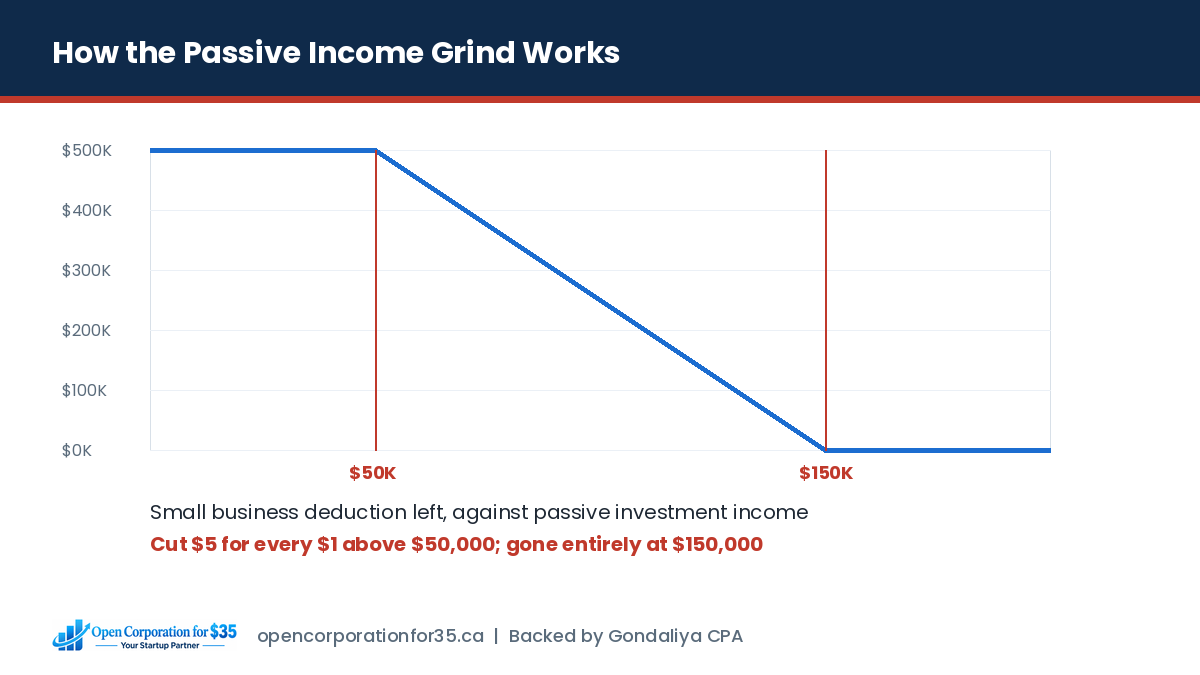
Passive investment income inside a corporation affects how much you save on taxes when incorporating in Canada. This is due to the passive investment income grind rule introduced since 2019.
Here’s what happens if passive income goes over $50,000 in a year:
- The $500,000 small business deduction limit lowers by three times the amount over that $50,000.
- This means your company pays higher taxes closer to regular rates instead of the smaller rates for active businesses.
Risk Warning: The multiplier is wrong. The business limit is reduced by $5 for every $1 of adjusted aggregate investment income above $50,000, not three times. At five times, the deduction is gone entirely once passive income reaches $150,000, which is the practical planning point an owner needs to know. “Three times” would put that ceiling at roughly $217,000 and understate how quickly the grind bites.
This rule stops companies from holding too many passive investments without paying more tax. It’s something important when planning your corporate taxes if you keep earnings invested passively.
Find out whether the numbers actually work
Incorporation from $35 including HST plus government fees, with a free CPA consultation before you commit. Please book a free consultation.
Assessing if Incorporation is Right for You
Assessing if Incorporation is Right for You
Your Call
Figuring out when to incorporate depends on your business type, income, and growth plans. You can save tax by incorporating, but it really depends on your situation. Knowing how corporation tax savings work and the costs involved helps you decide if incorporation fits your goals.
Suitability of Incorporation Based on Business Type and Income Level
Incorporation tax savings Canada kick in mostly when your net business income passes a point where corporate taxes are lower than personal taxes. Usually, businesses making more than $50,000 a year might benefit from incorporating. That’s because of the small business deduction (SBD), which has a combined federal and Ontario rate of 12.2% in 2026. But some industries, like professional services or investment businesses, face different rules.
A corporation can keep earnings inside and pay less tax than personal rates. This means you defer paying higher personal taxes later—unless you take money out as dividends. If your income is low or changes a lot, incorporating might just add paperwork without real corporation tax savings.
Here’s what to think about:
- Business stability matters; steady profits help.
- Higher income usually means bigger benefits.
- Industry rules affect eligibility for tax breaks.
Think about when to incorporate by running numbers based on how much profit you want to keep inside the company or spend personally.
Comparing Unincorporated and Incorporated Business Scenarios
When you compare sole proprietorships to corporations, tax savings depend on how much profit stays in the company versus what you pay yourself.
Sole proprietors pay personal tax rates on all their business income. In Ontario, this can be up to about 53.5.
Corporations pay less tax at first thanks to the SBD, but dividends paid out get taxed again personally through gross-up and dividend credits. This system tries to balance things but isn’t perfect. So often, the saving is just a delay in paying full taxes unless money stays inside longer.
Here’s a quick look:
- Tax rate: Sole proprietors pay personal rates; corporations use the SBD rate (12.2%).
- Profit retention: Not possible for sole proprietors; corporations can hold earnings at lower rates.
- Dividend tax: Only applies in corporations.
- Complexity: Corporations have more rules and costs.
Bottom line: You save mainly if you keep profits in the corporation. Taking all money out cuts most benefits.
The Ontario top personal rate is written as “about 53.5” with no percent sign. The figure is 53.53%, and house style is exact numbers rather than approximations. Please set it as 53.53%.
How Incorporation Supports Growth and Access to Capital
Incorporating helps grow your business by making it easier to raise money through shares or investors under Canadian-controlled private corporation (CCPC) rules. It also limits your personal risk compared to unincorporated setups—which matters beyond just taxes.
You can reinvest earnings inside the company and avoid paying high personal taxes right away like in sole proprietorships. Still, you need to weigh these perks against extra paperwork and legal steps that come with being incorporated federally or in Ontario.
Role of Shareholder Agreements in Corporate Governance
Once you’re incorporated, shareholder agreements become important. They set who controls what, how dividends get paid, how disputes get handled, and rules for selling shares. These don’t directly make incorporating save tax but protect everyone’s rights.
Good shareholder agreements need legal advice separate from accounting help focused on taxes. They shape ownership and long-term financial decisions that affect after-tax money too.
When to Seek Professional Advice on Incorporation Decisions
Figuring out if incorporating saves tax needs careful thought about your income, how much you’ll keep or spend personally versus in the company—and rules unique to places like Ontario’s new small business deduction limits starting 2026.
Open Corporation for $35 offers affordable CPA consultations online for people wondering about incorporation fast and accurate with CRA rules. Getting advice early stops costly mistakes like setting up a corporation too soon—where you just delay paying taxes but add hassle.
Sharad Gondaliya, CPA (Canada & USA), has over 10 years helping Canadian business owners figure this stuff out.
Additional Resources and Encouragement to Incorporate with Open Corporation for $35
Additional Resources and Next Steps
Resources
Interactive Tools and Checklists to Simplify Your Incorporation Process
Tools
Figuring out when to incorporate takes some thought. You need to look at your profits, expenses, and goals. Some interactive tools can help you see incorporation tax savings Canada-wide. These tools compare taxes for sole proprietors versus corporations. They consider Ontario corporate tax rates, the federal small business deduction, and personal income brackets.
Checklists can make the process easier by breaking down steps like:
- Getting a NUANS report
- Registering for GST/HST if needed
- Setting up payroll accounts for CPP
- Learning about compliance obligations after incorporation
These resources clarify when incorporating save tax benefits beat costs such as compliance fees.
Still, it’s smart to use these tools with professional advice. Your actual corporation tax savings depend on your specific facts—like retained earnings or small business deduction eligibility.
Testimonials Highlighting Tax Savings and Business Growth After Incorporation
Testimonials
Lots of Canadian business owners have seen real benefits from incorporating through Open Corporation for $35. Many say their cash flow improved because incorporation lets them defer some taxes. Plus, corporate tax rates often stay lower than personal rates.
People share stories about how good corporate tax planning helped them invest back into their business or plan better for retirement. Those stories show that incorporating can bring corporation tax savings now and support long-term stability with expert help.
Remember: each case is different. It’s best to get advice that fits your situation, especially with 2026 Ontario small business rate changes.
Risk Warning: This section describes client testimonials about tax savings without naming a single client, date or figure. CPA Ontario’s advertising rules restrict claims a firm makes about outcomes, and unverifiable testimonials that imply tax results are the riskiest category. Either replace this with named, dated and substantiable testimonials, or remove the section. Referring to unnamed people who “say their cash flow improved” carries the regulatory risk without giving a reader anything they can check.
Clear Calls to Action: Start Your Incorporation with Open Corporation for $35
Get Started
Open Corporation for $35 is part of Gondaliya CPA. They offer affordable online incorporation services run by registered Ontario CPAs. You can usually incorporate fast—often in 15 minutes—with clear pricing starting at $35 plus government fees.
You get same-day filing, instant NUANS reports in all provinces including Ontario’s competitive market, free CPA consultations on setup questions, options for registered office service, and help with ongoing compliance for those moving from sole proprietorships.
Give them a call at 647-212-9559 or email info@gondaliyacpa.ca between 9 AM and 8:30 PM any day to start your incorporation confidently.
“Often in 15 minutes” describes how long the form takes you to complete, not how long registration takes. Registry acceptance is outside your control and runs from same day to a few business days. Worth separating the two so the promise stays one you can keep.
Legal Disclaimer and Importance of Ongoing Compliance
Compliance
Incorporating means new compliance obligations that you didn’t have as a sole proprietor. For example, you must file an annual T2 corporate tax return within six months after your fiscal year ends. Also, if you pay yourself a salary, you have payroll deductions like CPP contributions to handle on time.
Compliance costs include government filing fees plus accounting services that usually start around $300 per year but can vary based on how complex things are. If you miss deadlines or rules, CRA or provincial authorities like Ontario’s Ministry of Finance can penalize you or audit your corporation.
Keeping up with compliance keeps your corporation in good standing but doesn’t guarantee lower taxes or avoid audits due to tricky rules like passive investment income limits or TOSI rules about family dividends. Talk regularly with qualified pros who know Canada’s changing rules.
Links to Related Resources and Support for Canadian Business Owners
Further Reading
- Federal Small Business Deduction — who qualifies for lower federal corporate tax rates.
- Ontario Small Business Tax Rate — current provincial rate details after 2026 updates.
- Business Income Tax Canada Overview — explains how personal dividends taxes link with corporate taxes.
- CRA Guide T4012 – T2 Corporation Income Tax Guide — details filing rules once incorporated.
These official sources give important info when deciding if incorporation will really save you corporation tax money based on your own situation.
FAQs on Incorporation Tax Savings and Corporate Tax Planning
Frequently Asked Questions
FAQ
What is the small business deduction rate for 2026 in Ontario?+
The combined small business deduction rate in Ontario is 12.2% for 2026, including federal and provincial taxes.
How does the passive income threshold affect tax savings?+
If passive income exceeds $50,000 annually, your small business deduction limit reduces, increasing your corporate tax rate.
What is the lifetime capital gains exemption amount in 2026?+
The lifetime capital gains exemption for qualifying small business shares is $971,190 in 2026.
How do dividend gross-up and dividend tax credit work?+
Dividends are grossed up by 38%, then reduced by a 15.02% dividend tax credit to offset double taxation.
When does incorporating actually save tax in Canada?+
Incorporation saves tax when your business profits exceed $50,000, allowing access to lower corporate rates and tax deferral.
How does CPP max contribution impact salary versus dividends?+
Salaries require CPP contributions up to a maximum of $3,754.45 in 2026; dividends do not affect CPP but may have other tax implications.
What are TOSI rules and their effect on family income splitting?+
TOSI rules limit income splitting by taxing certain dividends paid to family members at the highest rates unless exceptions apply.
What are compliance costs for corporations annually?+
Typical costs include T2 corporate tax filing fees starting around $300 plus bookkeeping and payroll remittance expenses.
How do associated corporations affect business limit sharing?+
Associated corporations must share the $500,000 small business deduction limit, reducing benefits if combined income exceeds that amount.
What role do shareholder agreements play post-incorporation?+
They govern ownership rights, dividend distribution, dispute resolution, and share transfers, protecting all shareholders.
Risk Warning: Three FAQ answers need correcting. The CPP maximum of $3,754.45 is the 2023 employee figure and takes no account of the second additional CPP contribution that now applies above the first earnings ceiling, so a reader comparing salary against dividends is working from an understated cost. The dividend answer again applies the eligible-dividend gross-up and credit to what is small business income. And the answer to the article’s own title question states flatly that incorporation saves tax above $50,000 of profit, which contradicts the body of the article, where the saving is described as a deferral that depends on how much you leave in the company.
Key Points on Incorporation Tax Planning and Compliance
Key Points on Tax Planning and Compliance
Key Points
- Corporate tax planning helps optimize savings through careful profit retention and income timing.
- The passive income grind rule reduces small business deduction when passive earnings exceed $50,000 yearly.
- Specified investment businesses face restrictions limiting eligibility for lower corporate tax rates.
- Shareholder loans can trigger taxable benefits if not managed properly under CRA rules.
- Professional corporations follow unique provincial tax rules affecting deductions and shareholder eligibility.
- Audit risk mitigation involves strict compliance with filing deadlines and accurate record keeping.
- CPA consultations provide expert guidance on incorporation timing, structure, and tax strategies.
- Comparing DIY incorporation with tax software or CPA services highlights trade-offs in cost versus expertise.
- Capital dividend accounts allow certain non-taxable distributions from corporations to shareholders.
- Salary payments affect CPP contributions; dividends avoid CPP but have different personal tax consequences.
- Personal services business rules restrict tax advantages for some incorporated professionals performing mainly personal services.
These points help Canadian entrepreneurs navigate incorporation with Open Corporation for $35 while maximizing corporation tax savings efficiently.
Professional Guidance on Incorporation Tax: How Open Corporation For $35 Helps
Professional Guidance and Quick Reference
Guidance
The honest answer to the title question is that incorporation rarely saves tax outright. It defers tax, and the deferral is worth something only in proportion to what you leave in the company. Two things do produce a permanent saving: income split within the TOSI rules where the exceptions genuinely apply, and the capital gains exemption on a qualifying sale.
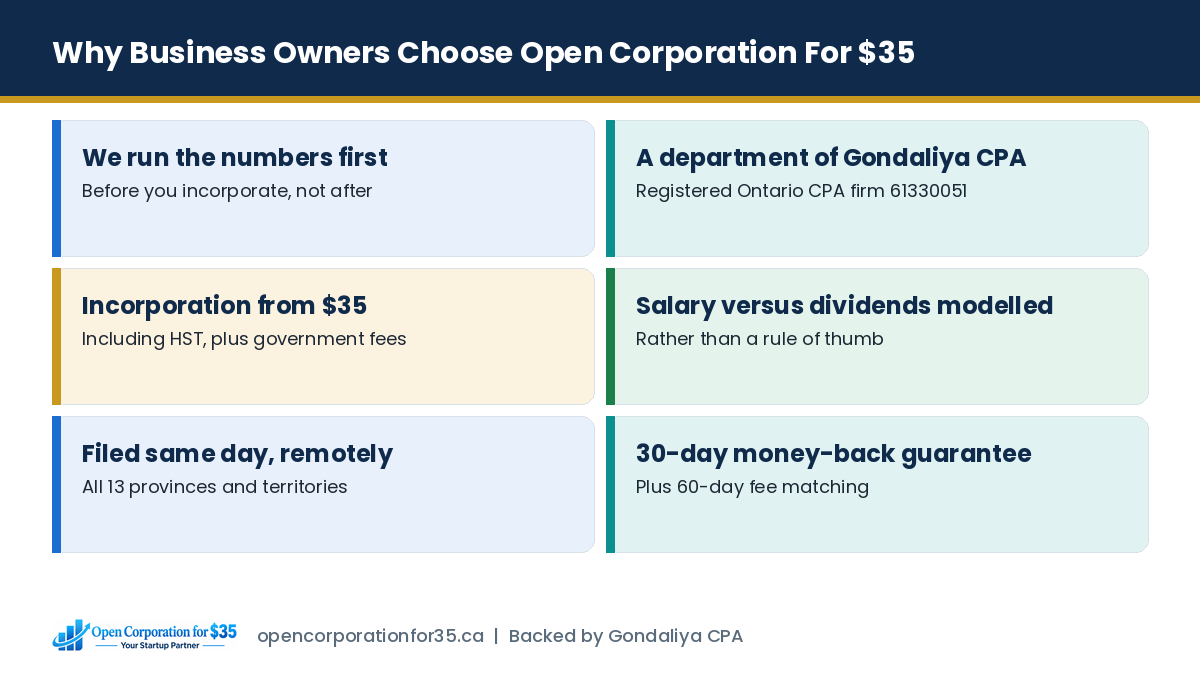
Open Corporation for $35 is a department of Gondaliya CPA. We run the comparison against your own numbers first, then incorporate only if it holds up.
Everything is done remotely, across all 13 provinces and territories.
Quick Answers: Key Numbers & Concepts at a Glance
At a Glance
- Ontario combined small business rate: 12.2%
- Federal small business rate: 9%
- Ontario small business rate: 3.2%
- Small business deduction limit: $500,000
- Passive income grind starts: $50,000
- Deduction fully ground out at: $150,000 of passive income
- Ontario top personal marginal rate: 53.53%
- T2 filing deadline: Six months after year end
- CCPC balance due: Three months after year end
- Our fee: $35 including HST, plus government fees
Who This Is For / Not For
Fit Check
- For: Sole proprietors with steady profits they do not need to draw in full, owners planning an eventual sale, and anyone weighing salary against dividends.
- Not For: Owners who spend everything they earn, businesses with unpredictable or seasonal income, and anyone incorporating mainly to look established rather than for tax or liability reasons.
People Also Ask
Quick Answers
Should I pay myself salary or dividends?+
There is no universal answer. Salary creates RRSP room and CPP entitlement and is deductible to the company; dividends avoid CPP but build no RRSP room. The right mix depends on your age, your retirement plans and how much you need personally, which is why it is worth modelling rather than guessing.
Can I incorporate partway through the year?+
Yes. You file a final sole proprietorship year on your personal return up to the transition date, and the corporation picks up from there with its own fiscal year end that you choose. The transfer of assets into the company needs care, because it can trigger tax if handled incorrectly.
What if I incorporate and it turns out not to help?+
You can wind the corporation up, though that costs more than not incorporating in the first place and has its own tax consequences. This is the main reason to run the numbers before rather than after.
Ask one question before anything else: how much of your profit will genuinely stay in the company. If the answer is most of it, incorporation is likely worth it. If the answer is none of it, the rate difference mostly disappears on withdrawal and you are paying compliance costs for liability protection rather than tax savings, which may still be a good reason, just a different one.
Want a checklist to work from? Please download our free incorporation tax savings checklist before your consultation.
Run the numbers before you incorporate
Incorporation from $35 including HST plus government fees, with a free CPA consultation on whether it actually helps you. Please book a free consultation.
What to Send Us
Send us your expected profit for the year, roughly how much you need to draw personally, whether you hold investments, and whether family members might be paid. That is enough for us to tell you whether incorporating helps you or just adds cost.
Published: September 23, 2026 · Last updated: September 23, 2026
Editorial policy: Our content is prepared by our team and reviewed by Sharad Gondaliya, CPA, and we update it as corporate and personal tax rates, the passive income rules and the capital gains exemption change.
Disclaimer: This article is educational information only and is not tax, legal, or financial advice. Tax outcomes depend entirely on your own circumstances. Please consult a CPA before acting.
Open Corporation for $35 is a department of Gondaliya CPA.
Operated by WealthBamboo Inc. Parent firm Gondaliya CPA Professional Corporation, CPA Ontario firm registration 61330051. Xero Partner Award Winner 2026. 1300+ five-star Google reviews. 30-day money-back guarantee and 60-day fee-matching policy. Phone 647-212-9559, email info@gondaliyacpa.ca, open 9:00 AM to 8:30 PM Monday to Sunday. Payment by Interac e-Transfer to info@gondaliyacpa.ca only, security question “Not Applicable” as auto-deposit is enabled. Card is also accepted.