
What Are Articles of Incorporation in Canada? Complete Guide for New Corporations
Articles of Incorporation Canada and Ontario: Complete Guide to Canadian Corporation Articles and Incorporation Documents Canada
Open Corporation for $35 is a department of Gondaliya CPA. Articles of incorporation Canada and articles of incorporation Ontario are essential for setting up a legal business entity, with Canadian corporation articles and incorporation documents Canada required to register your company officially. Understanding these key forms simplifies the process and helps secure your business foundation efficiently.
Quick Summary
Your articles are the corporation’s founding document: name, registered office, share structure, director range and any restrictions. Get the share structure right at filing, because changing it later needs articles of amendment, a shareholder resolution and another fee.
| Aspect | Details |
|---|---|
| What they are | The founding document that brings the corporation into existence. |
| Ontario filing fee | $360 to ServiceOntario. |
| Federal filing fee | $200 to Corporations Canada. |
| Changing them later | Articles of amendment plus a shareholder resolution. |
Reading time: 24 minutes.
Table of Contents
- What Are Articles of Incorporation?
- Types of Corporate and Incorporation Documents
- Requirements for Ordering Copies
- Ordering Corporate Documents Online
- Sending a Request by Email
- Articles under the Business Corporations Act (Ontario)
- The Ministry’s Role in Incorporation
- New Corporations, Not-for-Profits, Partnerships, Co-operatives
- Updating, Renewing, or Dissolving
- Frequently Asked Questions
- Key Corporate Filing Terms
- Professional Guidance and Quick Reference
The Numbers That Matter
This article covers Ontario and federal incorporation. All figures are in Canadian dollars. Government fees, director residency rules and registry processing times change, and requirements differ for not-for-profits, co-operatives and professional corporations. This is educational information only and not tax, legal, or financial advice. Please confirm current requirements before filing.
What Are Articles of Incorporation?
What Are Articles of Incorporation?
The Basics
Articles of incorporation are legal papers you need to start a corporation in Canada. They list the main details about the company. This includes the company’s name, purpose, and how it’s set up. Basically, they build the base for any Canadian corporation.
Definition and Purpose
Articles of incorporation in Ontario and Canada show that a company exists by law. You have to file them with the right registry to create a corporation legally. Their main job is to show how the company will be run and what rules it follows.
Key Information Included in Articles
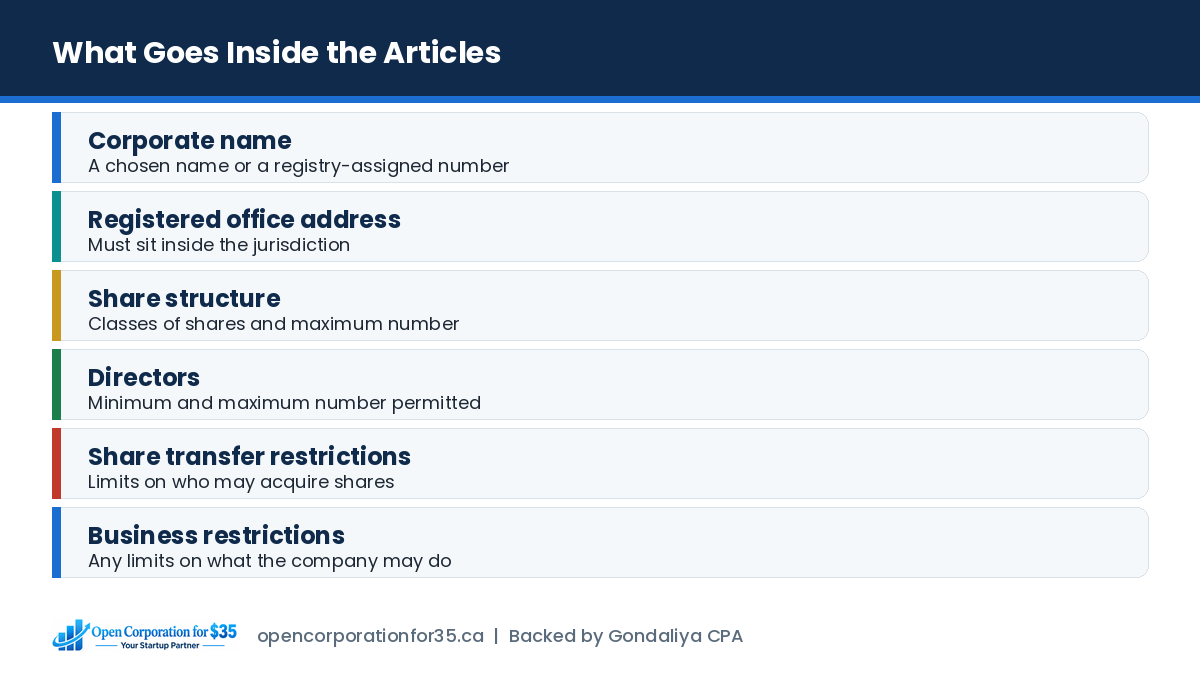
Canadian corporation articles usually have some key info:
- Corporate Name: The official business name.
- Registered Office Address: Where official mail goes.
- Share Structure: Types of shares and max number allowed.
- Directors’ Information: Number of directors needed and where they live.
- Business Restrictions: Limits on what the company can do.
These points help everyone know how the corporation works.
Legal Significance for Canadian Corporations
Articles of incorporation matter a lot for companies in Canada. They create the company’s legal identity. They also protect shareholders by spelling out their rights and duties. Filing correct articles is very important. Mistakes can cause delays or rejections from registries, stopping your business from running legally.
Share structure is where the money is. Most rejections we see are name problems, but most expensive fixes are share structures set up without thought, then amended a year later when a spouse, an investor or a freeze is added. Get the classes right on day one and the amendment fee never arrives.
Differences Between Federal and Ontario Incorporation
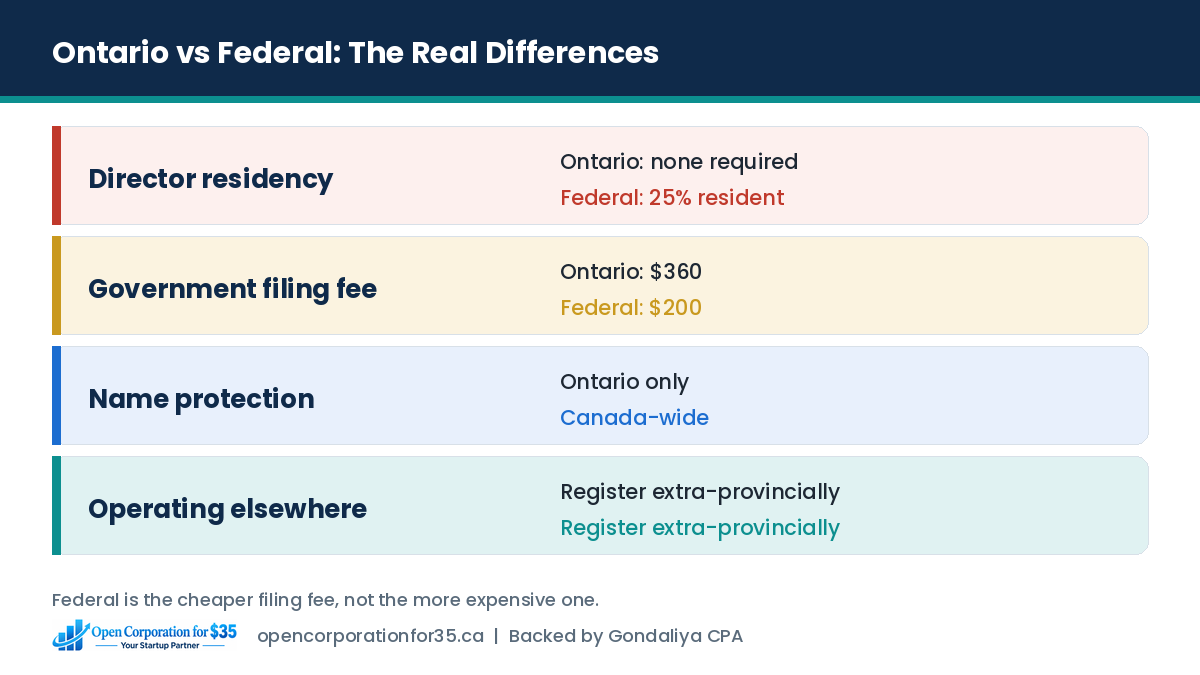
If you want to incorporate, it helps to know the difference between federal (CBCA) and Ontario (OBCA) articles of incorporation:
| Factor | Ontario (OBCA) | Federal (CBCA) |
|---|---|---|
| Jurisdiction | Provincial | National |
| Director Residency | At least 25% must live in Canada | At least 25% must live in Canada |
| Name Approval | Needs NUANS report | Needs NUANS report |
| Fees | Usually cheaper | Usually more expensive |
Risk Warning: The director residency row is wrong for Ontario. The OBCA resident director requirement was removed in July 2021, so an Ontario corporation can have a board entirely resident outside Canada. Only the federal CBCA still requires 25% resident Canadian directors. As written, the table also removes the single biggest reason a non-resident founder would choose Ontario over federal. Please correct the Ontario cell to “None required”. The fees row is also the wrong way round: Ontario costs $360 and federal costs $200, so federal is the cheaper filing, not the more expensive one.
Picking one depends on things like where you want to do business, rules you must follow, and costs for filing articles of incorporation. Knowing these differences helps people make better choices that fit their needs and laws about Canadian corporations.
Types of Corporate and Incorporation Documents Available
Types of Corporate and Incorporation Documents
Documents
Articles of incorporation Canada are the key papers that start a corporation. These Canadian corporation articles list important info like the company’s name, how shares work, and who the directors are. Incorporation documents Canada also cover other forms you need to file with government offices to make the corporation official.
Companies must send these papers to the right place—like Ontario Business Registry for Ontario or Corporations Canada for federal corporations. This step gets you a certificate of incorporation. Together, these documents prove your company exists under Canadian law.
Common Documents for Canadian Corporations
The main paper is always the articles of incorporation Ontario or similar depending on where you incorporate. These articles show basic company info such as:
- Corporate Name: Either a chosen name or just a number.
- Registered Office Address: Where records are kept officially.
- Share Structure: Types and max number of shares allowed.
- Directors’ Info: How many directors there must be; rules vary by province.
- Share Transfer or Business Rules: If any limits apply under OBCA or CBCA.
- Incorporator Details: Who files the paperwork.
These articles work like a company’s rulebook. They differ from bylaws (which guide daily running) and shareholder agreements (which handle ownership rights but stay private).
Other common Canadian corporation articles include:
- Initial returns (Ontario)
- Registered office notices
- Director appointment forms
- NUANS name search reports (needed before filing)
Together, these form the basic paperwork Canada asks for when starting a corporation.
Specialized Documents for Different Entity Types
Some corporations need extra papers beyond basic articles:
| Entity Type | Specialized Documents | Why They Matter |
|---|---|---|
| Professional Corporations | Regulatory approval certificates | Follow professional licensing rules |
| Non-Profit Corporations | Letters patent | Show charitable or non-profit goals |
| Holding Companies | Special share provisions | Control over other companies |
| Family Trust-Owned Entities | Declaration statements | Explain trust role in ownership |
These extra docs reflect special rules for different kinds of companies across provinces. For example, professional corporations must follow both OBCA/CBCA laws and their profession’s licensing bodies. Non-profits use letters patent instead of regular articles to state their purpose clearly.
Risk Warning: Letters patent is the pre-2021 system. Ontario not-for-profits now incorporate under the Ontario Not-for-Profit Corporations Act using articles of incorporation, and federal not-for-profits use the CNCA. Telling a reader to expect letters patent will send them looking for a form that is no longer issued. Please update both the table row and the paragraph.
Knowing which incorporation documents Canada needs depends on your business type and where you set up. Filing wrong or missing papers can slow down your registration or cause trouble later.
Requirements for Ordering Copies of Canadian Corporation Articles
Requirements for Ordering Copies
Copies
If you want copies of articles of incorporation Canada, you have to follow some rules. These papers show that a company is legally formed. They’re also called Canadian corporation articles or incorporation documents Canada. You need to give the right info so the office can find your records and send them to you.
Who Can Request Copies?
People who can ask for articles of incorporation Ontario or other Canadian corporation articles include:
- Directors or officers who run the company.
- Shareholders who prove they own part of it.
- Authorized people acting for the business.
- Sometimes, the public if the rules allow it.
The Ontario Business Registry lets you see these docs under some rules. They check IDs to keep info safe. If you’re not allowed, they might say no or only give non-certified copies.
When Certified Copies Are Required
Certified copies have a special seal or signature that shows they’re official. You need them when:
- Opening bank accounts in your company’s name.
- Sending government papers that need proof.
- Going to court where official papers matter.
- Doing big deals like selling parts of the business.
Incorporation documents Canada often must be certified for anything legal or formal. Like contracts with people who don’t know your company.
What Details Are Needed to Order?
You must give clear info so the office can find your Canadian corporation articles fast. Wrong info will slow things down.
Business Name or Number
Identify It
Give either:
- The exact name your company used when filing (articles of incorporation Ontario).
- The business number it got when registered (Canadian corporation articles).
Use the right spelling and numbers. Some companies just have numbers instead of names, so use that number exactly as is.
Type of Document Requested
Which Paper
Say what paper you want from incorporation documents Canada options:
| Document Type | What It Is |
|---|---|
| Articles of Incorporation | The original file that starts the company |
| Certificate/Notice(s) | Proof after filing; may show changes made |
| By-laws | Rules inside the company (not always filed) |
This helps get exactly what you need.
Contact Information and Payment Details
Payment
When ordering from Open Corporation for $35—run by Gondaliya CPA—you need to give your contact info: email and phone number.
They use this info to update you about your order. Pay by Interac e-transfer to info@gondaliyacpa.ca, credit card, or other ways they list.
Pay fast so they don’t hold up your order.
Ordering Corporate Documents Online: Cost and Process
Ordering Corporate Documents Online
Online
Ordering articles of incorporation Canada or incorporation documents Ontario online is pretty simple. These incorporation documents Canada are what you need to start your business legally. They include your articles of incorporation, NUANS name search report, and other forms.
You can file Canadian corporation articles online from anywhere in Canada. These websites help you fill out details like corporate name, share setup, director info, and office address. Ontario’s Business Registry lets you submit filings electronically under the OBCA, with new rules for 2026.
Online filing checks your info to catch mistakes before sending. After you submit incorporation documents Canada-wide, including federal CBCA filings, officials review them to make sure everything’s right. When they approve it, you get a certificate of incorporation that proves your company exists.
Step-by-Step Guide to Online Requests
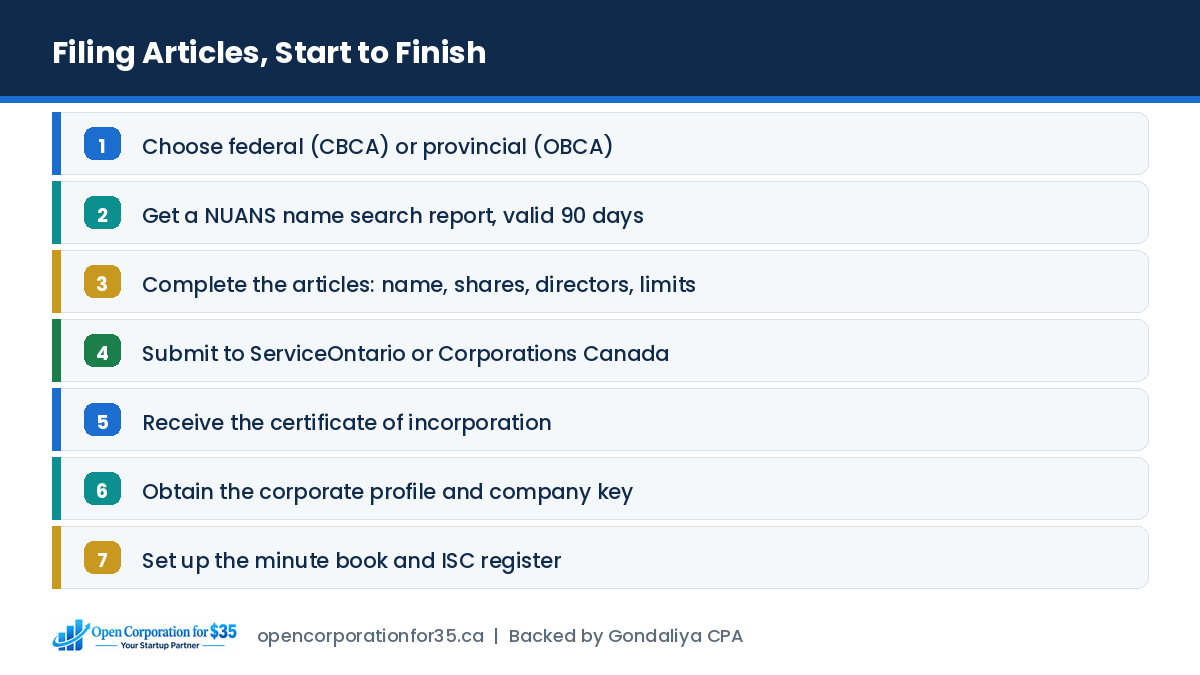
Filing Canadian corporation articles or articles of incorporation Ontario online goes like this:
- Pick where to incorporate: federal (CBCA) or provincial (OBCA for Ontario). This choice changes fees and rules.
- Get a NUANS name search report to see if your company name is available. It’s good for about 90 days.
- Fill out the articles with info like company name or number, share types, director count, and any limits on business activities.
- Submit your incorporation documents through ServiceOntario for Ontario or Corporations Canada federally.
- Wait for the certificate of incorporation once the government approves it.
- Get official corporate records like the profile and company key for future needs.
- Set up records after filing like a minute book or ISC register if needed.
This process makes sure you meet all legal steps without trouble.
Costs and Payment Methods
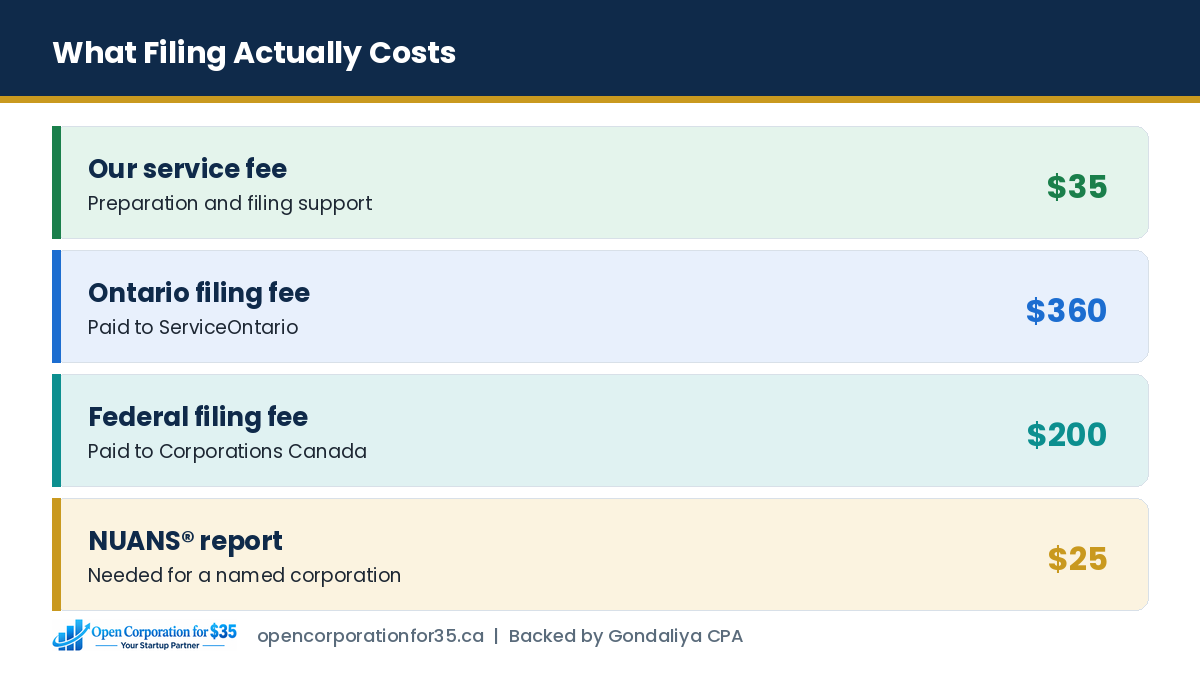
Here’s how much you’ll pay when ordering articles of incorporation Canada or related documents:
| Fee Type | Typical Amount (CAD) | Notes |
|---|---|---|
| Service Fee | $35 | Covers help with preparation plus HST |
| Government Filing Fee – ON | $360 | Paid directly to ServiceOntario |
| Government Filing Fee – Federal | $200 | Paid to Corporations Canada |
| NUANS Report | About $13–$30 | Needed before filing if using a business name |
Risk Warning: The NUANS row gives a range of about $13 to $30, while your own service pages quote a flat $25 for the NUANS® report. Two different figures for the same item on the same site invites a question at checkout. Please make them match, and note that house style is exact numbers rather than ranges.
You can pay using Interac e-Transfer (auto-deposit) at info@gondaliyacpa.ca with “Not Applicable” as the security question. Credit cards work too.
Knowing these costs ahead helps you avoid surprises when submitting your article-of-incorporation forms across provinces.
Sending a Request by Email
Sending a Request by Email
By Email
You can ask for articles of incorporation Canada or other incorporation documents Canada by email. Send your request to the right registry office. For federal corporations, reach out to Corporations Canada. They have online services and email contacts. If your company is in Ontario, contact the Ontario Business Registry at ServiceOntario.
When you email, say clearly that you want copies of articles of incorporation or similar papers. Include your company’s legal name and any registration number you have. This info helps the registry find your file faster.
Email requests are easy but can take some time. The processing depends on 2026 service rules for each registry. Remember, registries decide if they accept your request and if documents are ready. Open Corporation charges $35 to help with this but does not control the process.
Mail-In Requests
If you prefer old-school mail, you can still mail in your request for articles of incorporation Ontario or Canadian corporation articles.
In Ontario, send letters to ServiceOntario’s address for corporate filings under the OBCA (Ontario Business Corporations Act). For federal firms, mail your request to Corporations Canada’s address listed online.
Your mailed request must include all needed details plus payment for fees based on 2026 schedules. Mail takes longer since it involves manual handling and postal delivery.
Make sure you check current addresses and fees before sending anything. These change every year without warning from registries like OBCA or CBCA (Canada Business Corporations Act).
What Information to Include When Requesting Documents
To get articles of incorporation Canada or articles of incorporation Ontario without trouble, include this info in your request:
- Corporation Name: The exact legal name registered, including if it’s a numbered company.
- Corporation Number: The unique ID given when the company was first filed.
- Jurisdiction: Say if it’s an Ontario corporation under OBCA or a federal one under CBCA.
- Type of Document Requested: Be clear if you want “articles of incorporation,” “certificate of incorporation,” or something else.
- Contact Details: Your full name, phone number, email, and mailing address for delivery.
- Purpose (Optional): You can briefly say why you need these documents if asked by staff.
Giving exact details cuts down on back-and-forth emails and gets things done faster under 2026 Canadian corporate rules.
If you use Open Corporation’s $35 service, we make sure every submission has all needed info based on best practices across provinces, including Ontario’s updated business registry rules.
Articles prepared and filed for you
Incorporation from $35 including HST plus government fees, with your share structure set up properly the first time. Please book a free consultation.
Articles of Incorporation under the Business Corporations Act (Ontario)
Articles under the Business Corporations Act (Ontario)
OBCA
Articles of incorporation Ontario are the papers that start a corporation under the Business Corporations Act (OBCA). These Canadian corporation articles list key info about the company. You have to file them with the Ontario Business Registry to make your corporation official in Ontario.
Relevant Provisions and Legal Requirements
When you prepare incorporation documents Canada, especially articles of incorporation Ontario, they must follow OBCA rules. The articles need to include:
- Corporate name or numbered name
- Registered office address inside Ontario
- Types and max number of shares allowed
- Any limits on share transfers
- Min and max number of directors allowed
- Limits on business activities if any
These rules help registries, shareholders, and regulators know exactly what’s what. Filing proper incorporation documents Canada is required to get your certificate of incorporation that proves your company exists legally.
Filing Amendments or Changes
You can change articles of incorporation Canada after filing by following legal steps. Common changes might be:
- Changing the corporate name
- Altering share structure or types
- Updating number or residency of directors
How do you change articles of incorporation later? You send in articles of amendment with resolutions approved by shareholders. This keeps your paperwork current while you adjust your corporate setup.
Key Stat: Not every change needs articles of amendment. Swapping a director or moving the registered office is a notice of change, which is far cheaper and faster. Amendment is for the things written into the articles themselves: the name, the share classes, the director range and the restrictions.
Ministry of Public and Business Service Delivery and Procurement: Role in Incorporation
The Ministry’s Role in Incorporation
The Ministry
The Ministry handles filings under OBCA through ServiceOntario’s online portal. That’s where you submit your articles.
Oversight Responsibilities
Oversight
How long it takes for filings to get accepted varies by how busy they are. Usually, it takes from same-day up to a few business days for regular processing. Open Corporation for $35 helps clients get their papers ready fast to meet these timelines well.
Contact Points for Assistance
Support
If you have questions when filing, you can contact ServiceOntario. But using services like Open Corporation for $35 means experts check your forms first. This makes sure everything fits the rules before sending.
Accessing and Completing Forms for Incorporation
Getting your incorporation documents Canada done right matters a lot when filing articles in Ontario.
Online Form Tools
Online
ServiceOntario has an online tool where you fill out official forms directly. It matches OBCA standards exactly. You enter stuff like corporate name, director details, share types, registered office address, which helps cut down mistakes common with paper forms.
Downloading PDF and Print Options
Offline
If you want offline work, you can download PDFs from government sites showing official article templates across provinces including Ontario. Then you send printed or scanned copies depending on registry needs.
Key Information for New Corporations, Not-for-Profits, Partnerships, and Co-operatives
New Corporations, Not-for-Profits, Partnerships, Co-operatives
Entity Types
Different entity types need different documents at start.
Getting Started Guides
Guides
Canadian corporation articles are quite different from those used by not-for-profits or partnerships. Those use other registration rules outside normal business corporation laws. New companies should check guides made just for their type early on.
Unique Considerations for Each Entity Type
Differences
Corporations focus on shares and their classes. Not-for-profits focus more on membership without shares. Partnerships lean on partnership agreements instead of formal filings much. Co-operatives follow separate laws with their own required papers.
Updating, Renewing, or Dissolving Business Entities
Updating, Renewing, or Dissolving
Lifecycle
It’s important to keep records up to date so your business stays in good standing.
Renewal Processes
Renewal
To renew, you file annual returns that update info on shareholders and directors by deadlines set under OBCA. If you miss this, your corporation risks being dissolved by registry officials.
Dissolution Steps
Dissolution
To close a business formally, you file an application with resolutions showing the company will wind up. Sometimes final tax clearance is needed too.
Amending Existing Records
Amendments
Any changes after initial filing require special forms listing what’s different — these articles amendments must be approved before registry updates happen.
Filing Requirements and Annual Returns under Relevant Acts
OBCA requires more than just filing once:
You must file an initial return soon after incorporating that lists directors and shareholders recognized at start. Then annual returns keep public records current year after year so info stays transparent.
Costs, Timelines, and Additional Details for Incorporation Services
Standard Processing Times usually take 1–3 business days after submitting through ServiceOntario.
Expedited Service Options cost extra but can speed things up if available. Registry demand affects whether it’s offered.
Related Links, Support, and Contact Information
Open Corporation for $35 works daily 9:00 AM – 8:30 PM helping people prepare correct incorporation papers Canada-wide. They guide clients through ministry steps carefully so paperwork passes without trouble.
Sources Referenced
References
- Business Corporations Act (Ontario), Section 6
- ServiceOntario – Articles Amendment Process
- Ministry Public & Business Services Delivery – Processing Times
- Online Forms – ServiceOntario
- Downloadable Articles Templates – Government Sites
- Canada Revenue Agency – Types Of Businesses
- Co-operative Association Legislation Overview
- Initial Return Requirement Under OBCA
- Dissolution Procedures Guide – Government Resources
- Articles Amendment Instructions – Provincial Registries
- Annual Return Filings Under OBCA Regulations
- Processing Timeframes Published By Registries
FAQs on Articles of Incorporation Canada and Related Topics
Frequently Asked Questions
FAQ
What is a NUANS name search and why is it needed?+
A NUANS name search checks if your proposed company name is unique in Canada. It helps avoid name conflicts before filing articles of incorporation.
When should I file the initial return after incorporation?+
The initial return must be filed soon after incorporation. It updates government records about directors and shareholders.
What is a certificate of incorporation?+
It is an official document issued after your articles of incorporation are accepted. It proves your company legally exists.
What does the company key and corporate profile report include?+
The company key helps access corporate records online. The profile report shows detailed info about directors, shares, and filings.
What are the director residency requirements for federal and Ontario corporations?+
Federal law requires at least 25% of directors to live in Canada. Ontario has similar rules but may vary for minimum directors.
How can I renew or dissolve my corporation?+
Renew by filing annual returns. Dissolve by submitting proper winding-up documents with resolutions approved by shareholders.
What are articles of amendment used for?+
They update your original articles to reflect changes like share structure, corporate name, or director details.
What documents form the governance documents of a corporation?+
Governance documents include by-laws, shareholder agreements, and the corporate minute book which guide operations and ownership rights.
Risk Warning: The director residency answer says Ontario has rules similar to the federal 25%. It does not. Ontario removed its resident director requirement in July 2021 and now has none. This is the second place on the page carrying the same error, and together they would push a non-resident founder toward the wrong jurisdiction.
Key Corporate Filing Terms Explained by Open Corporation for $35
Key Corporate Filing Terms
Glossary
- ISC Register: A record system tracking share ownership and transfers for corporations.
- GST/HST Registration: Required to collect taxes if your business earns over a certain threshold.
- T2 Corporate Tax Return: Annual income tax return that all Canadian corporations must file with CRA.
- Share Transfer Restrictions: Rules limiting who can own or buy shares within a corporation.
- Professional Corporations: Require additional licenses and regulatory approvals beyond standard articles.
- Non-Resident Owners: Corporations with owners living outside Canada have special filing considerations.
- Federal Incorporation Fee: Government fee paid when incorporating under CBCA federally.
- Ontario Business Registry Fee: Fee paid when incorporating or filing documents in Ontario’s registry.
- Filing Acceptance Timelines: Typical processing timeframes range from same day to a few business days.
- Rebuilding ISC Register: Process to update share records when ownership changes occur significantly.
- Renewal Processes: Include annual returns and updates to keep the corporation in good standing.
- Dissolution Steps: Formal procedures to legally close a corporation, including filing required forms.
- Amalgamation: Combining two or more corporations into one entity under Canadian law.
- Continuance: Transferring a corporation’s registration between provinces or federal jurisdiction.
- Revival/Restoration: Process to reinstate a dissolved corporation back into active status.
- CRA Business Number Auto-registration: Automatic assignment of a business number upon federal incorporation.
These terms help you understand ongoing corporate compliance after submitting articles of incorporation with Open Corporation for $35.
Risk Warning: The ISC register is defined here as a system tracking share ownership and transfers. ISC means Individuals with Significant Control, and that register records people who control 25% or more of the corporation, whether through shares, voting rights or influence. It is not a share transfer ledger, which is a separate record in the minute book. The same wrong definition appeared on the banking post, so it is worth correcting once and reusing.
Professional Guidance on Articles of Incorporation: How Open Corporation For $35 Helps
Professional Guidance and Quick Reference
Guidance
Two decisions in the articles have lasting consequences: the jurisdiction and the share structure. Everything else can be changed with a notice of change for a small fee. Those two need articles of amendment, a shareholder resolution and a fresh filing.
Open Corporation for $35 is a department of Gondaliya CPA. We prepare and file the articles, set the share classes up for how you actually intend to own the company, and register the CRA accounts.
Everything is done remotely, across all 13 provinces and territories.
Quick Answers: Key Numbers & Concepts at a Glance
At a Glance
- Our service fee: $35 including HST
- Ontario filing fee: $360 to ServiceOntario
- Federal filing fee: $200 to Corporations Canada
- NUANS® report: $25
- NUANS® validity: 90 days
- Ontario director residency: None required
- Federal director residency: 25% resident Canadians
- Typical processing: 1 to 3 business days
- To change the articles: Articles of amendment
- To change a director: Notice of change, not an amendment
Who This Is For / Not For
Fit Check
- For: First-time incorporators choosing between Ontario and federal, owners who need more than one share class, and anyone ordering certified copies for a bank or a transaction.
- Not For: Not-for-profits and co-operatives, which incorporate under different statutes, and sole proprietors, who file no articles at all.
People Also Ask
Quick Answers
Can I write my own articles?+
Yes, the forms are public and you can file them yourself. The risk is not the form, it is the share structure, because a single class of common shares limits what you can do later with a spouse, a holding company or an estate freeze.
Do the articles list my shareholders?+
No. The articles set out the share classes the corporation may issue, not who holds them. Ownership sits in the share register and the ISC register in your minute book, which is why banks ask for those separately.
What happens if I pick the wrong jurisdiction?+
You are not stuck. Continuance moves a corporation between Ontario and federal, or between provinces. It costs more than choosing correctly at the outset, but it is a routine filing rather than a fresh start.
Choose the jurisdiction on director residency and where you will operate, then spend the time on the share classes rather than the name. Names can be changed cheaply and a numbered company can trade under a registered name. Share structures are the part that costs real money to fix later.
Want a checklist to work from? Please download our free articles of incorporation checklist before your consultation.

Get the share structure right the first time
Incorporation from $35 including HST plus government fees, NUANS® report at $25, and a free CPA consultation before anything is filed. Please book a free consultation.
What to Send Us
Send us your preferred name plus a second choice, the province you will operate in, where each director lives, and who will hold shares. We will tell you which jurisdiction fits and how the share classes should be set up.
Published: September 14, 2026 · Last updated: September 14, 2026
Editorial policy: Our content is prepared by our team and reviewed by Sharad Gondaliya, CPA, and we update it as government fees, director residency rules and registry requirements change.
Disclaimer: This article is educational information only and is not tax, legal, or financial advice. Please consult a CPA before acting.
Open Corporation for $35 is a department of Gondaliya CPA.
Operated by WealthBamboo Inc. Parent firm Gondaliya CPA Professional Corporation, CPA Ontario firm registration 61330051. Xero Partner Award Winner 2026. 1300+ five-star Google reviews. 30-day money-back guarantee and 60-day fee-matching policy. Phone 647-212-9559, email info@gondaliyacpa.ca, open 9:00 AM to 8:30 PM Monday to Sunday. Payment by Interac e-Transfer to info@gondaliyacpa.ca only, security question “Not Applicable” as auto-deposit is enabled. Card is also accepted.