
How to Open a Corporation in Canada from the UAE: Complete Guide for Dubai and Abu Dhabi Founders
Starting an open corporation Canada from UAE allows UAE residents to benefit from either federal vs provincial incorporation while managing Canada company registration UAE rules like nominee directors and CRA business numbers for foreign owners. Understanding Canada tax for non residents, GST HST obligations, and Canada business address requirements simplifies the process of incorporating Canada UAE citizen entrepreneurs aiming for cross border UAE Canada business success.
Quick Summary
A UAE resident can own a Canadian corporation outright, with no local partner and no need to relocate. What shapes the setup is the jurisdiction you file in, whether anyone on the board lives in Canada, and how you handle banking, which is the slowest step by a wide margin. Please note incorporation is separate from any visa or immigration programme.
| Aspect | Details |
|---|---|
| The ownership | 100% foreign ownership permitted. No local partner required. |
| The filing | Name search, articles of incorporation, then the certificate. |
| The CRA step | Form RC1 for the Business Number, then GST/HST and payroll accounts. |
| The slow step | Banking, because of AML and KYC checks on non-residents. |
Reading time: 25 minutes.
Table of Contents
- How to Register a Company in Canada from the UAE
- Choosing the Appropriate Business Structure for UAE Residents
- Legal and Ownership Requirements for Foreign Entrepreneurs
- Selecting the Best Province for Your Canadian Business Registration
- Step-by-Step Process to Incorporate a Company in Canada from the UAE
- Opening a Business Bank Account in Canada as a UAE Resident
- Key Costs Involved in Incorporating and Maintaining a Canadian Company
- Tax Considerations for UAE Entrepreneurs Operating Canadian Companies
- Understanding GST/HST Obligations for Foreign-Owned Corporations
- Cross-Border Tax Implications and Double Taxation Risks
- Director Residency Rules and Strategies to Mitigate Central Management Risk
- Managing Compliance To Avoid Tax Residency Triggers And Penalties
- Common Challenges Faced by UAE Residents Incorporating in Canada and Solutions
- Summary of Essential Steps to Open a Corporation in Canada from the UAE
- Encouragement to Seek Expert Guidance for Successful Incorporation and Compliance
- FAQs on Incorporating a Company in Canada from UAE
- Professional Guidance and Quick Reference
The Numbers That Matter
This article covers Canada, with Ontario and Toronto context, and assumes a UAE resident who wants to own a Canadian corporation without relocating. Government fees, thresholds, tax rates and residency rules are set by the registries and by the CRA, and they change. This is educational information only and not tax, legal, or financial advice. Please confirm your own position with a CPA before acting.
How to Register a Company in Canada from the UAE
How to Register a Company in Canada from the UAE
Overview
Starting a business in Canada while living in the UAE is becoming popular. You can open corporation Canada from UAE without having to be there or needing a local partner. This makes it easy for international entrepreneurs who want to start business Canada from UAE. You just need to know the right steps to incorporate Canada UAE citizen smoothly.
Overview of Incorporating a Business as a UAE Resident in Canada
If you are a non resident Canada corporation owner, you still have full control over your company. No local partner required means you run everything yourself. Also, incorporation offers limited liability. This protects your personal money if the business owes debts or faces legal issues.
Advantages of Starting a Business in Canada from the UAE
There are some clear benefits if you incorporate your company from the UAE:
- Cost-effective setup and maintenance compared to other countries.
- Established digital registries make remote company registration simple and fast.
- Strong business ecosystems support various industries with good infrastructure.
- Preferred access to large markets via trade deals helps expand your reach.
- Preferential tariff treatment lowers costs when trading goods internationally.
Impact of Canada-UAE Trade Agreements on Business Setup
Trade agreements like the Canada-UAE Foreign Investment Promotion and Protection Agreement (FIPA) help protect investors like you. These agreements support foreign owner corporation Canada setups and create safe investment environments. Plus, tax treaties between UAE and Canada reduce double taxes so profits don’t get taxed twice.
Understanding the CUSMA Gateway Effect for UAE Entrepreneurs
CUSMA opens doors for companies incorporated in Canada by granting access to North American markets. This agreement simplifies trade among US, Mexico, and Canada members, making it easier for your business to grow across borders. So, international entrepreneur Canada status means tapping into huge new opportunities with less hassle.
Setting up a Canadian company formation UAE residents can do remotely now with fewer barriers than before. By knowing these basics, you can confidently plan how to start business Canada from UAE and take advantage of what this market offers.
The first question from almost every Dubai-based founder is whether a local partner is required. None is. That requirement exists in some Gulf jurisdictions and simply does not apply in Canada.
Key Stat: Canadian law permits a UAE resident to hold every share of a Canadian corporation. The rule people mistake for an ownership limit applies to directors, not shareholders, and it varies between the federal registry and the provinces.
Choosing the Appropriate Business Structure for UAE Residents
Choosing the Appropriate Business Structure for UAE Residents
Structure
If you want to open corporation Canada from UAE, picking the right business structure matters a lot. For a Canada company UAE resident or someone who wants to start business Canada from UAE, knowing how corporate structures and taxes work saves time and money.
Foreign owner corporation in Canada lets non-residents own 100% of their business. You don’t need a local partner at all. That means you can incorporate Canada UAE citizen with full ownership control.
Most people choose between federal incorporation under the CBCA or provincial incorporation in places like British Columbia, Ontario, or Alberta.
Canadian corporate taxes change based on your structure and where you operate. Federal corporations pay federal taxes but must follow local rules too. Provincial corporations mainly follow their province’s laws but may need extra-provincial registration if they work in other provinces.
Registering as a non-resident is pretty simple. But it helps to know the difference between federal vs provincial incorporation Canada before you begin.
Federal Corporation under CBCA versus Provincial Corporations (BC, Ontario, Alberta)
Choosing federal vs provincial incorporation Canada depends on your business plans and how far you want to go as a foreign owner corporation in Canada.
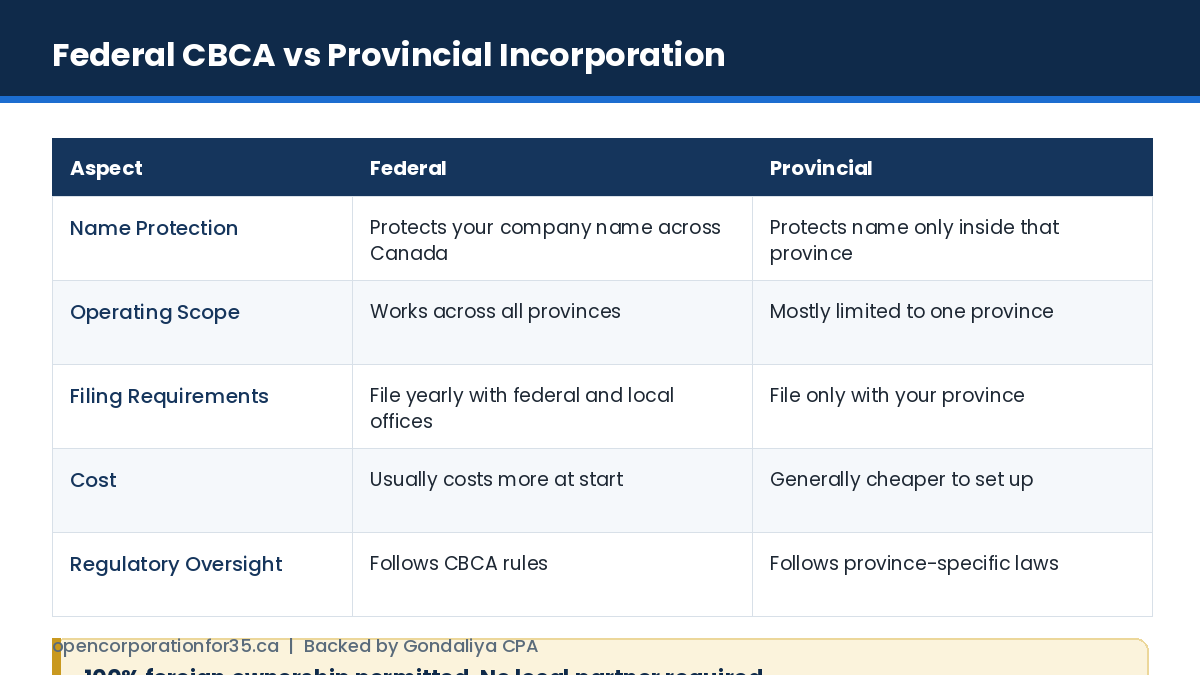
Here’s a quick look:
- Name Protection
- Federal: protects your company name across Canada
- Provincial: protects name only inside that province
- Operating Scope
- Federal: works across all provinces
- Provincial: mostly limited to one province
- Filing Requirements
- Federal: file yearly with federal and local offices
- Provincial: file only with your province
- Cost
- Federal: usually costs more at start
- Provincial: generally cheaper to set up
- Regulatory Oversight
- Federal: follows CBCA rules
- Provincial: follows province-specific laws
British Columbia has flexible rules that many tech startups like. Ontario gives access to the biggest market in Canada. Alberta offers lower tax rates good for energy companies.
Federal incorporation benefits include wider name protection and easier growth across provinces without re-registering. Provincial incorporation saves money and is simpler if you want just one region.
Limited Partnership and Branch of UAE Company Options
You don’t always have to create a new company. You can try limited partnerships or open branches of your UAE company in Canada.
Limited partnerships have two types of partners:
- General partners run the business and have full liability.
- Limited partners put in money but don’t manage daily work.
This works well if you want some investors who won’t be involved much but someone else runs things.
A branch office lets your existing UAE company do business directly in Canada without making a new legal entity. But watch out — branches can bring liabilities back to the parent company and face stricter rules than subsidiaries.
Both choices have different legal, tax, and paperwork effects. Think about your long-term plan for cross-border UAE-Canada business before deciding.
The branch route looks simpler on paper and rarely is. Once activity in Canada is real, the reporting and the permanent establishment question arrive together, and a Canadian subsidiary is usually the cleaner structure.
Legal and Ownership Requirements for Foreign Entrepreneurs
Legal and Ownership Requirements for Foreign Entrepreneurs
Ownership
One big plus when you open corporation Canada from UAE is no need for a local partner. Foreign owners keep full control over their companies. Canadian law allows 100% foreign ownership unless special rules apply (like banking).
You stay fully in charge of your shares. No residency needed for shareholders either, but note this:
- Some provinces ask that at least 25% of directors live in Canada.
- Nominee directors help non-residents meet this rule legally.
Nominee shareholders exist too but be careful. The CRA watches closely for transparency, so understand risks before using nominees.
Knowing foreign ownership regulations helps you follow rules while keeping control when you start business canada from uae as a non-resident entrepreneur working remotely.
A nominee director is a real director with real statutory duties, not a name on a form. Founders who treat the arrangement casually are the ones renegotiating it later under pressure.
Selecting the Best Province for Your Canadian Business Registration
Selecting the Best Province for Your Canadian Business Registration
Province
Choosing which province fits best depends on where you’ll mainly do business. Provinces each have their own rules on fees, reporting, taxes, labor laws, and even naming during registration.
Provincial business regulations differ like this:
- British Columbia: Good online services; popular with tech startups.
- Ontario: Biggest market; lots of government support.
- Alberta: Lower corporate income tax; great for resource industries.
If you want to run business in several provinces after registering somewhere else, expect extra-provincial registration steps. This means more paperwork to legally work outside your home province.
Look closely at your goals first. Then decide if federal versus provincial incorporation suits forming a canada company uae resident entity remotely best for you.
Founders reach for federal because it sounds bigger. The better question is where the first ten customers will be, and that single answer settles the jurisdiction faster than any comparison table.
Step-by-Step Process to Incorporate a Company in Canada from the UAE
Step-by-Step Process to Incorporate a Company in Canada from the UAE
The Steps
Starting a company in Canada from the UAE is doable, but you gotta follow some steps. Whether you want to open corporation Canada UAE or start business Canada from UAE, knowing each step helps avoid delays. Incorporating as a Canada UAE citizen requires clear paperwork and rules.
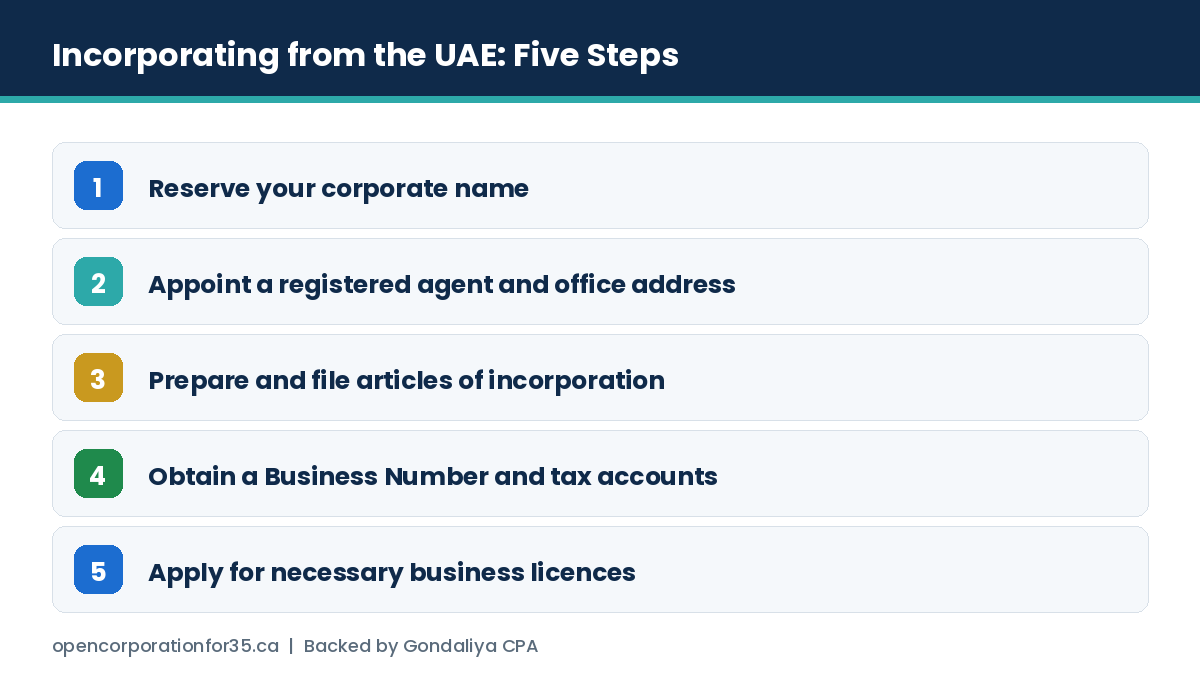
Reserving Your Corporate Name and Ensuring Compliance
First, you need to pick and reserve your company name. Do a business name search Canada to make sure no one else uses it or something close.
For federal registration, you usually need a NUANS name search. It checks your proposed name against other names and trademarks in Canada. This makes sure you get corporate name approval without trouble.
Each province may have its own rules but similar checks. After reserving, your name stays valid about 90 days federally. Use this time to finish the rest of your paperwork.
Appointing a Registered Agent and Establishing a Registered Office Address
Canadian law says every company must have an official address inside the province or country where it’s registered. If you live in the UAE, you must hire registered agent services Canada.
A registered agent is someone who receives legal mail and official documents for your company. They give you a legit registered office Canada address that meets Canadian rules. Usually, just a P.O. Box won’t work here.
Using registered agent services means you won’t miss important notices about taxes, filings, or legal stuff while living abroad.
Preparing and Filing Articles of Incorporation and Required Documentation
The main form to create your company is the Articles of Incorporation. It includes:
- Company’s legal name
- Business purpose
- Share structure
- Director info
You also need to send any other papers listed on the corporate documents checklist by Corporations Canada or the local province.
Pay your filing fee when submitting these forms. After approval, you’ll get a certificate of incorporation proving your company officially exists in Canada.
This certificate lets you move forward with tax registration and other legal steps even if you’re not in Canada.
Obtaining a Business Number and Registering for Tax Accounts including GST/HST
Once incorporated remotely from the UAE, get a CRA business number (BN). It’s needed for any taxable activity in Canada.
Foreign owners apply online or by mail using Form RC1 (Request for Business Number). The BN identifies your company for tax purposes like:
- GST/HST registration: Foreign companies selling over $30,000 CAD yearly must register for Goods & Services Tax / Harmonized Sales Tax.
- Payroll accounts if hiring staff
- Import/export accounts if needed
Registering early helps avoid penalties and keeps your business tax-compliant under Canadian laws for foreign owners.
Applying for Necessary Business Licenses to Operate in Canada
Depending on what business you run and where in Canada it is, you’ll need permits or licenses before starting operations.
Examples:
- Shops often need city-level licenses.
- Some professions require special regulatory approvals.
- Food businesses must pass health inspections and get proper permits at provincial or municipal levels.
As a non-resident, research which permits fit your sector carefully. Missing these could cause fines or stop your business even if you’ve already incorporated from abroad like Dubai/UAE.
Note: Check latest info directly with Corporations Canada (https://www.ic.gc.ca) and CRA (https://www.canada.ca/en/revenue-agency.html). Rules change sometimes; timings, fees, banking, or tax results aren’t guaranteed.
The ninety day name reservation sounds generous and rarely is. Founders who reserve a name and then start gathering documents often watch the clock run out and pay for a second search.
Opening a Business Bank Account in Canada as a UAE Resident
Opening a Business Bank Account in Canada as a UAE Resident
Banking
Opening a business bank account in Canada is a must if you want to open corporation Canada from UAE. Canadian banks ask non-residents, like UAE residents, for certain papers and checks before giving access to corporate bank accounts. Traditional banks often require strict rules for foreign owners. On the other hand, fintech business accounts give more flexible options designed for international clients.
If you’re a UAE resident trying to start business Canada from UAE, or an incorporate Canada UAE citizen status holder, you should know your banking options. Most big Canadian banks want proof of incorporation, ID documents, and sometimes your physical presence when setting up accounts. Some fintech providers let you onboard remotely with less fuss but might set transaction limits or charge higher fees.
Corporate bank account Canada can be hard to get because of anti-money laundering (AML) and know-your-customer (KYC) rules. These rules stop fraud and make sure things are clear. If you prepare all papers beforehand, the process will go smoother.
Challenges with Banking Access and Possible Alternatives
Non-residents face tough banking challenges non-residents because of strict AML/KYC requirements. These rules often mean you need to visit Canadian branches in person or get documents notarized. The goal is to confirm your identity but this slows down account opening for foreign owners who don’t know local steps.
One option is nominee director services Canada. Trusted people act as company directors when dealing with banks. But nominee director fiduciary duty means these nominees must legally act for the company’s benefit and keep secrets.
Nominee shareholder Canada setups protect privacy too but have legal issues that need care under Canadian law.
Because of these problems, many non-resident business owners try fintech platforms with digital corporate bank accounts that don’t require showing up in Canada. While easy, these options might not handle all transactions or credit lines that traditional banks offer.
Here’s a quick list of challenges and alternatives:
- Strict AML/KYC rules needing personal visits
- Need for notarized documents
- Nominee director services for banking help
- Legal duties of nominee directors
- Privacy via nominee shareholders with legal complexity
- Fintech platforms offering remote account setup
Banking, not incorporation, is the long pole for owners in the Gulf. The certificate can be issued in days while the account takes weeks, so the bank conversation should start the moment the certificate lands.
Key Costs Involved in Incorporating and Maintaining a Canadian Company
Key Costs Involved in Incorporating and Maintaining a Canadian Company
Costs
Incorporation filing fees Canada change if you pick federal or provincial incorporation. Federal online filings usually cost about CAD 200–250. Provincial fees vary by province; Ontario charges around CAD 360.
Annual corporate filings are required no matter where you live. You must send annual returns and update company details regularly. Fees run between CAD 20–100 yearly depending on where your company registers.
The registration process also has government fees plus any charges from agents or consultants helping UAE residents start companies in Canada.
Corporate registration fees Canada cover:
- Initial name searches ($30–60)
- Outsourced incorporation document prep (~CAD 300+)
- Ongoing compliance monitoring and reporting costs
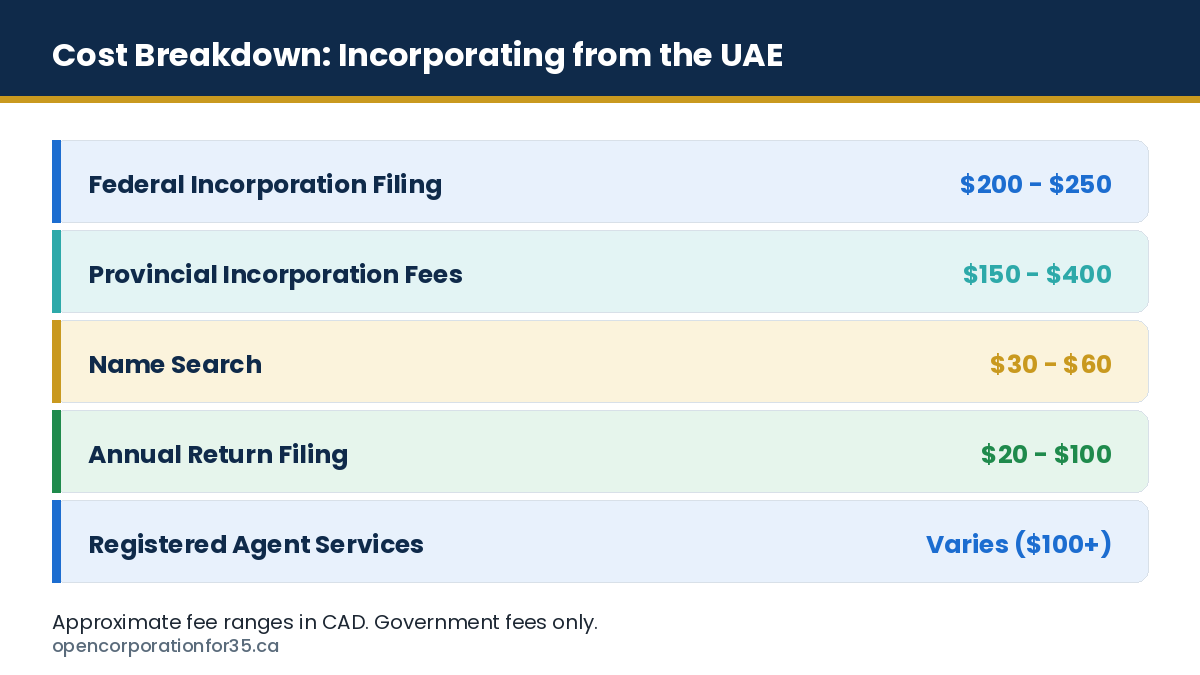
| Cost Item | Approximate Fee Range (CAD) |
|---|---|
| Federal Incorporation Filing | $200 – $250 |
| Provincial Incorporation Fees | $150 – $400 |
| Name Search | $30 – $60 |
| Annual Return Filing | $20 – $100 |
| Registered Agent Services | Varies ($100+) |
First-Year Setup Expenses and Annual Compliance Fees
In your first year after incorporating as a UAE non-resident owner, expect some setup costs beyond filing fees:
- Business Number Registration: Free through CRA but hiring consultants may cost extra
- GST/HST Registration: Needed if sales pass limits; no fee charged
- Legal/Accounting Help: Good for tax planning; prices vary a lot
- Annual Report Filing: Must file yearly report about company activities
Ongoing compliance means submitting annual returns on time plus updates if directors or shareholders change. These cause small admin fees yearly across provinces.
Ignoring these can lead to fines or company cancellation. This hits cross-border UAE-Canada businesses hard since they often manage things remotely.
Overview of Ongoing Reporting and Regulatory Obligations
Canadian corporate filings keep your company legal no matter who owns it. Non-residents have to follow:
- Annual Returns filed federally at Corporations Canada or provincially at registry offices
- Tax filings like T2 Corporate Income Tax Returns every year even if no income was made
- GST/HST payments once sales go over thresholds
Canadian business compliance requires keeping accurate books ready for CRA checks. Tax authorities watch foreign-owned companies closely because AML/KYC rules stay tight after incorporation.
To sum up, staying up-to-date on filings keeps your business running well in Canada’s system.
Owners budget the incorporation fee and forget the recurring line. The registered agent and the annual filings shape the yearly cost far more than the one-off, and both are easier to absorb when quoted at the start.
Incorporate in Canada without leaving the UAE
Same-day federal or provincial incorporation, instant NUANS name search, a registered office address that meets registry rules, and CRA account setup, all backed by a CPA firm. Please book a free consultation.
Tax Considerations for UAE Entrepreneurs Operating Canadian Companies
Tax Considerations for UAE Entrepreneurs Operating Canadian Companies
Corporate Tax
If you live in the UAE and want to start a company in Canada, there are some tax points you should know. Canadian corporate taxes apply no matter where you live. That means foreign owners must pay federal and provincial taxes on money made in Canada. The federal tax rate is about 25%, plus the rates your province charges.
Canada allows foreign ownership but demands following local business rules and filing taxes on time. Even if your company makes no profit, you must get a CRA business number and file yearly returns. Planning your taxes carefully helps reduce what you owe in both the UAE and Canada under cross-border taxation rules.
Also, GST and HST affect foreign-owned Canadian businesses. You need to register if sales pass CAD 30,000 a year. Knowing these rules stops penalties and smooths your startup process when forming a company Canada from UAE.
Check all details with official sources since this is just a quick overview. There may be extra fees or approvals involved that are not covered here.
UAE founders are used to a very different tax environment at home, so the annual T2 obligation is the item that surprises most. It is due whether or not the company traded that year.
Understanding GST/HST Obligations for Foreign-Owned Corporations
Understanding GST/HST Obligations for Foreign-Owned Corporations
GST/HST
Foreign-owned Canadian companies deal with GST (Goods and Services Tax) or HST (Harmonized Sales Tax). This depends on where they operate inside Canada. If your taxable sales go over CAD 30,000 yearly, you have to register for GST/HST with the CRA.
Once registered, you must file reports either every quarter or year, depending on how much money you make. Some provinces charge only GST at 5%. Others combine GST and PST into HST which can be as high as 15%. This affects how you price your goods or services and manage cash flow.
Missing these steps can lead to fines or interest on unpaid tax amounts. Foreign owners should get advice from experts who understand how cross-border taxation UAE Canada works before registering for GST/HST.
Key points:
- Register if sales exceed CAD 30,000
- File quarterly or annual GST/HST reports
- Know whether province charges GST only or combined HST
- Consult specialists on foreign ownership tax rules
Registering voluntarily before the threshold is often the better move where there are Canadian costs, because input tax credits can be recovered from the first invoice rather than the first breach.
Cross-Border Tax Implications and Double Taxation Risks
Cross-Border Tax Implications and Double Taxation Risks
Treaties
Running a Canadian company while living in the UAE can cause double taxation risks. Both countries might want tax on the same income. Luckily, there is an income tax treaty between UAE and Canada that tries to stop this problem.
This treaty lets you claim credits for taxes paid abroad so you don’t pay twice on one income source. That’s important if you start business Canada from UAE under foreign ownership rules.
Cross-border tax laws ask for clear records of deals between related parties in different countries. You also need to report properly in both places every year.
Talking to international tax pros who know about cross-border issues helps avoid problems with double taxation avoidance agreements. They also help keep your company from accidentally becoming permanently established in either country too soon.
Transfer pricing between a UAE parent and a Canadian subsidiary is the area that draws attention. Documenting the arrangement properly at the start costs far less than defending it during a review.
Director Residency Rules and Strategies to Mitigate Central Management Risk
Director Residency Rules and Strategies to Mitigate Central Management Risk
Directors
Canadian law doesn’t always say directors must live in Canada. But some provinces want at least one director living inside them if the company is provincially incorporated. Federally incorporated companies don’t have this rule.
If you’re an expat or a Dubai-based investor, federal incorporation may offer more freedom by reducing residency limits.
Nominee directors can act for the company but they have full legal duties like any other director. They must act honestly and put the company’s interests first. Some new entrepreneurs don’t realize nominee roles come with real responsibilities beyond just signing papers.
Good governance reduces risks tied to central management controls seen by Canadian courts during audits or disputes. If control looks like it happens mostly from outside Canada without proper structures, tax authorities may treat your whole company as Canadian resident for tax purposes, which can add costs unexpectedly.
To keep things smooth:
- Check who can be director legally
- Use nominee directors carefully knowing their duties
- Structure management to meet legal rules but maintain control remotely
This helps avoid surprises about personal liability or added taxes after incorporation.
Where the board actually meets and decides matters more than where the company was registered. Founders running everything from Dubai should have that reviewed rather than assumed.
Managing Compliance To Avoid Tax Residency Triggers And Penalties
Managing Compliance To Avoid Tax Residency Triggers And Penalties
Residency Risk
Following Canadian business compliance rules strictly helps stop your company from being seen as a Canadian resident for tax purposes by mistake. Having too much presence like an office or staff there could create permanent establishment risk which means full Canadian taxes apply—not just withholding taxes usually paid by non-residents.
Many UAE-based businesses run their main operations offshore while only keeping small footprints inside Canada just enough to meet legal requirements without triggering residency tests.
Failing to file required paperwork yearly—even if the company is inactive—can lead to penalties or forced closure by authorities because of poor administration.
Here’s what you should keep in mind:
- File all annual documents on time
- Avoid operating beyond minimal local presence
- Keep good records of management decisions made outside Canada
- Work with advisors who specialize in non-resident companies’ compliance
Doing these steps keeps your reputation clean, avoids costly penalties, and ensures your business can grow freely without unexpected problems from changing laws or audits down the road.
Stay updated by checking official sources often so info stays current and accurate over time—this minimizes audit risks and gives peace of mind while running your cross-border business between UAE and Canada smoothly.
Risk Warning: A dormant corporation still files. Owners who pause a venture assume the filings pause with it, and the default notice goes to a registered office nobody is checking. That is how an idle company ends up struck from the register.
Board minutes are the evidence nobody keeps until they need them. A short record showing where decisions were actually taken is the cheapest protection against a residency argument years later.
Common Challenges Faced by UAE Residents Incorporating in Canada and Solutions
Common Challenges Faced by UAE Residents Incorporating in Canada and Solutions
Challenges
Starting a foreign owner corporation in Canada can be tricky for UAE residents. Foreign ownership rules change by province and industry. Canada usually allows full foreign ownership, but some fields have limits that need checking.
Opening business bank accounts is tough for non-residents. Canadian banks often want you there in person or proof of residency. This makes the remote company setup process from abroad harder. Nominee director services in Canada can help by offering local representation. They also keep your company following corporate governance rules.
Keeping up with Canadian business compliance is important but confusing for owners far away. You must meet filing deadlines, keep records right, and know federal vs provincial rules. Professional advisors who know cross-border incorporation make handling this easier.
Knowing about foreign ownership limits, banking problems, and compliance early on helps UAE entrepreneurs start a company in Canada more smoothly.
Addressing Banking Delays and Residency Workarounds
Opening a business bank account Canada side takes time for UAE residents. Banks ask for strict ID checks and proof of residency. You might need to travel there just to finish the paperwork.
Fintech business accounts offer a faster way in. They don’t always ask for Canadian residency or physical visits. But these digital accounts sometimes have transaction caps unlike regular banks.
Some companies use nominee directors to meet director residency rules when needed. These directors take on fiduciary duties locally but keep things transparent through legal contracts. This method keeps corporate governance intact under Canadian law.
Knowing these options helps UAE owners get past banking delays when opening companies remotely in Canada.
Maintaining Active Status and Filing Requirements for Canadian Corporations
Canadian corporations must file annual corporate filings like annual returns and shareholder updates on time. Missing deadlines can bring penalties or even cause inactive companies to be dissolved by Corporations Canada or provincial offices.
Inactive company penalties remind you that even if your business isn’t running now, you must still keep records like meeting minutes and financial reports as required by corporate record-keeping laws.
Regularly filing paperwork keeps your corporation active. This matters if you want government programs like GST/HST registration or a CRA business number for taxes when running cross-border operations between the UAE and Canada.
Watching deadlines closely cuts risks linked to missing compliance that could harm your company’s standing later on.
The time difference works in your favour rather than against it. A question sent from Dubai in the afternoon is answered while it is still morning in Toronto, so most of these files move a full day faster than founders expect.
Summary of Essential Steps to Open a Corporation in Canada from the UAE
Summary of Essential Steps to Open a Corporation in Canada from the UAE
Summary
Opening a company remotely from the UAE has clear steps made for non-residents:
- Name Search & Reservation: Do a NUANS name search federally or equivalent provincially.
- Choose Incorporation Type: Pick federal or provincial based on where you’ll do business.
- Prepare Documents: Write articles of incorporation and bylaws.
- File Incorporation Application: Submit online through Corporations Canada or provincial registry.
- Register Business Number (BN): Get BN from CRA for tax accounts like GST/HST.
- Set Up Corporate Records: Keep minute books; electronic copies are fine.
- Open Bank Account Remotely: Use fintech if you can’t visit bank branches.
- Ensure Compliance Ongoing: Keep up with yearly filings and bookkeeping regularly.
This clear process makes incorporating Canada as an UAE citizen easier despite distance challenges.
Founders who arrive with three name options, a decision on the province, and an answer on whether anyone on the board lives in Canada move fastest. Everything else follows from those three.
Encouragement to Seek Expert Guidance for Successful Incorporation and Compliance
Encouragement to Seek Expert Guidance for Successful Incorporation and Compliance
Advisory
Dealing with cross-border incorporation needs coordinated advisory help focused on foreign owner corporations run by UAE residents in Canada. Legal rules, banking issues, residency workarounds, and ongoing compliance get complicated fast.
Professional support helps you avoid costly errors, speeds up approvals, and keeps you compliant all year long. Experts explain changing rules so you can focus on your new business without extra paperwork stress.
For solid advice suited to both countries, talk with specialists before you start the process.
Disclaimer: Always check official government sources since policies may change without warning; no guarantees exist on approval times, costs, taxes, banking acceptance, or other factors beyond control.
Founders who bring an adviser in at the filing stage save money. Those who bring one in after the first missed deadline spend it. The difference is rarely the complexity of the structure, it is simply when the conversation happened.
FAQs on Incorporating a Company in Canada from UAE
FAQs on Incorporating a Company in Canada from UAE
FAQ
What is the Business Number (BN) registration process in Canada for UAE residents?+
You register for a Business Number (BN) with the CRA after incorporation. It identifies your company for tax and other accounts.
Do UAE residents need to file tax returns in Canada?+
Yes, foreign owners must file corporate income tax returns (T2) yearly, even if no profit is made.
What are bookkeeping requirements for Canadian corporations owned by foreigners?+
You must keep accurate records of income, expenses, and corporate transactions to meet Canadian compliance.
Can foreign entrepreneurs obtain business permits in Canada?+
Yes. Business permits depend on the industry and province. Non-residents must meet local regulations.
What are nominee director fiduciary duties in Canada?+
Nominee directors must act honestly and in the company’s best interest under Canadian corporate law.
How can UAE residents reduce Canadian tax residency risk?+
Maintain minimal physical presence and manage key decisions outside Canada to avoid residency triggers.
What annual returns do Canadian corporations need to file?+
Annual corporate filings must be submitted federally or provincially, including updated shareholder and director info.
Are there special rules for intercompany transactions between UAE and Canada entities?+
Yes. These transactions require proper documentation and arm’s length pricing to comply with tax laws.
Can starting a business in Canada help with business immigration or startup visa programs?+
Incorporation is a step but additional criteria apply for business immigration and startup visas.
Two questions dominate every UAE enquiry: whether a local partner is needed, and whether incorporating helps with a visa. The answers are no to the partner, and incorporation on its own does not grant immigration status.
Essential Points on Cross-Border Tax Planning and Compliance
Tax Planning
- Plan taxes considering both Canadian corporate tax rates and UAE treaties.
- File all required GST/HST reports if sales exceed CAD 30,000 annually.
- Keep detailed records for cross-border transactions to avoid audits.
- Use professional advisors for international tax planning between UAE and Canada.
Remote Company Registration Tips
Remote Setup
- Use digital incorporation services for faster federal or provincial registration.
- Understand incorporation timelines to plan your launch effectively.
- Employ registered office providers offering virtual office addresses.
Managing Banking Challenges for Non-Residents
Banking
- Prepare documents to meet AML/KYC requirements before applying at banks.
- Consider fintech solutions that allow remote account setup but check transaction limits.
- Nominee director services can facilitate banking relationships under legal compliance.
Understanding Canadian Government Business Regulations
Regulations
- Stay updated on provincial business regulations which vary widely by location.
- Comply with corporate governance rules like director eligibility and record keeping.
- Follow all Canadian government incorporation fees guidelines during setup.
Corporate Compliance Deadlines and Filings
Deadlines
- Submit annual returns timely to avoid penalties or dissolution risks.
- File T2 corporate income tax returns annually regardless of revenue status.
- Maintain thorough corporate records to support audit readiness by tax authorities.
Additional Legal and Administrative Considerations
Legal
- Review federal incorporation restrictions relevant to your sector before registering.
- Extra-provincial registration may be needed when operating across provinces.
- Nominee shareholders require careful legal evaluation due to transparency rules.
These FAQs and bullet points provide clear guidance on remote company registration, cross-border taxation, banking hurdles, compliance obligations, and legal duties for UAE residents incorporating in Canada with Open Corporation for $35.
Professional Guidance on Canada Incorporation from the UAE: How Open Corporation For $35 Supports Gulf Founders
Professional Guidance and Quick Reference
Guidance
Incorporating from the UAE is a sequencing problem rather than a form problem. The filing itself is quick. Choosing the jurisdiction against your board, arranging a registered office the registry will accept, opening the CRA accounts in the right order, and starting the bank conversation early is the work that decides how long the whole thing takes.
Open Corporation For $35 is backed by Gondaliya CPA, which means your incorporation, your CRA accounts and your tax filings sit with one team rather than three providers who never speak to each other. We run the name search, file the articles, register the Business Number and GST/HST where needed, and send you the certificate and confirmations for your minute book.
Our team works to current registry and CRA practice and builds each filing around your own facts rather than a template. Whether you are incorporating federally for national reach or provincially to keep it simple, we confirm the position before anything is submitted.
Quick Answers: Key Numbers & Concepts at a Glance
At a Glance
- Federal incorporation filing: About CAD 200 to 250
- Provincial incorporation fees: CAD 150 to 400
- Name search: CAD 30 to 60
- Annual return filing: CAD 20 to 100
- Registered agent services: Varies, from CAD 100
- Foreign ownership: 100% permitted, no local partner
- Name reservation validity: About 90 days federally
- GST/HST registration: Once yearly sales pass CAD 30,000
- GST rate: 5%, with HST as high as 15% in some provinces
- T2 corporate return: Filed yearly, even with no income
Who This Is For / Not For
Fit Check
- For: UAE residents who want to own a Canadian corporation without relocating, Dubai and Abu Dhabi founders targeting the North American market, owners who need a registered office and CRA accounts arranged for them, and anyone weighing a Canadian subsidiary against a branch of their UAE company.
- Not For: Anyone expecting incorporation to grant a visa or residency, corporations already incorporated in Canada that only need annual filings, and businesses in sectors where foreign ownership is restricted, such as banking.
People Also Ask
Quick Answers
Do I need a Canadian partner to incorporate?+
No. Canada has no local partner requirement. A UAE resident can hold every share, and the only residency question relates to directors in certain jurisdictions.
Should I open a subsidiary or a branch of my UAE company?+
A subsidiary is usually cleaner. A branch keeps liability with the UAE parent and brings its own reporting and permanent establishment questions once activity in Canada becomes real.
How long does the whole process take?+
The incorporation itself is fast. Banking is the step that sets the real timeline, so start that conversation the week the certificate is issued rather than after.
Glossary of Key Terms
Plain-English Definitions
- NUANS: The name search report checking your proposed name against existing Canadian names and trademarks.
- CBCA: The Canada Business Corporations Act, the statute governing federal corporations.
- Registered agent: A person or firm appointed to receive legal mail and official documents for the corporation.
- Registered office: The official Canadian address where documents are served. A post office box will not qualify.
- Nominee director: A resident appointed as a formal director to satisfy a residency rule, without taking ownership.
- Business Number: The CRA identifier that all tax accounts attach to, including GST/HST and payroll.
- T2: The corporate income tax return, filed yearly with the CRA.
- Permanent establishment: A fixed place of business in Canada that triggers Canadian tax on the profits attributable to it.
- Central management and control: The test of where a company is really directed, which can affect its tax residency.
- AML and KYC: Anti-money laundering and know-your-customer checks that banks apply before opening an account.
Pick the jurisdiction from where your customers are, settle the board against the residency rule before you file, arrange a Canadian registered office first, and open the bank conversation the week the certificate is issued. Those four decisions set how smoothly the first year runs.
UAE to Canada Incorporation Readiness Check
This quick self-check flags which parts of your Canadian setup need attention. Please answer the six questions below.
UAE to Canada Incorporation Readiness Check
Six quick questions on your plans. No fee quoted.
Points to review:
This is a general prompt, not tax or legal advice or a quote. Your position depends on your full facts, so for a real review please book a free consultation.
Want a checklist to work from? Please download our free UAE to Canada incorporation checklist before your consultation.
Start your Canadian incorporation from the UAE
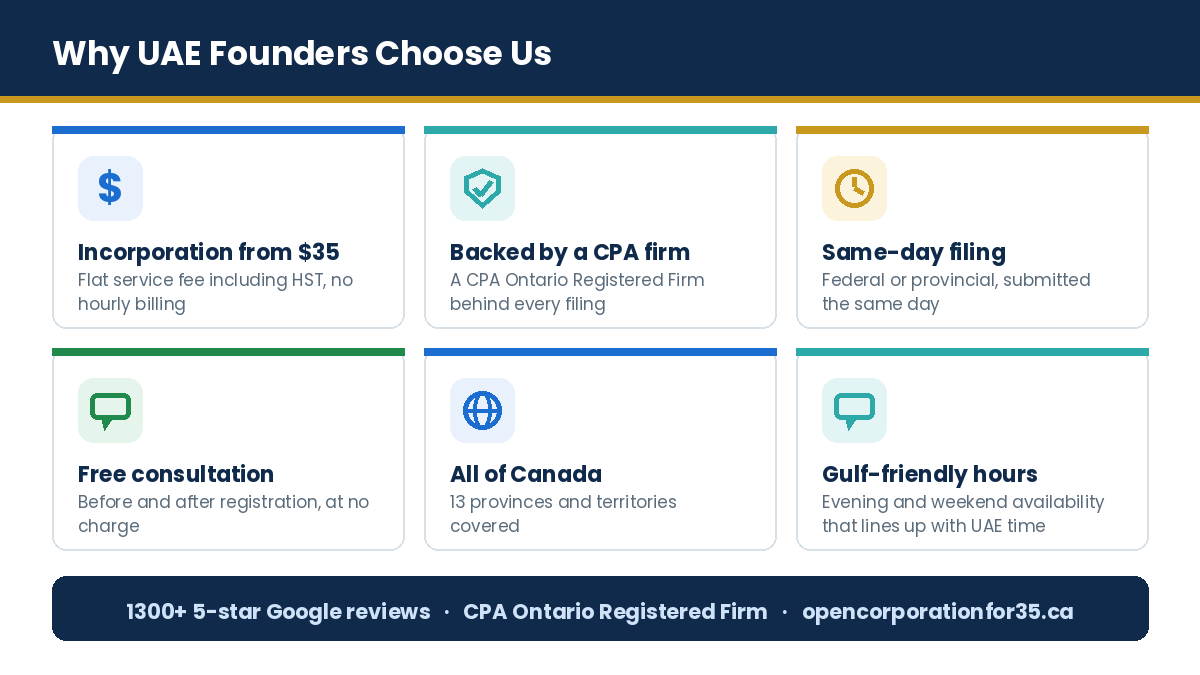
Same-day federal or provincial incorporation, instant NUANS name search, a registered office address that meets registry rules, and CRA account setup, all from a CPA-backed team with evening and weekend availability that lines up with Gulf hours. Please book a free consultation.
Next Steps
Send us your preferred company name, the province you plan to sell into, and whether anyone on your board lives in Canada. We will confirm the jurisdiction, the CRA accounts and the filing deadlines before anything is submitted. If our content helps, please add opencorporationfor35.ca as a preferred source on Google.
Published: June 29, 2026 · Last updated: June 29, 2026
Editorial policy: Our content is prepared by our filing team and reviewed by Sharad Gondaliya, CPA, and we update it as registry requirements, fees and compliance rules change.
Disclaimer: This article is educational information only and is not tax, legal, or financial advice. Fees, deadlines and residency rules change, and outcomes depend on your specific facts. Please consult a CPA before acting.