
Why Canada is Attractive for Non-Resident Entrepreneurs
Start business in Canada from abroad through Canada incorporation for non residents with Open Corporation For $35, which streamlines the process of establishing a corporation remotely. It covers critical steps such as foreign entity setup in Canada and understanding corporate residency rules to help non-resident business owners register successfully.
Quick Summary
Canada suits foreign founders because ownership carries no residency test, the whole registration can be done remotely, and a Canadian entity gives you a credible base inside the USMCA trading bloc. What actually needs deciding is the entity type, since a subsidiary, a branch and an employer of record leave you in very different liability positions. Please note corporate residency is decided by where central management sits, not by where you incorporated.
| Aspect | Details |
|---|---|
| The appeal | No residency test on ownership, remote setup, USMCA market access. |
| The choice | Subsidiary, branch office or employer of record, each with different liability. |
| The catch | Corporate residency follows central management and control. |
| The timeline | Several days up to four weeks, depending on jurisdiction and workload. |
Reading time: 27 minutes.
Table of Contents
- FAQs: Opening a Corporation in Canada as a Non-Resident (2026 Guide)
- Key Requirements for Non-Residents
- Federal vs Provincial Incorporation Explained
- Costs of Opening a Corporation in Canada
- Common Mistakes Non-Residents Make When Incorporating in Canada
- Step-by-Step Process Overview: Incorporating as a Non-Resident
- Benefits of Incorporating in Canada as a Non-Resident
- Residency of a Corporation and Tax Considerations
- Foreign Entity Setup Options: Subsidiary vs Branch Office vs EOR
- Requirements for Foreign Company Setup in Canada
- Compliance Obligations After Incorporation
- Challenges Faced by Non-Residents When Incorporating in Canada
- Final Summary
- Professional Guidance and Quick Reference
The Numbers That Matter
This article covers Canada, with Ontario and Toronto context, and assumes a foreign entrepreneur setting up here from abroad. Fees, thresholds, processing times and director residency rules are set by the federal and provincial governments, and they change. This is educational information only and not tax, legal, or financial advice. Please confirm your own position with a CPA before acting.
FAQs: Opening a Corporation in Canada as a Non-Resident (2026 Guide)
FAQs: Opening a Corporation in Canada as a Non-Resident (2026 Guide)
FAQ
Starting a corporation in Canada when you don’t live there can be a smart move. This guide answers common questions and gives you the basics about setting up your business from another country.
FAQ Section Overview
Here, you’ll find answers about how non-resident incorporation in Canada works. Topics include who can own the company, address needs, banking, taxes, and more. Take a quick look at these core points:
- Non-residents can open corporations in Canada.
- You don’t need permanent residency or citizenship.
- You can fully own your Canadian company.
- Federal and provincial incorporation differ.
- A Canadian address is usually needed for registration.
Core FAQs
Can a non-resident open a corporation in Canada?+
Yes, you can. Non-residents are allowed to incorporate without living in Canada during the process.
Do I need permanent residency or citizenship to incorporate?+
Nope. You don’t have to be a permanent resident or citizen to open a company here.
Can a non-resident own 100% of a Canadian corporation?+
Yes! Foreigners can own all shares of their Canadian corporation without limits.
What are the differences between federal and provincial incorporation for non-residents?+
Federal incorporation lets your business operate across all provinces with one name. Provincial incorporation means you work only in one province but might face fewer rules at first.
Is a Canadian address required for incorporation?+
You usually must have a registered office address inside Canada. But you don’t have to be physically there yourself.
How can non-residents open a Canadian business bank account?+
Banks require ID and proof of business registration. Non-residents need these documents when applying for an account.
Are nominee directors allowed for non-resident corporations?+
Yes. Nominee directors can act for owners who live abroad but must follow all legal duties.
What are the GST/HST registration requirements for non-resident corporations?+
If your business makes over $30,000 CAD from taxable sales inside Canada each year, you must register for GST/HST even if you’re not based there.
How is corporate tax applied to non-resident companies in Canada?+
You pay tax only on income earned inside Canada. Income made outside isn’t taxed here unless there’s a treaty saying otherwise.
What is the typical timeline for incorporating as a non-resident?+
The process can take from several days up to four weeks. It depends on your situation and the services you use.
Which documents are required to incorporate remotely?+
You need things like your company’s articles and ID such as passports or driver’s licenses from your home country. You submit these online usually.
Can I operate my Canadian corporation entirely from abroad?+
Yes, many run their Canadian businesses while staying overseas. Just keep up with rules and filing duties set by Canada.
Key Stat: Ownership of a Canadian corporation carries no residency or citizenship test at all. A non-resident can hold 100% of the shares. The only residency question that ever arises concerns the board of directors.
The real draw for most foreign founders is not tax. It is having a credible, bankable entity inside a stable jurisdiction with USMCA access, which changes how suppliers and payment processors treat the business.
Key Requirements for Non-Residents
Key Requirements for Non-Residents
Requirements
Starting a business in Canada as a non-resident means knowing some rules about residency, directors, compliance, and banking. These rules help your company follow Canadian laws and work well even if you live abroad.
Residency Rules Affecting Directors and Shareholders
You might ask, “Do I need permanent residency (PR) to start a company in Canada?” The answer is no. You don’t need PR or citizenship to own or start a corporation here.
But the rules about directors’ residency change depending on the province:
- Some provinces want at least one director who lives in Canada.
- Others don’t have this rule.
For example:
- British Columbia doesn’t require resident directors.
- Ontario says 25% of directors must be residents if there are four or more directors.
You should always check the latest rules because provinces update them sometimes.
Director Structure Options for Non-Resident Companies
Non-residents often find it hard to meet residency rules for directors. One way around this is to use a nominee director. This person lives in Canada and acts for your company on paper.
Nominee directors help follow the law while keeping your control over the company. But you must pick nominee directors carefully since they have legal duties.
Some provinces allow all directors to be non-residents. Others want one Canadian resident director or offer other options like corporate trusteeship.
Compliance Obligations After Incorporation
After setting up your company, you must keep up with some legal requirements:
- File annual returns with federal or provincial offices.
- Keep corporate records like minutes and resolutions updated.
- Send tax returns every year based on money made inside and outside Canada.
If you don’t do these things, you risk fines or your company being shut down. Also, if you sell enough inside Canada, you may need to register for GST/HST tax—even if you work from another country.
Banking Prerequisites and Challenges for Non-Residents
Getting a Canadian bank account helps your business but can be tricky for non-residents:
- Banks usually want you there in person when opening an account.
- Some banks let international founders open accounts remotely but with limits.
A Canadian bank account makes paying bills easier, helps with taxes, and builds trust with customers or suppliers in Canada.
It’s smart to look into banks that know how to work with foreign owners before you start registering your company.
| Requirement | Description | Notes |
|---|---|---|
| Director Residency | Varies by province; some require resident directors | Check latest provincial rules |
| Registered Office Address | Must be a physical address in Canada | PO boxes not allowed |
| Shareholder Eligibility | Non-residents can be sole shareholders | No citizenship needed |
| Banking | Canadian bank account recommended | Remote opening possible but limited |
Risk Warning: A PO box as the registered office will get the filing rejected. It has to be a real street address inside the jurisdiction of incorporation, which is the single most common cause of rejection we see.
Federal vs Provincial Incorporation Explained
Federal vs Provincial Incorporation Explained
Comparison
When you pick federal or provincial incorporation, it affects where and how your business works across Canada. This matters especially if you’re starting business in Canada from abroad.
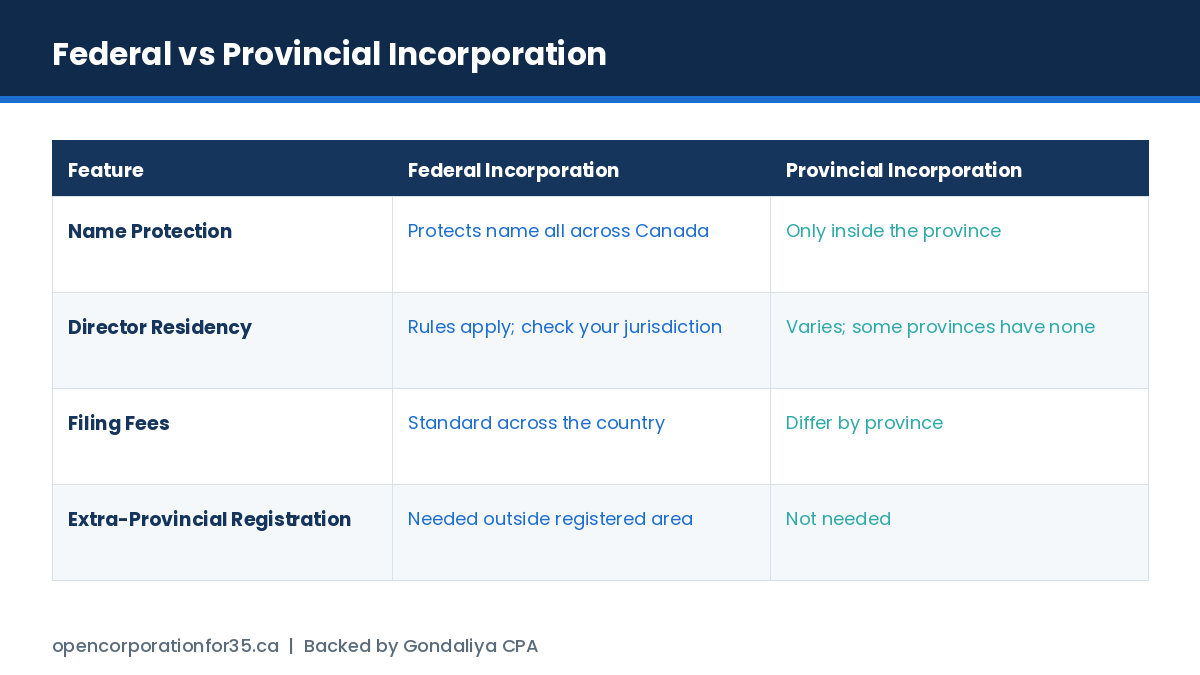
| Feature | Federal Incorporation | Provincial Incorporation (e.g., BC, Ontario) |
|---|---|---|
| Name Protection | Protects name all across Canada | Only protects name inside the province |
| Director Residency Rules | Some provinces still require resident directors federally | Rules vary; some provinces have none |
| Filing Fees | Fees are standard across the country | Fees differ by province |
| Extra‑Provincial Registration Required* | Needed if working outside registered area | Not needed |
* Extra-provincial registration means registering your federal company separately when doing business in other provinces than where it’s registered first.
Federal incorporation has some perks for foreign founders planning to grow their business across many provinces:
- Your company’s name is safe nationwide—no one else can take it anywhere in Canada.
- You deal with one set of filing rules instead of many different provincial ones.
Provincial incorporation fits best if your business stays mostly in one place. The fees can be lower there too. But it means more work if you want to expand later since extra registrations are needed.
Keep in mind fees charged by services like Open Corporation For $35 plus government filing fees vary depending on whether you choose federal or provincial registration.
Choose wisely based on where you plan to operate—and double-check the current laws so your business runs smoothly as a foreign owner setting up shop in Canada’s stable market.
Costs of Opening a Corporation in Canada
Costs of Opening a Corporation in Canada
Costs
Starting a corporation in Canada as a non-resident means you’ll face some costs. Knowing these helps you plan your budget when you want to open corporation in Canada for foreigners or start business in Canada from abroad.
Government Fees
Fees
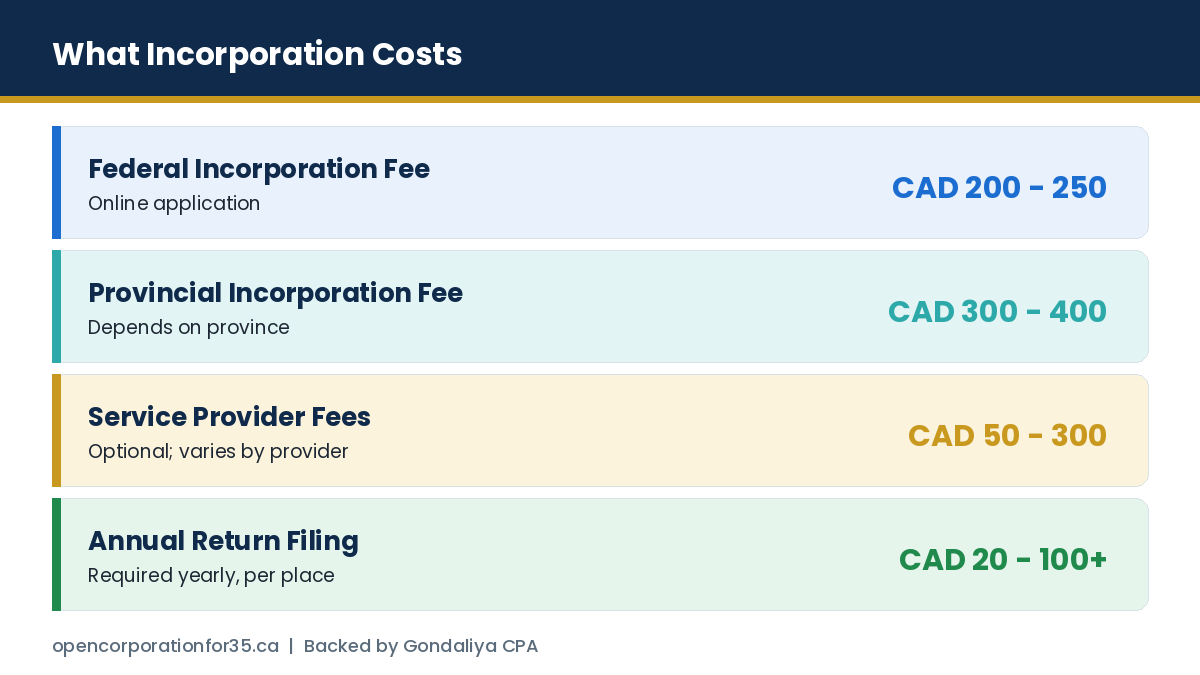
Fees differ if you pick federal or provincial incorporation. Federal incorporation costs about CAD 200 to CAD 250 for online filings. Provincial fees tend to be higher, around CAD 300 to CAD 400. These fees cover registering your company name and getting your certificate of incorporation.
Service Provider Fees
Services
If you use an online service like Open Corporation For $35, expect extra charges between CAD 50 and CAD 300. These services help with paperwork, NUANS name searches, articles of incorporation documents, and filing government forms remotely.
Ongoing Costs
Annual
After incorporating, you need to keep up with annual filings and maybe extra-provincial registrations if you do business outside your province or federally incorporated but operating provincially. Annual filing fees usually run between CAD 20 and CAD 100 per place.
Other ongoing expenses include:
- Registered office address services (if no Canadian address is available)
- Accounting and tax support
- GST/HST registration upkeep (if it applies)
| Cost Type | Estimated Range (CAD) | Notes |
|---|---|---|
| Federal Incorporation Fee | $200 – $250 | Online application |
| Provincial Incorporation Fee | $300 – $400 | Depends on province |
| Service Provider Fees | $50 – $300 | Optional; varies by provider |
| Annual Return Filing | $20 – $100+ | Required yearly |
| Registered Office Address | Variable ($100+) | Needed if no local address |
Check current rules with Canadian government offices because regulations can change.
Common Mistakes Non-Residents Make When Incorporating in Canada
Common Mistakes Non-Residents Make When Incorporating in Canada
Mistakes
Non-residents often get stuck due to unfamiliar rules when they incorporate a business in Canada as a non-resident. Avoiding mistakes saves time and money.
Misusing Nominee Directors
Mistake 1
Some think nominee directors are always needed or that nominee directors take on all duties. Provinces like British Columbia allow nominee directors for a short time, but most places require at least one resident director unless federally incorporated under newer rules letting non-resident majority directors outside Quebec.
Not knowing this causes problems with compliance or bank approvals.
Ignoring Canadian Registered Office Address Requirements
Mistake 2
Every Canadian corporation must have a registered office inside its jurisdiction. Non-residents without a physical address sometimes skip this or give wrong addresses. This leads to rejected paperwork or missing important legal notices.
Using virtual office providers with real registered addresses is smart when incorporating remotely.
Skipping GST/HST Registration
Mistake 3
Non-resident companies doing taxable work in Canada might have to register for GST/HST. Not registering on time causes fines and interest even if sales are small at first.
Knowing when GST/HST applies based on where the business operates keeps taxes correct from the start.
Trouble Opening Canadian Bank Accounts Remotely
Mistake 4
Many foreigners struggle opening bank accounts because banks require strict Know Your Customer checks. Some banks want personal visits even though remote incorporations exist elsewhere. Expect delays if you assume easy access without prepping.
Summary Table: Common Mistakes
Summary
| Mistake | Impact | How To Avoid |
|---|---|---|
| Misusing nominee directors | Compliance trouble | Check residency rules per region |
| Missing registered office address | Paperwork rejection | Use verified virtual offices |
| Skipping GST/HST registration | Penalties | Understand tax obligations early |
| Underestimating bank account issues | Delays setting up operations | Research banks’ remote account options |
A nominee director carries the same legal duties and liabilities as any other director. Treating the arrangement as a paperwork formality rather than a legal relationship is where the trouble usually starts.
Step-by-Step Process Overview: Incorporating as a Non-Resident
Step-by-Step Process Overview: Incorporating as a Non-Resident
Step by Step
Setting up your company remotely means knowing each step — from choosing federal vs provincial incorporation to registering everything needed. This makes starting business in Canada from abroad smoother.
Step 1: Pick Federal or Provincial Incorporation
Step 1
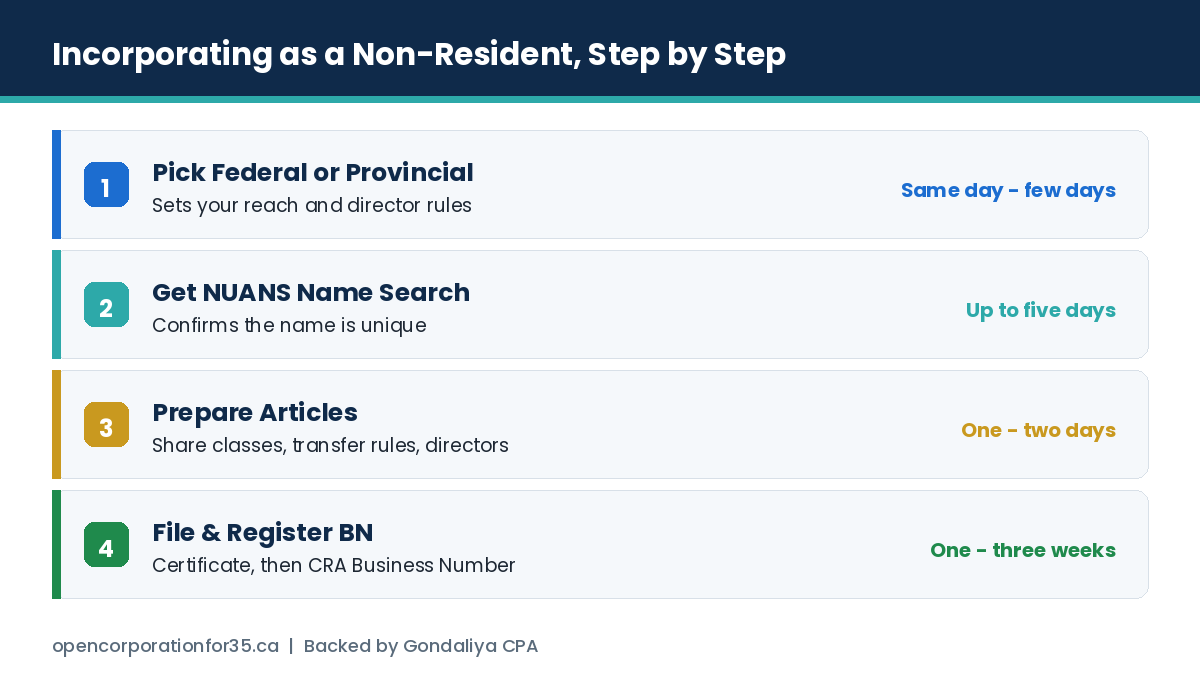
Federal corporations protect your company name across Canada but need extra-provincial registrations if working in specific provinces. This adds paperwork but offers wider reach. Provincial incorporation limits your area but cuts down initial steps if focusing locally.
Comparison Snapshot
Snapshot
| Federal Incorporation | Provincial Incorporation | |
|---|---|---|
| Name protected nationwide | ||
| Name protected only inside province | ||
| Extra-provincial registration required | ||
| Simpler process inside one province | ||
| More market flexibility |
Choose what fits your target markets; always check current laws before starting.
Step 2: Get NUANS Name Search Report
Step 2
NUANS checks if your corporate name is unique against existing names nationally (for federal) or provincially (if needed). This prevents rejection later during filing.
NUANS reports usually take up to five days, but some service providers speed this up when working remotely.
Step 3: Prepare Articles of Incorporation Documents
Step 3
These documents say how the company works — share classes, number of shares allowed, transfer rules — all part of your legal framework sent with other forms during filing.
Formats differ slightly between federal and provincial jurisdictions but mostly look similar:
- Company name
- Share details
- Director info
Many use service providers to draft these correctly so there are no delays caused by mistakes.
Step 4: File Application & Register Business Number (BN)
Step 4
Send forms electronically through Corporations Canada’s site for federal filings or the provincial registry for local ones. After approval, you get the Certificate of Incorporation.
Once incorporated, the Canada Revenue Agency assigns a Business Number (BN). This connects your tax accounts like payroll deductions and GST-HST if needed.
Process Timeline Table
Timeline
| Step | Estimated Timeframe |
|---|---|
| Choosing Jurisdiction | Same day – few days |
| NUANS Name Search | Up to five days |
| Articles Preparation | One – two days |
| Application Filing | One – three weeks* |
| Business Number Registration | Within one week after incorporation |
*Processing time depends on workload; electronic filings often move faster than paper ones.
Double-check timelines with official agencies because wait times can vary throughout the year.
This step-by-step guide helps non residents incorporate companies smoothly while meeting all rules during their remote start across Canada’s economy.
Set up your Canadian company from anywhere
NUANS name search, articles of incorporation, filing and CRA Business Number registration, plus a Canadian registered office address if you need one. Please book a free consultation.
Benefits of Incorporating in Canada as a Non-Resident
Benefits of Incorporating in Canada as a Non-Resident
Benefits
Starting a business in Canada is pretty good for non-residents. You can open corporation in Canada for foreigners without too much hassle. Even if you want to start business in Canada from abroad, it’s doable. Non resident incorporation Canada means you don’t have to live there to own a company.
Here are some perks:
- Big Market: Canadian companies can sell stuff all over the provinces and also trade with the US and Mexico thanks to USMCA.
- Trustworthy Image: Being a Canadian business helps people trust you more worldwide.
- Easy Setup: You can do most of it online without showing up in person.
- No Need to Live There: You don’t have to be a citizen or permanent resident.
- Tax Deals: Canada has deals with many countries that cut down taxes for your business.
- Choice of Structure: You pick federal or provincial incorporation depending on what works best.
All these points make Canada a solid choice for foreign owners using non resident incorporation Canada.
Residency of a Corporation and Tax Considerations
Residency of a Corporation and Tax Considerations
Residency
It’s key to know where your company counts as a resident. Usually, this means where the main control happens. The directors or shareholders don’t have to live in Canada.
How Residency Works
If your corporation is made in Canada, it counts as resident there even if the owners live somewhere else. But if you manage everything from abroad, check with officials so you follow the rules right.
Taxes You Should Know
Canadian companies pay tax on money earned inside the country. But income made outside might not be taxed by Canada, though other places might tax it. If you sell enough goods or services in certain provinces, GST/HST tax rules kick in.
GST/HST Registration for International Biz
If your sales go over $30,000 CAD yearly in provinces with harmonized tax, you need to register for GST/HST. Then, you collect these taxes from customers and pay them back to the government on a set schedule.
| Topic | Info |
|---|---|
| Corporate Residency | Based on where central control is; owners need not reside |
| Taxes | Pay on income from inside Canada |
| GST/HST Threshold | Sales above $30K CAD require registration |
| Tax Treaties | Help avoid paying double taxes with other countries |
Be sure to check official sites because rules can change any time.
This is the point most worth getting professional advice on. A company incorporated in Canada is treated as resident here, so the worldwide income question turns on facts that are easy to get wrong from a distance.
Foreign Entity Setup Options: Subsidiary vs Branch Office vs Employer of Record (EOR)
Foreign Entity Setup Options: Subsidiary vs Branch Office vs Employer of Record (EOR)
Entity Options
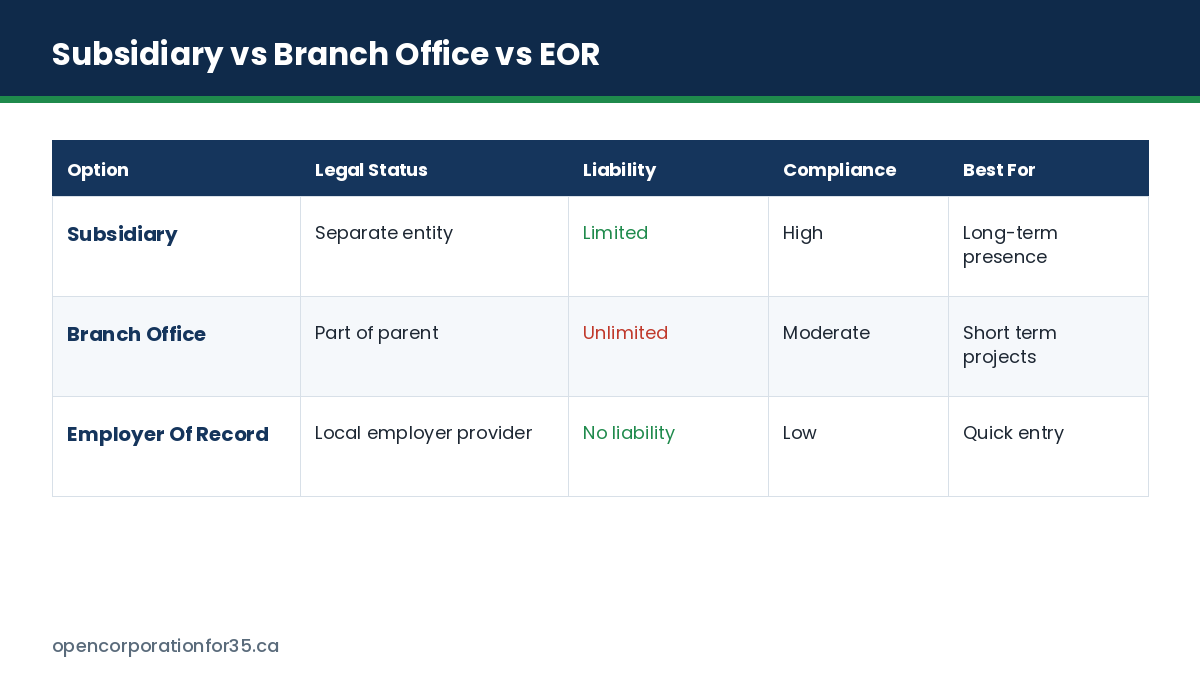
If you want to start business in Canada from abroad using non resident incorporation, think about these choices beyond just making your own company.
1. Subsidiary Company
A subsidiary is its own legal company under Canadian laws but owned by your foreign firm. It protects your parent company by keeping things separate.
- Pros:
- Limits risks tied directly to foreign owners
- Easier to get local loans or money
- Cons:
- Must follow full rules and file reports regularly
2. Branch Office
This is like an extension of your foreign company, not its own separate thing legally.
- Pros:
- Quicker and simpler setup than subsidiaries
- Cons:
- Parent company takes all liability for branch’s actions
3. Employer of Record (EOR)
With EOR, another local group hires employees for you while you still manage their work remotely. Good when testing market waters before setting up fully.
- Pros:
- Hire staff fast without heavy paperwork
- Cons:
- Less control over contracts compared to direct hires
| Option | Legal Status | Liability | Compliance | Best For |
|---|---|---|---|---|
| Subsidiary | Separate entity | Limited | High | Long-term presence |
| Branch Office | Part of parent | Unlimited | Moderate | Short term projects |
| Employer Of Record (EOR) | Local employer provider | No liability | Low | Quick entry & flexible hiring |
Your choice depends on how much control you want and how fast you need things going when opening corporation in Canada for foreigners working remotely.
Almost every client we set up ends with a subsidiary. The branch looks quicker until you notice it pulls the parent company’s liability into Canada, which is rarely what anyone actually wants.
Requirements for Foreign Company Setup in Canada
Requirements for Foreign Company Setup in Canada
Setup Rules
Starting a company in Canada when you’re not a resident has some rules. The process for non resident incorporation Canada is pretty clear but you need to know the details.
Here’s what you need for non-resident incorporation in Canada:
- Foreigners can own all the shares. You don’t need to live there.
- Directors: At least 25% must live in Canada if you register in certain provinces. Federal rules can differ.
- Your company needs a real address in Canada where it’s registered. P.O. Boxes won’t work.
- You have to check your business name with a NUANS report or similar service.
- File articles of incorporation online or by mail, depending on federal or provincial rules.
If you want to open corporation in Canada for foreigners, make sure to check the latest government info since rules change.
| Requirement | Federal Incorporation | Provincial Incorporation |
|---|---|---|
| Director Residency | Depends on province | Usually 25% directors live locally |
| Registered Office Address | Must be inside Canada | Must be inside province |
| Shareholder Residency | No limits | No limits |
| Name Search | NUANS report required | Province-specific search |
Knowing these basics makes your non resident company Canada setup easier and faster.
Compliance Obligations After Incorporation
Compliance Obligations After Incorporation
Compliance
Once your company is set up, following the rules is key. This is true if you start business in Canada from abroad. Non resident incorporation Canada means you have to keep up with Canadian laws all the time.
Your main compliance tasks include:
- Annual filings: File annual returns with the right government office. You might also have to send financial statements based on size or place.
- Taxes: If sales go over $30,000 CAD a year, register for GST/HST. You must file corporate income tax returns yearly even if no profit.
- Keep corporate records: Store meeting notes, resolutions, and shareholder lists at your Canadian office.
- Get a Business Number (BN): This comes from the CRA and handles taxes and payroll.
- Employment laws: Follow local rules if you hire people there, like payroll taxes and safety standards.
- Extra provincial registration: If doing business outside where you incorporated, register extra-provincially first.
Missing these steps could cause fines or even cancel your company. Many non-residents hire experts who know Canadian law after they open corporation in Canada remotely.
Challenges Faced by Non-Residents When Incorporating in Canada
Challenges Faced by Non-Residents When Incorporating in Canada
Challenges
Opening a corporation in Canada for foreigners has good points but also some tricky parts. Many face issues when they start business in Canada from abroad.
Here are common challenges:
- Banks often want you there in person to open accounts because of money laundering laws. This makes remote banking hard without local help.
- Director residency rules limit choices unless you pick nominee directors carefully with legal advice.
- If you work beyond one province, extra registrations add cost and complexity that surprise some people.
- Tax rules across countries can confuse folks. Double tax treaties exist but need expert help to understand how they apply.
- Legal papers use tough words and long sentences that are hard to get without clear help aimed at beginners.
Still, many foreign business owners find ways around these issues using services made for non resident company setup. They offer low-cost options that follow current rules well enough for most cases
Banking is consistently the slowest part, not the incorporation. Approaching more than one institution helps, because policies on non-resident directors vary a great deal between banks.
Final Summary
Final Summary
Summary
Starting a business in Canada as a non-resident has many benefits. Non resident incorporation Canada lets people and companies from other countries open a corporation without living there. You can do it from anywhere, and it’s not too expensive or complicated.
Canada has a strong economy and good laws. It also gives access to big markets in North America. You can pick federal incorporation, which works all over Canada, or go with a province that fits your needs better. Many options work well for foreigners.
Some perks are better trust from Canadian clients and partners, tax treaties that may help avoid paying tax twice, and easier banking for non-residents. The federal system often asks for one Canadian resident director, except in Quebec. But some provinces have other rules that make this easier.
Opening a corporation in Canada for foreigners means you get local benefits while growing internationally. Many entrepreneurs use this to reach the Canadian market and beyond.
Check with the right Canadian authority before you start because rules might change.
Additional FAQs on Non Resident Incorporation Canada
What are the corporate governance requirements for non-resident corporations in Canada?+
Non-resident corporations must follow Canadian corporate governance rules. This includes holding board meetings, maintaining corporate records, and keeping meeting minutes and resolutions updated.
How do government filing fees and service fees affect incorporation costs?+
Government filing fees cover official registration costs, while service fees pay for incorporation help and document preparation. Both add to the total incorporation cost.
What ongoing fees should non-residents expect after incorporating in Canada?+
You must budget for annual filings, registered office services, accounting, tax filing, and possible extra-provincial registrations.
Can a nominee director fully manage corporate duties for a non-resident company?+
A nominee director can perform legal duties but must comply with all Canadian laws. Shareholders retain ultimate control.
What are the tax reporting obligations for foreign-owned Canadian companies?+
Companies must file annual tax reports with Canadian income tax authorities on income earned inside Canada.
How do double tax treaties impact tax obligations for non-resident corporations?+
Double tax treaties can reduce withholding taxes and prevent double taxation on income earned in Canada and abroad.
Is extra-provincial registration mandatory for federally incorporated non-resident companies operating in provinces?+
Yes, if you operate outside your initial jurisdiction, you must register extra-provincially to comply with provincial laws.
How does a Business Number (BN) benefit a non-resident corporation?+
A BN allows access to tax accounts like GST/HST, payroll deductions, and import/export programs essential for compliance.
What is the role of registered office services in non-resident incorporation?+
Registered office services provide a physical Canadian address needed for legal notices and official communications.
Key Points: Corporate Structure and Compliance Essentials
Key Points
- Shareholder Rights: Foreign shareholders have full rights including voting and profit sharing.
- Liability Limitation: Corporations limit personal liability of shareholders to invested capital.
- Corporate Bylaws: These set internal rules for governance and operations of the company.
- Corporate Records Maintenance: Keeping up-to-date records ensures compliance during audits or legal checks.
- Meeting Minutes & Resolutions: Documenting decisions is required by law to validate company actions.
Taxation and Financial Management Highlights
Tax
- Corporate Tax Rates: Non-resident companies pay rates on Canadian-source income per federal/provincial laws.
- Tax Obligations: Filing yearly returns on earnings inside Canada is mandatory regardless of residency status.
- Withholding Taxes: Certain payments like dividends may have withholding taxes reduced by treaties.
- Accounting and Tax Filing: Professional support helps meet deadlines and maintain correct financial statements.
Practical Tips for Smooth Incorporation
Tips
- Use reputable online incorporation services to handle filings remotely.
- Choose provinces with favorable director residency rules if nominee directors are used.
- Plan banking infrastructure early; some banks require local presence or trusted agents.
- Take advantage of government incentives supporting startups to lower initial costs.
Growth Support & Market Access Advantages
Growth
- Canada’s startup ecosystem offers resources such as incubators and funding options.
- Incorporation boosts business credibility with Canadian customers and partners worldwide.
- Name protection under federal incorporation helps safeguard brand identity across provinces.
This content supplements your knowledge of non resident incorporation Canada with clear insights into compliance, taxation, corporate structure, costs, and growth strategies tailored for foreigners opening corporations remotely in Canada.
Professional Guidance on Setting Up From Abroad: How Open Corporation For $35 Supports Foreign Founders
Professional Guidance and Quick Reference
Guidance
Two decisions carry most of the weight. The entity type, because a subsidiary limits liability while a branch pulls the parent company into Canada, and the jurisdiction, because that sets the director rules you will live with. Both should be settled before any form is filed.
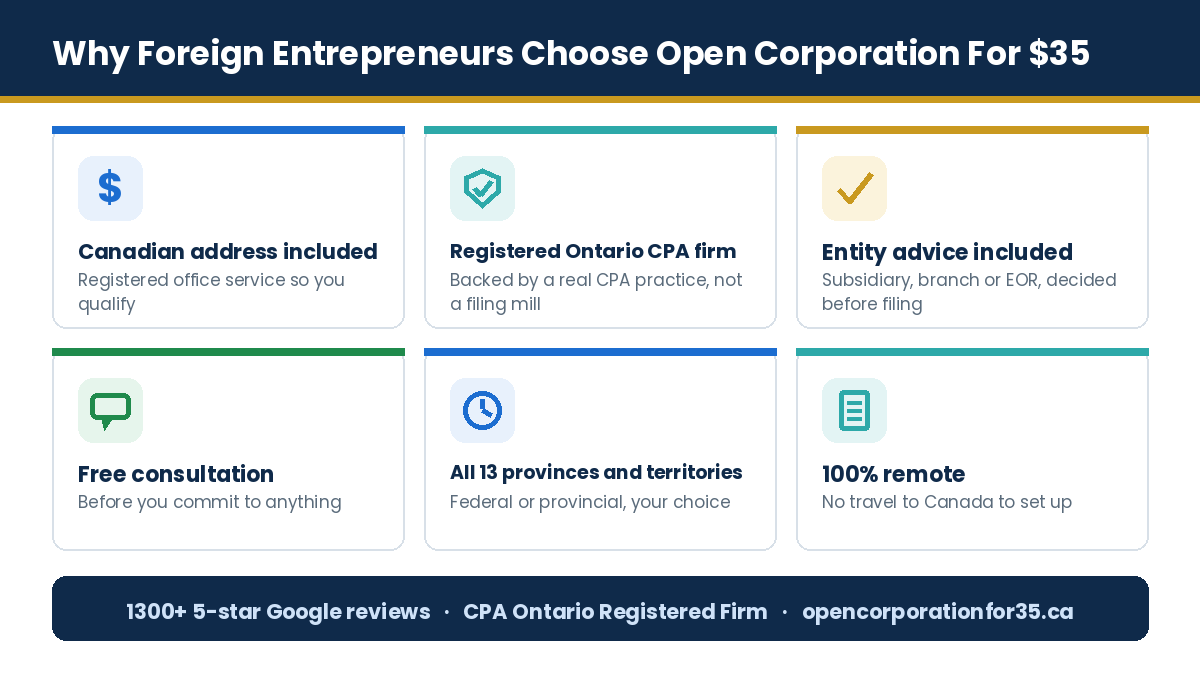
Open Corporation For $35, backed by Gondaliya CPA, handles the whole chain in one pass: the name search, the incorporation filing, the registered office address, the Business Number and the program accounts.
Everything is done remotely. No travel to Canada is required to incorporate or register.
Quick Answers: Key Numbers & Concepts at a Glance
At a Glance
- PR or citizenship required: No
- Maximum foreign share ownership: 100%
- Federal incorporation fee: CAD 200 to CAD 250 online
- Provincial incorporation fee: CAD 300 to CAD 400
- Service provider fees: CAD 50 to CAD 300
- Annual filing fee: CAD 20 to CAD 100 per place
- GST/HST threshold: $30,000 CAD in annual taxable sales
- NUANS report: Up to five days
- Application filing: One to three weeks
- Full timeline: Several days up to four weeks
Who This Is For / Not For
Fit Check
- For: Foreign founders weighing a Canadian entity, companies choosing between a subsidiary, a branch and an employer of record, owners wanting USMCA market access, and anyone needing a Canadian registered office address.
- Not For: People hoping a company will support an immigration application, since it grants no status, and businesses in restricted sectors that carry foreign ownership limits.
People Also Ask
Quick Answers
Subsidiary or branch, which should I pick?+
A subsidiary in almost every case. It is a separate legal entity, so the parent company’s liability stops at the border. A branch leaves the parent exposed to everything the Canadian operation does.
Does incorporating in Canada mean I pay Canadian tax on worldwide income?+
A corporation incorporated in Canada is treated as resident here, which brings worldwide income into scope. This is the point most worth modelling with a CPA before you choose a structure.
Will a Canadian company help me sell into the United States?+
USMCA gives Canadian companies preferential access, but it does not remove US tax or state registration obligations if you establish a presence there. Treat it as market access, not a tax plan.
Glossary of Key Terms
Plain-English Definitions
- Corporate residency: Where a company is treated as resident for tax, based on incorporation and central management.
- Subsidiary: A separate Canadian company owned by a foreign parent.
- Branch office: An extension of the foreign company, not a separate legal entity.
- Employer of record (EOR): A local provider that employs staff on your behalf.
- Extra-provincial registration: Registering to operate in a province other than where you incorporated.
- NUANS: The name search report confirming your proposed name is available.
- Registered office: The official street address of the corporation in its jurisdiction.
- Nominee director: A director appointed to satisfy a residency requirement or preserve privacy.
- USMCA: The trade agreement between Canada, the United States and Mexico.
- Double tax treaty: An agreement that prevents the same income being taxed twice in two countries.
Choose the subsidiary unless you have a specific reason not to, pick the jurisdiction by where you will trade and what director rule you can meet, secure a real street address before filing, and model the corporate residency position with a CPA before you commit to a structure.
Foreign Entrepreneur Readiness Check
This quick self-check flags which parts of your setup need attention. Please answer the six questions below.
Foreign Entrepreneur Readiness Check
Six quick questions on your plans. No fee quoted.
Points to review:
This is a general prompt, not tax or legal advice or a quote. Your position depends on your full facts, so for a real review please book a free consultation.
Want a checklist to work from? Please download our free foreign entrepreneur setup checklist before your consultation.
Start your Canadian company from abroad
Entity advice, name search, incorporation, registered office address and CRA registrations, all set up together and handled entirely remotely. Please book a free consultation.
What to Send Us
Send us where your parent company sits, the province or provinces you plan to trade in, whether you will hire in Canada, and where the board will actually meet. We will confirm the right entity and jurisdiction before anything is filed.
Published: May 13, 2026 · Last updated: May 13, 2026
Editorial policy: Our content is prepared by our team and reviewed by Sharad Gondaliya, CPA, and we update it as incorporation rules, fees and CRA thresholds change.
Disclaimer: This article is educational information only and is not tax, legal, or financial advice. Fees, thresholds and processing times change, and outcomes depend on your specific facts. Please consult a CPA before acting.