
Open Corporation Canada from Australia: How Australian Residents Can Start and Incorporate a Business in Canada with CRA Number and Tax Complianc
Starting an open corporation Canada from Australia is straightforward for Australian residents looking to expand into Canadian markets, with clear steps for incorporation, including CRA business number registration and meeting corporate tax obligations as a foreign owner. Understanding federal vs provincial incorporation, nominee director requirements, and GST/HST setup ensures compliance and smooth operation of your Canada company from Australia.
Reading time: 24 minutes.
Table of Contents
- Overview and Benefits of Incorporating a Business in Canada from Australia
- Understanding Federal vs Provincial Incorporation in Canada
- Director and Shareholder Requirements for Australian Residents
- The Importance of Business Address and Nominee Director Options in Canada
- Legal Implications of Non-Resident Incorporation and Remote Company Setup
- Selecting the Right Incorporation Route: Federal or Provincial
- Conducting a Name Search and Reserving Your Company Name
- Filing Articles of Incorporation and Required Documentation
- Registering for a CRA Business Number and Tax Accounts
- Opening a Canadian Business Bank Account as a Non-Resident
- Timelines, Fees, and Cost-Effective Strategies for Incorporation
- Canada Corporate Tax Considerations for Foreign Owners
- Understanding GST/HST Registration and Compliance for Australian Businesses
- Managing Tax Residency Risks and Double Taxation Treaties
- Annual Compliance Requirements: Filings, Reports, and Inactive Corporation Obligations
- Bookkeeping, T2 Tax Filing and Accounting Practices for Non-Resident Companies
- Practical Challenges and Strategic Guidance for Australians Incorporating in Canada
- Summary and Next Steps for Starting Your Canadian Business from Australia
- Frequently Asked Questions
- Professional Guidance and Quick Reference
The Numbers That Matter
This article covers Canada, with Ontario and Toronto context, and assumes an Australian resident who wants to own a Canadian corporation without relocating. Government fees, processing times and residency rules are set by the registries and by the CRA, and they change. This is educational information only and not tax, legal, or financial advice. Please confirm your own position with a CPA before acting.
Overview and Benefits of Incorporating a Business in Canada from Australia
Overview and Benefits of Incorporating a Business in Canada from Australia
Overview
Register a Company in Canada from Australia: Key Considerations
If you’re an Australian resident, you can open a corporation in Canada from Australia without needing to live there permanently. That makes it easier for people who want to start business Canada from Australia but don’t want to move. The process has some eligibility requirements you should know about before jumping in. Canadian business registration for Australians is designed to be handled remotely.
Understanding the unique process for Australian residents
Australians can set up a non-resident corporation Canada fairly easily. Foreign ownership of a company in Canada is allowed. This means you can form a legal entity formation Canada while still living in Australia. No need for permanent residency.
Initial steps and decision factors
To get started, check out the incorporation requirements Canada. You’ll need to pick your business structure and get some paperwork ready. Luckily, there is a streamlined registration process that makes things quicker for people setting up remotely.
Why Australian Residents Choose to Incorporate in Canada
A lot of Australians pick Canada because it opens doors to new markets. Running cross-border business setup lets them tap into the North American market with ease. That’s a big deal for international entrepreneurs Canada.
Tax-wise, incorporating in Canada helps with corporate tax obligations foreign owners face. Plus, the double taxation treaty Australia Canada cuts down on paying tax twice on the same income. Canadians rules on corporate governance also apply, which keeps things clear and organized.
Differences Between Federal and Provincial Incorporation for Australian Owners
Here’s the lowdown on federal vs provincial incorporation:
- Federal incorporation benefits: Your company gets recognized across all provinces and territories.
- Provincial incorporation differences: Rules vary by province, so compliance might be simpler locally but limits where your business can operate.
- Pros and cons for non-resident directors: Using nominee director role can make life easier for non-residents but there are specific nominated directors rules you must follow in Canada.
Jurisdiction matters here because provincial registrations differ, affecting cross-border commerce and how you set up your business structure canada.
Eligibility and Ownership Requirements for Australians Registering Canadian Companies
When Australians register companies in Canada:
- Shareholder rules matter: Usually at least one director must live in Canada unless you have nominee director requirements canada.
- You must keep good shareholder records canada to stay legal.
- Residency checks include canadian director residency requirement.
- Tax issues come up too, like cross-border tax planning and ongoing tax compliance canada.
Following these guidelines helps avoid problems later and keeps your company running smooth as you start this venture abroad.
The first thing Australian founders want confirmed is whether they have to relocate. They do not. What decides the shape of the setup is the board and the address, and both can be settled in a single conversation before anything is filed.
Key Stat: There is no restriction on foreign ownership of a Canadian corporation. An Australian resident can hold every share. The rule people mistake for an ownership limit is the director residency requirement, and it applies to the board rather than the shareholders.
Understanding Federal vs Provincial Incorporation in Canada
Understanding Federal vs Provincial Incorporation in Canada
Jurisdiction
If you want to open corporation Canada from Australia, you have to decide between federal and provincial incorporation. Federal incorporation lets your company work under Canadian laws across all provinces and territories. This fits businesses that want to operate nationwide or in many places in Canada.
Provincial incorporation Canada registers your company in just one province, like Ontario or British Columbia. It’s often easier to handle but limits your operations mostly to that province unless you register again elsewhere.
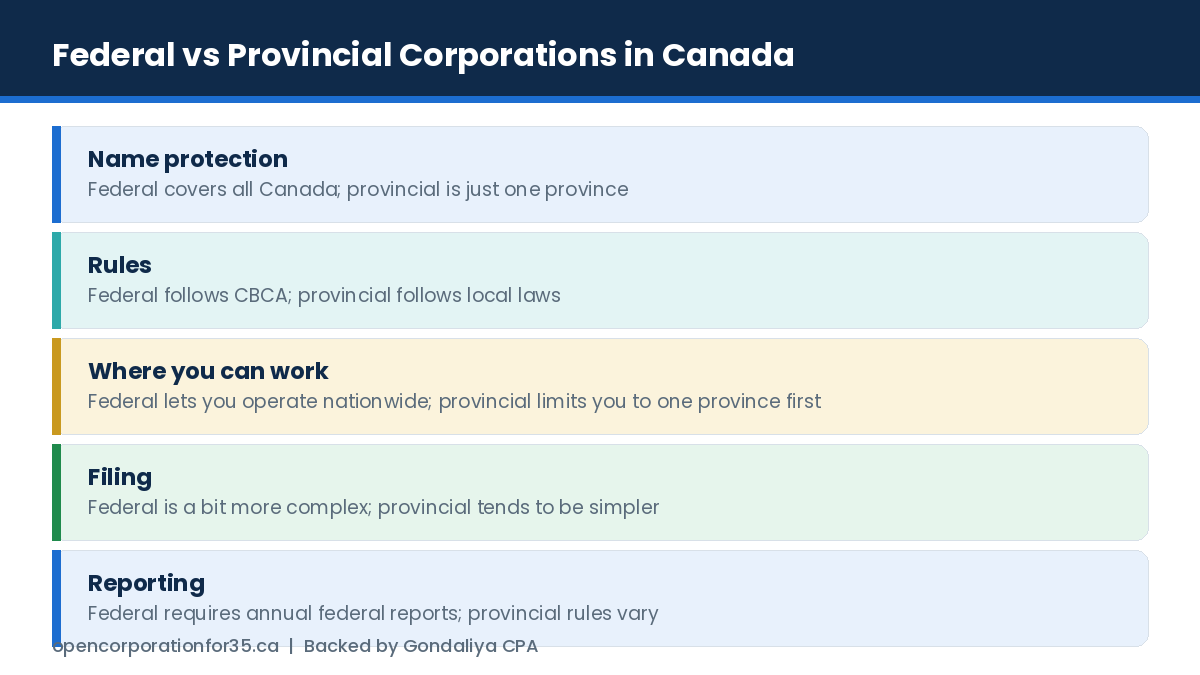
Here are some differences between federal and provincial corporations:
- Federal names get protection across Canada; provincial names only protect within one province.
- Rules and requirements change depending on the province.
- Both need to follow Canadian business regulations compliance rules, such as annual reports and taxes.
For Australians starting business Canada from Australia, knowing these points helps pick the best choice. Federal incorporation gives more freedom for growth but can cost more and take more paperwork than provincial options.
Founders reach for federal because it sounds bigger. The better question is where the customers actually are, because a single-province operation pays for national name protection it will never use.
Director and Shareholder Requirements for Australian Residents
Director and Shareholder Requirements for Australian Residents
Directors
Canada company Australian resident rules let non-residents like Australians set up companies without permanent residency. But some provinces ask for at least one director who lives in Canada. Federal incorporation requires at least 25% of directors to live in Canada.
Nominee director Canada services help if no directors live locally but it’s required. Nominee director requirements Canada say nominees must follow Canadian corporate laws while acting for foreign owners.
Owners of a non-resident corporation Canada should know about foreign owner corporate tax. The Canadian government taxes income made inside the country no matter who owns the company. So, non-resident director rules Canada include tax planning.
Australian residents who incorporate remotely should check if they meet directorship rules from federal or provincial authorities before applying.
A nominee director is a real director with real statutory duties, not a name on a form. Founders who treat the arrangement as a formality are the ones who end up renegotiating it later under pressure.
The Importance of Business Address and Nominee Director Options in Canada
The Importance of Business Address and Nominee Director Options in Canada
Address
You need a real business address in Canada when you open corporation from Australia. This address acts as the registered office where official mail goes. Business address requirements Canada say it must be a physical location—not just a P.O box—and open during normal business hours.
Many foreign owners use mail forwarding services in big cities like Toronto or Vancouver. These services get government mail safely for companies that run from outside Canada.
Nominee director options add trust when you need someone local but don’t want to give control away from Australian shareholders. Using a solid business address plus nominee directors keeps communication clear with Canadian authorities through the life of your company.
The address is the channel every default notice travels down. Owners abroad who let it lapse do not find out from the registry, they find out from a bank or a buyer months later.
Legal Implications of Non-Resident Incorporation and Remote Company Setup
Legal Implications of Non-Resident Incorporation and Remote Company Setup
Legal
Incorporate remotely canada steps let Australians form companies without visiting or having permanent residency—a big plus with today’s travel limits.
Still, non resident canada tax matters stay important after setup: income earned by the company might trigger federal filings with the CRA plus GST or HST taxes if sales hit certain levels inside Canada.
Remote setup means you must watch out for ongoing duties like filing annual reports on time even if your company is inactive in Canada.
Knowing these legal points early avoids surprises about tax bills, bank access issues tied to foreign owners, and deadlines set by government agencies watching over Canadian companies.
Always double-check info on official websites since rules change often; approval times, fees, banking access, and tax results can vary a lot depending on your exact situation when starting cross-border businesses like Canadians do locally today.
Incorporation is the easy part and the part founders focus on. The obligations that follow it run for the life of the company, and they are what actually need a plan on day one.
Selecting the Right Incorporation Route: Federal or Provincial
Selecting the Right Incorporation Route: Federal or Provincial
Decision
If you want to open corporation Canada from Australia, picking federal or provincial incorporation matters. Both let Australians start a business without needing Canadian residency. But their differences can affect your plans.
Federal incorporation Canada gives you name protection across all provinces. You can use the same company name everywhere in Canada. This suits businesses that want to grow beyond one province or trade between provinces. It follows the Canada Business Corporations Act (CBCA), which sets uniform rules.
Provincial incorporation Canada limits your company to one province like Ontario or British Columbia. The process usually has simpler filings but restricts where you can operate unless you register more places later.
Here’s a quick look at Differences Between Federal and Provincial Corporations:
- Name protection: Federal covers all Canada; provincial is just one province
- Rules: Federal follows CBCA; provincial follows local laws
- Where you can work: Federal lets you operate nationwide; provincial limits you to one province first
- Filing: Federal is a bit more complex; provincial tends to be simpler
- Reporting: Federal requires annual federal reports; provincial rules vary
For Australians opening business Canada from Australia, federal incorporation benefits include wider reach and stronger brand protection. But provincial incorporation may cost less if you only want local customers.
The route that suits a founder at launch is often not the one they assumed. We ask where the first ten customers will be, and that single answer settles the jurisdiction more reliably than any comparison table.
Conducting a Name Search and Reserving Your Company Name
Conducting a Name Search and Reserving Your Company Name
Name Search
Before you register corporation Canada, do a Canadian company name search first. This step makes sure your name isn’t already taken or too close to another business’s name.
You can check names online through government sites like NUANS for federal incorporations or provincial databases for local ones. Reserving your company name keeps it safe while you file papers. Usually, this costs extra fees.
When you register corporation Canada as an Australian, confirming no other businesses use similar names avoids confusion and legal issues. This is especially important when incorporating remotely.
Bringing one name to a first call is the most common cause of delay we see. Bringing three removes it, because a rejected name no longer stops the whole filing while a second search is run.
Filing Articles of Incorporation and Required Documentation
Filing Articles of Incorporation and Required Documentation
Documents
Filing Articles of Incorporation makes your company official in Canada. Non-residents who incorporate remotely find online filing helps streamline the process a lot.
The articles must show:
- Your corporate name
- Registered office address (must be inside the province or federally recognized area)
- Details on share structure
- Director info (some places allow nominee directors)
A checklist for incorporation documents includes proof of identity for directors and shareholders, NUANS report if needed, signed consents from directors, plus fees paid upfront.
Getting all these right keeps things smooth during remote setup and meets legal requirements for both federal vs provincial filings.
Share structure is the field founders skip past and later wish they had thought about. It is straightforward to set at incorporation and a paid amendment to change once shares have been issued.
Registering for a CRA Business Number and Tax Accounts
Registering for a CRA Business Number and Tax Accounts
CRA
After incorporating, getting a CRA business number is necessary for taxes through the Canada Revenue Agency. This number links tax accounts like GST/HST registration — very important if foreign owners run cross-border businesses from Australia.
Non-resident companies must register tax accounts based on what they do in Canada — like selling goods subject to GST/HST or hiring local staff with payroll deductions.
Setting up your Canadian business number is done online through CRA’s Business Registration Online site once incorporation is confirmed.
Knowing about GST HST registration helps keep foreign-owned businesses on the right side of Canadian tax rules while working remotely.
The Business Number does not arrive with the certificate. It is a separate application to a separate authority, and owners who assume otherwise usually discover the gap at the bank.
Opening a Canadian Business Bank Account as a Non-Resident
Opening a Canadian Business Bank Account as a Non-Resident
Banking
Opening a Canadian business bank account remote onboarding got easier but still tricky because banks check non-residents carefully to fight fraud.
Australian entrepreneurs should have certified ID copies used in incorporation plus proof of registered office address in Canada ready.
Some banks let parts of account opening happen online but often visiting a branch physically is needed depending on the bank’s rules.
Choosing banks familiar with foreign-owned firms helps make banking easier once your business starts moving money in Canada.
Banking, not incorporation, is the long pole for owners abroad. The certificate can be issued in days while the account takes weeks, so the bank conversation should start the moment the certificate lands.
Timelines, Fees, and Cost-Effective Strategies for Incorporation
Timelines, Fees, and Cost-Effective Strategies for Incorporation
Costs
Incorporation in Canada usually takes 1–3 weeks depending on whether you pick federal or provincial routes and how complete your application is at first try.
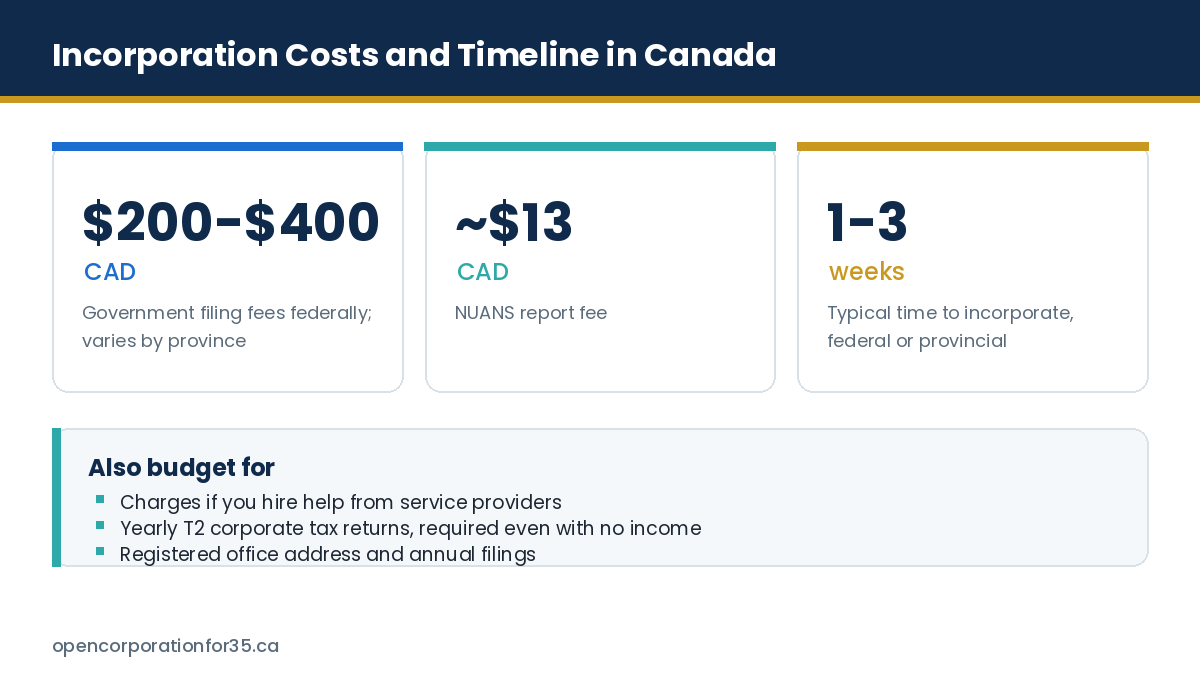
Costs include:
- Government filing fees ($200–$400 CAD federally; varies by province)
- NUANS report fee (~$13 CAD)
- Charges if you hire help from service providers
To save money, pick provinces that fit where you plan to sell most—provincial filings cost less than federal if you stay local.
Fee structures differ widely so budgeting carefully avoids surprises not just at start but also during yearly filings like T2 corporate tax returns required even if no income happens inside Canada.
Disclaimer: Always check current rules directly from official government sources before starting because regulations can change
Founders budget the setup and forget the recurring line. The address service and the annual filings shape the yearly cost far more than the one-off fee, and both are easier to absorb when quoted at the start.
Incorporate in Canada without leaving Australia
Same-day federal or provincial incorporation, instant NUANS name search, a registered office address that meets registry rules, and CRA account setup, all backed by a CPA firm. Please book a free consultation.
Canada Corporate Tax Considerations for Foreign Owners
Canada Corporate Tax Considerations for Foreign Owners
Corporate Tax
If you open corporation Canada from Australia, you need to know about corporate tax. Foreign ownership company Canada rules let non-residents set up a company without living in Canada. But Canadian business taxation still requires foreign owners to follow certain corporate tax obligations.
Canada taxes resident companies on all their income worldwide. Non-resident companies incorporated in Canada pay tax only on income earned inside the country. Cross-border tax planning helps avoid surprises and keeps your tax bill low.
Keep in mind that corporate tax rates change by province and federal levels. Usually, the combined rate falls between 25% and 31%. Also, dividends sent to Australian shareholders might face withholding taxes.
Talking with a Canadian tax professional who knows foreign ownership will help you handle this right. They can point out treaties or exemptions that work for cross-border businesses.
Withholding on dividends back to Australia is the item founders discover last and should model first. It changes the effective return on the whole structure, not just the tax line.
Understanding GST/HST Registration and Compliance for Australian Businesses
Understanding GST/HST Registration and Compliance for Australian Businesses
GST/HST
Australian businesses wanting to open business Canada from Australia should learn about the Canadian GST/HST system. The Goods and Services Tax (GST) is 5% federally. Some provinces combine GST with their sales tax as Harmonized Sales Tax (HST), which can go up to 15%.
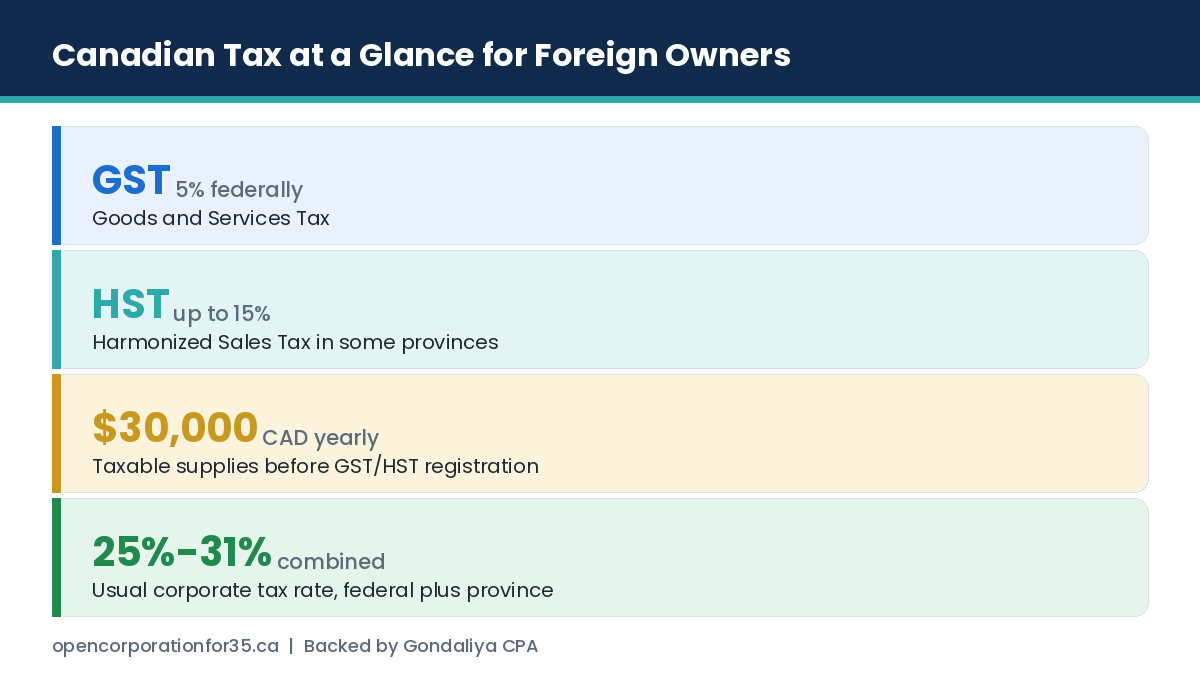
Foreign owners must register for GST/HST if taxable supplies go over CAD $30,000 yearly. Registering means you can charge GST/HST to customers and claim back credits on business expenses.
You register by applying online via the CRA or sending forms by mail after starting your company or hitting that $30,000 mark. Without registration, you can’t charge sales tax or recover it on purchases legally.
Once registered, filing returns usually happens every quarter. You must send the collected tax minus credits back to the government on time every year.
Registering voluntarily before the threshold is reached is often the better move for a business with Canadian costs, because input tax credits can be recovered from the first invoice rather than the first breach.
Managing Tax Residency Risks and Double Taxation Treaties
Managing Tax Residency Risks and Double Taxation Treaties
Treaties
Non resident Canada tax rules mean owning a company here doesn’t make you a Canadian resident for personal taxes automatically. Still, your corporation could be considered resident depending on where management happens or where it was formed.
Australia and Canada have a double taxation treaty to stop people from paying tax twice on the same money. This treaty splits taxing rights between both countries clearly.
Australians with Canadian companies need to understand how this treaty changes dividend withholding rates, capital gains taxes, and other income types. This helps them plan smart international setups.
Tax residency risks happen if control shifts unexpectedly into one country. This might cause extra filings or audits under rules about foreign-owned companies operating abroad or locally.
Where the board actually meets and decides matters more than where the company was registered. Founders who run everything from Australia should have that reviewed rather than assumed.
Annual Compliance Requirements: Filings, Reports, and Inactive Corporation Obligations
Annual Compliance Requirements: Filings, Reports, and Inactive Corporation Obligations
Annual Filings
Canadian company annual compliance means filing yearly reports with Corporations Canada or provincial registries based on your initial incorporation choice from Australia.
You must submit financial statements every year and keep records of directors’ details including nominee directors if used. Even without local offices, registered addresses are usually needed.
Inactive corporation filing Canada rules apply if your company didn’t trade during a fiscal year but still exists legally. Missing these filings can lead to dissolution notices stopping future reactivation unless fixed fast according to deadlines set by authorities like the CRA.
Staying up-to-date avoids fines and protects credit scores. It also keeps banking smooth when opening accounts after incorporating across borders like Australia-to-Canada setups common nowadays with more remote work worldwide.
Expert advice is good because government rules change often; checking official sources before big decisions pays off big time.
The dormant company is the one that gets dissolved. Founders pause a venture and assume the filings pause with it, and by the time the registry acts the notice has gone to an address nobody checks.
Bookkeeping, T2 Tax Filing and Accounting Practices for Non-Resident Companies
Bookkeeping, T2 Tax Filing and Accounting Practices for Non-Resident Companies
Bookkeeping
Good bookkeeping is key no matter where owners live but gets trickier when dealing with cross-border transactions as an Australian entity incorporated in Canada.
You must keep clear records that follow CRA standards so you’re ready if an audit happens anytime. These rules apply everywhere in Canada no matter the province.
Hiring a Canadian tax professional familiar with foreign-owned corporations is wise. They know how to handle unique challenges that come with these setups well.
Filing T2 corporate tax return yearly is required once your company is incorporated—even if you don’t make much money yet. The return should show true financial results backed by documents kept safe and easy to access whenever needed.
Late filings bring penalties that disrupt normal operations and harm reputation both inside and outside the company’s circles. Following good accounting practices shows professionalism globally recognized as important by investors and partners alike.
Keeping up-to-date on laws helps avoid mistakes. You can stay prepared by working with experts who track changes regularly so your business stays compliant long-term without surprises!
Currency handling is where cross-border books go wrong most often. Transactions recorded in Australian dollars without a consistent conversion policy create work at year end that nobody budgeted for.
Practical Challenges and Strategic Guidance for Australians Incorporating in Canada
Practical Challenges and Strategic Guidance for Australians Incorporating in Canada
Practical
Operational Realities: Banking, Licensing, and Physical Presence Requirements
Starting a business in Canada from Australia isn’t always simple. Canadian business licences change depending on the province and industry you choose. You need to find out exactly which permits your business needs before you begin. Some require federal approval; others come from local provinces.
Opening a bank account is another tricky part. Many Canadian banks want you to be there in person or provide lots of documents. Remote banking onboarding in Canada exists, but expect extra checks because of anti-money laundering laws. Australian residents should gather all their ID papers early to avoid delays.
Your corporation must have a registered office address in Canada. This is the official place for legal papers and government mail. If you don’t have a physical office, many use mail forwarding Canada services to handle this.
You’ll also need business permits based on local municipal rules where your company will work. This could include zoning permissions or health inspections.
Knowing these details helps you open your business Canada Australia with fewer surprises or hold-ups.
Common Mistakes to Avoid When Incorporating as an Australian Resident
- Thinking approval is automatic: No government guarantees your application will pass.
- Not checking eligibility: Even if you’re not a resident, you still might need a director living in Canada (rules vary).
- Forgetting to check info with government sites or authorized agents.
- Ignoring filing deadlines: Missing annual returns or taxes can bring fines or even shut down your company.
Plan carefully and follow instructions closely to avoid costly errors during incorporation.
Risks Associated with Misaligned Tax Residency and Compliance Failures
Tax residency matters a lot for Australians owning companies in Canada:
- If Canada sees you as a tax resident, you must report income and collect GST/HST.
- Skipping tax filings can lead to penalties, fines, or worse.
- Without knowing the tax treaty between Australia and Canada, you might pay tax twice unless handled right.
Not following rules can cost big money. Talk with tax experts who know cross-border businesses before starting.
Strategic Advisory: Aligning Incorporation Choices with Business Goals
How and where you set up your company shapes your success in Canada:
- Federal incorporation protects your company name across all provinces but needs extra registrations if working outside that province.
- Provincial incorporation costs less but fits better if you focus on just one region at first.
International entrepreneurs should match their plans with customer locations, supply chains, and rules. Pick the best setup that helps growth without extra hassle.
Cross-border business setup requires clear goals plus knowledge about Canada’s markets when opening corporation Canada from Australia.
Maintaining Compliance and Managing Ongoing Costs Efficiently
After incorporation, staying legal while controlling costs matters:
- File annual reports on time based on federal or provincial schedules.
- Pay renewal fees; some places charge taxes like GST/HST if sales pass certain limits.
Save money by using virtual offices as registered addresses or outsourcing bookkeeping instead of hiring staff locally.
Review compliance cycles often to avoid risks linked to inactive companies. Many foreign-owned firms forget they must keep filing even if not trading while managing remotely from Australia.
Disclaimer: This information offers general ideas only. Always check current rules about incorporation steps, fees, approvals, banking policies, licenses, taxes, and regulations directly with Canadian government sources before acting. No promises made about approval chances or how long processes take.
Licensing is the item most often discovered after trading has started. It is worth a single check against the province and the industry before the first sale rather than after the first complaint.
Summary and Next Steps for Starting Your Canadian Business from Australia
Summary and Next Steps for Starting Your Canadian Business from Australia
Summary
Benefits of Incorporating in Canada for Australian Entrepreneurs
Opening a corporation Canada from Australia can give you access to a strong, stable market. A Canada company Australian resident can tap into new opportunities across North America without needing to be there in person. You can start business Canada from Australia and still incorporate Canada as Australian, even if you don’t have permanent residency.
Here are some benefits:
- Competitive tax rates that can save money
- Eligibility for GST/HST rebates on some costs
- Better positioning with international partners and customers
- Easier cross-border business between Canada and Australia
More and more international entrepreneurs Canada welcomes, making it simpler to manage your operations remotely.
Preparing for a Smooth Company Registration and Operation in Canada
Register corporation Canada involves a few clear steps. Canadian business registration for Australians usually means:
- Getting your business name approved
- Filing incorporation papers (federal or provincial)
- Getting a CRA business number
- Setting up tax accounts like GST/HST if needed
The streamlined registration process keeps things manageable even when you’re overseas. You must meet eligibility requirements, like having at least one director who fits residency rules, but nominee directors can help where allowed. To keep things running smoothly, know about filing deadlines, bookkeeping rules, corporate taxes for non-residents, and keeping an official Canadian business address.
Planning ahead helps you avoid fines or having your corporation dissolved because of missed paperwork.
How to Initiate Your Canadian Incorporation with Expert Support
You can start your incorporation easily if you get expert help. Services like Open Corporation for $35 offer affordable packages. They handle tasks such as:
- Name searches
- Preparing documents
- Advising on federal or provincial incorporation
- Registering your CRA number
Contacting professional service providers helps you meet all legal needs quickly. Experts can explain nominee directors and banking setup too. This support saves time and avoids mistakes when filing from abroad so you can focus on growing your cross-border business.
Encouragement to Take the First Steps Towards Canadian Market Expansion
Thinking about how to start business Canada from Australia? Now is a good time to make this move. Incorporating as an Australian entrepreneur abroad protects your legal standing and may bring financial benefits for growth beyond home markets.
Taking these first steps shows you’re serious — to investors, clients, and suppliers alike. It builds trust by giving your company a formal structure in Canada’s solid system. Whether you want to expand product lines or find new partners up north, starting early lays the foundation you’ll need down the road.
Contact Information and Consultation Opportunities for Incorporation Assistance
If you want help through every step—from questions to full setup—reach out to professionals experienced with Australia-to-Canada incorporations. They can offer consultations on:
- Eligibility rules
- Federal vs provincial incorporation choices
- CRA registrations
- Nominee directors options
- Tax concerns including non-resident status
- Banking challenges and ongoing compliance
They provide info tailored just for your situation.
Disclaimer: Always check details with official government sources before moving forward. Rules can change suddenly, affecting approvals or fees during overseas incorporation. This content doesn’t guarantee results related to government approvals or third-party services like banking or tax decisions.
The founders who move fastest are the ones who arrive with three names, a decision on the province, and a clear answer on whether anyone on the board lives in Canada. Everything else follows from those three.
Frequently Asked Questions
Frequently Asked Questions
FAQ
What are the main Canadian business permits needed for Australian entrepreneurs?+
Business permits depend on industry and province. You may need municipal, provincial, or federal licenses before operating.
How much do incorporation costs in Canada usually amount to?+
Fees range from $200 to $400 CAD federally. Provincial fees vary. Additional costs include NUANS reports and service provider fees.
What is included in the incorporation documents checklist for non-residents?+
Checklist covers Articles of Incorporation, NUANS report, director consents, identity proofs, share structure details, and filing fees.
How do Canadian business regulations affect foreign-owned companies?+
Foreign owners must follow corporate governance rules, file annual reports, maintain records, and comply with tax and licensing laws.
What are the key Canadian company annual compliance obligations?+
Submit annual returns, financial statements, keep shareholder records updated, and pay applicable fees or taxes timely.
How does company filing in Canada work for Australians?+
You file incorporation documents with federal or provincial registry online or by mail. Follow specific provincial requirements if applicable.
What defines Canadian corporate governance for non-resident companies?+
It includes director duties, shareholder rights, nominee roles, record keeping, and adherence to CBCA or provincial laws.
Why is legal incorporation important when expanding internationally?+
Legal incorporation ensures regulatory compliance, protects personal assets, supports financial credibility, and enables proper business transactions.
How can operational viability be ensured for a Canada company managed from Australia?+
Maintain a registered Canadian address, comply with local permits, keep financial records current, and manage tax filings properly.
What role does tax residency play for Australian owners of Canadian companies?+
Tax residency affects where income is taxed. Non-residents pay tax on Canadian income; personal residency rules may differ.
What strategic decisions impact business setup in Canada from Australia?+
Choosing federal vs provincial incorporation affects reach and cost. Director residency rules influence nominee needs.
Which compliance obligations must be met after incorporation?+
Annual filings, GST/HST registration if applicable, bookkeeping standards, corporate tax returns (T2), and license renewals.
How can financial credibility be established for a foreign-owned corporation in Canada?+
By timely filings, proper bookkeeping, holding valid licenses, maintaining good credit history, and transparent governance practices.
Why is understanding cross-border tax classification essential?+
It prevents double taxation issues and ensures correct reporting of income between Australia and Canada.
Two questions dominate every Australian enquiry: whether full foreign ownership is allowed, and whether a Canadian director is needed. The answers are yes to ownership, and it depends entirely on the jurisdiction chosen.
Additional Key Points on Incorporation & Compliance
Key Points
- Continuous compliance cycle: Stay current with corporate filings to avoid penalties or dissolution.
- Long-term sustainability: Plan governance and finances to support growth beyond initial setup.
- Structural planning: Choose appropriate share structures to fit ownership goals.
- Regulatory framework: Align operations with federal and provincial laws including AML/KYC rules.
- Stakeholder engagement: Communicate clearly with shareholders and nominee directors regularly.
- International entrepreneurs: Understand cultural and market differences for successful expansion.
- Structured guidance: Seek professional help to navigate complex Canadian requirements.
- Effective business operations: Use digital incorporation tools for efficient setup and management.
- Strategic architecture: Map out your corporate structure to optimize taxes and legal protections.
- Operational activation: Secure banking relationships adhering to Canadian banking requirements including anti-money laundering checks.
Essential Registration & Compliance Terms
Glossary
- Foreign ownership Canada allows 100% non-resident shareholder control under certain conditions.
- Non-resident company formation requires adherence to director residency rules or use of nominee directors.
- International business expansion Canada benefits from trade agreements like CPTPP and USMCA easing market access.
- Corporate tax implications Canada include rates ranging from 25%–31% depending on province plus withholding taxes on dividends abroad.
- Canadian federal incorporation governed by the Canada Business Corporations Act (CBCA) provides nationwide name protection but involves more regulatory steps than provincial registrations.
- Provincial business registration Canada varies by location; Ontario or British Columbia are popular choices due to streamlined processes or cost advantages.
- Canadian business licensing depends on your sector; confirm permits needed before starting operations locally.
- Foreign director requirements Canada differ by jurisdiction; some provinces require at least one resident director while others accept nominee services.
- Canadian banking requirements enforce Know Your Customer (KYC) checks aligned with Anti-Money Laundering (AML) regulations; prepare documentation accordingly.
- Canadian business number registration activates CRA tax accounts such as GST/HST or payroll deductions mandatory based on your activities.
- Tax compliance Canada demands ongoing reporting including T2 corporate tax returns even if no profit is generated.
- Administrative penalties Canada apply if you miss filings or fail to maintain corporate records properly.
- Corporate filings Canada include annual returns through Corporations Canada or relevant provincial registries.
- Nominee shareholder Canada arrangements assist foreign owners meeting local directorship or shareholder residency mandates.
- Canada business address requirements mandate a physical registered office for legal notices.
- Cross-border taxation complexities arise around permanent establishment concepts affecting Australian residents owning Canadian corporations.
- Tax treaties Canada Australia reduce withholding rates on dividends or royalties enhancing international tax planning options.
- Inactive corporation filing rules prevent automatic dissolution but require minimal annual reporting even when dormant.
- Bookkeeping Canada standards mandate clear financial records compatible with CRA audits.
- Corporate record keeping ensures document retention according to legal timelines supporting audit readiness.
- Business entity types Canada include corporations (federal/provincial), partnerships, sole proprietorships tailored to operational needs.
- Remote business registration facilitates incorporations fully online accommodating overseas applicants efficiently.
- Fee structure Canada incorporation impacts budget planning; consider both upfront government fees plus ongoing costs such as report submissions.
- Foreign business incorporation Canada opens pathways for global startups aiming at North American markets with structured legal frameworks.
Risk Warning: A dormant corporation still files. Owners who pause a venture assume the filings pause with it, and the default notice goes to a registered office nobody is checking. That is how an idle company ends up struck from the register.
Professional Guidance on Canada Incorporation from Australia: How Open Corporation For $35 Supports Australian Residents
Professional Guidance and Quick Reference
Guidance
Incorporating from Australia is a sequencing problem rather than a form problem. The filing itself is quick. Choosing the jurisdiction against your board, arranging a registered office the registry will accept, opening the CRA accounts in the right order, and starting the bank conversation early is the work that decides how long the whole thing takes.
Open Corporation For $35 is backed by Gondaliya CPA, which means your incorporation, your CRA accounts and your tax filings sit with one team rather than three providers who never speak to each other. We run the name search, file the articles, register the business number and GST/HST where needed, and send you the certificate and confirmations for your minute book.
Our team works to current registry and CRA practice and builds each filing around your own facts rather than a template. Whether you are incorporating federally for national reach or provincially to keep it simple, we confirm the position before anything is submitted.
Quick Answers: Key Numbers & Concepts at a Glance
At a Glance
- Government filing fees: $200 to $400 CAD federally
- NUANS report fee: Around $13 CAD
- Incorporation timeline: One to three weeks
- Director residency, federal: At least 25% resident Canadians
- Director residency, provincial: Depends on the province
- GST/HST threshold: Taxable supplies over CAD $30,000 yearly
- GST rate: 5% federally, HST up to 15%
- Corporate tax rate: Usually 25% to 31% combined
- T2 deadline: Six months after the fiscal year end
- Registered office: Physical Canadian address, no PO boxes
Who This Is For / Not For
Fit Check
- For: Australian residents who want to own a Canadian corporation without relocating, founders selling into the North American market, owners who need a Canadian registered office and CRA accounts arranged for them, and anyone weighing federal against provincial incorporation.
- Not For: Anyone expecting incorporation to grant a work permit or residency, corporations already incorporated in Canada that only need annual filings, and sole traders who do not want a separate legal entity.
People Also Ask
Quick Answers
Can an Australian resident own 100% of a Canadian corporation?+
Yes. There are no restrictions on foreign ownership of shares. The rules that vary between jurisdictions apply to directors, not to shareholders.
Do I have to visit Canada to incorporate?+
No. The name search, the filing and the CRA registration are all done online. Banking is the one step that may still require a branch visit.
Is there a Canadian equivalent of an LLC?+
No. Canada has no LLC format. Foreign owners typically incorporate a Canadian corporation or register a branch of the foreign company instead.
Glossary of Key Terms
Plain-English Definitions
- NUANS: The name search report checking your proposed name against existing Canadian names.
- CBCA: The Canada Business Corporations Act, governing federal corporations.
- Articles of incorporation: The document creating the corporation and setting out its share structure.
- Registered office: The official Canadian address used for legal service and registry notices.
- Nominee director: A Canadian resident appointed as a formal director without taking ownership.
- Business number: The CRA identifier that all tax accounts attach to.
- GST/HST: The federal goods and services tax and the harmonised provincial version.
- T2: The corporate income tax return, due six months after the fiscal year end.
- Inactive corporation filing: The annual reporting still required when a company is dormant.
- Permanent establishment: A fixed place of business in Canada that triggers Canadian tax.
Choose the jurisdiction from where your customers are, settle the board against the residency rule before you file, arrange a Canadian registered office first, and model the withholding on dividends home before you build the structure. Those four decisions set how smoothly the first year runs.
Australia to Canada Incorporation Readiness Check
This quick self-check flags which parts of your Canadian setup need attention. Please answer the six questions below.
Australia to Canada Incorporation Readiness Check
Six quick questions on your plans. No fee quoted.
Points to review:
This is a general prompt, not tax or legal advice or a quote. Your position depends on your full facts, so for a real review please book a free consultation.
Want a checklist to work from? Please download our free Australia to Canada incorporation checklist before your consultation.
Start your Canadian incorporation from Australia
For tailored assistance incorporating in Canada from Australia at just $35, Open Corporation for $35 offers expert services guiding you through every step efficiently.
Next Steps
Send us your preferred company name, the province you plan to sell into, and whether anyone on your board lives in Canada. We will confirm the jurisdiction, the CRA accounts and the filing deadlines before anything is submitted. If our content helps, please add opencorporationfor35.ca as a preferred source on Google.
Published: July 27, 2026 · Last updated: July 27, 2026
Editorial policy: Our content is prepared by our filing team and reviewed by Sharad Gondaliya, CPA, and we update it as registry requirements, fees and compliance rules change.
Disclaimer: This article is educational information only and is not tax, legal, or financial advice. Fees, deadlines and residency rules change, and outcomes depend on your specific facts. Please consult a CPA before acting.