
How to File Annual Returns for a Canadian Corporation Owned by a Non-Resident
TLDR:
Annual return Canada non resident requirements are essential for maintaining good standing of your federal or provincial incorporated Canadian corporation, especially for non-resident owners. Filing the annual return on time, along with meeting CRA compliance, GST/HST registration, and extra-provincial registration rules, ensures smooth operations and avoids administrative dissolution.
Quick Summary
An annual return keeps your corporation alive on the registry, and where the owners live changes nothing. What decides the outcome is whether you know your anniversary date, whether every province you are registered in is covered, and whether the default notice can actually reach you. Please note the annual return is a corporate law filing and is entirely separate from your T2.
| Aspect | Details |
|---|---|
| The filing | Annual return with the registry, plus ISC information federally. |
| The clock | Anniversary date federally, fiscal year end in Ontario. |
| The separate filing | T2 corporate tax return with the CRA, six months after year end. |
| The penalty | Administrative dissolution, then a revival application and fee. |
Reading time: 22 minutes.
Table of Contents
- Annual Return Filing Obligations for Non-Resident-Owned Canadian Corporations
- Key Compliance Responsibilities for Non-Resident Canadian Corporation Owners
- Differences Between Federal and Provincial Annual Return Filing Requirements
- Importance of Timely Annual Return Filing to Maintain Good Standing
- Overview of Corporate Annual Filing Deadlines and Consequences of Non-Compliance
- Gathering Required Information for Annual Return Submission
- Understanding Individuals with Significant Control (ISC) Reporting Requirements
- Identifying the Correct Form and Filing Method Based on Incorporation Type
- How to Verify Your Corporation’s Status Using the ISC Register and Corporations Canada
- Understanding Additional Registration Needs: Extra-Provincial and GST/HST
- How to File an Annual Return Online Through Corporations Canada
- Paying Annual Return Fees: Costs and Accepted Payment Methods
- Filing Annual Returns for Out-of-Province Corporations and Cooperatives
- Managing Virtual Meetings and Shareholder Approvals When Filing
- Aligning Annual Return Filing with Other Corporate Compliance Requirements
- Fees, Services, and Support for Filing Annual Returns as a Non-Resident
- Related Information and Resources for Non-Resident Canadian Corporations
- FAQs on Annual Return Filing for Non-Resident Canadian Corporations
- Key Points on Non-Resident Canadian Corporation Compliance
- Professional Guidance and Quick Reference
The Numbers That Matter
This article covers Canada, with Ontario and Toronto context, and assumes an incorporated Canadian business whose owners live outside Canada. Government fees, deadlines and residency rules are set by the registries and change over time. This is educational information only and not tax, legal, or financial advice. Please confirm your own position with a CPA before acting.
Annual Return Filing Obligations for Non-Resident-Owned Canadian Corporations
Annual Return Filing Obligations for Non-Resident-Owned Canadian Corporations
The Basics
Overview of annual return obligations for foreign entrepreneurs
If you own a Canadian corporation but live outside Canada, you must file an annual return. This filing keeps your company legal and active. The annual return lists key info like your registered office and who runs the business. Miss the filing, and your corporation could be dissolved by the government.
Non-residents need to know the rules for both federal and provincial filings. Each province has its own regulations. Still, all aim to keep corporate info current.
Summary of compliance requirements for non-resident ownership
Foreign owners must meet several rules. The main task is to submit an annual return each year. This includes:
- Updating your registered office address.
- Listing directors and their residency details.
- Reporting any changes in your company’s setup or operations.
You usually have 60 days after your incorporation anniversary to file under federal law (CBCA). Provinces may have different deadlines, so check often.
The most common misunderstanding we correct on a first call is the belief that living outside Canada removes the filing obligation. It does not. A corporation with no revenue, no staff and no Canadian bank account files exactly the same annual return as an operating one.
Key Compliance Responsibilities for Non-Resident Canadian Corporation Owners
Key Compliance Responsibilities for Non-Resident Canadian Corporation Owners
Responsibilities
Timely filing of returns to maintain corporation status
Filing an annual return on time keeps your corporation legal in Canada. Miss the deadline, and you could face fines or even lose your company’s status through administrative dissolution.
To stay clear:
- Note your important dates.
- Get paperwork ready early.
- Think about hiring help if unsure.
Ongoing responsibilities for directors and shareholders
Directors have a big job making sure laws are followed. Usually, one director must be a Canadian resident unless local rules say otherwise (like in Ontario, which no longer has a residency rule).
Directors and shareholders should:
- Check filings regularly.
- Update info on changes quickly.
This stops trouble later.
Owners who set a recurring reminder the week they incorporate almost never miss a return. The ones who rely on remembering the date, or on a notice arriving in the post, are the ones we meet after a default has already been recorded against the corporation.
Differences Between Federal and Provincial Annual Return Filing Requirements
Differences Between Federal and Provincial Annual Return Filing Requirements
Comparison
Comparison of federal vs. provincial filing
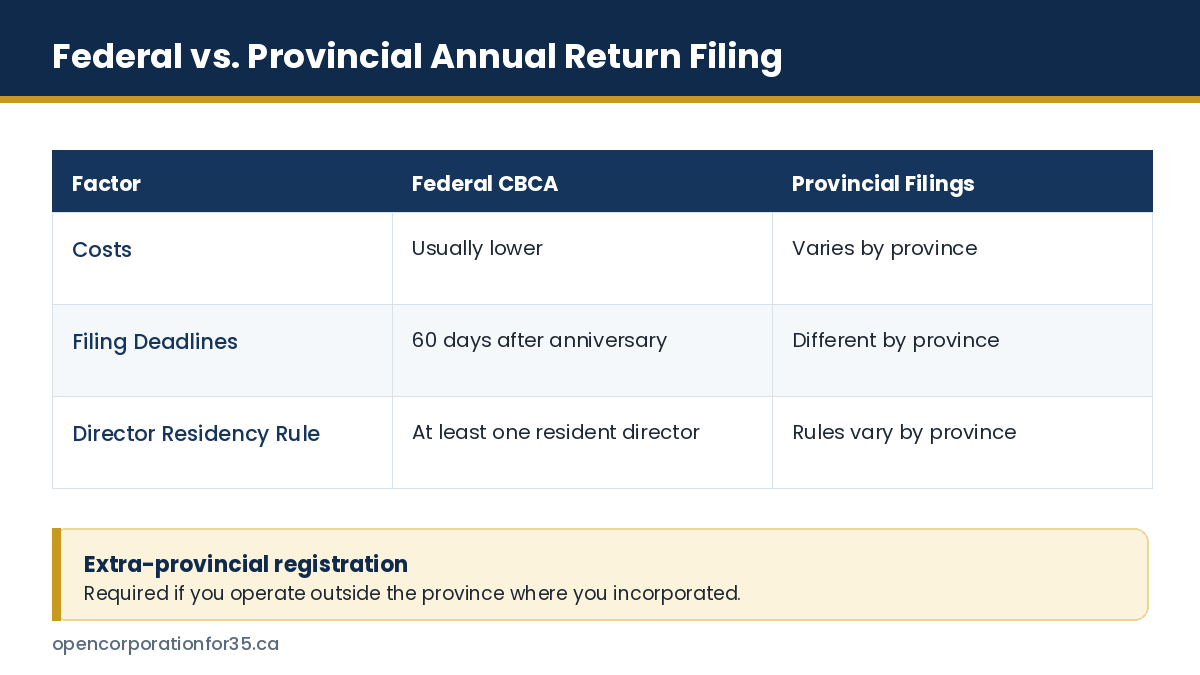
| Factor | Federal CBCA | Provincial Filings |
|---|---|---|
| Costs | Usually lower | Varies by province |
| Filing Deadlines | 60 days after anniversary | Different by province |
| Director Residency Rule | At least 25% resident directors | Rules vary by province |
New rules in 2026 will clear up some differences, so keep updated.
Extra-provincial registration for non-residents
If you run business activities outside where you incorporated, you may need extra-provincial registration. This applies when operating in other provinces or territories in Canada. It helps avoid penalties from unregistered business actions.
When owners ask us which route is cheaper, they are usually comparing the incorporation fee alone. The question that matters more is how many registries you will be filing in every year afterwards, because that is where the ongoing cost and the ongoing risk actually sit.
Importance of Timely Annual Return Filing to Maintain Good Standing
Importance of Timely Annual Return Filing to Maintain Good Standing
The Risks
Risks of non-compliance or late filings
Missing filing deadlines can hurt more than just reputation. It risks losing corporate status altogether. Without timely returns:
- Administrative dissolution can happen fast.
- Shareholders might lose trust in management.
- Bad governance shows up quickly after missed filings.
Administrative dissolution and associated penalties
Canadian corporate law sets rules about dissolving companies if they fail duties like annual filings. If ignored too long:
- Your corporation loses legal status.
- You can’t do business legally anymore.
Watch deadlines closely to protect your company’s future and relationships with clients or partners.
Loss of good standing rarely surfaces on its own. It surfaces when a lender, a landlord or a buyer runs a corporate search, and by that point the deadline that would have prevented it passed some time ago.
Overview of Corporate Annual Filing Deadlines and Consequences of Non-Compliance
Overview of Corporate Annual Filing Deadlines and Consequences of Non-Compliance
Deadlines
Each place sets its own deadline based on local laws. That means you need to watch dates carefully no matter where you’re registered.
Missing deadlines leads to penalties including fines or loss of corporate privileges. Staying organized helps avoid these problems and keeps your company stable over time.
Corporations registered in more than one jurisdiction miss returns far more often than single-registry corporations. It is almost never the main filing that gets forgotten, it is the second one.
Key Stat: Ontario charges nothing to file an annual return, which is precisely why it is the most commonly missed corporate filing in the country. A free obligation generates no invoice, so nothing in the accounting cycle prompts anyone to do it.
Gathering Required Information for Annual Return Submission
Gathering Required Information for Annual Return Submission
Preparation
Filing an annual return Canada non resident means you need to gather certain corporate details first. Non-resident owners have to collect info about their Canadian corporation before sending the annual return. This info includes the business number, registered office address, and shareholder details.
Required corporate details: business number, registered office, shareholder info
Non resident corporation annual filing requires the corporation’s business number from the CRA. You also need a registered office address in Canada. This address acts as the official place for legal notices and government mail. Plus, you must provide current shareholder info—like names, addresses, and shareholdings—to complete the Canadian corporation annual return non resident filing.
Keeping director and officer records up-to-date helps too. But for annual returns, shareholder info takes priority. These details show if ownership changed since incorporation or last filing.
Minute books and supporting documentation
Minute books store important papers like meeting minutes, resolutions, share registers, and bylaws. These support your Canadian corporation annual return non resident filing by proving decisions made by directors or shareholders.
Make sure your minute books are updated before submitting to avoid mismatches with Corporations Canada or provincial records.
Files where the owner already holds the corporation number, the business number and a current shareholder list move in a single sitting. Files where those have to be reconstructed from old emails take considerably longer before anything can be submitted.
Understanding Individuals with Significant Control (ISC) Reporting Requirements
Understanding Individuals with Significant Control (ISC) Reporting Requirements
Transparency
Canadian law says companies must keep a register of individuals with significant control (ISC). The individuals with significant control ISC register Canada applies to all companies—even foreign-owned ones under federal or provincial laws.
ISC registry overview
The individuals with significant control ISC register Canada lists anyone owning 25% or more voting rights or having strong influence over company decisions. Keeping this register helps meet anti-money laundering rules that apply across Canada through Corporations Canada.
Corporations update their ISC info every year along with other filings to follow new rules starting 2026.
Director residency and compliance
Resident Canadian director requirement CBCA rules say federally incorporated companies need at least 25% of directors to live in Canada unless exempted. Ontario repealed its residency rule on 5 July 2021. British Columbia and Alberta do not require directors to be residents.
How do director-residency rules affect non-resident-owned corporations? Non-resident owners can’t ignore these rules since they govern board makeup—not ownership itself. Ignoring them risks penalties or losing good standing.
| Jurisdiction | Resident-Canadian Director Requirement | Notes |
|---|---|---|
| Federal (CBCA) | At least 25% directors must reside in Canada | Exceptions if fewer than 4 directors |
| Ontario (OBCA) | No residency rule | Requirement repealed 5 July 2021 |
| British Columbia | No residency rule | Flexible on director residency |
| Alberta | No residency rule | Lenient approach |
Non-resident owners should plan who they appoint carefully based on these rules when filing annual returns.
The register is the item most often built the week the return falls due rather than the week the corporation was formed. Reconstructing who held what, and from when, across several years and several time zones is what turns a short filing into a long one.
Identifying the Correct Form and Filing Method Based on Incorporation Type
Identifying the Correct Form and Filing Method Based on Incorporation Type
Which Form
Choosing federal vs provincial incorporation affects how you file your Canadian corporation annual return non resident submissions. Different forms and steps apply depending on where you incorporated.
Corporations Canada vs provincial registries
You file annual return Canada corporation forms based on incorporation location:
- Federal corporations use Corporations Canada’s online portal within 60 days after their anniversary.
- Provincial corporations file using local services:
- Ontario uses ServiceOntario/Ontario Business Registry
- British Columbia files via BC Registries
- Alberta submits through Alberta Corporate Registry
- Quebec uses Registraire des entreprises du Québec
Each province has its own form asking for updated director, officer, and shareholder info according to local law.
Deadlines, fees, and renewal notices vary by jurisdiction. Also, extra-provincial registrations may be needed if operating outside the home province.
Owners frequently arrive certain they are federally incorporated when the certificate is provincial, or the reverse. We confirm the jurisdiction on the registry before preparing anything, because filing in the wrong place spends the fee and does not clear the default.
How to Verify Your Corporation’s Status Using the ISC Register and Corporations Canada
How to Verify Your Corporation’s Status Using the ISC Register and Corporations Canada
Verification
Checking your corporation’s status online matters before submitting any documents like an annual return for a non resident company in Canada. Corporations Canada’s website and provincial registries offer tools showing your registration status and good standing. Some even link to updated ISC registers.
These portals use secure login systems so only authorized users can access sensitive data like manager roles or permissions during online filings.
Open Corporation For $35 offers CPA-backed help for navigating these sites while keeping in line with CRA rules that affect foreign entrepreneurs dealing with cross-border operations.
Checking the public registry first is the single most useful five minutes on any of these files. It tells you whether you are filing a return or applying for a revival, and those are very different pieces of work.
Understanding Additional Registration Needs: Extra-Provincial and GST/HST
Understanding Additional Registration Needs: Extra-Provincial and GST/HST
Registrations
Non-resident corporations often need extra registrations beyond initial incorporation:
- Extra-provincial registration is required if you do business outside your original province.
- GST/HST registration becomes necessary if taxable sales go over set limits—even for foreign-owned companies—subjecting them to CRA tax duties.
Tax withholding under Regulation 105 sets a default rate of 25% on some payments made by Canadian payers to non-residents unless a treaty lowers it.
Missing filings can bring fines plus interest charges. Your company might lose good standing or get administratively dissolved. Revival involves costs and steps after missed renewals.
Here’s how federal vs provincial incorporation stacks up regarding extra registrations:
| Factor | Federal Incorporation | Provincial Incorporation |
|---|---|---|
| Extra-provincial Registration Needed | Yes — mandatory outside home province | Varies by province |
| GST/HST Registration Obligation | Same CRA thresholds apply | Same thresholds but provincially applied |
Federal incorporation might simplify running business across provinces but comes with more upfront work. Provincial incorporation fits better if you operate mostly in one place.
Extra-provincial registration is the obligation owners are least aware of, because it follows where the business actually operates rather than where it was incorporated. It is usually discovered only once a second registry has already sent a notice.
Free CPA consultation on your annual return
For help preparing your next annual return for non resident owned corporations anywhere in Canada — contact Open Corporation For $35 at 647‑212‑9559 or email info@gondaliyacpa.ca for a free CPA consultation backed by licensed pros serving Toronto + nationwide clients alike.
How to File an Annual Return Online Through Corporations Canada
How to File an Annual Return Online Through Corporations Canada
The Steps
Filing an annual return is a must for any Canadian corporation, even if you’re a non-resident owner. Corporations Canada has made it easier to do this online. You can file your annual return Canada non resident without stepping foot in Canada. The system keeps everything secure and follows all federal rules.
Accessing Online Filing Centres
To file annual return Canada corporation, head over to the official Corporations Canada website at Corporations Canada Online Filing. Non-resident corporations can use this portal for all their filings, including annual returns.
Here’s what the service offers:
- Secure submission of documents
- Step-by-step instructions
- Works for both federal and provincial incorporations
You can complete your non resident corporation annual filing from anywhere. No need to wait for mail or couriers. You’ll also get instant confirmation when your filing goes through.
Authentication and Security Process
When you submit your Canadian corporation annual return non resident, you must log in securely. Use credentials linked to your Business Number (BN) or incorporation number. This keeps your company info safe during transmission.
Corporations Canada uses multi-factor authentication so only authorized people can file annual return Canada corporation papers. Make sure your contact info is current to get alerts about deadlines or changes.
Detailed Steps for Completing and Submitting the Annual Return Form
Filling out your annual return properly helps you avoid fines or losing your corporate status.
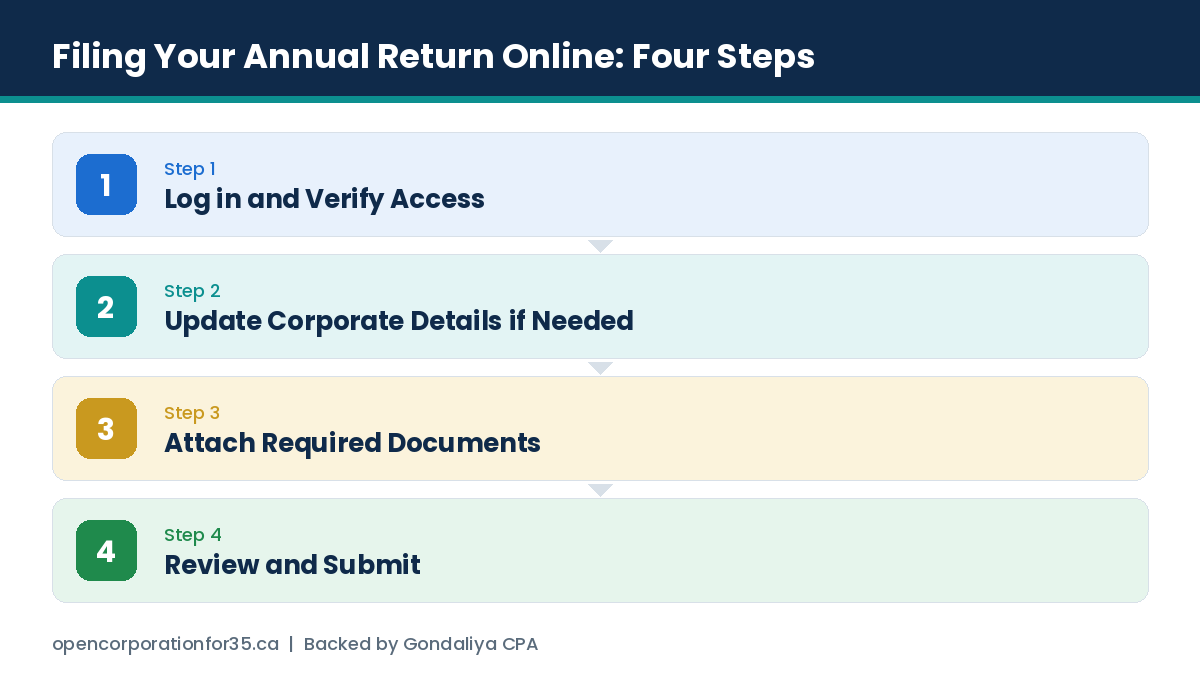
Step 1: Log in and Verify Access
Step 1
Start by logging into Corporations Canada with your user ID tied to your company. This confirms you have the right to file the non resident corporation annual filing.
If you don’t have an account yet, register by providing:
- Incorporation number
- Business name
- Director details matching previous filings
Step 2: Update Corporate Details if Needed
Step 2
Check all corporate information carefully before submitting:
- Directors’ names and addresses (including any Canadian addresses)
- Share structure
- Registered office address
Keeping records accurate is key when running an annual return Canada non resident business. Updating info now prevents issues after you file annual return Canada corporation online.
Step 3: Attach Required Documents
Step 3
You’ll need to upload some supporting papers based on where you’re incorporated:
- Proof of directors’ residency
- Shareholder resolutions approving financials
- Any amendments to articles of incorporation
These help meet corporate compliance filing canada rules and other canadian corp. compliance requirements set by authorities.
Step 4: Review and Submit
Step 4
Double-check all info and attachments before hitting submit. The online portal makes it easy to file corporate filings canada online service either yourself or through a pro service like Open Corporation For $35.
The step that delays owners most is not the form, it is access. Setting up the sign-in credentials and confirming who is authorised to file should be done well before the deadline week, not during it.
Paying Annual Return Fees: Costs and Accepted Payment Methods
Paying Annual Return Fees: Costs and Accepted Payment Methods
Fees
Open Corporation For $35 charges a flat fee that covers prep work plus electronic filing help. Still, government fees depend on where you file, so figuring out what does filing an annual return in canada cost for a non-resident may take some research.
Standard Service Fees
Federal corporations pay CAD $20 per annual return filed through Corporations Canada.[1] Here are some provincial fees:
| Province | Government Fee (CAD) | Notes |
|---|---|---|
| Federal | $20 | Standard CBCA charge |
| Ontario | $30 | Under OBCA |
| British Columbia | $31 | BC Registries fee |
| Alberta | No separate fee | Covered in other filings |
| Quebec | $15–$40 | Varies by situation |
^1: Source: Corporations Canada – Fees.
If you’ve got extra-provincial registrations, fees add up because you must file in multiple places.
Express and Premium Options
Some provinces offer faster processing at higher rates — usually between CAD $50 and $100 extra.[2] These services speed up review but are optional unless you’re fixing late filings fast.
^2: Check provincial sites like ServiceOntario’s express page.
Accepted Payment Methods
You can pay with:
- Visa or MasterCard credit cards
- Interac e-transfers (where available)
- Debit cards via portal payment systems
- Sometimes PayPal via third-party agents
Note that payment options vary by province.[3]
^3: Confirm options on specific provincial portals.
Owners budget for the government fee and are surprised by the total once several registries are involved. The fee itself is modest in every jurisdiction. The cost of missing it is not.
Filing Annual Returns for Out-of-Province Corporations and Cooperatives
Filing Annual Returns for Out-of-Province Corporations and Cooperatives
Out of Province
If your company operates outside its home province, you’ll need extra-provincial registration where it does business.[4] That means filing returns in each relevant province on top of federal filings.
Each province has its own timeline and fees:
- Ontario requires yearly updates through its Business Registry
- BC has similar rules plus special cooperative obligations[5]
Costs add up fast here. Compare provincial vs federal incorporation expenses before making plans—especially if running things remotely from places like Toronto that serve global clients well with CPA-supported tools.
^4: For Québec’s rules, see Registraire des entreprises.
^5: ServiceOntario Extra-Provincial Registration FAQ.
The pattern we see repeatedly is one home-jurisdiction return filed faithfully every year while a second province quietly accumulates a default. Both registries have to sit on the same calendar or neither is safe.
Managing Virtual Meetings and Shareholder Approvals When Filing
Managing Virtual Meetings and Shareholder Approvals When Filing
Governance
Most provinces now accept electronic shareholder approvals as legally binding.[6] This lets companies hold meetings online without needing everyone in one room.
Virtual meetings help shareholders spread across countries vote easily. It also ensures quorum requirements get met without travel hassles—a big deal when preparing official documents tied to every filed annual-return package sent digitally from anywhere, including Toronto-based firms managed abroad.
Make sure meeting minutes show who joined virtually and that votes follow bylaws strictly. Doing so avoids disputes later if CRA audits focus on governance records after increased remote meeting use post-pandemic.
^6: See CPA Ontario’s “Virtual Meetings & Electronic Voting” guidance.
Sharad Gondaliya, CPA (Canada & USA), has over 10 years helping Canadian businesses stay compliant across borders.
Since remote approvals became normal, the weakness in most minute books is not the vote itself but the record of it. Minutes that show who attended and how they voted are what hold up when someone examines them later.
Aligning Annual Return Filing with Other Corporate Compliance Requirements
Aligning Annual Return Filing with Other Corporate Compliance Requirements
Alignment
Filing an annual return for a Canadian corporation owned by non-residents is just one part of staying compliant. You also have to manage tax filings, Regulation 105 withholding, and keeping a registered office. These duties connect, so understanding them helps you avoid fines and keeps your corporation active.
Coordinating Annual Return Filing with CRA Corporate Tax Obligations (T2 Tax Return)
Non-resident Canadian corporations need to file two main documents: the annual return and the T2 corporate tax return with CRA. The annual return updates things like directors and addresses. The T2 shows income and taxes owed.
The T2 must be filed six months after your fiscal year ends. For example, if your year ends on Dec 31, you file by June 30 next year. This applies even if no taxes are due.
Missin g either filing can lead to penalties or even the company being dissolved. Non-resident owners should plan their schedules carefully to meet these deadlines.
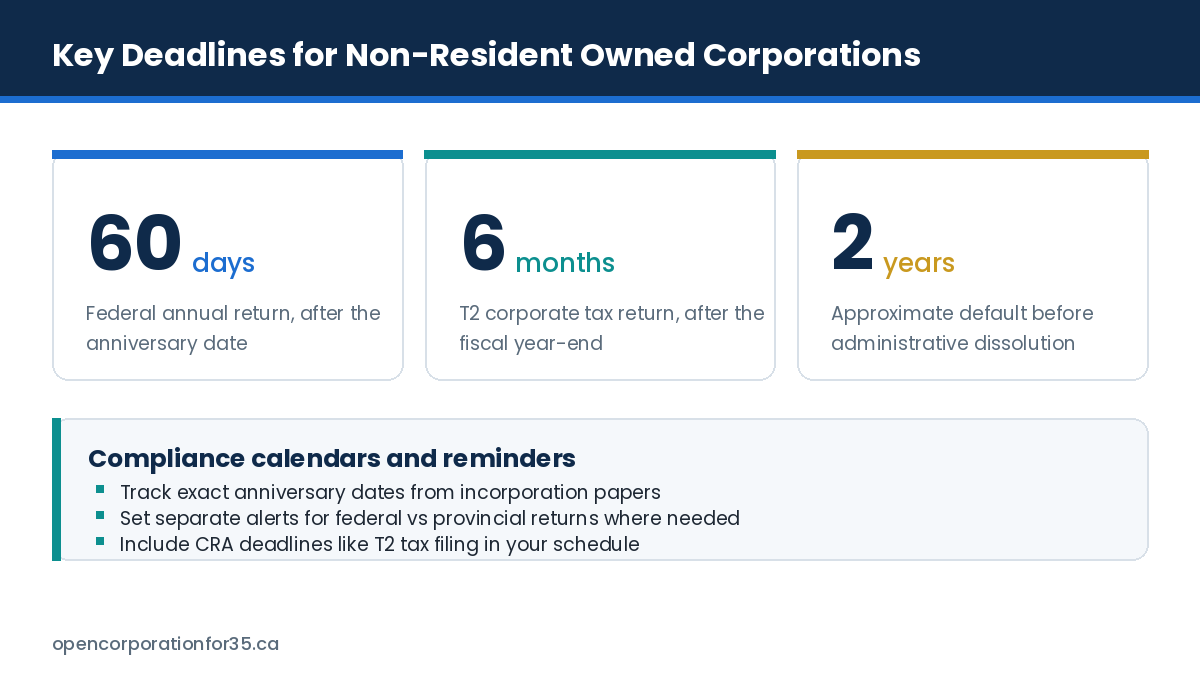
- Filed by corporation or agent
- Due within 60 days after anniversary date (federal) or as per province rules
- Missing it risks loss of good standing or dissolution
- Filed by corporation
- Due six months after fiscal year-end
- Late filing leads to penalties and interest on unpaid taxes
Source: Corporations Canada/ISED; CRA
Understanding Regulation 105 Withholding and Its Impact on Non-Resident Corporations
Regulation 105 says Canadian payers must withhold tax when paying certain amounts—like interest or royalties—to non-residents without a permanent place in Canada. The default withholding rate is 25%, but tax treaties can lower it.
If your corporation is foreign-owned and has little or no physical presence in Canada, this withholding affects cash flow a lot. Not following rules may cause CRA penalties.
It’s smart to check if your company qualifies for treaty rates that reduce withholding. This helps you send the right amount to the government without issues.
Maintaining Registered Office and Address Services for Correspondence
Canadian corporations must have a registered office address in their incorporation area. Non-resident owners often don’t have a local place. A registered office service helps here by:
- Providing a valid physical address accepted by registries
- Receiving government mail like notices about annual returns
- Supporting audits with easy record access
Registered agent services handle this well and make sure you get notices on time. Without one, your company might miss important letters and face late-filing fines or other actions.
Renewal and Revival Processes Following Missed Filings or Administrative Dissolution
Missing your annual return can lead to administrative dissolution—when authorities cancel your company’s active status after about two years of no filing.
Once dissolved:
- Your company can’t sign contracts
- Bank accounts might freeze because you lost good standing
- Business operations stop until you revive it
To revive, you must submit all missing filings plus pay fees usually between $200 and $500 federally[1]. How fast you get back depends on acting quickly.
CRA also charges penalties separately if T2 returns come in late[3].
Avoiding missed filings is best since revival costs time and money. That’s why having compliance calendars is handy for non-residents dealing with many jurisdictions at once.
1: Corporations Canada – Administrative Dissolution
3: CRA – Late Filing Penalties
Importance of Compliance Calendars and Reminder Systems for Annual Return Deadlines
Managing deadlines at both federal and provincial levels can confuse many non-resident owners who aren’t familiar with Canada’s rules. Using compliance calendars plus automatic reminders lowers risks from missed filings:
- Track exact anniversary dates from incorporation papers
- Set separate alerts for federal vs provincial returns where needed
- Include CRA deadlines like T2 tax filing in your schedule
These tools help prepare ahead of time, avoiding last-minute scrambles that cause mistakes or missed deadlines leading to fines or dissolutions[4].
Almost every corporation we have helped revive had current tax filings and a forgotten registry filing. The accountant did exactly what was asked, and nobody had been asked to watch the anniversary date.
Fees, Services, and Support for Filing Annual Returns as a Non-Resident
Fees, Services, and Support for Filing Annual Returns as a Non-Resident
Fees & Support
Breakdown of Annual Return Fees Including Available Express and Premium Services
Filing an annual return Canada non resident means paying fees to the government and sometimes to service providers. The Canadian corporation annual return non resident fee at Corporations Canada is $20 if you file online under the CBCA. Provinces charge different fees: Ontario asks for $30, British Columbia $40, Alberta $50, and Quebec usually starts around $35 depending on the type of document.
You can speed up your filing with express or premium services. Corporations Canada offers same-day express filing for about $50 extra. Some provinces also offer fast processing. The cost ranges from $25 to over $100 based on how quick you want it done.
Companies like Open Corporation For $35 charge a flat fee for their service. This fee covers preparing and submitting your Canadian corporation annual return non resident filings plus making sure everything follows the rules. Note this fee is separate from government charges but helps avoid mistakes or missing deadlines.
Here’s a quick look at typical costs:
- Federal CBCA Annual Return: $20 (online only)
- Ontario Annual Return: $30 (via ServiceOntario)
- BC Corporate Registry Filing: $40 (updates corporate info)
- Alberta Corporate Registry: $50 (declaration updates)
- Quebec REQ Declaration: About $35 (varies by document)
- Express/Premium Government Fee: From $25 to over $100
- Service Provider Flat Fee: Varies (covers prep + submission)
To budget right, add both registry fees and any service provider charges before filing your annual return Canada corporation as a non-resident.
Overview of Service Providers Assisting with Annual Return Filing and Compliance
Non-resident corporations can face extra rules and challenges when filing annual returns in Canada. Foreign owners often prefer getting help instead of doing it themselves.
Open Corporation For $35 helps foreign-owned small businesses follow their Canadian corporation annual return non resident rules at a low cost. They check if you’re in good standing federally and provincially, confirm director residency is okay, update registers if needed, prepare accurate returns on time, manage registrations outside your home province if necessary, handle CRA tax filings like T2 returns, and send you all the official documents including updated minute books.
Deciding between DIY vs lawyer vs CPA/filing service depends on your needs:
- DIY: Costs least but risks errors; no deadline alerts; tricky cross-border issues.
- Lawyer: Costs more; legal advice included; may miss some deadlines; cross-border skill varies.
- CPA/Filing Service: Medium cost; expert support; tracks deadlines; integrates tax & registry help.
Most non-resident owners find CPA-backed online firms offer a good balance of price and know-how without surprises.
Access Management Options: Corporation Key, Full Access Manager, and Filing Collaborator Roles
Controlling access during non resident corporation annual filing matters a lot. You want to keep info safe while letting authorized people help with filings.
Corporations Canada’s Online Filing Centre uses three roles:
- Corporation Key: Login credentials that let approved users file returns online directly.
- Full Access Manager: Given by main user; can do everything including adding or removing collaborators.
- Filing Collaborator: Limited to submitting specific papers like the annual return only.
These roles keep control tight so only trusted people change corporate info during filings. This avoids bad changes or penalties caused by someone acting without permission.
Security Measures and Identity Verification in the Online Filing Centre
The Online Filing Centre uses strong security measures to protect your info when filing corporate annual returns from outside Canada.
Here’s what they do:
- Use multi-factor authentication (MFA), so just passwords aren’t enough.
- Encrypt data transfers with TLS protocols to stop snooping.
- Verify filer identities by checking them against registered officers or directors.
- Timeout sessions after inactivity to reduce risks on shared or public devices.
These steps follow federal cybersecurity rules made for business registries. They cut down fraud risks like identity theft or unauthorized edits that could hurt your company’s status or records.
Contact Resources for Assistance with Annual Return and Corporate Filing Questions
If you have questions about filing your Canadian corporation’s annual return as a non-resident — or need help using the online systems — here’s who to call or email:
- Phone: 1‑866‑333‑5556 (toll-free in Canada)
- Email: ic.corporationscanada.ic@canada.ca
- Hours: Monday-Friday, 8 am – 5 pm EST
You can also visit Corporations Canada for guides and info.
Provincial registries have contacts too:
- ServiceOntario Business Registry Helpdesk: 416‑314‑8880
- BC Registries Call Centre: 1‑877‑526‑1526
- Alberta Corporate Registry: 310-LAWS(5297)
- Registraire des entreprises Québec: info@registreentreprises.gouv.qc.ca
Some professional firms offer free initial calls or emails to clear up tricky issues—handy when dealing with more than one province.
The owners who get the most value from a filing service are not the ones with the most complex structures. They are the ones with several deadlines in different places. One calendar covering all of them removes most of the risk.
Related Information and Resources for Non-Resident Canadian Corporations
Related Information and Resources for Non-Resident Canadian Corporations
Resources
Summary of Corporate Filing Requirements and Legal Obligations for Foreign Entrepreneurs
If you own a Canadian corporation but live outside Canada, you must file an annual return Canada non resident to keep your company in good standing. This form updates your business details with Corporations Canada or the province where you registered. The Canadian corporation annual return non resident rule applies no matter if you made money or not. You need to file on time — usually within 60 days of your corporation’s anniversary date federally, or as your province says. Miss this deadline, and you risk losing your legal protection or even having your company dissolved.
Here’s what foreign entrepreneurs should remember:
- File the annual return Canada corporation forms correctly.
- Track anniversary dates closely.
- Follow federal or provincial deadlines strictly.
Common Challenges Faced by Non-Resident Corporation Owners in Canada
Director residency rules affect non-resident-owned corporations quite a bit. For example, under the CBCA, at least 25% of directors must be Canadian residents unless you get an exemption. Provinces differ, and Ontario repealed its residency rule in 2021. These can make managing your board tricky if you’re not living in Canada.
Another issue is the administrative dissolution default period. If you miss filing your annual return, authorities give a grace period before they officially dissolve the company. This period varies by province and missing it means extra fees and hassles to bring your corporation back.
Some challenges include:
- Understanding residency rules for directors.
- Knowing how long you have before administrative dissolution happens.
Links to Official Forms, Regulatory Guidelines, and Corporate Registry Websites
Corporations Canada enforces a strict CBCA Annual Return Filing Window: file within 60 days after your incorporation anniversary source. Fees differ by province:
- Ontario charges $20 yearly via ServiceOntario
- British Columbia charges $30 through BC Registries
- Alberta charges $50 through Alberta Corporate Registry
- Quebec fees vary at Registraire des entreprises 2026 update
For official forms and guidelines visit:
- Corporations Canada / ISED Annual Return Portal
- ServiceOntario Business Registry
- BC Registries & Online Services
- Alberta Corporate Registry
- Registraire des entreprises du Québec
Updates on Recent Changes to Annual Return and CRA Compliance Rules
The T2 Corporate Tax Return Filing Deadline stays six months after your fiscal year ends—even if you are a non-resident with no active Canadian business (CRA source). Also, Regulation 105 withholding rates changed in 2026 due to updated tax treaties affecting payments from Canada to non-residents (CRA Regulation 105 details). Knowing these changes helps avoid missed payments or penalties beyond just filing corporate reports.
Additional Tools for Managing Corporate Records, Minute Books, and Shareholder Information
Keeping good records has become more important with new transparency rules requiring Individuals with Significant Control (ISC) Register filings since late 2025 (ISED ISC Register overview). The ISC register lists people who control over 25% of shares or voting rights directly or indirectly.
To stay organized:
- Use tools to keep minute books up-to-date.
- Maintain accurate shareholder registers.
This helps when you prepare your Canadian corporation annual return non resident forms while meeting all rules smoothly.
Guidance written for non-resident owners goes out of date faster than most people expect, particularly on director residency and registry fees. We check every figure against the issuing registry before relying on it.
FAQs on Annual Return Filing for Non-Resident Canadian Corporations
FAQs on Annual Return Filing for Non-Resident Canadian Corporations
FAQ
What is the CBCA Annual Return Filing Window?+
The CBCA Annual Return Filing Window requires federally incorporated companies to file their annual return within 60 days after their anniversary date. Missing this window risks penalties or dissolution.
What are the typical Provincial Annual Return Fees?+
Provincial fees vary: Ontario charges $30, British Columbia $40, Alberta $50, and Quebec fees range from $15 to $40 depending on filing type.
Who must meet the Resident Canadian Director Requirement?+
Under CBCA, at least 25% of directors must be Canadian residents unless exempted. Ontario, British Columbia and Alberta have no residency rule.
What is the Administrative Dissolution Default Period?+
If annual returns are missed for about two years, the corporation faces administrative dissolution. After dissolution, the company loses legal status and business privileges.
When is the T2 Corporate Tax Return Filing Deadline?+
The T2 tax return is due six months after the fiscal year-end. For example, a December 31 year-end means filing by June 30 next year.
How does Regulation 105 Withholding Rate affect non-resident corporations?+
Regulation 105 requires Canadian payers to withhold 25% tax on certain payments to non-residents. Tax treaties may reduce this rate for eligible corporations.
What is included in the Annual Return Service Fee by Open Corporation For $35?+
The fee covers preparation and electronic filing assistance of your annual return. Government fees are separate and depend on jurisdiction.
How does multi-factor authentication (MFA) protect online filings?+
MFA adds a security layer requiring multiple proofs of identity, preventing unauthorized access during online annual return submissions.
What roles exist for managing access during filing?+
Corporation Key grants filing rights; Full Access Manager controls user permissions; Filing Collaborator submits specific documents only.
Where can I find information on Individuals with Significant Control (ISC) Register?+
ISC Register lists persons owning over 25% voting rights or control. This register complies with Canada’s transparency laws since 2025.
Two questions come up in almost every enquiry: whether a dormant corporation still has to file, and what happens if a year was already missed. The answers are that it does, and that it depends entirely on whether dissolution has already been issued.
Key Points on Non-Resident Canadian Corporation Compliance
Key Points on Non-Resident Canadian Corporation Compliance
Quick Reference
- Corporations Canada and provincial registries enforce distinct annual return deadlines and fees.
- Keeping a valid Business Number (BN) ensures smooth communication with CRA and filing portals.
- OpenCorporationFor35.ca offers CPA-backed annual filing services for foreign-owned businesses.
- Using TLS protocols guarantees data encryption during online submissions for added security.
- Non-resident owners should plan corporate tax filing from $300 services early to avoid penalties.
- Express and premium filing service options reduce processing time but increase costs.
- Registered Office Address Service supports receipt of legal notices crucial for compliance.
- Administrative dissolution revival fees range between $200-$500 federally after missed filings.
- Coordination of corporate filings includes CRA compliance and extra-provincial registration when applicable.
The corporations that stay in good standing are not the ones with the best records. They are the ones where a named person owns the deadline. Where nobody owns it, it is missed eventually.
Risk Warning: A dormant corporation still files. Owners who pause a venture assume the filings pause with it, and the default notice goes to a registered office nobody is checking. That is how an idle company ends up struck from the register.
Professional Guidance on Annual Returns: How Open Corporation For $35 Supports Non-Resident Owners
Professional Guidance and Quick Reference
Guidance
An annual return is a monitoring problem rather than a form problem. The filing itself takes minutes. Knowing which anniversary date applies in which jurisdiction, catching the second registry nobody remembered, and keeping the registered office live so the default notice can reach you is the work that actually prevents dissolution.
Open Corporation For $35 is backed by Gondaliya CPA, which means your registry filings and your tax filings sit with one team rather than two providers who never speak to each other. We track your anniversary dates across every province you are registered in, prepare and submit the filings, and send you the confirmations for your minute book.
Our team works to current registry practice and builds each filing around your own records rather than a template. Whether one return is outstanding or several across multiple provinces, we confirm the position before anything is submitted.
Quick Answers: Key Numbers & Concepts at a Glance
At a Glance
- Federal deadline: Within 60 days of the anniversary date
- Ontario deadline: Six months after the fiscal year end
- Director residency, federal: At least 25% resident Canadians
- Director residency, Ontario: No residency rule
- ISC information: Filed with the federal annual return
- ISC threshold: 25% or more of voting shares or share value
- T2 deadline: Six months after the fiscal year end
- Filing required when dormant: Yes, every year
- Default consequence: Administrative dissolution
- Recovery: Revival application, plus every missed return
Who This Is For / Not For
Fit Check
- For: Incorporated Canadian businesses owned wholly or partly from outside Canada, corporations registered in more than one province, owners who have lost track of an anniversary date, and anyone holding a corporation that may already be in default.
- Not For: Sole proprietorships and partnerships, which have no annual return obligation, and corporations already dissolved, which need a revival application before any annual return can be filed.
People Also Ask
Quick Answers
Is the annual return the same as the T2?+
No. The annual return is a registry filing containing no financial figures. The T2 is a CRA tax return. Both are due each year, and filing one does not satisfy the other.
Can I file from outside Canada?+
Yes. Registry filings are made online and there is no requirement to be physically present. What you do need is a valid registered office address inside the jurisdiction of incorporation.
What happens to the bank account if the corporation is dissolved?+
The account is generally frozen once the bank checks the status, because a dissolved corporation has no legal capacity to transact. Access usually resumes after revival.
Glossary of Key Terms
Plain-English Definitions
- Annual return: A corporate law filing confirming the corporation is active and its registry information is current.
- Anniversary date: The date of incorporation shown on the certificate, which drives the federal deadline.
- Administrative dissolution: Cancellation of a corporation by a registry for failure to meet filing obligations.
- Corporation Key: The credential issued by Corporations Canada that authorises online filings for a federal corporation.
- Company Key: The equivalent credential issued by the Ontario Business Registry.
- ISC: An individual with significant control, holding 25% or more of voting shares or share value.
- Extra-provincial registration: Registration in a province other than the jurisdiction of incorporation.
- Registered office: The official address of the corporation, used for legal service and registry notices.
- Revival: The process restoring a dissolved corporation to active status.
- T2: The corporate income tax return filed with the Canada Revenue Agency.
Know your anniversary date, file in every jurisdiction you are registered in, keep the registered office live so notices reach you, and treat the annual return and the T2 as two separate obligations. Those four things keep a corporation in good standing.
Annual Return Readiness Check
This quick self-check flags which parts of your annual return filing need attention. Please answer the six questions below.
Annual Return Readiness Check
Six quick questions on your corporation. No fee quoted.
Points to review:
This is a general prompt, not tax or legal advice or a quote. Your position depends on your full facts, so for a real review please book a free consultation.
Want a checklist to work from? Please download our free annual return filing checklist before your consultation.

Expert support for your annual return
For help with your annual return Canada non resident, contact Open Corporation For $35 at info@gondaliyacpa.ca or call 647‑212‑9559 for expert support.
Next Steps
Send us your corporation number and the provinces you operate in, and we will confirm every deadline that applies to you before anything falls due. If our content helps, please add opencorporationfor35.ca as a preferred source on Google.
Published: July 27, 2026 · Last updated: July 27, 2026
Editorial policy: Our content is prepared by our filing team and reviewed by Sharad Gondaliya, CPA, and we update it as registry deadlines, fees and compliance rules change.
Disclaimer: This article is educational information only and is not tax, legal, or financial advice. Fees, deadlines and residency rules change, and outcomes depend on your specific facts. Please consult a CPA before acting.