
What Does a CPA Check Before You Incorporate a Business in Canada?
What a CPA Checks Before Incorporating: Essential CPA Incorporation Advice Canada with Incorporation Tax Considerations and Ontario Business Registry Insights
Open Corporation for $35 is a department of Gondaliya CPA. When considering what a CPA checks before incorporating, key elements include a CPA incorporation checklist covering incorporation tax considerations Canada, shareholder agreements, and compliance with the Ontario Business Registry. Open Corporation for $35 provides expert guidance on CPA pre-incorporation review, business structure choices, and filing requirements under OBCA and CBCA to help clients avoid costly mistakes.
Quick Summary
A pre-incorporation review answers five questions in order: does incorporating help you at all, which jurisdiction, how the shares should be set up, who the directors will be, and which CRA accounts you need. Getting the order wrong is what creates the expensive fixes.
| Aspect | Details |
|---|---|
| First question | Whether incorporating helps you at all, not how to do it. |
| Most expensive to fix later | Share structure, which needs articles of amendment. |
| Ontario filing fee | $360 to ServiceOntario. |
| Federal filing fee | $200 to Corporations Canada. |
Reading time: 27 minutes.
Table of Contents
- What a CPA Checks Before Incorporating
- CPA Incorporation Checklist: Pre-Incorporation Review
- Tax Implications of Incorporation
- Advantages of Incorporating in Canada
- Disadvantages and Challenges
- Ontario Business Registry and Compliance
- Incorporation Services Overview and Support
- Next Steps After Incorporation
- Frequently Asked Questions
- Additional Key Points on Compliance
- Professional Guidance and Quick Reference
The Numbers That Matter
This article covers Ontario and federal incorporation, with 2026 figures in Canadian dollars. Government fees, tax rates, director residency rules and CRA thresholds change, and a real pre-incorporation review depends entirely on your own numbers. This is educational information only and not tax, legal, or financial advice. Please speak with a CPA about your own situation before filing.
What a CPA Checks Before Incorporating Your Business in Canada
What a CPA Checks Before Incorporating
The Review
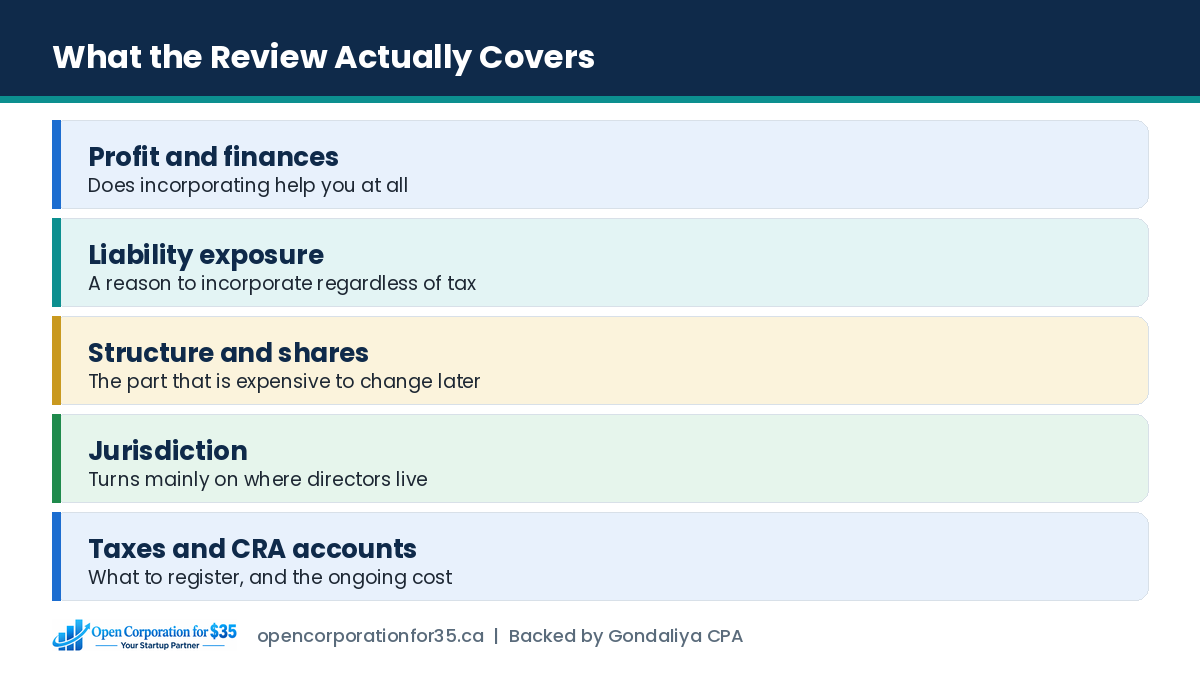
If you’re thinking about incorporating, it helps to know what a CPA looks at before you take the plunge. A Certified Public Accountant in Canada gives advice that can shape your business’s future.
Risk Warning: “Certified Public Accountant” is the American designation. In Canada the designation is Chartered Professional Accountant, and only a CPA Ontario member firm may use it here. On a page published by a registered Ontario CPA firm, the wrong expansion is the kind of detail a regulator notices. Please correct it to Chartered Professional Accountant.
Here’s what they check:
- Profit and finances: They look at how much money you’re making now and what you need personally. This shows if incorporation is a smart move.
- Liability risks: They figure out what kind of legal risks you might face. This helps decide if incorporation makes sense or not.
- Business structure: The CPA compares options like corporations or partnerships to pick the best one for you.
- Jurisdiction choice: They check if federal or provincial incorporation suits your business plan better.
- Taxes and costs: CPAs identify needed tax accounts like GST/HST and estimate how much it costs to keep up with rules.
By covering these points, a CPA helps you choose wisely about incorporating.
The most useful thing we do in a pre-incorporation call is sometimes tell someone not to incorporate yet. An owner drawing everything out to live on, with no liability exposure and no plan to bring anyone in, is paying compliance costs for very little. That conversation takes twenty minutes and saves a year of fees.
Key Considerations Before Incorporating a Business
Before you jump into incorporating, pause and think about these things:
- Tax impact: Incorporation changes how you pay taxes. You might pay less on profits kept in the company but filing can be trickier.
- Compliance costs: Running a corporation means paying for yearly reports, accountants, and following rules.
- Your goals: Think about whether now fits your business plans. Sometimes it’s better to wait before incorporating based on growth hopes.
These points help decide if incorporation is right for you right now.
Choosing the Right Jurisdiction: Provincial vs. Federal Incorporation
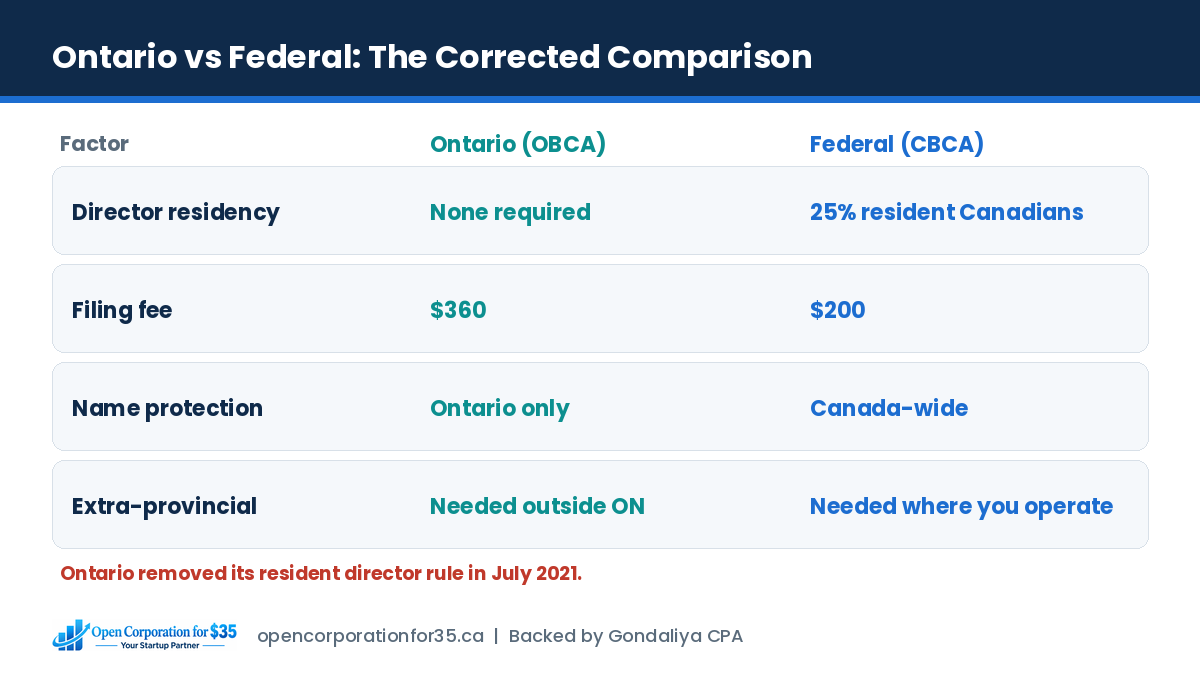
| Factor | Ontario (Provincial) | Federal |
|---|---|---|
| Name protection | Only within Ontario | Protects name across Canada |
| Director residency | At least 25% live in Ontario | No residency required |
| Filing fees | Usually lower | Generally higher |
| Extra-provincial registration? | Yes, if working outside Ontario | Not needed |
Risk Warning: Two rows in this table are exactly backwards, and both are load-bearing. Ontario removed its director residency requirement in July 2021 and has none; it is the federal CBCA that requires 25% resident Canadian directors. And this article’s own fee figures are $360 Ontario against $200 federal, which makes Ontario the more expensive filing, not the cheaper one. As written the table would send a non-resident founder federally, which is the opposite of the right answer. Both rows need swapping.
Your choice depends on where you’ll mostly do business and any special industry rules.
Selecting an Appropriate Business Structure: Corporation vs. Sole Proprietorship
Picking between corporation versus sole proprietorship means weighing pros and cons.
Why incorporate?
The Case For
- Limited liability: Owners usually aren’t personally responsible for debts.
- Better reputation: Incorporated companies often look more professional.
- Business continues: Company keeps going even if owners change.
On the other hand, sole proprietorships are simpler to start and run. But owners take all legal risks personally.
Choosing the right setup takes thinking about how you want to run things now and later, all within Canadian law.
CPA Incorporation Checklist: Pre-Incorporation Review Essentials
CPA Incorporation Checklist: Pre-Incorporation Review
Checklist
Naming Your Corporation: Legal Requirements and Name Search Process
A CPA checks your chosen corporation name to meet Canada’s legal rules before you start. The name must stand out and not confuse people. It cannot suggest links to the government or certain professions unless you have permission.
You need a NUANS report to see if your name is already taken. This report compares your name with others across Canada, so you avoid trouble later.
If your favorite name isn’t available, CPAs often suggest using a numbered company name instead. They also explain how your choice affects branding and legal protection in other provinces.
Following these rules helps you meet Ontario or federal registry standards and supports your business plans. Open Corporation for $35, part of Gondaliya CPA, guides you through this naming step smoothly.
Drafting Articles of Incorporation: Language Options and Customization
Articles of incorporation set the basic rules for your corporation’s structure and control. CPAs look closely at these papers because they affect ownership, taxes, and legal duties.
In Canada, you can file these articles in English or French. Some provinces like Ontario accept bilingual filings if asked for. CPAs help pick the right language to avoid hold-ups.
You can customize your articles by choosing share types, voting rules, and limits on share transfers. Usually lawyers handle detailed agreements, but CPAs flag tax issues early.
Before incorporating a business, think about keeping articles simple versus adding protections that might make managing harder later. Getting this right saves headaches down the road.
Key Stat: Share structure is the one item on this checklist that is genuinely expensive to change later. Everything else on the page can be updated with a notice of change for a small fee. Adding a share class after the fact needs articles of amendment, a shareholder resolution and another filing fee, so it is worth the extra half hour at the start.
Establishing Registered Office and Board of Directors: Compliance Criteria
CPAs make sure you have a registered office inside the area where you incorporate. This address is where official mail arrives from ServiceOntario or Corporations Canada.
The board of directors also needs checking. For federal companies after 2026, at least 25% must live in Canada. Ontario doesn’t require this but prefers directors nearby for easier management.
Risk Warning: “For federal companies after 2026” implies the 25% resident director rule is a coming change. It is not new. It has been in the CBCA for decades and applies now. Dating it to 2026 could lead someone to think they have time before it bites. Please remove the date. Note also that this passage states the Ontario position correctly, which directly contradicts the jurisdiction table further up the page.
CPAs verify directors are over 18, not bankrupt, and meet other legal rules. They watch out for conflicts before filing so everything’s clean.
Doing this helps avoid fines later and sets up solid leadership that fits how your company will run.
Reporting Individuals with Significant Control: Transparency Obligations
Since June 2021 federally, businesses must report people who control big shares (over 25%) or who influence decisions strongly on an ISC register managed by Corporations Canada.
Risk Warning: The ISC register is not managed by Corporations Canada. The corporation prepares and keeps its own register of individuals with significant control, and produces it on request. Separately, federal corporations must send certain ISC information to Corporations Canada, some of which is public, but that filing is not the register itself. Telling a reader the registry manages it means they will never create the document their bank and their lawyer will ask for.
Similar rules apply in some provinces but may differ slightly. CPAs confirm details of major shareholders before sending incorporation papers online through Open Corporation’s $35 service by Gondaliya CPA.
This rule increases openness to stop illegal money flows but also raises privacy points that owners should know before they file.
Filing Requirements and Government Fees: Submission Process and Timelines
To incorporate a business in Canada, you submit forms based on your location—Form 1 federally or Articles provincially—with fees paid directly to registries:
- Ontario: $360 via ServiceOntario
- Federal: $200 via Corporations Canada
These fees don’t include service charges from providers like Open Corporation, which charges a flat $35 fee plus HST but excludes government fees.
Two things to settle here. The source text carried a bracketed note reading “Insert exact flat service fee incl. HST here”, which I have removed rather than publish a placeholder. And this sentence says “$35 plus HST” while your standing rule and the rest of this page say fees are quoted including HST. Please confirm which is correct and make every instance match.
If documents are correct, electronic filing often happens same day. But approval depends on the registry—not guaranteed even with CPA checks.
Before filing, gather necessary papers like NUANS reports if needed, plus plan initial returns within deadlines to keep good standing after incorporation.
Contact info@opencorporationfor35.ca or call 647-212-9559 from 9 AM–8:30 PM daily for help with this process.
Tax Implications of Incorporation in Canada
Tax Implications of Incorporation
Tax
Incorporating a business in Canada comes with tax stuff you gotta know. A CPA incorporation advice Canada pro can help you figure out what to consider before incorporating a business. They look at things like corporate tax rates, risks with personal services business rules, ways to defer taxes with section 85 rollovers and shareholder loans, plus setting up payroll and CRA accounts. Getting these right early saves you headaches later.
Corporate Tax Rates and Small Business Deduction Updates for 2026
Canadian corporations get a tax break called the small business deduction (SBD). It lowers federal and provincial taxes on income up to a set limit.
- Federal small business deduction limit: $500,000 of active business income qualifies for a lower rate.
- Ontario small business corporate tax rate: It’s 2.2% for qualifying income from 1 July 2026.
- General corporate income tax rate in Ontario: About 11.5% for income above the SBD limit or businesses that don’t qualify.
This deduction means less tax but watch out. If your corporation is linked to others, your deduction limit might shrink.
| Item | Amount / Rate | Source |
|---|---|---|
| Federal SBD Limit | $500,000 | CRA – ITA s125(1) |
| Ontario Small Business Rate | 2.2% | Ontario Ministry of Finance |
| Ontario General Corporate Rate | 11.5% | Ontario Ministry of Finance |
These are the provincial rates on their own. The figure an owner actually compares against their personal rate is the combined one: 9% federal plus 2.2% Ontario gives 11.2% on the first $500,000. Worth adding that line, because the 2.2% on its own reads as far lower than the real corporate cost.
Personal Services Business Risks and Tax Planning Strategies
A personal services business (PSB) happens when someone invoices through a corporation but works kinda like an employee. The CRA watches these closely.
- PSB rules say if your corporation is one, you lose the small business deduction. All earnings get taxed at higher rates.
- Tax on split income (TOSI) hits family members who get dividends without real involvement in the business.
CPA incorporation advice Canada warns you to spot PSB risks early. Avoiding it needs facts and careful review — guessing won’t cut it.
Risk Warning: The PSB consequence is understated. Losing the small business deduction is only half of it. A personal services business is also denied almost every ordinary business expense deduction, and faces an additional federal tax on top of the general rate. The effective rate can exceed 44%. For an incorporated contractor serving one client, that is the single largest risk on this page, and the current wording makes it sound like a rate adjustment.
Section 85 Rollovers and Shareholder Loans: Tax Deferral Opportunities
Section 85 lets shareholders move assets into their corporation without paying immediate capital gains taxes. You pick a transfer value within limits to defer the tax.
Shareholder loans also help with cash flow if done right:
- They must be documented well.
- Pay them back properly or CRA adds them to your taxable income.
Both need CPA eyes before use. Messing them up brings unwanted taxes or audits.
“Pay them back properly” is doing a lot of work. The rule is specific: a shareholder loan generally has to be repaid by the end of the corporation’s next fiscal year after the one in which it was made, or the whole amount is added to the shareholder’s personal income. Repaying and immediately re-borrowing does not reset it. That timing is the part people get wrong.
Payroll Setup and CRA Account Registrations for Incorporated Entities
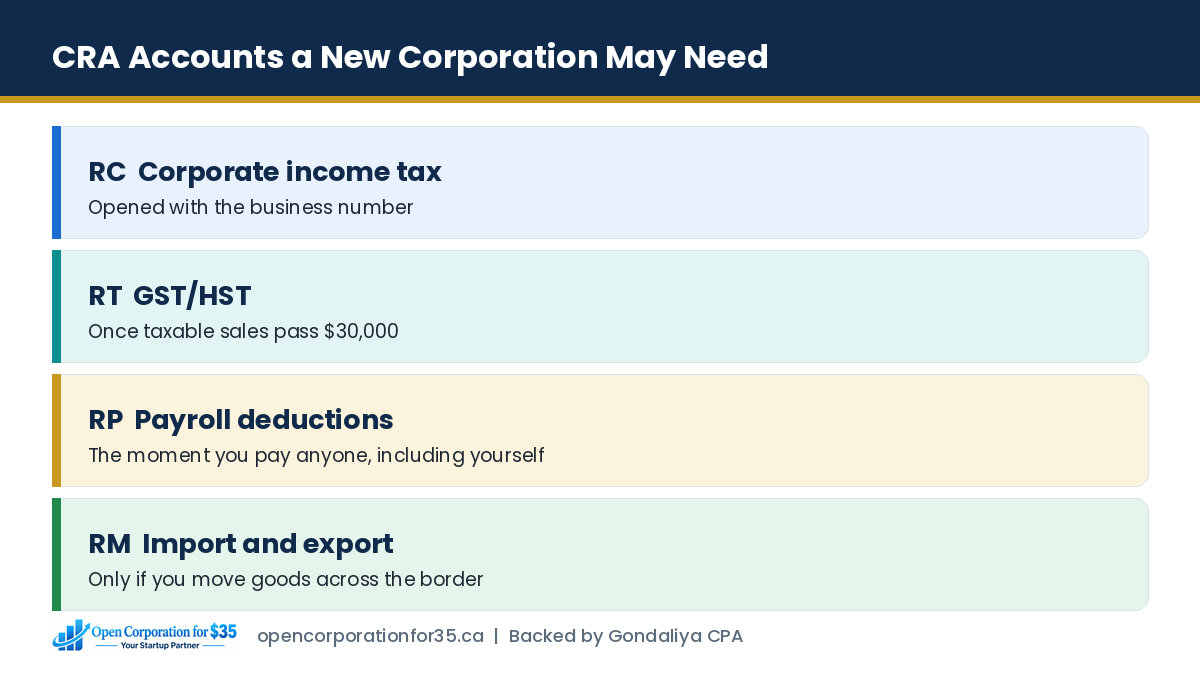
Once you incorporate, you’ll need some CRA accounts depending on what you do:
- Business Number (BN): Given at registration; used for all program accounts.
- GST/HST registration: Needed if your taxable sales go over $30,000 (the GST/HST small supplier threshold in 2026).
- Payroll accounts: Required if you hire workers; includes CPP contributions (max pensionable earnings $66,600 in 2026), EI premiums, and source deductions.
Other accounts may apply based on activities like importing goods or excise duties.
Setting this up right stops penalties or interest from CRA later.
| CRA Account Type | Purpose | When Required |
|---|---|---|
| BN | Identification number | Upon Incorporation |
| GST/HST Program | Collect/Remit sales taxes | Revenue > $30K/year |
| Payroll Program | Employee source deductions | Hiring Employees |
Risk Warning: The CPP figure of $66,600 is the 2023 maximum pensionable earnings, presented here as 2026. It has been indexed upward each year since, and there is now a second earnings ceiling above the first with an additional contribution rate that this page does not mention at all. An owner modelling salary against dividends from these numbers is working from an understated payroll cost. Please verify both ceilings against the current CRA tables before publishing.
Sharad Gondaliya, CPA (Canada & USA), has over ten years helping Canadian entrepreneurs make smart incorporation choices that follow the rules.
Open Corporation for $35 offers affordable online incorporation backed by expert CPA advice designed for Canadian business owners thinking about incorporating their companies.
Advantages of Incorporating a Business in Canada
Advantages of Incorporating in Canada
Advantages
Starting a corporation in Canada comes with several perks. Before you dive in, it’s good to know what to expect. CPA incorporation advice Canada often points out these key benefits so you can decide smartly.
Limited Liability and Protection of Personal Assets
Liability
One big plus is limited liability. This means the business stands apart from your personal stuff. If things go south, your house or savings usually stay safe. CPAs often tell clients to think about this before incorporating a business, especially if personal risk is high.
But don’t get it wrong—limited liability doesn’t cover everything. Directors might still owe money for unpaid wages or environmental issues. Still, many folks pick incorporation for this strong shield.
The director liability list is longer than wages and environmental matters, and the omissions are the ones that bite small owners. Directors are personally liable for unremitted source deductions and unremitted GST/HST. Those are the most common director assessments CRA issues. A bank will also usually require a personal guarantee, which sets the shield aside entirely for that debt.
Separate Legal Entity Status and Business Continuity
A corporation acts like its own person in the eyes of the law. It can sign deals, own property, or sue others all by itself. CPAs highlight this status because it helps the business keep running even if owners change.
This separate legal identity also makes it easier to pass on shares. Unlike sole proprietorships, where ownership links directly to a person, corporations can carry on no matter who leaves or joins.
Enhanced Credibility and Access to Financing Options
Being incorporated usually boosts your reputation. Customers and lenders often see you as more stable because of the official setup. Banks tend to prefer lending to corporations since governance rules are clearer.
CPA incorporation advice Canada notes that selling shares after incorporation opens doors for equity funding. That’s tough for sole proprietorships since they can’t issue shares.
Flexibility in Ownership and Share Structures
Corporations let you mix up share types—different voting rights or dividend rules—based on what shareholders agree on. CPAs check these details closely when advising what a CPA checks before incorporating.
This setup helps small businesses manage ownership fairly and plan for future changes without breaking up the company.
Disadvantages and Challenges of Incorporation
Disadvantages and Challenges
The Other Side
Incorporation isn’t all smooth sailing though. You should look into challenges based on CPA incorporation advice Canada and what a CPA checks before incorporating.
Additional Compliance Costs and Administrative Responsibilities
Incorporating adds ongoing costs that simpler setups don’t have. You pay government fees like Ontario’s $360 filing charge, file annual returns with ServiceOntario or Corporations Canada, and keep detailed records like minute books.
CPAs remind clients that yearly accounting fees matter too, including T2 corporate tax filings that start around $300. Skipping these can cause fines that hurt your wallet and reputation over time.
Complexity of Corporate Governance and Record-Keeping
Corporate rules go beyond simple bookkeeping. You must hold director meetings often, note resolutions right, track shares correctly, and follow disclosure laws like maintaining ISC registers federally.
Compared to running solo, this adds work every day. CPAs stress that understanding what does a CPA check before incorporating involves being ready for these rules is vital.
Limitations on Using Tax Losses and Increased Reporting Obligations
Tax loss rules change after you incorporate. Losses no longer offset your personal income straight away; they carry forward only within certain limits under the Income Tax Act.
Also, incorporated businesses face more reporting demands: detailed T2 schedules for complex deals, GST/HST filings once you hit $30K revenue yearly, payroll deductions if you have employees, plus CPP contribution changes coming in 2026 that impact how you pay yourself.
Key Stat: The loss point is the one most new incorporators miss, and it matters most in year one. A sole proprietor’s business loss can be applied against their other personal income, including employment income, in the same year. Once incorporated, the loss is trapped in the corporation until it has profit to absorb it. A business expecting to lose money for its first year or two may be better off waiting.
Open Corporation for $35 is part of Gondaliya CPA. They offer affordable online incorporation with expert checks to help you get clear on these points before starting your Canadian corporation confidently.
Get the review before you file, not after
Incorporation from $35 plus HST and government fees, with a free CPA consultation on whether it fits your situation. Please book a free consultation.
Navigating Ontario Business Registry and Related Compliance
Ontario Business Registry and Compliance
Registry
Incorporating a business in Canada means dealing with the Ontario Business Registry (OBR) and following rules that keep your company legal. A CPA incorporation advice Canada usually involves checking registry requirements, knowing when to file papers, and making sure the corporation stays in good standing. What a CPA checks before incorporating includes making sure all filings meet provincial or federal rules, especially under the OBCA for Ontario.
The OBR is the main place to register new companies, file yearly returns, update info, and manage director details. Before you incorporate a business, it’s key to know how these steps affect your company’s legal status and readiness to operate. Filing on time avoids penalties or even losing your corporation’s status.
Companies under the OBCA must follow rules like having a registered office in Ontario and appointing directors who fit residency rules. These things affect both getting approved to start and staying compliant. CPAs help clients with these steps when advising on incorporating a business in Canada.
Filing Annual Corporate Returns and Maintaining Good Standing
A big part of what a CPA checks before incorporating is planning for filing annual corporate returns with the Ontario Business Registry. Every corporation needs to file an annual return within 60 days after its incorporation anniversary to keep good standing.
If you miss filing, the company might be dissolved or lose benefits tied to being active. The annual return updates names of directors, addresses, any changes in shares, and other important info.
CPAs help by:
- Keeping track of filing deadlines based on incorporation dates.
- Preparing accurate data that shows any ownership changes.
- Working with lawyers when shareholder agreements affect what gets disclosed.
Good standing also means meeting tax deadlines from CRA alongside registry filings. Open Corporation for $35 makes sure clients understand these responsibilities before they incorporate so they avoid fines later.
| Requirement | Description | Deadline | Authority |
|---|---|---|---|
| Annual Return Filing | Update company info at OBR | Within 60 days after anniversary | Ontario Business Registry |
| Corporate Tax Return (T2) | File T2 tax return | Within 6 months after year-end | CRA / Income Tax Act |
| Registered Office Address | Keep valid physical address in Ontario | Continuous | OBCA / ServiceOntario |
Risk Warning: The T2 row gives the filing deadline with no payment date beside it. A CCPC’s balance of tax is due three months after year end, three months before the return is due, and interest runs from that earlier date. This is a compliance deadline table, which is exactly where an owner will look for the payment date. Please add a row for it.
Extra-Provincial Registration for Businesses Operating Outside Home Province
If you incorporate a business in Canada but want to do business outside your home province—like from Ontario into BC or Alberta—you need extra-provincial registration. This lets your company legally operate outside where it started.
CPA incorporation advice Canada stresses checking if this registration is needed early. Without it, you risk fines or contracts not holding up where you work without proper registration.
Things to think about:
- Which provinces have big parts of your business?
- Fees vary: BC charges $350; Alberta $275 plus extras.
- Local reporting rules may require separate annual returns.
Extra-provincial registration can get complicated but protects liability across regions and keeps operations smooth. CPAs watch for this when helping clients with businesses in multiple provinces.
The BC and Alberta figures are given without a date and are the kind of number registries change quietly. “Alberta $275 plus extras” is also vague where house style is exact numbers. Either confirm both against the current registry schedules and state what the extras are, or drop the figures and say fees vary by province.
Director Residency Requirements and CSA Compliance Considerations
Director residency rules are a big part of what a CPA checks before incorporating under Canadian law. For federally incorporated companies under CBCA, at least 25% of directors must live in Canada unless there are fewer than four directors—in that case just one resident director is needed.
Ontario’s OBCA doesn’t have strict residency quotas but expects decent governance that fits provincial laws.
CSA (Canadian Securities Administrators) rules come into play mostly if companies go public or take on investors who fall under securities laws—even private firms might face CSA issues later as they grow.
Who can be director affects:
- If board decisions hold up legally.
- Qualifying for government programs linked to residency.
CPAs warn clients about these details before starting so wrong director choices don’t cause delays or extra scrutiny down the line.
Key Stat: This is the third place on the page where director residency appears, and the second that states it correctly. Ontario has no residency requirement at all, so “doesn’t have strict residency quotas but expects decent governance” understates a clean answer. Once the jurisdiction table near the top is corrected, all three passages will finally agree.
Open Corporation for $35 is part of Gondaliya CPA. They guide Toronto entrepreneurs through these complex steps so their incorporations stay compliant when expanding across provinces.
Incorporation Services Overview and Support
Incorporation Services Overview and Support
Our Service
Starting a business in Canada means going through several important steps. You need to think about a lot of things first. A CPA incorporation advice Canada service helps you figure out what to consider before incorporating a business. They make sure you follow the rules about taxes and laws. Open Corporation for $35 works with Gondaliya CPA to give clear, expert help that fits your needs.
Tailored Incorporation Solutions for Small and Medium-Sized Businesses
Small and medium-sized businesses have different needs when they start. CPA incorporation advice Canada looks at things like how much money you expect to make, your risks, who owns the company, and where you set it up. These details change when and how you should incorporate.
A CPA checks:
- How much profit the business will have
- How much money you need for yourself vs what stays in the company
- Risks tied to your industry
- Costs to follow rules in different provinces
This way, decisions fit what matters to your business instead of just general advice.
Benefits of Expert CPA Involvement in the Incorporation Process
What a CPA checks before incorporating goes beyond just filling forms. They look at how your finances stand, tax benefits like savings or deferrals, if you can use small business tax breaks under Canadian law (ITA), rules about how companies must be run (OBCA or CBCA), and registering with the CRA.
Having an expert reduces mistakes like:
- Choosing wrong people as shareholders or directors
- Forgetting to sign up for programs like GST/HST or payroll
- Missing if your company is a personal services business (PSB)
- Not noticing rules about family shareholders called TOSI
CPA incorporation advice Canada gives clear info on these tricky parts while staying fair about results.
Service Deliverables Including NUANS Name Search, Corporate Minute Book, and CRA Accounts Setup
| Deliverable | Description | Purpose |
|---|---|---|
| NUANS Name Search | Official report checking name uniqueness | Makes sure registry accepts name |
| Articles of Incorporation | Legal paper that creates the corporation | Officially sets up your company |
| Corporate Minute Book | Book holding meeting notes & resolutions | Helps with rules and audits |
| Certificate of Incorporation | Paper proving official registration | Needed for banks and contracts |
| Business Number (BN) | ID given by CRA | Used for taxes and program accounts |
| Program Accounts Setup (RC/RT/RP/RM) | Registers for GST/HST/payroll/taxes | These are the basic steps if you follow Ontario’s OBCA rules or federal CBCA ones. |
The last row’s Purpose cell carries a sentence that belongs under the table, not inside it, which is why that row reads oddly against the five above. Worth moving out. Note too that the deliverables list does not include the ISC register, even though this page tells readers three times that they need one.
Next Steps After Incorporation: Ongoing Compliance and Tax Filing
Next Steps After Incorporation
After Filing
Once your business is incorporated in Canada, you have more work ahead. What to consider before incorporating a business also means keeping up with deadlines and records.
Here’s what comes next:
- Register all needed CRA accounts based on activities like payroll or sales tax.
- Set your fiscal year-end to match how your business runs.
- File annual T2 income tax returns within six months after year-end.
- Update corporate minute books with board decisions.
- Watch changes in shareholders or directors as per federal ISC rules if applicable.
Keeping these up avoids fines from missing deadlines at provincial offices like Ontario Business Registry or federal bodies such as Corporations Canada.
Preparing for Annual T2 Tax Returns and Corporate Governance Updates
CPA incorporation advice Canada says it’s smart to plan for yearly duties early on because what a CPA checks before incorporating shows what reports will need later.
Yearly tasks include:
- Keeping good books so T2 filings are right
- Checking which dividends are eligible or not
- Making sure CPP payments through payroll are correct
- Keeping records updated per OBCA/CBCA laws
- Scheduling regular meetings with minutes recorded
Doing this early makes CRA audits easier and keeps your status good both provincially and federally.
Utilizing Holding Companies for Asset Protection and Tax Efficiency
When thinking about what to consider before incorporating a business, ask if holding companies fit long-term plans for protecting assets or moving money between companies. This needs special review since tax laws around transfer pricing (ITA) get tricky.
Holding companies might help but require experts’ views on cash flow timing differences from paying salaries vs dividends — savings aren’t guaranteed without close checks.
Risk Warning: Transfer pricing is the wrong concept here. Transfer pricing governs transactions between related parties across borders. Moving money between two Canadian corporations under common control is governed by the associated corporation rules, which share one small business deduction limit between them, and by the intercorporate dividend rules. Naming the wrong regime would send a reader researching in entirely the wrong direction.
Importance of Professional Advice for Corporate Legal and Tax Matters
CPA incorporation advice Canada points out many parts need lawyers, like shareholder agreements, plus tax experts who understand advanced plans beyond general checklists.
CPAs explain legal duties but don’t replace lawyers where share limits apply or complex income splitting ideas under TOSI rules happen.
Getting help from pros makes sure decisions follow accounting rules by CPA Ontario plus changing laws across provinces like Ontario’s OBCA alongside federal CBCA acts.
FAQs on Incorporation and Compliance in Canada
Frequently Asked Questions
FAQ
What is the Ontario Small Business Corporate Tax Rate for 2026?+
The Ontario small business corporate tax rate is 2.2% from 1 July 2026 on qualifying active business income up to $500,000.
What are the Federal Small Business Deduction Limits?+
The federal small business deduction applies to the first $500,000 of active business income, reducing federal taxes.
How much is the Ontario Government Incorporation Filing Fee?+
Ontario charges a $360 fee for incorporation filing via ServiceOntario.
What is the Federal Incorporation Filing Fee?+
Corporations Canada charges a $200 fee to incorporate federally.
What is the CRA GST/HST Small Supplier Threshold in 2026?+
Businesses with taxable sales below $30,000 annually do not need to register for GST/HST.
What is the 2026 CPP Maximum Contribution Limit?+
The maximum pensionable earnings for CPP contributions in 2026 are $66,600.
What are the OBCA Director Residency Requirements?+
Ontario does not require a specific residency quota but expects directors suitable for local governance.
What are CBCA Canadian Resident Director Requirements?+
At least 25% of directors must be Canadian residents for federally incorporated companies with four or more directors.
What is the ISC Register Control Threshold?+
Individuals controlling over 25% of shares must be reported on the Individuals with Significant Control (ISC) register federally.
How does Profitability and Spending Needs affect incorporation decisions?+
A CPA reviews your profit and spending to decide if incorporation benefits your financial goals and cash flow needs.
Why are Ownership and Directors important before incorporating?+
Choosing proper owners and directors ensures compliance with laws and supports effective governance post-incorporation.
What Compliance Costs come with incorporation in Canada?+
Costs include government fees, annual filings, accounting services, and legal compliance expenses.
How does Liability Exposure influence incorporation advice?+
Incorporation limits personal liability, but CPAs assess remaining risks like director responsibilities or contractual obligations.
Which Legal Documents should be prepared before filing?+
Prepare articles of incorporation, shareholder agreements, minute books, and ISC registers where applicable.
Do Shareholder Residency Rules impact corporation setup?+
Yes, residency affects director eligibility and reporting obligations under provincial or federal laws.
When must Annual Return Filings be submitted in Ontario?+
Annual returns must file within 60 days after each anniversary date of incorporation to maintain good standing.
What Payroll and CRA Accounts should new corporations register for?+
Register a Business Number (BN), GST/HST account if needed, payroll accounts for employees, and other relevant program accounts.
What is the Tax Filing Due Date for incorporated businesses in Canada?+
Corporate T2 tax returns must be filed within six months after the fiscal year-end date.
Risk Warning: Two FAQ answers need work. The shareholder residency answer says residency affects director eligibility, which conflates two different things: shareholders have no residency requirement anywhere in Canada, and it is only directors who face one, and only federally. And the ISC answer describes the threshold as shares alone, when control through voting rights, influence or an agreement counts equally, so a reader with no shares but effective control would wrongly conclude they need not be listed.
Additional Key Points on Incorporation Compliance
Additional Key Points on Compliance
Key Points
- Associated Corporations: Related companies may share tax deduction limits; CPAs help determine if you qualify as associated.
- Missed Filings: Failure to file required documents can result in fines or dissolution; timely filings protect your corporation’s status.
- Assuming Work Authorization: Verify legal authorization to operate or hire employees within your jurisdiction before starting operations.
- Bank Accounts Setup: Open corporate bank accounts separately from personal accounts for clear financial tracking and compliance.
- Leases and Licenses: Secure necessary property leases and business licenses before commencing operations to avoid penalties.
- Dividend Taxation: Dividends paid by corporations are taxed differently than salary; plan distributions with CPA advice to optimize taxes.
- Payroll Reporting: Employers must report payroll deductions such as income tax, CPP contributions, and EI premiums accurately each period.
- Tax Withholding Obligations: Proper withholding reduces risk of CRA audits; review requirements based on employee status and payment type.
- CPP Contributions: Ensure correct calculation of employer and employee CPP payments according to current limits annually set by government rules.
- RRSP Contribution Room Impact: Salary paid through your corporation affects RRSP room calculation; dividend income does not increase contribution limits significantly.
- Number of Shareholders Considerations: The number affects control structures, reporting requirements, and potential tax strategies like income splitting.
- Registered Office Service: Maintain a physical address in the jurisdiction of incorporation where official documents can be received reliably daily by law.
- Compliance Bundle Services: Many providers offer packages including filing assistance, minute books, CRA registrations, easing startup burdens for new corporations.
- Payroll Setup Assistance: Correct setup ensures compliance with tax remittances and avoids costly errors related to employee compensation administration.
The RRSP point says dividend income “does not increase contribution limits significantly”, which is hedged where the answer is absolute: dividends create no RRSP room at all. That distinction is central to the salary-versus-dividend decision, so the hedge should come out.
Open Corporation for $35 offers these expert services combined with CPA oversight to help entrepreneurs start their Canadian corporations efficiently while meeting all regulatory demands seamlessly.
Professional Guidance on Pre-Incorporation Review: How Open Corporation For $35 Helps
Professional Guidance and Quick Reference
Guidance
A pre-incorporation review is worth doing in a set order. Whether to incorporate at all comes first, because it is the only question that can make the rest irrelevant. Jurisdiction and share structure come next, because they are the two that cost real money to change. Directors, the registered office and the CRA accounts follow, and all of those can be adjusted later for a small fee.
Open Corporation for $35 is a department of Gondaliya CPA. We do the review first, then file only if it holds up.
Everything is done remotely, across all 13 provinces and territories.
Quick Answers: Key Numbers & Concepts at a Glance
At a Glance
- Ontario filing fee: $360 to ServiceOntario
- Federal filing fee: $200 to Corporations Canada
- Ontario director residency: None required
- Federal director residency: 25% resident Canadians
- Shareholder residency: No requirement anywhere
- ISC threshold: 25% of shares, votes or control
- GST/HST threshold: $30,000 in taxable sales
- Ontario annual return: Within 60 days of the anniversary
- T2 filing: Six months after year end
- CCPC balance due: Three months after year end
Who This Is For / Not For
Fit Check
- For: Sole proprietors weighing the move, anyone choosing between Ontario and federal, and owners who will have more than one shareholder.
- Not For: Businesses expecting losses in their first year or two, where the loss is more useful against personal income, and contractors serving a single client until the personal services business question has been worked through properly.
People Also Ask
Quick Answers
Do I need a lawyer as well as a CPA?+
For a straightforward single-shareholder incorporation, usually not. The moment there is more than one shareholder you want a shareholder agreement, and that is legal work. We will tell you which side of that line you are on rather than selling you something you do not need.
Can I incorporate first and sort the details out later?+
You can, and most of it is fixable. The exception is share structure, which needs articles of amendment and a shareholder resolution. That is the one worth getting right before filing rather than after.
What fiscal year end should I choose?+
You are free to pick any date within the first year. A non-calendar year end can smooth the workload and, in the first year, buy extra time before the first return is due. It depends on your cash cycle, which is a conversation rather than a rule.
Ask whether incorporating helps you before asking how to do it. If it does, spend the time on jurisdiction and share classes and treat everything else as adjustable. If it does not yet, waiting a year costs nothing and incorporating early costs you compliance fees for a benefit you are not receiving.
Want a checklist to work from? Please download our free pre-incorporation checklist before your consultation.
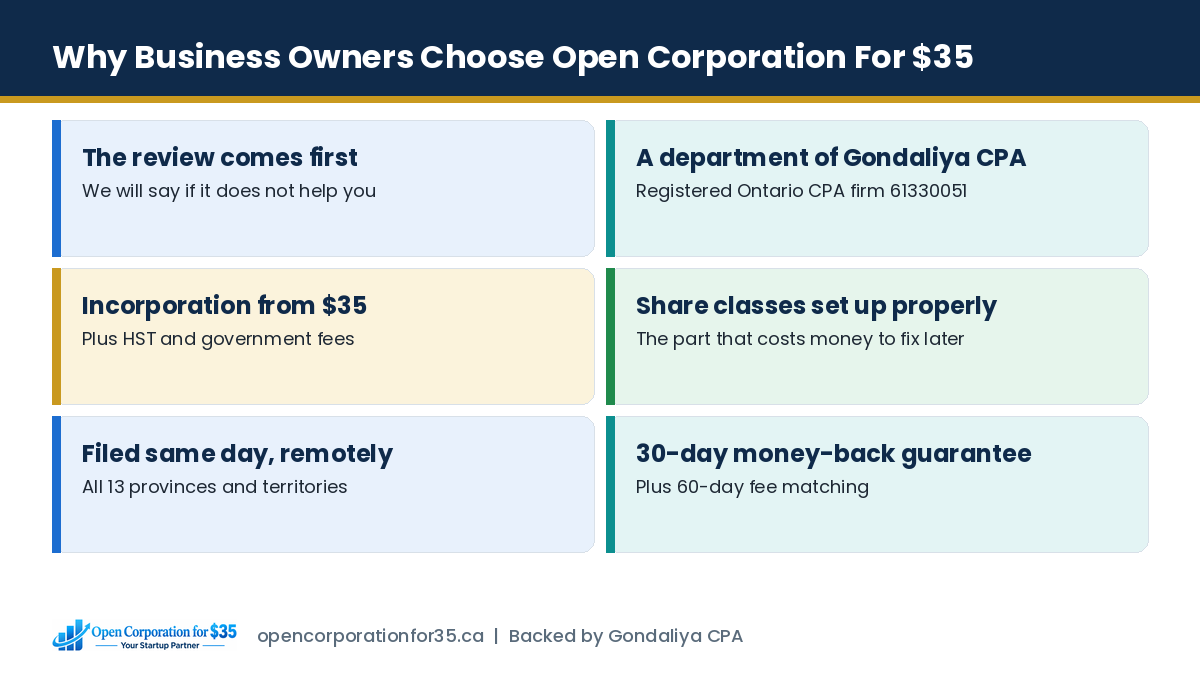
The review comes first, the filing comes second
Incorporation from $35 plus HST and government fees, with a free CPA consultation before anything is filed. Please book a free consultation.
What to Send Us
Send us your expected profit, how much you need to draw personally, who will hold shares, where each director lives, and whether you serve one main client. That is enough for us to run the review and tell you whether to file.
Published: September 30, 2026 · Last updated: September 30, 2026
Editorial policy: Our content is prepared by our team and reviewed by Sharad Gondaliya, CPA, and we update it as government fees, tax rates, director residency rules and CRA thresholds change.
Disclaimer: This article is educational information only and is not tax, legal, or financial advice. A real pre-incorporation review depends on your own circumstances. Please consult a CPA before acting.
Open Corporation for $35 is a department of Gondaliya CPA.
Operated by Gondaliya CPA Professional Corporation, CPA Ontario firm registration 61330051. Xero Partner Award Winner 2026. 1300+ five-star Google reviews. 30-day money-back guarantee and 60-day fee-matching policy. Phone 647-212-9559, email info@opencorporationfor35.ca, open 9:00 AM to 8:30 PM Monday to Sunday. Payment by Interac e-Transfer to info@gondaliyacpa.ca only, security question “Not Applicable” as auto-deposit is enabled. Card is also accepted.