
How to File Corporate Taxes in Canada as a Non-Resident Company
Corporate tax filing Canada non resident requires understanding income tax information relevant to non-resident corporations and the residency of a corporation. Open Corporation for $35 offers a fast and reliable way to complete your Canada T2 filing, ensuring compliance with corporate tax rules for foreign companies.
Quick Summary
A non-resident corporation that carries on business in Canada files a T2 return every year, within six months of its fiscal year end, whether or not it owes tax. What decides the outcome is where central management and control actually sits, because that determines residency and everything that follows from it. Please note the payment deadline is shorter than the filing deadline, which is what catches most foreign companies out.
| Aspect | Details |
|---|---|
| The return | T2 Corporation Income Tax Return, plus the schedules that fit your activity. |
| The deadline | Six months after fiscal year end to file; two months to pay any balance owing. |
| The rates | 15% federal, plus provincial tax wherever you operate. |
| The risk | 5% of unpaid tax, then a further 1% each month for up to ten months. |
Reading time: 24 minutes.
Table of Contents
- Overview and Key Facts
- Eligibility, Requirements, and Incorporation
- Tax Rules, Deadlines, Penalties, and Provincial Differences
- Costs, Common Mistakes, Benefits, and Support Resources
- Summary of Key Points on Corporate Tax Filing for Non-Residents in Canada
- Confirm With Government Authority Regarding Approval, Fees & Other Matters
- Professional Guidance and Quick Reference
The Numbers That Matter
This article covers Canada, with Ontario and Toronto context, and assumes a non-resident corporation earning income or carrying on business in Canada. Rates, thresholds, fees and deadlines are set by the CRA and the provinces, and they change. This is educational information only and not tax, legal, or financial advice. Please confirm your own position with a CPA before acting.
Overview and Key Facts
Overview and Key Facts
The Basics
FAQ Overview Table
| Question | Answer |
|---|---|
| What is corporate tax filing for non-residents in Canada? | It means foreign companies must file taxes on income they earn inside Canada. |
| How do I file corporate taxes as a foreign company in Canada? | Foreign companies fill out a T2 return, showing their Canadian income and expenses. |
| What is a non-resident corporation tax return in Canada? | It’s the tax return that non-resident corporations submit if they earn money in Canada. |
| What does T2 filing for non-resident companies entail? | Non-residents use Form T2 to report earnings, deductions, and calculate taxes owed to the CRA. |
| Are there specific CRA filing rules for non-residents? | Yes, these rules tell non-residents how and when to submit their Canadian tax returns. |
Key Facts About Corporate Tax Filing for Non-Resident Corporations in Canada
Filing corporate taxes as a non-resident corporation has some key points:
- Non-Resident Tax Rules: Non-resident corporations pay taxes only on income made inside Canada.
- Foreign Corporation Tax Filing: These companies use the T2 return to report all taxable activities done in Canada.
- Withholding Tax Obligations: Some Canadian income like dividends or royalties may have withholding taxes for non-residents.
- Late Filing Penalties: The CRA charges penalties if you miss your T2 filing deadline. Avoid delays to stay clear.
- Inactive Corporation Filing Requirements: Even if a company does nothing in a year, it might still need to file documents showing it’s inactive.
Residency of a Corporation and Its Impact on Tax Obligations
Knowing how residency works matters for taxes:
- Deemed Resident vs Deemed Non-Resident: A corporation can be “deemed resident” if it meets rules about where management controls happen.
- Residency Determination Factors: Where key decisions are made counts more than just the physical location of the company.
- Central Management and Control Consideration: If decisions come mostly from outside Canada, the company might be deemed non-resident, changing tax duties.
Getting these basics right helps businesses follow Canadian tax rules better. It also helps with planning money matters within CRA’s framework.
Key Stat: Residency is decided by where central management and control actually sits, not by where the company was registered. A corporation incorporated abroad but run from Canada can end up taxed on its worldwide income rather than only its Canadian income.
Owners assume incorporating in Canada makes them resident, or that incorporating abroad keeps them non-resident. Neither holds. Where the board actually meets and decides is what the CRA looks at.
Eligibility, Requirements, and Incorporation
Eligibility, Requirements, and Incorporation
Setup
Who Can Incorporate a Company in Canada as a Non-Resident
Non-residents can set up companies in Canada without needing to live there. You don’t have to be physically present or hold permanent residency. This makes it easier for foreign investors and businesses to join the Canadian market from afar.
Here’s what you should know:
- Legal Incorporation Jurisdiction: You can pick federal incorporation under the Canada Business Corporations Act (CBCA) or choose provincial incorporation based on where you want to do business.
- Remote Setup: The entire incorporation process can be done online or with the help of agents. This keeps costs down and avoids travel.
- Corporate Tax Filing Canada Non Resident: It’s important to understand your tax duties as a non-resident, especially regarding corporate tax filing.
By choosing this route, foreign companies get access to Canada’s stable market while handling their compliance remotely.
Ownership Rules for Foreign Companies in Canada
Owning a Canadian company as a foreigner comes with some rules. These are made to keep things clear and legal.
Consider these points:
- Nominee Directors Canada: Some provinces ask that at least one director lives in Canada. Nominee directors might fill this spot if rules allow.
- Nominee Shareholder Regulations: Using nominee shareholders is okay but must follow CRA rules about disclosure.
- Non Resident Corporation Tax Return Canada: Every foreign-owned company must file taxes properly, no matter the ownership setup.
Knowing these rules helps you avoid legal troubles and keeps your company running smoothly.
Incorporation Process for Non-Residents
The steps to incorporate as a non-resident look much like those for locals but with some extra paperwork.
Here’s what you’ll do:
- Pick Jurisdiction: Federal vs Provincial Incorporation Canada
– Federal incorporation protects your company name across all provinces.
– Provincial incorporation limits you mostly to one province, which could suit small local businesses better. - Register Business Number with CRA
– Getting a Business Number (BN) is necessary for tax filings like T2 returns. - Prepare Articles of Continuance
– If you’re moving your corporation or changing status, this document confirms it legally. - Submit Forms Remotely
– You can file all papers online or through an agent—no need to be in Canada physically.
This method lets you create a company that meets Canadian laws and readies you for tax filing later on.
T2 Corporation Income Tax Return – Filing Requirements for Non-Resident Corporations
All companies doing business in Canada must file a T2 Corporation Income Tax Return every year. Non-resident firms have these specifics:
- File within six months after your fiscal year ends.
- Even if your company made no profit, filing is usually required unless an exemption applies.
- Late filings bring penalties plus interest charged by CRA.
You report all income earned inside Canada here. This also helps if you want to follow cross-border tax treaties and keep good standing with banks or government contracts.
Required Documents for T2 Filing and Business Registration
| Document | Purpose |
|---|---|
| CRA BN Tax Account | Your official ID number from registration |
| Certificate of Incorporation | Proof your company legally exists |
| Completed T2 Form | Main tax return form |
| Relevant Schedules | Detailed financial info based on activities |
| Information Circulars | Guides provided by CRA |
| Supporting Financial Statements | Audited reports backing up your figures |
Make sure all forms attach properly to avoid delays during CRA review.
Remote Setup Options for Non-Resident Corporations
Canada makes setting up companies remotely easy, especially for those outside the country. This suits people who want:
- A cost-effective setup with no travel costs
- Quick online submissions through secure portals
- Help from experts familiar with cross-border incorporation rules
Such remote setups let international entrepreneurs enter Canada’s market without fuss while staying legal and compliant—covering everything from formation right through corporate tax filing Canada foreign company requirements.
Disclaimer: This text offers general info only. Always check official Canadian government sources before starting incorporation or tax filings as a non-resident. No guarantees exist about approval times, fees, banking, or taxes tied to forming companies here.
The director residency point is the one worth checking against current law for your chosen province, because the rules have changed in recent years and older guidance still circulates widely online.
Tax Rules, Deadlines, Penalties, and Provincial Differences
Tax Rules, Deadlines, Penalties, and Provincial Differences
Rules & Deadlines
Non-Resident Tax Rules Under the Income Tax Act and Common Law Principles
Non-resident corporations earning money or doing business in Canada must follow certain tax rules under the Income Tax Act. Usually, a foreign company must file a corporate income tax return (T2) if it does business or has taxable income from Canadian sources.
Here’s what you need to know:
- Non-resident companies have to file a T2 return showing their Canadian income even if they don’t have a permanent establishment.
- The T2 filing for non-residents must include all relevant Canadian activities and income.
- Foreign corporations pay federal corporate taxes on business done inside Canada. They may also owe provincial taxes where they operate.
- The CRA requires timely filing and payment of taxes by non-residents. Late or missing filings can cause penalties.
- Non-residents do pay tax on profits from business or property located in Canada.
Common law helps clarify when a company is seen as “carrying on business” here. That status means they must fully comply with filing rules including the T2.
For more details, check out CRA’s official info: Canada Revenue Agency – Non Residents.
Federal vs Provincial Corporate Income Tax Differences Table
Knowing how federal and provincial corporate taxes differ helps with planning and filing correctly. Here’s a quick comparison:
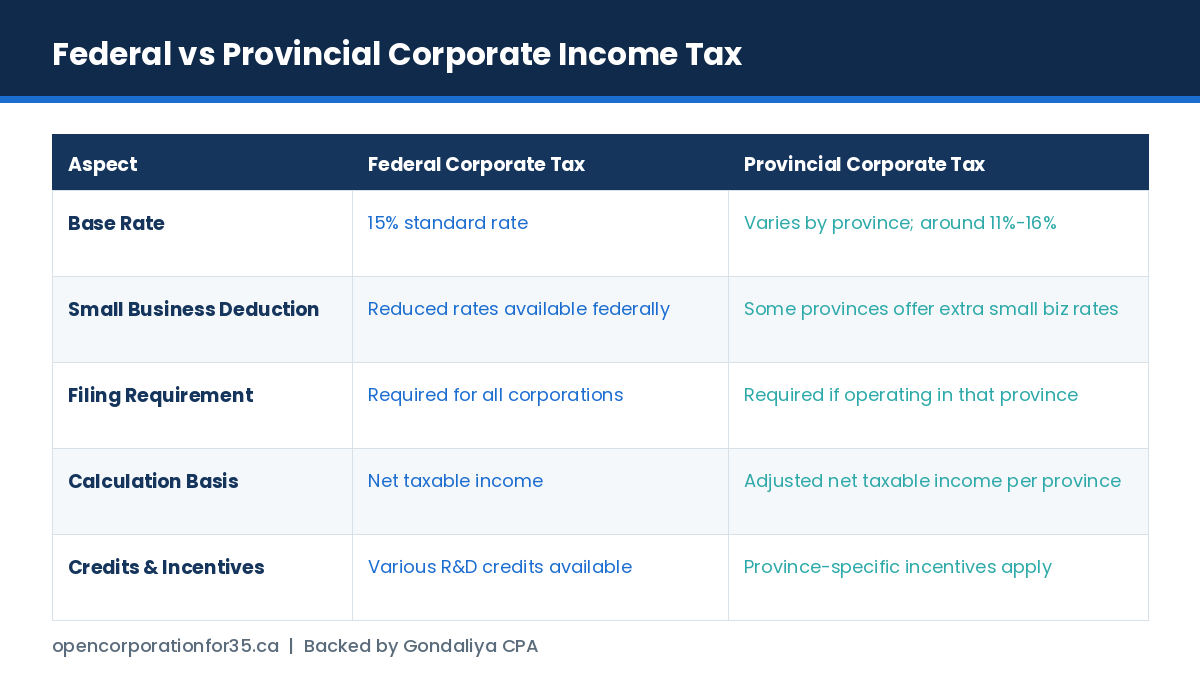
| Aspect | Federal Corporate Tax | Provincial Corporate Tax |
|---|---|---|
| Base Rate | 15% standard rate | Varies by province; around 11%-16% |
| Small Business Deduction | Reduced rates available federally | Some provinces offer extra small biz rates |
| Filing Requirement | Required for all corporations | Required if operating in that province |
| Calculation Basis | Net taxable income | Adjusted net taxable income per province |
| Credits & Incentives | Various R&D credits available | Province-specific incentives apply |
Federal tax applies everywhere but doesn’t replace separate provincial filings when needed. Each province runs its own tax system along with federal rules.
For current rates, visit: Federal and Provincial Rates.
Tax Deadlines for T2 Filing by Non-Resident Companies in Canada
Filing your T2 return on time avoids penalties and extra costs.
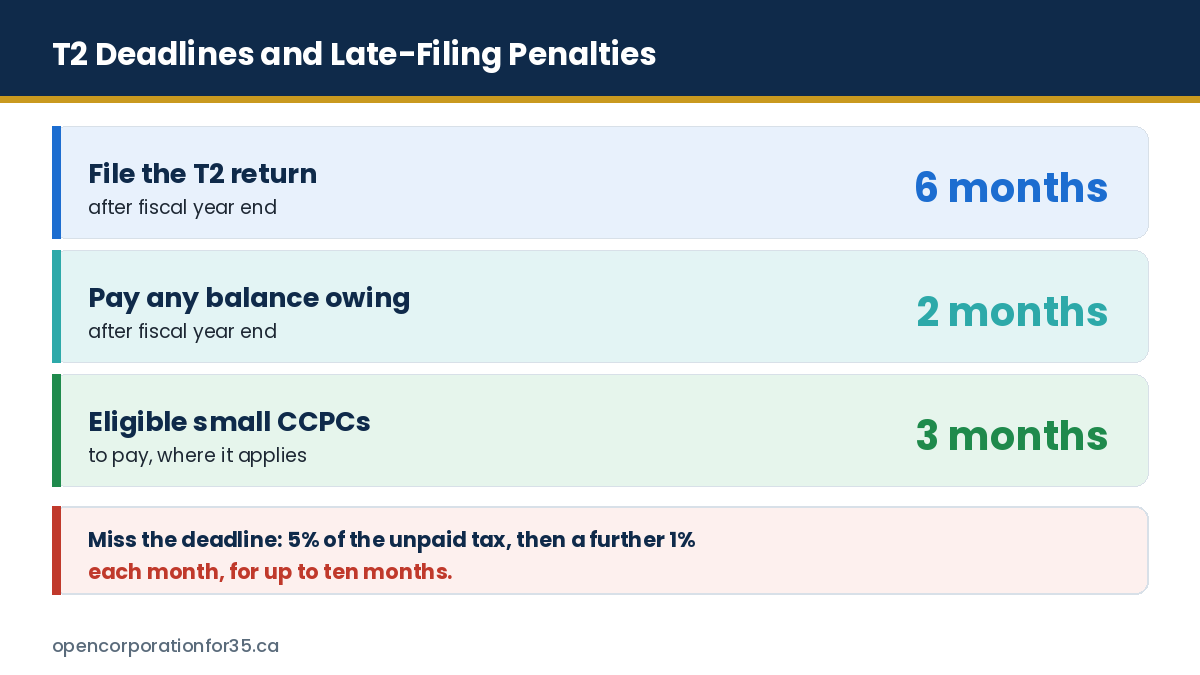
Key deadlines include:
- You must file your T2 within six months after your fiscal year ends.
- Pay any balance owing within two months after fiscal year-end (or three months for eligible small CCPCs).
Missing these dates can lead to late-filing fees plus interest on what you owe.
To file quickly and efficiently:
- Get your financial statements ready soon after year-end.
- Use CRA-approved accounting software for e-filing.
- Consider help from accountants familiar with non-resident returns.
Being ahead makes dealing with cross-border tax rules less stressful.
Late Filing Penalties for T2 Returns by Foreign Corporations
CRA charges penalties if foreign companies file their T2 returns or payments late:
- A penalty of 5% of the unpaid tax applies right after the deadline.
- An extra 1% penalty adds each month up to ten months until you file and pay fully.
These penalties add up fast — filing promptly saves money.
Avoid late penalties by:
- Keeping good records during the fiscal year
- Starting your filing early
- Setting reminders or alerts to meet deadlines
If you can’t file on time due to unexpected issues, contact CRA early. They might give some relief but you’ll need to explain why (CRA Late-Filing Penalty Information).
Risk Warning: The filing deadline and the payment deadline are not the same date. Interest starts running two months after year end even though the return is not due for six, so a company that waits for the filing deadline is already paying interest.
Filing Requirements for Inactive or Dormant Corporations in Canada
Even if a foreign corporation isn’t active in Canada, some minimal filing rules apply:
- Inactive corporations usually submit simplified returns showing no activity but stay legally registered.
- You must keep registration up to date with annual filings unless you dissolve officially.
- Reporting even minimal info prevents losing good standing with CRA or facing administrative dissolution (Inactive Corporation Guidelines).
- Some provinces charge small fees no matter what; check local rules carefully.
Keeping your paperwork straight makes restarting operations later easier while staying compliant now.
Dormant corporations are where the penalty bill quietly builds. Owners stop trading, assume there is nothing to file, and return two or three years later to a stack of nil returns and accumulated late-filing penalties.
Costs, Common Mistakes, Benefits, and Support Resources
Costs, Common Mistakes, Benefits, and Support Resources
Costs
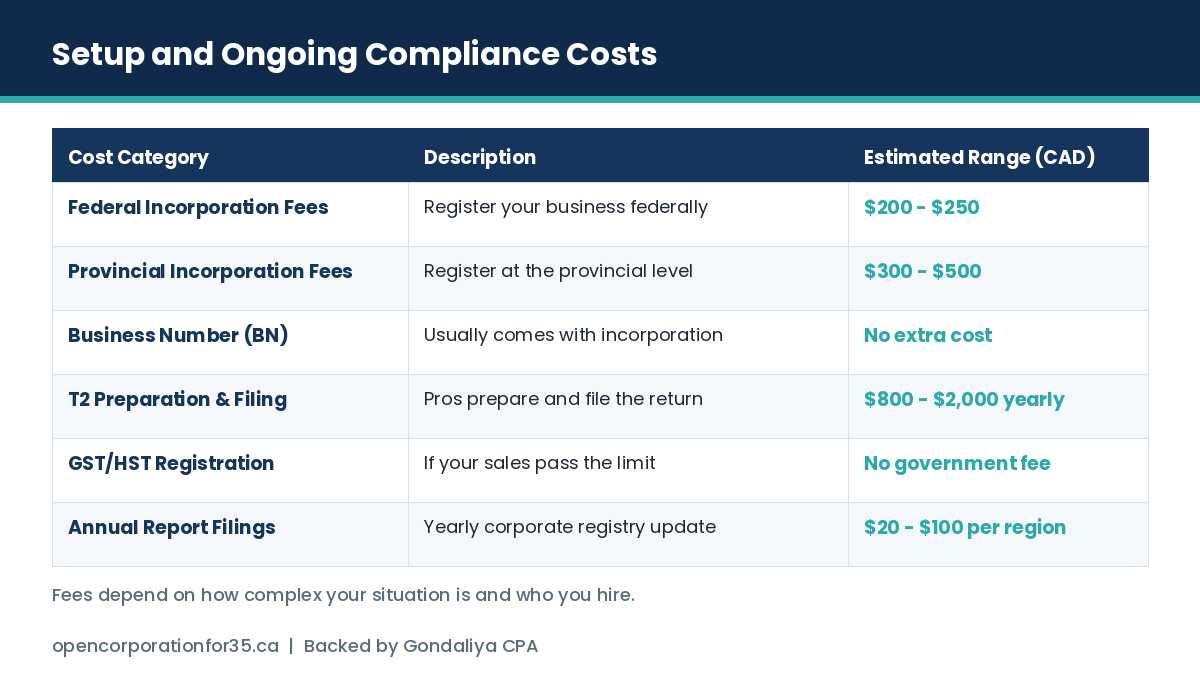
Costs Table: Setup, Annual Filing, and Ongoing Compliance for Non-Resident Corporations in Canada
If you’re a foreign company looking to file corporate taxes in Canada, knowing your costs helps plan better. Here’s a simple breakdown of what you might pay for setting up and keeping your business compliant.
| Cost Category | Description | Estimated Range (CAD) |
|---|---|---|
| Federal Incorporation Fees | Fee to register your business federally | $200 – $250 |
| Provincial Incorporation Fees | Fees if you register at the provincial level | $300 – $500 |
| Business Number (BN) Registration Fee | Usually comes with incorporation | No extra cost |
| Corporate Tax Return Preparation & Filing* | Paying pros to prepare and file T2 returns | $800 – $2,000 yearly |
| GST/HST Registration | Needed if your sales pass a certain limit | No government fee |
| Annual Report Filings | Yearly updates required by corporate registry | $20 – $100 per region |
| Bookkeeping & Accounting | Regular financial record keeping | Varies; monthly fees apply |
*Fees depend on how complex your situation is and who you hire.
You can save money by choosing cost-effective setup options like remote incorporation services. These let you form your company without being in Canada physically. It’s a practical way to start and control expenses.
Common Mistakes When Filing Corporate Taxes as a Foreign Company in Canada
Filing taxes wrong can lead to penalties. Foreign companies need to follow CRA filing rules non resident strictly. Here are some mistakes to watch out for:
| Common Mistake | Explanation |
|---|---|
| Late Filing Penalties Canada T2 | Filing late causes fines starting at 5% plus daily interest. Deadlines matter. |
| Misapplication of Common Law Principles | Wrongly figuring out residency or permanent establishment messes up tax duties or treaty use. |
| CRA Filing Rules Non Resident | Finding forms like Schedule 88 or RC59 can slow things or cause audits. |
| Tax Penalty Fees | Underestimating taxes due leads to interest and penalties stacking up. |
| Failure to Maintain Proper Records | Poor bookkeeping means errors and invites audits. |
Avoid these by following CRA instructions closely. Talk to experts familiar with non resident corporation tax return Canada rules if unsure.
Benefits of Proper Corporate Tax Filing for Non-Residents in Canada
Filing right brings more than just peace of mind:
- You can use Canadian tax treaty benefits that lower withholding taxes on dividends, interest, and royalties.
- You get to maximize deductions, cutting down taxable income from business costs in Canada.
- Staying on time keeps you clear of late-filing fines.
- Being compliant builds trust with banks, investors, and partners — good for growing your business here.
Filing properly means you get all perks tied to being a foreign company doing business in Canada.
Where to Find Information Returns Guides and Technical References from CRA
The CRA offers lots of resources made for non-resident corporations:
- Find CRA forms and publications like the T2 tax package at Canada.ca.
- The Corporate Tax Guides (T4012) explain how to fill returns based on where your company lives.
- Look at Information Circulars for tricky topics like transfer pricing rules for cross-border dealings (Circular IC87–1R6).
Use these official sources often. They help keep your filings accurate without guesswork.
If you want to set up remotely or need help with complex issues—like withholding taxes or inactive companies—getting expert advice pays off. Rules change without warning, so check official sites regularly.
The preparation fee is driven by how tidy the bookkeeping is, not by how large the company is. A clean set of records for a small trading company often costs less to file than a messy one for a dormant one.
File your T2 without the guesswork
Incorporation, CRA Business Number registration, and T2 corporate tax filing for non-resident owners, handled remotely from start to finish. Please book a free consultation.
Summary of Key Points on Corporate Tax Filing for Non-Residents in Canada
Summary of Key Points on Corporate Tax Filing for Non-Residents in Canada
Summary
Filing corporate taxes in Canada as a non-resident company has specific rules. These rules help foreign companies follow Canadian tax laws the right way.
Corporate Tax Filing Requirements:
Non-resident corporations that earn money or do business in Canada must file a corporate tax return (T2) every year. They have to file even if they don’t owe any tax. The CRA says filing the T2 return is a must.
CRA Filing Rules for Non-Residents:
The Canada Revenue Agency (CRA) asks for detailed reports on income from Canadian sources. Foreign companies need to register for a Business Number (BN). They may also need a special CRA BN tax account just for their corporate filings.
Cross-Border Tax Considerations:
Companies working between Canada and the US face extra tax rules. Things like double taxation treaties, withholding taxes, and transfer pricing matter here. Often, Canadian entities must withhold taxes when paying non-residents.
Withholding Tax Obligations:
Canada charges withholding taxes on payments like dividends, interest, and royalties sent to non-residents. These taxes might be lower or waived under treaties. Making sure to send these payments correctly avoids penalties.
Late Filing Penalties:
If companies miss the T2 deadline, they pay penalties that grow over time. Usually, the return is due six months after the fiscal year ends. But payment deadlines can change depending on if the company is resident or not.
Confirming Details with Government Authorities:
Tax rules change often and can be tricky. Non-resident corporations should check all current rules directly with government agencies or get professional advice before filing or making decisions about fees, approvals, banking, or taxes.
Treaty relief is claimed on the return rather than granted automatically. A company entitled to a reduced withholding rate still pays the full rate unless the paperwork is filed to claim it.
Confirm With Government Authority Regarding Approval, Fees & Other Matters
Confirm With Government Authority Regarding Approval, Fees & Other Matters
Confirm First
This guide shares general info about corporate tax filing requirements for non-resident corporations in Canada. Rules around approvals, fees, banking setups, and taxes can vary by situation and change over time.
You should always confirm details with official government authorities, such as the CRA or provincial bodies before you file or commit to anything financially. That way you get the most current info that fits your case without assuming any guarantees about costs or approvals.
Seeking professional help from accountants who know international taxes is wise too—especially with tricky cross-border rules—to keep things legal and cost-effective through remote incorporation services if needed.
What is taxable Canadian property and how does it affect non-resident corporations?+
Taxable Canadian property includes real estate and certain shares. Non-residents disposing of such property must file returns and may owe departure tax.
How can a foreign company claim treaty exemptions on withholding taxes?+
To claim treaty exemptions, file Schedule 91 with your T2 return and provide proof to the CRA. Treaty benefits reduce withholding rates.
What steps are involved in completing and attaching schedules to the T2 return?+
Complete all required schedules, like Schedule 97 or 20, then attach them to your T2 return before submission to the CRA.
How does a non-resident corporation calculate tax payable in Canada?+
Calculate tax using net taxable income, apply federal and provincial rates, then subtract credits and prepayments.
When must a foreign company notify the CRA about changes affecting tax status?+
Notify the CRA promptly of any changes like address, directors, or fiscal year to maintain accurate records.
How does a non-resident company obtain a certificate of compliance in Canada?+
Apply for a certificate through CRA by filing required forms and paying any departure tax owed after disposing of taxable Canadian property.
What payments are subject to withholding under Part XIII taxation rules?+
Dividends, interest, royalties, and management fees paid to non-residents usually require withholding taxes unless exempted by treaties.
What is the process for making payments and paying balances owing for corporate taxes?+
Pay any balance owing by the deadline via CRA online services or bank transfers to avoid interest and penalties.
When must a non-resident corporation register for payroll deductions in Canada?+
Register if hiring employees who work physically in Canada; this covers CPP, EI premiums, and income tax withholdings.
What important notices should foreign companies be aware of from the CRA?+
Important notices include assessments, audits, or requests for additional information related to your corporate filings.
Additional Key Points on Non-Resident Corporate Tax Filing in Canada
Checklist
- Use interpretation bulletins from CRA for detailed guidance on complex tax matters.
- Seek professional advice as no guarantees exist regarding tax treatments or processing times.
- Corporate income tax return Canada requires adherence to both federal vs provincial differences in rates and credits.
- Keep General Index of Financial Information (GIFI) updated for efficient return processing.
- Use Schedule 91 to claim treaty exemptions properly when applicable.
- Declare disposition of taxable Canadian property accurately to avoid penalties.
- Obtain certificate of compliance Canada when ceasing operations or selling assets subject to departure tax rules under Section 219.1.
- Comply with Part XIII withholding obligations; authorized foreign banks may have special rules under Part XIII.1 tax provisions.
- Register your business registration number Canada early to streamline GST/HST remittances and payroll deductions accounts setup if required.
- Understand harmonized sales tax (HST) Canada implications based on provinces where you do business.
- Refer frequently to corporate tax guides Canada issued by CRA for current regulations and filing instructions.
- Maintain international tax compliance Canada by reviewing cross-border taxation rules regularly including OECD Action 7 guidelines where applicable.
- Follow corporation income tax filing process carefully using authorized software certified by CRA when e-filing returns digitally is preferred over paper submission due to accuracy and speed benefits.
- Track all corporate tax deadlines Canada corporations must meet annually including filing dates, payments due dates, and registration renewals for ongoing filing obligations.
- Learn how late filing penalties Canada T2 returns accrue swiftly and how timely filing avoids unnecessary fees plus interest charges on unpaid balances owing.
- Know how to incorporate without PR status by selecting legal incorporation jurisdiction wisely considering federal vs provincial incorporation Canada differences impacting governance requirements like nominee directors Canada rules.
- Manage nominee shareholder regulations carefully ensuring compliance with disclosure requirements as part of non-resident company banking setups essential for smooth operations.
- Utilize CRA digital services efficiently such as corporation internet filing service for streamlined submissions that reduce audit risks.
- Prepare bookkeeping according to Canadian corporate bookkeeping standards adopting best practices minimizing errors during corporate bookkeeping Canada reviews.
- Stay updated on Canadian tax law updates affecting foreign company taxation regularly as they influence corporate tax payment schedules.
- Understand passive investment income Canada’s treatment impacting your small business income threshold eligibility if applicable.
- Organize records well supporting net taxable income calculation aiding quick review process during potential CRA audits or requested information circulars.
The GIFI is where most avoidable delays start. Financial statements that do not map cleanly onto the GIFI codes slow the return down and invite questions that would otherwise never have been asked.
Professional Guidance on Non-Resident Corporate Tax: How Open Corporation For $35 Supports Foreign Companies
Professional Guidance and Quick Reference
Guidance
Non-resident corporate tax turns on two questions asked in order. First, where does central management and control sit, because that settles residency. Second, does the activity in Canada amount to carrying on business, because that settles whether the T2 is required. Everything else follows from those two answers.
Open Corporation For $35, backed by Gondaliya CPA, handles the whole chain in one place, from incorporation and the CRA Business Number through to the T2 and its schedules. That matters because the residency position taken at incorporation shapes every return afterwards.
We work remotely from start to finish, so no travel to Canada is needed at any stage.
Quick Answers: Key Numbers & Concepts at a Glance
At a Glance
- T2 filing deadline: Six months after fiscal year end
- Balance payment deadline: Two months after fiscal year end
- Small CCPC payment deadline: Three months where eligible
- Federal corporate rate: 15% standard
- Provincial corporate rate: Around 11% to 16%, by province
- Late-filing penalty: 5% of unpaid tax, then 1% monthly
- Maximum penalty period: Ten months
- Treaty exemption schedule: Schedule 91
- Federal incorporation fee: $200 to $250
- Provincial incorporation fee: $300 to $500
Who This Is For / Not For
Fit Check
- For: Foreign companies earning income or carrying on business in Canada, non-residents who have incorporated here and now face their first T2, owners of dormant Canadian corporations with unfiled years, and anyone disposing of taxable Canadian property.
- Not For: Companies with no Canadian source income and no Canadian business activity, and individuals rather than corporations, who file a personal return instead.
People Also Ask
Quick Answers
Do I file a T2 if my Canadian company made no money?+
Generally yes. The return is required whether or not there is tax to pay, and the late-filing penalty applies to a nil return as well.
Does a treaty mean I owe nothing in Canada?+
A treaty may reduce or remove tax on certain income, but the return still has to be filed and the relief claimed on it. Relief is not automatic.
Can I do all of this without coming to Canada?+
Yes. Incorporation, the Business Number and the T2 can all be handled remotely. No travel is required at any stage.
Glossary of Key Terms
Plain-English Definitions
- T2: The corporate income tax return every Canadian corporation files each year.
- Non-resident corporation: A corporation whose central management and control sits outside Canada.
- Permanent establishment: A fixed place of business that gives Canada the right to tax profits.
- Carrying on business: The activity test that triggers the filing obligation.
- Taxable Canadian property: Canadian real estate and certain shares, taxed on disposal.
- Certificate of compliance: CRA clearance obtained after disposing of taxable Canadian property.
- Part XIII tax: Withholding tax on dividends, interest, royalties and management fees paid abroad.
- Schedule 91: The schedule used to claim treaty exemptions on the T2.
- GIFI: The General Index of Financial Information, the standard coding for financial statements.
- Articles of Continuance: The document confirming a corporation moving jurisdiction or changing status.
Settle residency before anything else, diarise the two-month payment date rather than the six-month filing date, file even when the company is dormant, and claim treaty relief on the return rather than assuming it. Those four decide whether the year is routine or expensive.
Non-Resident T2 Readiness Check
This quick self-check flags which parts of your filing position need attention. Please answer the six questions below.
Non-Resident T2 Readiness Check
Six quick questions on your filing position. No fee quoted.
Points to review:
This is a general prompt, not tax or legal advice or a quote. Your position depends on your full facts, so for a real review please book a free consultation.
Want a checklist to work from? Please download our free non-resident corporate tax checklist before your consultation.
Get your Canadian T2 filed properly
Incorporation, CRA Business Number registration, GIFI-coded financial statements and the T2 with its schedules, all handled remotely for non-resident owners. Please book a free consultation.
What to Send Us
Send us your fiscal year end, where the directors actually meet, which provinces you operate in, and whether any Canadian property was sold. We will confirm your residency position and your filing and payment dates before anything is submitted.
Published: June 11, 2026 · Last updated: June 11, 2026
Editorial policy: Our content is prepared by our team and reviewed by Sharad Gondaliya, CPA, and we update it as CRA rates, deadlines and filing rules change.
Disclaimer: This article is educational information only and is not tax, legal, or financial advice. Rates, fees and deadlines change, and outcomes depend on your specific facts. Please consult a CPA before acting.