
Open a Corporation in Canada from India: Complete Guide for Indian Entrepreneurs
Starting an open corporation Canada from India involves understanding CRA business number setup, non-resident Canada tax rules, and compliance requirements for Indian citizens. By following the incorporation process Canada India offers, Indian residents can benefit from clear ownership rules, federal vs provincial incorporation options, and efficient business address requirements.
Quick Summary
An Indian resident can own and run a Canadian corporation without relocating and without permanent residency. What shapes the setup is the jurisdiction you file in, whether anyone on the board lives in Canada, and getting the CRA Business Number opened in the right order. Please note incorporation is separate from any visa or immigration route.
| Aspect | Details |
|---|---|
| The filing | Name search, articles of incorporation, then a CRA Business Number. |
| The board | Federal rules require 25% resident Canadian directors. Some provinces have no rule. |
| The address | A registered business address inside Canada, arranged before you file. |
| The ongoing work | Annual returns, T2 every year, and GST/HST once you pass the threshold. |
Reading time: 28 minutes.
Table of Contents
- Understanding Incorporation in Canada for Indian Residents
- Step-by-Step Process to Incorporate a Company in Canada from India
- Registering for Business Number (BN) with Canada Revenue Agency (CRA)
- Managing Non‑Resident Ownership and Directorship
- Financial Considerations and Cost Structure
- Tax Obligations for Non-Resident Corporations
- Banking Solutions for Indian Residents Operating Canadian Companies
- Navigating Canada Revenue Agency (CRA) Requirements
- Understanding Non-Resident Tax Rules and Withholding Taxes
- Maintaining Corporate Compliance with CRA Regulations
- Advantages and Challenges of Incorporating in Canada from India
- Additional Practical Guidance for Indian Entrepreneurs
- Next Steps: Starting Your Canadian Corporation Registration Process
- Frequently Asked Questions
- Professional Guidance and Quick Reference
The Numbers That Matter
This article covers Canada, with Ontario and Toronto context, and assumes an Indian resident who wants to own a Canadian corporation without relocating. Government fees, thresholds and residency rules are set by the registries and by the CRA, and they change. This is educational information only and not tax, legal, or financial advice. Please confirm your own position with a CPA before acting.
Understanding Incorporation in Canada for Indian Residents
Understanding Incorporation in Canada for Indian Residents
The Basics
Opening a corporation in Canada from India is quite doable for Indian residents. You can start a company as a non-resident and follow Canadian business laws for foreigners. It’s good to know about foreign ownership rules Canada and how Canadian corporate governance for non-residents works. These help you avoid trouble later.
Overview of Business Incorporation in Canada
If you want to incorporate in Canada as an India owner, you need to pick between federal vs provincial incorporation Canada. Federal means your company works all over the country. Provincial limits you to one province only. To form your company, you have to follow some steps: choose your legal entity, register your company name, file papers with the government, and get licenses if needed.
Types of Business Structures Available to Indian Citizens
Indian citizens have some choices when it comes to business entity types Canada offers:
- Sole proprietorship Canada: One person owns the whole thing.
- Partnership in Canada: Two or more people share the business.
- Corporation: This creates a separate legal entity. It keeps personal stuff safe if the business has problems.
Each type affects your taxes, liabilities, and rules you must follow.
Key Differences Between Federal and Provincial Incorporation
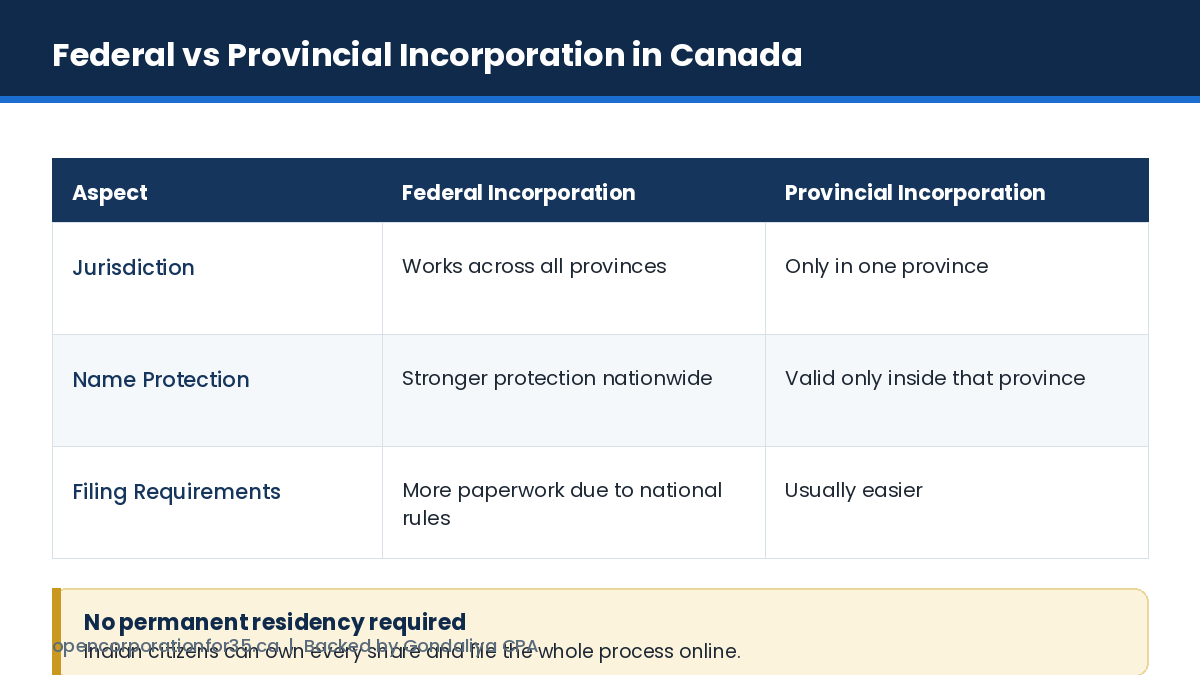
| Aspect | Federal Incorporation | Provincial Incorporation |
|---|---|---|
| Jurisdiction | Works across all provinces | Only in one province |
| Name Protection | Stronger protection nationwide | Valid only inside that province |
| Filing Requirements | More paperwork due to national rules | Usually easier |
Think about what fits your plan before choosing.
Eligibility Criteria for Indian Citizens to Incorporate in Canada
If you are an Indian citizen opening business in Canada, you must meet some rules. Usually, one director needs to live in Canada. If you don’t live there, a nominee director Canada rules might help. You’ll also need ID and must follow Canadian legal rules for foreigners starting businesses.
Planning Your Business Incorporation from India
Setting up your Canada company from India takes planning. You need to handle paperwork remotely and prepare for doing business in another country’s market.
Choosing the Right Business Structure and Province
Planning 1
Pick a business structure that fits how you want to work. Also, choose the province carefully since each has its own rules and maybe benefits for startups.
Naming Your Canadian Company: Rules and Availability Checks
Planning 2
Canadian business naming conventions demand unique names. Before registering, check name availability with canadian business name search tools. Reserve your name early if possible to protect it against others using it later.
Understanding Compliance Obligations and Legal Requirements
Planning 3
Corporate compliance Canada means doing yearly filings and keeping records according to canadian legal requirements for businesses. Non-resident companies especially should keep up with ongoing compliance so they don’t face fines or other issues.
Importance of a Registered Business Address in Canada
Planning 4
Every Canadian company needs a registered business address canada law requires this for official mail and legal purposes. If you’re remote, consider using a registered agent service that provides an address without needing physical office space yourself. This makes setup easier from abroad!
Indian founders arrive with the structure already decided and the jurisdiction still open. It is worth doing it the other way round, because where your first customers sit decides the province, and the province decides the director question.
Key Stat: There is no restriction on foreign ownership of a Canadian corporation. An Indian citizen can hold every share. The rule people mistake for an ownership limit is the director residency requirement, and it applies to the board rather than the shareholders.
Step-by-Step Process to Incorporate a Company in Canada from India
Step-by-Step Process to Incorporate a Company in Canada from India
The Steps
Starting a company in Canada from India is pretty simple. You can do it all online without moving or having permanent residency. Indian citizens who want to open corporation Canada from India need to pick between federal vs provincial incorporation Canada. Each option has its own perks.
Here’s the usual company formation steps Canada:
- Pick federal or provincial incorporation. Federal covers all provinces; provincial sticks to one.
- Check your business name for availability.
- Get your incorporation documents ready and file them online.
- Wait to get your Certificate of Incorporation.
- Register for a CRA Business Number (BN).
- Set up tax accounts for GST/HST and other taxes.
Keep in mind non resident Canada tax rules. Knowing them early helps you avoid trouble.
Preparing Required Documentation for Canadian Incorporation
CRA incorporation requirements Canada ask for certain documents when you’re incorporating as an Indian citizen or foreign owner:
- Filled Articles of Incorporation form
- NUANS report (for federal) showing your business name is unique
- Passport copies of directors and shareholders
- Registered office address in your province or federally
- Signed consent forms from directors
- Proof of payment for filing fees
Having these ready speeds up the remote setup.
Name Reservation and Company Registration Application
Before registering, you must do a business name search Canada. This checks if someone else uses your name.
Steps are:
- Run a NUANS search federally or use the provincial database.
- Reserve the approved company name if your province needs it.
- Send your registration app with the reserved name details and other papers.
This makes sure you can legally use your company name across Canada.
Receiving Certificate of Incorporation
After your application clears, you get the Certificate of Incorporation. This proves your company is real under Canadian law.
It shows:
- Your company’s official name
- Date you incorporated
- Whether it’s federal or provincial
Keep this certificate safe. Banks, permits, and regulators will ask for it.
Bringing one name to a first call is the most common cause of delay. Bringing three removes it, because a rejected name no longer holds up the whole filing while a second search is run.
Registering for Business Number (BN) with Canada Revenue Agency (CRA)
Registering for Business Number (BN) with Canada Revenue Agency (CRA)
Business Number
Once incorporated, you must get a CRA business number foreign owner status needs proper registration.
Here’s what BN does:
- Acts as ID across federal tax programs like GST/HST and payroll
- Foreign owners need to give clear info on ownership during application
- You can register online or by mail using Form RC1
A BN lets you handle non resident Canada tax rules right while doing business between India and Canada.
Setting Up Corporate Tax Accounts: GST/HST and Other Taxes
Foreign-owned Canadian companies must register under tax programs like GST HST Canada foreign-owned firms follow special rules depending on sales locations in provinces that have HST versus those charging just GST.
Keep in mind:
- Check if goods or services you sell are taxable under GST/HST laws
- Filing frequency depends on yearly revenue set by CRA
- Corporate tax obligations canada include federal income taxes plus possible provincial taxes
Registering early avoids penalties and keeps finances smooth after incorporation.
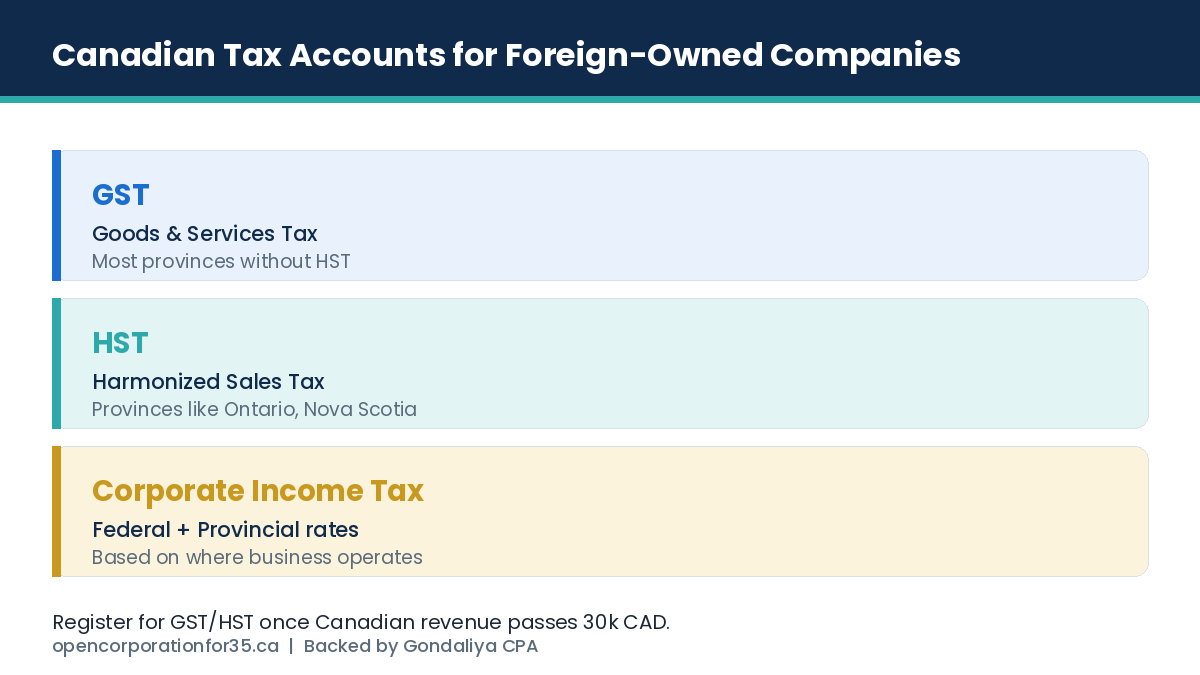
| Tax Account Type | Description | Applies To |
|---|---|---|
| GST | Goods & Services Tax | Most provinces without HST |
| HST | Harmonized Sales Tax | Provinces like Ontario, Nova Scotia |
| Corporate Income Tax | Federal + Provincial rates | Based on where business operates |
The Business Number does not arrive with the certificate. It is a separate application to a separate authority, and owners who assume otherwise usually discover the gap when the bank asks for it.
Managing Non‑Resident Ownership and Directorship
Managing Non‑Resident Ownership and Directorship
Ownership
Canada allows non-residents to invest but has some rules about directors and ownership:
- Directors don’t have to be Canadian residents federally; some provinces may differ
- Many use nominee director service if no local director is present
- Foreign ownership rules canada companies let foreigners control fully but need transparency
- Keeping good records helps stay compliant
Knowing this helps Indian entrepreneurs incorporate canada indian citizen without showing up physically.
Nominee Director Services and Resident Director Requirements
Some provinces want at least one resident director; others don’t — this changes how nominee director services work:
- Nominee directors represent officially while owners keep control overseas
- Service providers help meet nominee director requirements so filings stay correct
- Not all places require resident directors; check before picking federal vs provincial incorporation canada
Nominee services make remote setup easier when opening corporation canada from india remotely.
Ownership Rules for Foreign Entrepreneurs Including Indian Citizens
Foreigners including Indian citizens can own companies here but must follow normal rules:
- You don’t need citizenship to own shares fully
- Some industries limit foreign involvement due to security
- Anti-money laundering laws apply
Indian nationals have clear options to start business canada with proper structure tailored to their needs.
Remote Incorporation Options and No Permanent Residency Requirement
One big plus: you can finish open business canada from india process online without visiting or having PR status:
Benefits:
- Online portals make submissions quick
- Digital signatures accepted—no paper needed
- No permanent residency needed—anyone worldwide can join
- Nominee services help manage local governance keeping laws followed
Remote registration helps Indians expand into Canada’s economy without stress.
Disclaimer: Always check with official government sources before starting since rules might change about approvals, fees, banking, or taxes for non-resident corporations in Canada.
A nominee director is a real director with real statutory duties, not a name on a form. Founders who treat the arrangement casually are the ones renegotiating it later under pressure.
Financial Considerations and Cost Structure
Financial Considerations and Cost Structure
Costs
If you want to open corporation Canada from India, you need to know the money part first. Setting up a Canada company setup from India costs more than just the fees to start it. Startup business Canada from India needs a budget for government fees, taxes, and keeping up with rules.
Canadian business startup costs change if you pick federal or provincial incorporation. Usually, government filing fees run from CAD 200 to CAD 400. You might also pay for name search reports, legal help if needed, and a registered office address in Canada.
Taxes and compliance take a big chunk of your budget too. Even if you work from India, non-resident corporations must follow Canadian tax laws. This means filing corporate income taxes and registering for GST/HST if required.
Planning your money well stops surprises during the setup or later when running your Canadian company.
Detailed Breakdown of Incorporation Costs in Canada
When you incorporate in Canada, Indian residents should know these government fees:
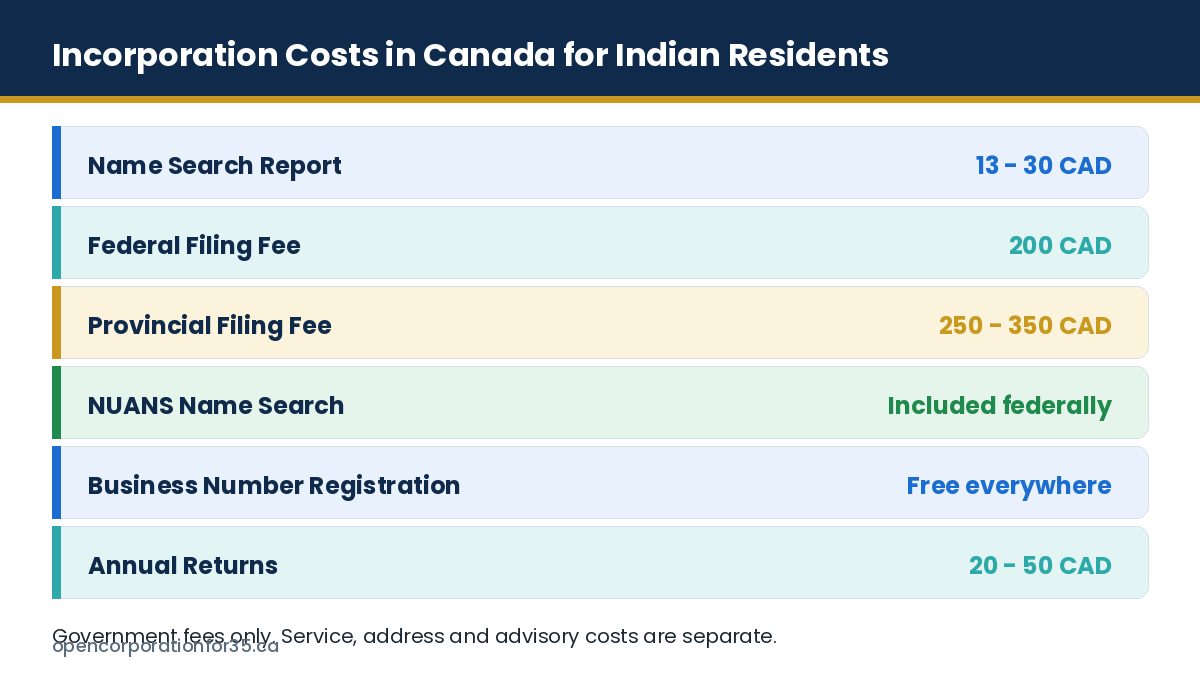
- Name Search Report: 13 – 30 CAD (federal), varies by province
- Federal Filing Fee: 200 CAD
- Provincial Filing Fee: around 250 to 350 CAD depending on province
- NUANS Name Search: Included federally, separate fee in some provinces
- Business Number Registration: Free everywhere
You also pay business renewal fees each year to keep your corporation active. These usually cost between 20 and 50 CAD federally but may change by province.
Other corporate filings like annual returns or director updates come with small government fees. Expect about 20 to 100 CAD depending on where you register.
Ongoing Compliance and Filing Costs
All Canadian companies must follow corporate governance rules. This is true for Indian citizens starting business Canada from India too.
Here are key ongoing costs:
- Annual Returns: You file these yearly; cost is roughly 20–50 CAD.
- Inactive Corporation Filings: If your company doesn’t do business but stays registered, minimal filings might still be needed at lower rates.
- Compliance Calendar Management: Tracking deadlines for T2 returns, GST/HST payments, and payroll helps avoid fines.
Missing deadlines can cause fines that raise your running costs big time.
Founders budget the setup and forget the recurring line. The address service and the annual filings shape the yearly cost far more than the one-off fee, and both are easier to absorb when quoted at the start.
Incorporate in Canada without leaving India
Same-day federal or provincial incorporation, instant NUANS name search, a registered office address that meets registry rules, and CRA account setup, all backed by a CPA firm. Please book a free consultation.
Tax Obligations for Non-Resident Corporations
Tax Obligations for Non-Resident Corporations
Corporate Tax
Non resident Canada tax rules say foreign-owned companies must meet certain requirements even without physical presence here.
If a foreign company does taxable activities, it must register for a CRA Business Number. It also pays corporate income tax on money made in Canada under domestic laws and tax treaties between India and Canada that stop double taxation.
Canadian tax compliance means keeping clear records. You have to separate Indian operations from Canadian income clearly.
Corporate Tax Rates and Filing Requirements Including T2 Returns
Non-resident corporations pay the same federal corporate tax rate as others—about 15%. Provinces add their own rates from around 8% to 16%. So combined rates often sit near the mid-twenties percent range based on where you set up.
All incorporated firms file a T2 Corporate Income Tax Return yearly with the CRA. This applies no matter profit or residency status. The return is due six months after fiscal year-end; payment follows two months later unless an extension applies.
The detail that catches Indian owners out is that the payment deadline sits earlier than the filing deadline. Filing on time and paying late still attracts interest, so both dates belong in the calendar.
Banking Solutions for Indian Residents Operating Canadian Companies
Banking Solutions for Indian Residents Operating Canadian Companies
Banking
Opening a bank account in Canada as a non-resident can be tricky but is necessary for smooth operations when starting business canada from india remotely.
Big banks offer services made for foreign owners with online applications needing:
- ID proof
- Company papers like Articles of Incorporation
- CRA Business Number proof
Sometimes banks want you to visit personally but some allow full remote setup by video call.
Picking good banking solutions helps manage currency exchange, payments inside and outside Canada, and makes GST/HST payments easier.
Disclaimer: Always check official sources before acting since rules about incorporation fees, taxes, and banking can change anytime. No promises about approval times or exact fees here.
Banking, not incorporation, is the long pole for owners abroad. The certificate can be issued in days while the account takes weeks, so the bank conversation should start the moment the certificate lands.
Navigating Canada Revenue Agency (CRA) Requirements
Navigating Canada Revenue Agency (CRA) Requirements
CRA
If you want to open a corporation in Canada from India, you gotta know the Canada Revenue Agency (CRA) rules. The CRA handles tax collection and business registration for all companies in Canada, even those owned by folks living abroad. Foreign owners need to register their businesses with the CRA and get a Business Number (BN). This number is like an ID for tax accounts — corporate income tax, GST/HST, payroll deductions, import/export duties, and more.
Foreign-owned companies have specific incorporation requirements from the CRA. They must give clear info about who owns the company and what it does during registration. Skipping this or messing up can cause fines or slow things down. Also, non-residents don’t need permanent residency to set up a company here, but they still must follow these federal rules.
Registering with the CRA means your company plays by Canadian tax laws from day one. You have to file yearly returns and keep records that meet Canadian standards. Check official sources often because rules change sometimes.
- Foreign owners must register with CRA.
- Obtain a Business Number (BN) for tax accounts.
- Provide clear ownership details when incorporating.
- File annual returns and keep records.
- Rules can change — verify regularly.
CRA Business Number Setup for Foreign-Owned Entities
Getting a CRA Business Number (BN) is a big step if you’re an Indian resident starting a business in Canada. This 9-digit number identifies your company in Canada’s tax system. Foreign owners need this BN before doing any taxable business.
You apply by filling out Form RC1 online or sending it by mail. When you fill this form as an Indian citizen starting a company in Canada, include details about directors, shareholders, and your business address—even if it’s just a virtual office.
Once you get your BN, it links all your tax accounts under one ID:
- Corporate income tax
- GST/HST
- Payroll deductions (if hiring)
- Import-export accounts (if needed)
Having one number makes dealing with the CRA easier for payments or audits and keeps everything organized.
Steps to get BN:
| Step | Description |
|---|---|
| Submit Form RC1 | Apply online or mail with owner & company info |
| Receive 9-digit BN | Unique ID linking all related tax accounts |
| Register Tax Accounts | Corporate Income Tax / GST-HST / Payroll etc |
Tax Registration Procedures for GST/HST and Other Accounts
If you plan to sell goods or services in Canada from India and expect over $30K CAD yearly revenue where GST/HST applies—you must register for these taxes early.
GST means Goods and Services Tax. It’s a federal sales tax used in most provinces except Quebec. There, they use HST which mixes provincial sales taxes with federal ones depending on location inside Canada.
Foreign companies have different rules about GST/HST:
- Non-resident firms may need to file returns.
- You must register once revenue passes CAD 30k.
- Filing depends on how much you make yearly.
You register GST/HST through your BN after incorporation using forms like RC1B that cover foreign registrants’ indirect taxes. Each province might have slightly different rules so watch out for those details.
Knowing this helps you avoid surprise bills later — especially when working cross-border between India and Canada where tax rules can get tricky.
Remember:
- Register GST/HST after incorporation.
- Watch revenue thresholds ($30k CAD).
- Filing frequency varies by turnover size.
- Provincial rules can differ—check carefully.
Registering voluntarily before the threshold is often the better move for a business with Canadian costs, because input tax credits can be recovered from the first invoice rather than the first breach.
Understanding Non-Resident Tax Rules and Withholding Taxes
Understanding Non-Resident Tax Rules and Withholding Taxes
Withholding
Canada has special tax rules for people or companies outside its borders owning Canadian businesses.
Here’s how it works:
- Companies run from outside Canada but earning money inside pay taxes on that income.
- If you send dividends, interest, or royalties back to foreign owners, withholding taxes apply.
Withholding tax rates usually sit between 15%–25%. But there are treaties like the Indo‑Canada Double Taxation Avoidance Agreement that cut these rates if conditions are met.
To avoid paying taxes twice, file paperwork properly to claim credits both in Canada and abroad.
Corporate income tax rates vary too—federal rate is about 15%, plus extra charges depending on the province where your business is registered. This affects how much you owe overall once deductions apply. Even if your company doesn’t do much some years, filing T2 returns every year is mandatory.
Summary:
- Non-residents taxed on Canadian income.
- Withholding taxes apply on money sent abroad.
- Treaties lower withholding rates if followed.
- Federal + provincial corporate taxes apply.
- File T2 returns yearly even if inactive.
Treaty relief is claimed, not granted automatically. Owners who assume the lower rate applies by default are the ones who find the full rate was withheld at source and now has to be recovered.
Maintaining Corporate Compliance with CRA Regulations
Maintaining Corporate Compliance with CRA Regulations
Compliance
Staying compliant after starting your Canadian company remotely matters a lot. Not following Canadian business compliance rules risks fines or worse—like losing good standing or getting suspended.
Here’s what you need to watch:
- Meet annual filing deadlines without fail.
- Keep books tidy and follow GAAP standards.
- Pay collected taxes like GST/HST on time.
- Maintain a valid registered office address per local laws.
- Be careful if using nominee directors—legal limits exist at both provincial & federal levels.
Ignoring these can cost more than saving by cutting corners overseas. Plus, audits become tougher with messy records or missed filings. It’s smart to check in with experts who know Canadian laws well before and during running your business remotely.
Always verify updates directly through official government websites so no surprises pop up when dealing with CRA stuff later on.
Key compliance tips:
- File on time every year
- Keep accurate records
- Remit collected taxes promptly
- Maintain legal office address
- Use nominee directors cautiously
Disclaimer: Rules change often. Always check latest official sources before acting. We don’t guarantee results or processing times mentioned here.
The corporations that stay in good standing are not the ones with the best records. They are the ones where a named person owns the deadline. Where nobody owns it, it gets missed eventually.
Advantages and Challenges of Incorporating in Canada from India
Advantages and Challenges of Incorporating in Canada from India
Pros & Cons
Starting a company in Canada from India offers many chances for foreign business owners. It lets Indian residents open corporation Canada from India and connect with a steady economy. Cross border India Canada business grows thanks to Canada’s clear legal rules and friendly policies for investors.
Still, there are challenges too. Canadian business compliance risks include tough rules on reports required by federal or provincial laws. Non resident Canada tax rules mean you must know about corporate tax obligations Canada places on foreign companies. This includes filing yearly returns and paying taxes on time. Canadian corporate governance for non-residents means directors often need to live in Canada, unless exceptions apply.
Foreign entrepreneurs have to watch out carefully to follow all rules. Talking with pros who know CRA incorporation requirements Canada can help you manage these rules while enjoying the benefits of setting up remotely without living there permanently.
Benefits of Canadian Incorporation for Indian Entrepreneurs
Indian citizens opening business in Canada get lots of perks beyond just entering a new market. The startup visa Canada program helps immigrant entrepreneurs by offering ways to get permanent residence if they build innovative businesses.
Canada also invites foreign direct investment with trusted regulatory systems that protect ideas and make sure contracts are enforced. This builds trust for Indian investors wanting global market access in a safe environment.
Other benefits include:
- Skilled workers available across provinces.
- Government grants that support new ideas.
- A strong banking system that eases international payments.
These points make starting a company appealing when planning cross-border expansion between India and Canada.
Common Mistakes and How to Avoid Them
Many new incorporators mess up by ignoring rules made for non-resident ownership:
- Skipping nominee director requirements: Some provinces want at least one director to be a Canadian resident; missing this can cause problems.
- Confusing nominee shareholder roles: Using nominees wrong might cause legal trouble or lose control of shares.
- Missing ongoing filing duties: Forgetting deadlines for annual returns or inactive corporation filing canada* can lead to fines or even losing the company.
- Overlooking tax registrations: Not signing up quickly for GST/HST or getting a CRA business number foreign owner status delays work and invites penalties.
Avoid these by checking federal vs provincial incorporation rules first, keeping your paperwork ready per CRA standards, and staying in touch with advisors who know cross-border laws well.
Addressing Risks and Compliance Challenges
Canadian business compliance risks need constant care after you incorporate:
- Ongoing compliance requirements canada* mean submitting financial reports yearly, keeping corporate records updated, renewing licenses as needed, and following local employment laws if hiring people.
- Inactive corporation filing canada* says you must tell authorities if your business stops temporarily but stays registered; ignoring this risks administrative action.
- Corporate governance laws canada* put duties on directors like acting honestly even if shareholders live outside Canada—breaking these can bring lawsuits or government checks.
Being active here lowers risks and shows others you run a responsible business in Canada under its rules.
Opportunities for Cross-Border Business Expansion between India and Canada
Cross-border taxation india canada* agreements help money matters by cutting double taxation through deals like the Comprehensive Economic Partnership Agreement (CEPA). These make trade easier by clarifying tax duties on income earned across countries.
International trade treaties*, including USMCA benefits for canadian companies*, boost export chances especially near U.S.-Canada borders where lower tariffs help compete globally versus places without such deals.
For Indian firms thinking about start business canada from india options, using these treaties along with smart partnerships opens doors not just locally but throughout North America’s connected supply chains — building growth models good for both local ideas and multinational moves at once.
Always check details directly with government offices since rules change often; no promises are made about approvals, fees, banking setups, or exact taxes based on this info alone.
The dormant company is the trap nobody expects. Founders pause a venture and assume the filings pause too, and by the time the registry acts the notice has gone to an address nobody checks.
Additional Practical Guidance for Indian Entrepreneurs
Additional Practical Guidance for Indian Entrepreneurs
Practical
If you want to open a corporation in Canada from India, you need to understand Canadian business compliance. The law says you must register your company with federal or provincial authorities. You also have to file yearly reports on time. Professional consulting in Canada can guide you through government fees, filing deadlines, and corporate governance rules. This helps keep your business running smoothly.
Canadian corporations have rules about shareholder meetings, director duties, and keeping records. Non-resident owners might have to appoint a resident director in some provinces. Knowing these rules helps you avoid penalties. Staying current with requirements keeps your business in good standing.
Incorporation Timelines and Processing Time Expectations
Incorporation timelines in Canada change depending on whether you go federal or provincial. The digital incorporation process has made things faster. Usually, federal online applications take 1 to 5 business days for approval.
Provincial registration may take a bit longer because some places process manually. But generally, it’s done within a week. This seamless incorporation lets Indian entrepreneurs start a business in Canada without traveling there.
Preparing your documents before applying helps avoid delays during approval.
Obtaining Necessary Business Permits and Licences
To start a company in Canada as an India resident, you must get the right permits for your industry and location. Non-residents need Canadian business permits before starting work legally.
You might need municipal trade licenses, health permits for food businesses, professional certificates, or import/export permissions. Each province has its own licensing rules, so check local laws first.
Apply early so you get approvals before opening day and avoid fines for unlicensed operations.
Bookkeeping and Corporate Record Maintenance Requirements
Bookkeeping in Canada requires accurate financial records that show all transactions quickly. Companies must keep a corporate minute book with key papers like articles of incorporation, bylaws, resolutions passed by directors or shareholders, share certificates issued, and registers of directors/shareholders.
Director records prove governance compliance during audits or CRA checks. Good bookkeeping supports correct tax filings like T2 corporate income tax returns due at each fiscal year-end by CRA deadlines.
Keeping records organized makes reporting easier and shows transparency when officials or investors ask.
Accessing Business Support, Financing, and Government Resources
Indian entrepreneurs wanting to incorporate in Canada can get help from the Business Development Bank of Canada (BDC). BDC offers loans designed for immigrant entrepreneurs starting new businesses nationwide.
Provinces also provide small business grants to cover startup costs like equipment or marketing—helpful when running things remotely from India.
Government resources offer free advice on regulations plus networking chances connecting international founders with local experts who know cross-border India-Canada business well.
Minute books are the item most often left until a bank or a buyer asks for one. Building it alongside the incorporation costs almost nothing. Reconstructing it under time pressure costs a great deal more.
Next Steps: Starting Your Canadian Corporation Registration Process
Next Steps: Starting Your Canadian Corporation Registration Process
Get Started
- Pick federal or provincial incorporation based on where you want to do business.
- Search the name to make sure it’s unique per CRA rules.
- Get your documents ready including Articles of Incorporation signed digitally.
- Submit your application with government fees online via official portals made for remote setup.
- Wait for approval confirmation sent electronically in a few days.
This cost-effective way gives operational flexibility with limited liability protection. It shields personal assets abroad while helping you grow globally.
You usually must appoint at least one director who meets residency rules unless the province says otherwise; use digital signatures allowed by Canadian authorities; follow filing deadlines strictly to avoid inactive corporation status.
Getting professional support ensures expert help through complex regulations — helping growth while keeping legal clarity every step of the way.
Set up your presence now using trusted regulatory systems built on transparent economy principles with efficient processes and simple incorporation steps. Clear understanding of operational compliance, eligibility rules, and required documents matters—all are key to long-term success connecting markets internationally.
Disclaimer: Always check directly with official government sources before moving forward.
The founders who move fastest arrive with three names, a decision on the province, and a clear answer on whether anyone on the board lives in Canada. Everything else follows from those three.
Frequently Asked Questions
FAQs:
FAQ
What is the process for obtaining a Canadian business number for foreign owners?+
Foreign owners apply for a Business Number (BN) by submitting Form RC1. The BN links tax accounts like GST/HST and corporate income tax under one ID.
Can Indian entrepreneurs open a Canadian business bank account as non-residents?+
Yes, some Canadian banks offer remote account setup via video calls. You need company documents and proof of identity to open accounts.
What are the key differences between federal vs provincial business incorporation in Canada?+
Federal incorporation allows nationwide operations and name protection. Provincial limits operations and protections to one province with simpler filings.
How do nominee shareholders help Indian citizens in Canada incorporation?+
Nominee shareholders hold shares on behalf of actual owners. This protects privacy and helps meet local ownership requirements.
What are common corporate filings required annually in Canada?+
Annual returns, T2 corporate tax returns, and maintaining updated shareholder and director records are mandatory yearly filings.
How do Canadian trade agreements benefit Indian entrepreneurs?+
Agreements like USMCA reduce tariffs and ease market entry. They create opportunities for cross-border business growth.
What is a Corporate Minute Book, and why is it important?+
A Corporate Minute Book holds essential records such as bylaws, resolutions, share registers, and director minutes. It supports compliance during audits.
Are there risks involved with compliance when starting a business remotely in Canada?+
Yes, missing filing deadlines or incorrect records can lead to fines or suspension. Following compliance rules keeps your business in good standing.
Two questions dominate every Indian enquiry: whether full foreign ownership is allowed, and whether a Canadian director is needed. The answers are yes to ownership, and it depends entirely on the jurisdiction chosen.
Key Points on Remaining Topics for Indian Entrepreneurs Incorporating in Canada
Key Points
- Business Performance Statistics Canada: Track industry trends to optimize your startup’s growth strategy.
- Startup Visa Canada: Explore immigration options linked to starting an innovative business in Canada.
- Self-Employed Immigrant Business: Understand eligibility criteria if planning solo entrepreneurship under immigration programs.
- Business Licensing Canada: Obtain permits based on your industry and location to operate legally.
- Foreign Direct Investment Canada: Benefit from Canada’s investor-friendly policies that support foreign capital inflow.
- Indian Entrepreneur Canada Incorporation: Access tailored consulting services that understand cross-border regulations.
- USMCA Benefits for Canadian Companies: Leverage tariff reductions and enhanced trade access across North America.
- Registered Agent Service: Use a local registered agent to handle legal correspondence and official notices remotely.
- Share Registers & Director Records: Maintain accurate records as proof of ownership and governance compliance.
- Corporate Tax Filing T2: File annual income tax returns regardless of residency status to meet CRA requirements.
- Corporate Search Reports: Use these reports to verify company details before engaging in partnerships or investments.
- Beneficiary Ownership Disclosure: Disclose ultimate owners per Canadian anti-money laundering laws during incorporation.
- Tax Accounts Canada: Register for GST/HST, payroll, and other tax accounts promptly after incorporation.
- Government Registry: Keep updated registrations at federal or provincial registries for good standing status.
- International Education Consulting Canada & Visa Advisory Services Canada: Indian entrepreneurs can explore additional service sectors growing in the Canadian market.
- Technology Services Canada & Professional Consulting Canada: Consider outsourcing tech or advisory services compliant with local laws for efficiency.
- Global Market Access & Financial Institutions Canada: Use trusted financial partners to manage currency exchange and payments internationally.
- Corporate Governance Laws Canada & Shareholder Rights Canada: Follow rules ensuring directors act responsibly while protecting shareholder interests.
- Digital Incorporation Process & Digital Signature Canada Incorporation: Utilize online platforms with digital signatures for faster company setup from India.
- Business Registration Canada Non-Resident & Remote Business Setup Canada: Complete entire registration online without physical presence or permanent residency requirement.
- CRA Tax Number Application & GST and HST Registration Canada: Timely apply for tax IDs and sales tax registrations to comply with revenue laws from day one.
- Non-resident Tax Withholding Canada & Tax Implications for Foreign Corporations in Canada: Understand withholding taxes on dividends sent abroad plus corporate income tax duties within Canada’s borders.
- Nominee Shareholder Canada & Resident Director Requirements: Use nominee services when local resident directors or shareholders are mandatory under provincial rules.
- Incorporation Timelines Canada & Compliance Calendar Canada: Monitor filing deadlines through compliance calendars to avoid penalties during digital incorporation timelines averaging 1–5 days federally.
- Canadian Business Compliance Requirements & Ongoing Compliance Costs: Plan budgets including annual filing fees, bookkeeping expenses, and legal advisory costs critical to maintaining active status in government registries.
Risk Warning: The T2 is due every year whether or not the company traded, and the balance is payable earlier than the return is due. Owners who treat a quiet year as a year off are the ones who find interest running on an amount they did not know was owed.
Professional Guidance on Canada Incorporation from India: How Open Corporation For $35 Supports Indian Entrepreneurs
Professional Guidance and Quick Reference
Guidance
Incorporating from India is a sequencing problem rather than a form problem. The filing itself is quick. Choosing the jurisdiction against your board, arranging a registered office the registry will accept, opening the CRA accounts in the right order, and starting the bank conversation early is the work that decides how long the whole thing takes.
Open Corporation For $35 is backed by Gondaliya CPA, which means your incorporation, your CRA accounts and your tax filings sit with one team rather than three providers who never speak to each other. We run the name search, file the articles, register the Business Number and GST/HST where needed, and send you the certificate and confirmations for your minute book.
The time difference works in your favour. A question sent from India in the evening is answered while it is still morning in Toronto, so most of these files move a full day faster than founders expect.
Quick Answers: Key Numbers & Concepts at a Glance
At a Glance
- Federal filing fee: 200 CAD
- Provincial filing fee: Around 250 to 350 CAD
- Name search report: 13 to 30 CAD federally
- Business Number registration: Free everywhere
- Annual return: Roughly 20 to 50 CAD
- Federal approval: 1 to 5 business days
- GST/HST threshold: Revenue passing CAD 30,000
- Federal corporate tax: About 15%, plus 8% to 16% provincial
- Withholding on payments abroad: Usually 15% to 25%, treaty may reduce
- T2 return: Six months after fiscal year end, payment two months earlier
Who This Is For / Not For
Fit Check
- For: Indian residents who want to own a Canadian corporation without relocating, founders selling into the North American market, owners who need a registered office and CRA accounts arranged for them, and anyone weighing federal against provincial incorporation.
- Not For: Anyone expecting incorporation to grant a work permit or permanent residence, corporations already incorporated in Canada that only need annual filings, and sole traders who do not want a separate legal entity.
People Also Ask
Quick Answers
Can an Indian citizen own 100% of a Canadian corporation?+
Yes. There are no restrictions on foreign ownership of shares. The rules that vary between jurisdictions apply to directors, not to shareholders.
Does incorporating in Canada help with immigration?+
Not by itself. Owning a corporation and obtaining a visa or permanent residence are separate tracks with separate criteria, and one does not create the other.
Do I need a PAN or Indian tax clearance to incorporate in Canada?+
No. The Canadian registry needs identity documents and a Canadian registered office. Your Indian tax position is a separate matter, though it is worth reviewing before profits are repatriated.
Glossary of Key Terms
Plain-English Definitions
- NUANS: The name search report checking your proposed name against existing Canadian names.
- Articles of Incorporation: The document that creates the corporation and sets out its share structure and directors.
- Certificate of Incorporation: Proof that the corporation legally exists, issued once the filing is approved.
- Business Number: The nine-digit CRA identifier that all tax accounts attach to.
- Form RC1: The CRA form used to request a Business Number.
- Registered office: The official Canadian address used for legal service and registry notices.
- Nominee director: A Canadian resident appointed as a formal director without taking ownership.
- T2: The corporate income tax return, due six months after the fiscal year end.
- Withholding tax: Tax deducted at source on dividends, interest or royalties paid abroad.
- Minute book: The corporate record holding bylaws, resolutions, share registers and director records.
Choose the jurisdiction from where your customers are, settle the board against the residency rule before you file, arrange a Canadian registered office first, and model the withholding on any profits sent back to India. Those four decisions set how smoothly the first year runs.
India to Canada Incorporation Readiness Check
This quick self-check flags which parts of your Canadian setup need attention. Please answer the six questions below.
India to Canada Incorporation Readiness Check
Six quick questions on your plans. No fee quoted.
Points to review:
This is a general prompt, not tax or legal advice or a quote. Your position depends on your full facts, so for a real review please book a free consultation.
Want a checklist to work from? Please download our free India to Canada incorporation checklist before your consultation.
Start your Canadian incorporation from India
Open Corporation for $35 helps Indian entrepreneurs navigate these steps with expert guidance focused on seamless remote incorporation, operational compliance, timely filings, and strategic growth opportunities in the Canadian market.
Next Steps
Send us your preferred company name, the province you plan to sell into, and whether anyone on your board lives in Canada. We will confirm the jurisdiction, the CRA accounts and the filing deadlines before anything is submitted. If our content helps, please add opencorporationfor35.ca as a preferred source on Google.
Published: July 6, 2026 · Last updated: July 6, 2026
Editorial policy: Our content is prepared by our filing team and reviewed by Sharad Gondaliya, CPA, and we update it as registry requirements, fees and compliance rules change.
Disclaimer: This article is educational information only and is not tax, legal, or financial advice. Fees, deadlines and residency rules change, and outcomes depend on your specific facts. Please consult a CPA before acting.