First-Year Filing Calendar for a New Corporation
First Year Corporation Filing Requirements Canada: Key Deadlines, T2 Filing, and Compliance Calendar for New Corporations
Open Corporation for $35 is a department of Gondaliya CPA. TLDR: The first year corporation filing requirements Canada include meeting key T2 filing deadlines and following the new corporation compliance calendar to satisfy CRA filing requirements. Open Corporation for $35 guides new businesses through annual corporate tax filing, GST/HST filing, payroll remittance deadlines, and mandatory electronic submissions to stay compliant under federal tax rules and Ontario Business Registry regulations.
Quick Summary
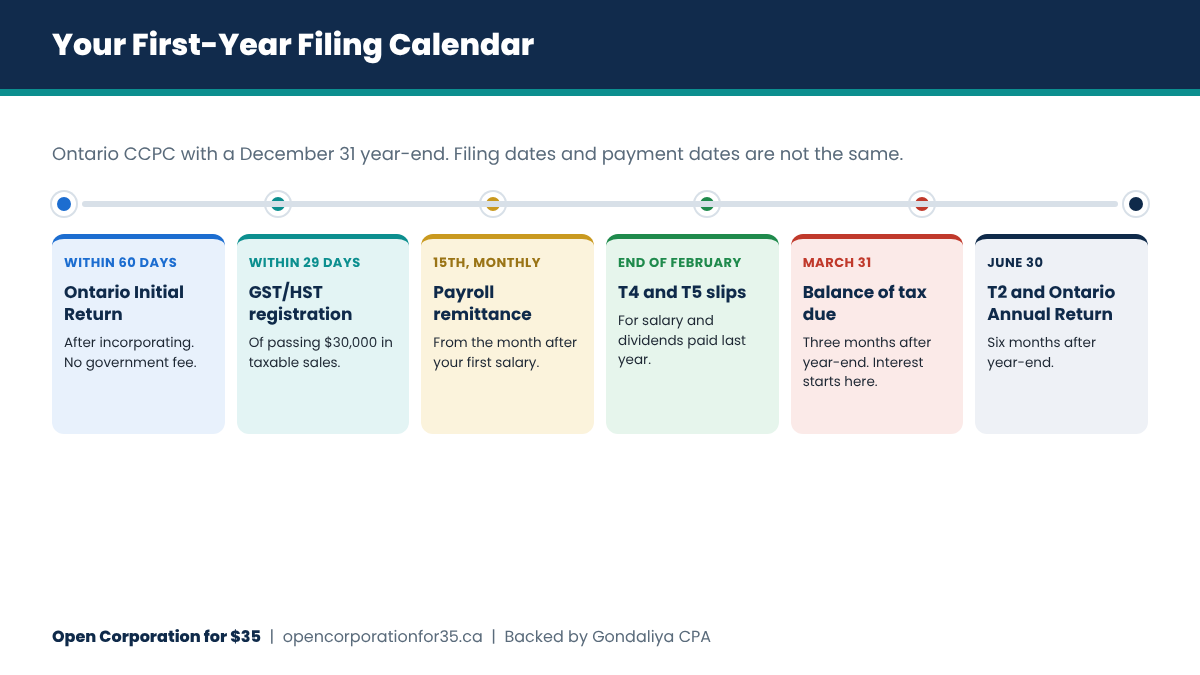
A new corporation’s first year has two kinds of deadline: filing dates and payment dates. Tax is due before the return is, and most first-year interest charges come from treating the two as the same date.
| Aspect | Details |
|---|---|
| T2 return | Due six months after the fiscal year-end, filed electronically. |
| Balance of tax | Due two months after the year-end, or three months for a qualifying CCPC. |
| Instalments | Not usually due in year one. Required once tax is over $3,000 in both the current and the previous year. |
| GST/HST | Register within 29 days of passing $30,000 in taxable sales. |
| Payroll and slips | Remit by the 15th of the next month. T4 and T5 slips by the last day of February. |
| Ontario registry | Initial Return within 60 days of incorporating. Annual Return within six months of each year-end. |
Reading time: 32 minutes.
Table of Contents
This article uses federal rules and Ontario rules for 2026, in Canadian dollars, with notes on federal, BC and Alberta registry filings. Deadlines, thresholds, payroll rates and forms change, and your own dates depend on your incorporation date and fiscal year-end. This is educational information only and not tax, legal, or financial advice. Please speak with a CPA about your own situation before filing.
First Year Corporation Filing Requirements and Deadlines in Canada
Filing Requirements and Deadlines
DeadlinesUnderstanding Corporate Tax Filing Deadlines for New Corporations
New corporations in Canada face a few important filing deadlines to keep in mind. The main one is the T2 Corporate Tax Return. You need to file it within six months after your corporation’s fiscal year ends. For example, if your company started on January 1st with a December 31 year-end, your first T2 would usually be due by June 30th of the following year.
Risk Warning: The T2 filing date is not the payment date. Please do not wait for the six-month filing deadline to pay tax, because interest starts from the balance-due day.
Here are some key dates to remember:
- T2 Due Date: Six months after your fiscal year-end
- Balance-Due Day: Usually two or three months after the fiscal year-end, depending on your corporate type
Missing these dates can cause penalties. So, knowing when to file is really important for any new business.
Defining the Fiscal Year and Its Impact on Filing Dates
Your fiscal year-end date affects when you have to file your taxes. You can pick a fiscal year that fits your business cycle. But, the first tax year can’t be longer than 53 weeks.
Here’s what that means:
- If you pick December 31 as your fiscal year-end at incorporation, then all filings follow that date.
- Your first tax period might be shorter or longer, but never over 53 weeks.
Choosing the right fiscal year-end makes it easier to plan and track your finances.
The fiscal year-end is the one first-year choice that sets every later date. We usually suggest a year-end in a quieter month for the business, so the T2 and the year-end bookkeeping do not land in the busiest season. Changing the year-end later needs CRA approval, so please decide it before the first return, not after.
Adjustments to Deadlines for Weekends and Public Holidays
Deadlines can change if they land on weekends or public holidays. When this happens, you get until the next business day to file or pay.
This applies to:
- T2 Corporate Tax Returns
- Payroll remittances
- Other payments like GST/HST
For example, if your balance-due day falls on a Saturday, pay by Monday at the latest to avoid late fees.
Knowing these rules helps you avoid surprises and extra charges.
Difference Between Filing Deadlines and Payment Deadlines
It’s easy to mix up filing deadlines and payment deadlines. But they are different things.
- Filing Deadline: When you must send in forms like the T2 return. For most new corporations, this is six months after their fiscal year ends.
- Payment Deadline: When you must pay any taxes owed. This could be two or three months after your fiscal year ends, depending on whether you’re a Canadian-controlled private corporation (CCPC) or not.
Missing either deadline can lead to fines or interest charges from the CRA.
Getting these dates right helps keep your business in good standing with tax authorities during its first year.
Key Stat: For a December 31 year-end, a qualifying CCPC pays its balance of tax by March 31 and files its T2 by June 30. Interest runs from March 31, three months before the return is due.
Preparing and Filing Your First Corporate Income Tax Return (T2)
Filing Your First T2 Return
T2 ReturnIf you just started a corporation in Canada, you’ll need to follow certain first year corporation filing requirements Canada. Filing your T2 corporate income tax return on time matters. Missing deadlines could bring penalties. So, you should learn the new corporation filing deadlines Canada. The first year corporate tax filing Canada involves steps that meet both federal and provincial rules under the Income Tax Act (ITA).
Mandatory Electronic Filing Requirements for New Corporations
For tax years starting after 2023, Canadian corporations must file their T2 returns electronically. This applies no matter how big or small your company is or where it’s located; only a few types, such as insurance and non-resident corporations, are exempt. It’s part of the new corporation compliance calendar Canada.
Risk Warning: A corporation that must file electronically and sends a paper T2 can be charged a penalty. Please do not mail a paper return unless your corporation is one of the exempt types.
Electronic filing speeds up processing and cuts down errors compared to paper forms. You have to use certified software or CRA-approved service providers to submit online. If you don’t comply, you risk penalties or delays.
It’s a good idea to sign up for a CRA My Business Account soon after incorporation. This lets you get notices and file securely online.
Required Forms and Publications for First-Year Filings
You’ll mainly need the T2 Corporation Income Tax Return form. Along with this, expect to complete:
- Schedule 50: Info about your shareholders.
- Schedule 24: Declaration if this is your first-time filing.
- GIFI forms: These cover your financial statements.
- Provincial schedules depending on your province (like Ontario’s Schedule 500).
The CRA’s T4012 – T2 Corporation – Guide helps first-year filers understand what to do. It explains how to report income, even if you had no business activity or profit in that fiscal year.
Keep proper records supporting all figures reported. This follows ITA recordkeeping rules.
Step-by-Step Guide to Filing Your T2 Return
- Pick Fiscal Year-End: Choose your fiscal year-end within 53 weeks of starting your company. This sets your reporting period length.
- Prepare Financial Statements: Make sure statements follow GAAP standards since they back up GIFI info.
- Fill Out Schedules: Complete Schedule 50 with shareholder details, Schedule 24 if it applies, plus any provincial forms needed.
- Calculate Taxable Income & Credits: Deduct things like the small business deduction if you’re eligible as a Canadian-controlled private corporation (CCPC). Check current rates for 2026.
- Use Certified Software: File electronically before your deadline—usually six months after fiscal year-end.
- Save Confirmation: Keep CRA receipt numbers as proof you filed on time.
- Plan Payment If Needed: Remember payment deadlines are different; usually due two or three months after fiscal year-end (see next section).
Following these steps helps you meet new corporation filing deadlines Canada smoothly and avoid problems with the CRA.
For a Canadian private corporation, the GAAP that applies is usually Accounting Standards for Private Enterprises (ASPE). A first-year corporation with no audit requirement normally has its statements prepared under a compilation engagement, which is enough to support the GIFI schedules.
Eligibility and Procedures for Extended Payment Deadlines
Your T2 return is due six months after your fiscal year ends but when you pay taxes depends on your situation:
- If you’re a CCPC that claims the small business deduction and your taxable income for the previous year, with associated corporations, was not over the $500,000 business limit, payment is due three months after fiscal year-end.
- Other corporations must pay within two months of fiscal year-end.
Risk Warning: The three-month balance-due day applies only to a CCPC that meets the small business deduction tests. Please do not assume every private corporation gets three months.
If you can’t pay by the balance-due day, interest starts adding up right away. It’s best to talk to a CPA quickly who can check your case. Just know that getting extra time to pay isn’t automatic; you have to arrange it directly with CRA.
This difference between filing and payment deadlines means keeping an updated new corporation compliance calendar Canada is key during your first tax cycle.
Corporate Income Tax Payments and Instalment Obligations
Tax Payments and Instalments
PaymentsIf your corporation just started in Canada, you need to know about corporate income tax payments. The first year corporation filing requirements Canada include sending in the T2 return and following instalment payment rules set by the CRA. These instalments help make sure you pay your taxes on time and avoid extra charges.
Determining Instalment Requirements for New Corporations
Corporations must pay instalments if their net tax owed goes over $3,000 in both the current and the previous year[1]. This rule is key when setting up a new corporation compliance calendar Canada because it adds more deadlines beyond just filing returns.
Risk Warning: Once both years are over $3,000, instalments are owed whether or not CRA sends a reminder. Please do not wait for a notice before paying.
Usually, new corporations start paying instalments in their second tax year unless special cases apply. But sometimes, businesses might have to pay earlier. This depends on projected income or related companies’ past tax amounts.
The CRA checks your business number (BN) and past filings to decide. So, keep a close eye on new corporation filing deadlines Canada to avoid missing any instalment notices.
- Instalments start if net tax payable > $3,000 in both the current and the previous year.
- First-year payments usually don’t happen but can vary.
- Compliance calendars add quarterly or monthly payment dates.
| Factor | Threshold/Rule | Source |
|---|---|---|
| Instalment requirement trigger | Net tax payable > $3,000 in both the current and the previous year | CRA – Instalments |
| First-year obligation | Usually none; depends on facts | CRA guidance |
| Compliance calendar impact | Adds quarterly/monthly payment dates | CRA / ITA |
Instalment Due Dates and Payment Schedules
The balance-due day for paying corporate income tax is different from the T2 return deadline.
- Most corporations pay two months after fiscal year-end.
- If your company is a Canadian-controlled private corporation (CCPC), you have three months instead[2].
For example, if your fiscal year ends December 31 and you’re a CCPC, you have until March 31 to pay without penalties.
Once instalments kick in, they’re due monthly, or quarterly if your corporation qualifies. Knowing this helps you build a solid new corporation compliance calendar Canada that fits both filings and payments.
Quarterly instalments are an option. A small CCPC can choose them if it meets CRA’s conditions: taxable income and taxable capital within the limits, the small business deduction claimed, and a clean filing and payment record for the past 12 months. Every other corporation pays monthly, on the last day of each month.
| Fiscal Year-End Month | Balance-Due Day (Non-CCPC) | Balance-Due Day (CCPC) |
|---|---|---|
| December | February 28 | March 31 |
| June | August 31 | September 30 |
Dates shown are examples; always check official info yearly.
Calculating Instalment Amounts and Avoiding Underpayments
If your estimated corporate tax over $3,000, instalments may start in your second tax year[1]. You can pick from three ways to figure out how much to pay:
- No-calculation: Pay the amounts on CRA’s instalment reminders, based on your last two years’ taxes.
- Prior-year amount: Use actual taxes paid last year.
- Current-year estimate: Guess this year’s taxes but watch carefully.
CRA’s three options in detail: option 1 is one-twelfth of this year’s estimated tax each month, option 2 is one-twelfth of last year’s tax, and option 3 bases the first two payments on the year before last and the other ten on last year. The amounts on CRA’s instalment reminders use option 3.
Paying less than needed can lead to interest even if you catch up later[3]. To avoid this:
- Check taxable income often.
- Change instalments as estimates change.
- Get advice before finalizing amounts—things like small business deductions or dividends affect your tax owed.
Following these tips matches first year corporate tax filing Canada rules while helping cash flow stay smooth inside your new corporation compliance calendar Canada plan.
How to Make Payments on Time to Avoid Interest and Penalties
Paying late costs you interest every day after the balance-due day until full payment arrives[4]. You might also face penalties for repeated late payments. There’s no legal extension for these dates.
To keep on track:
- Mark T2 filing dates and balance-due days separately.
- Set reminders before each instalment deadline.
- Pay online via “My Business Account” at CRA for fast processing.
Missing these can add costs that hurt your startup funds when you least want it.
Sharad Gondaliya, CPA (Canada & USA), has over 10 years helping many Canadian business owners.
References
CRA – Corporation Income Tax Installments
Income Tax Act – Section regarding CCPC Payment Deadlines
CRA – Interest Charges On Late Payments
CRA – Penalties For Late Filing And Payment
Penalties, Interest, and Consequences of Late Filing or Payment
Penalties and Interest
PenaltiesWhen a corporation starts in Canada, it has to follow the first year corporation filing requirements Canada and meet new corporation filing deadlines Canada. Missing these can cause penalties and interest to pile up. This means the tax bill grows bigger. Knowing what happens if you file or pay late helps owners avoid these extra costs.
Interest Charges on Late or Insufficient Instalment Payments
Interest builds up every day on any unpaid tax after the due date. Usually, that date is three months after your fiscal year ends for most Canadian-controlled private corporations (CCPCs). For other corporations, it’s two months.1 If instalments are required but paid late or not enough during the year, interest applies from each instalment due date until you pay in full.
Risk Warning: CRA does not extend the balance-due day or the T2 filing deadline. Please do not plan around a later date.
The CRA sets the interest rates based on 90-day Treasury bill yields. They update these rates every quarter.2 A new corporation following its first year corporate tax filing Canada rules faces growing interest charges if instalments are missed according to the new corporation compliance calendar Canada.
On overdue tax, CRA adds 4 percentage points to the prescribed rate, and the interest compounds daily.
Corporations should track their income closely. Guessing too low on instalments may cause surprise interest charges even when annual taxes get paid by the deadline.
Penalty Rates for Late Filing and Repeated Non-Compliance
Filing a T2 return late triggers immediate penalties under federal law. This happens whenever tax is still unpaid at the filing deadline.3 The basic penalty is 5% of unpaid tax at the deadline plus 1% per month after that, up to 12 months. If you’ve been penalized before within three years, penalties go higher: 10% upfront plus 2% monthly up to 20 months.
Risk Warning: A late T2 holds up any refund and can cost the dividend refund. Please do not skip filing because no tax is owing.
New businesses must watch new corporation filing deadlines Canada closely because one missed deadline can start these penalties. These fines add up on top of any interest owing.
If a company keeps missing deadlines, CRA may audit more often. That can make future filings harder and relief programs less accessible. Keep in mind that registry filings like Ontario annual returns have different deadlines than CRA filings.4
Options for Reducing or Avoiding Instalment Interest and Penalties
There’s no automatic forgiveness for late payments or filings. Still, some actions can reduce penalties:
- Contact CRA quickly if you see a payment problem; a taxpayer relief request on Form RC4288 might cut penalties but needs expert advice.
- Estimate income carefully early in your first year corporate tax filing Canada so instalments don’t fall short.
- File electronically; this prevents delays that could count as late.
- Work with a CPA to check your numbers and rules before sending forms—especially with tricky items like shareholder loans.
Relief from penalties and interest for a missed deadline is requested under the taxpayer relief provisions on Form RC4288, for reasons such as illness or a CRA error, within 10 calendar years. The Voluntary Disclosures Program is for correcting unreported income or errors, not for late filing on its own.
Following a clear new corporation compliance calendar Canada helps keep payments aligned with rules. That way, you avoid mixing CRA deadlines with registry ones.5
Impact of Missing Corporate Tax Return Deadlines on New Corporations
Not filing your T2 return on time—usually six months after fiscal year-end—can cause more than fines:
- You might lose refundable amounts like the dividend refund or SR&ED credits.
- The chance of an audit goes up for coming years.
- Getting clearance certificates for selling assets could take longer.
- Provincial tax rates might get complicated, especially in places like Ontario.
Risk Warning: A dividend refund is lost if the T2 is filed more than three years after the year-end. Please do not leave an old year unfiled.
Filing is important even if your return shows zero balance under first year corporation filing requirements Canada.6 Also remember, ignoring either CRA or registry filings risks your good standing across jurisdictions such as Ontario Business Registry rules.
Notes
1 Income Tax Act (ITA), Paragraph 157(1)(b); CRA – Balance Due Day
2 CRA Prescribed Interest Rates
3 ITA Subsections 162(1) and 162(2); CRA Late-Filing Penalties
4 Ontario Business Registry Annual Return Requirements; Corporations Canada Annual Return Rules
5 CRA Taxpayer Relief Provisions, Form RC4288
6 ITA Section 150(1); Schedule 24 First-Time Filer Requirement
Get your first-year dates right from day one
Incorporation from $35 including HST plus government fees, with a free CPA consultation on your fiscal year-end and first-year deadlines. Please book a free consultation.
Compliance Calendar and Additional Annual Filing Requirements for New Corporations
Compliance Calendar and Annual Filings
CalendarStarting a new corporation in Canada means you have several deadlines to keep track of. Beyond just taxes, you’ll need to register and file for GST/HST if you pass certain sales limits. You also have payroll remittance dates and must file T4 and T5 slips by set times. Plus, don’t forget annual returns with federal or provincial corporate registries. Knowing these dates helps you handle your first year corporation filing requirements Canada without headaches.
GST/HST Filing Deadlines and Thresholds for New Businesses
Your new corporation needs to watch its sales closely. If your taxable supplies go over $30,000 in any four consecutive calendar quarters, you must register for GST/HST. That’s the small supplier threshold. You have 29 days from passing that limit to sign up with the CRA.
There is a second test. If taxable sales go over $30,000 in a single calendar quarter, you must charge GST/HST on the sale that takes you over, and register within 29 days of that sale.
Once registered, how often you file depends on how much you make annually:
- If annual taxable supplies are $1,500,000 or less: file once a year.
- Between $1,500,001 and $6 million: file quarterly.
- Over $6 million: file every month.
Here’s a quick look:
| Annual Taxable Supplies | Filing Frequency | Return Due Date | Authority |
|---|---|---|---|
| ≤ $1,500,000 | Annual | Within 3 months after fiscal year-end | CRA |
| > $1,500,000 ≤ $6M | Quarterly | Last month of quarter + 1 month | CRA |
| > $6M | Monthly | Following month end | CRA |
You can register before reaching the threshold if it suits your business. But it’s smart to check with a CPA first.
Key point: Surpassing $30,000 in taxable sales within four quarters means you must register for GST/HST within 29 days1.
Payroll Remittance Deadlines and Reporting Obligations (T4/T5 Slips)
Once you pay your first employee or dividends that need reporting slips, payroll rules kick in fast.
- Payroll Remittances: You must send source deductions like CPP and EI premiums monthly by the 15th of the next month if you’re a regular remitter. Some remitters pay more often.
- T4 Slips: These report employee earnings and are due by the last day of February each year.
- T5 Slips: Needed if dividends or investment income were paid; also due by the last day of February.
Missing deadlines can lead to penalties from CRA. In Ontario, WSIB coverage starts when hiring employees unless exempted3. Employer Health Tax applies once payroll hits certain limits.
An owner-manager who controls more than 40% of the voting shares is not insurable for EI, so no EI is deducted from their own salary. CPP still applies. T4 and T5 slips are due on the last day of February, which is February 29 in a leap year.
Pay Types and Slips
Salary or Dividends| Factor | Salary | Dividends | Notes |
|---|---|---|---|
| Payroll Account Needed? | Yes | No | For source deduction remits |
| Slip Type | T4 | T5 |
Note: Make payroll remittances right after your first paycheck to avoid fines or interest charges.
Annual Return Filing Requirements under the CBCA and Ontario Business Registry
If your corporation is federal (CBCA), you must file an annual return within 60 days after your incorporation anniversary date. Ontario corporations get six months from the end of each tax year through the Ontario Business Registry45.
Risk Warning: The Ontario Annual Return is no longer filed with the T2. Please do not assume your tax return covers it; it is filed separately in the Ontario Business Registry, and a new Ontario corporation also files an Initial Return within 60 days.
Annual returns update info like directors’ names and office addresses.
Changes like appointing new directors or moving the registered office require filings too — usually within fifteen days of the change. A change to the share structure needs articles of amendment instead.
Risk Warning: Shares issued in a class that is not in your articles are not validly issued. Please do not issue new shares before the articles of amendment are filed.
Here’s how filings compare across provinces:
| Requirement | Ontario Corporation | BC Corporation | Alberta Corporation | Federal Corporation (CBCA) |
|---|---|---|---|---|
| Annual Return Window | Within six months after tax year-end | Within two months post-anniversary | Within three months post-anniversary | Within sixty days post-incorporation anniversary |
| Filed With | Ontario Business Registry | BC Corporate Registry | Alberta Corporate Registry | Corporations Canada/ISED |
| Notice of Change Deadline | Fifteen days from change occurrence | Fifteen days from change occurrence | Fifteen days from change occurrence | Fifteen days from change occurrence |
Bottom line: Stay on top of both registry deadlines and tax filings to keep your corporation in good standing and avoid fines.
Corporate Filing Obligations Specific to Ontario Corporations
Ontario companies face some extra steps:
- File an annual return via the Ontario Business Registry within six months after the end of each tax year.
- Pay Employer Health Tax once payroll passes exemption limits.
- Register for WSIB coverage when hiring workers unless specifically exempted.
The EHT rate changes depending on total wages paid yearly6. These requirements sit alongside federal payroll deductions but are handled by different agencies — Ministry of Finance manages EHT; CRA handles deductions like CPP/EI.
Key Stat: An eligible Ontario employer pays no Employer Health Tax on its first $1,000,000 of Ontario payroll. Above that, the rate runs from 0.98% to 1.95%, depending on total payroll.
Resources and Support for Managing Corporate Filing Obligations
Handling first year corporation filing requirements Canada means juggling multiple agencies. You’ll deal with CRA for taxes and payroll accounts; provincial business registries; WSIB; Ministry of Finance offices — all with different forms and timelines.
Many business owners find keeping a tailored new corporation compliance calendar Canada handy. It tracks key dates linked to incorporation anniversaries and fiscal year ends.
Professional help is useful for understanding tricky parts like when instalment payments start (over $3,000 owed), mandatory electronic filing for tax years starting after 2023,7 updated CPP rates,2 and other key factors that affect timing or amounts due.
It pays to check in with CPAs who know Canadian corporate tax rules before locking down your compliance schedule or making voluntary elections.8
Encouragement to Plan Ahead Using a New Corporation Compliance Calendar
Setting up a detailed new corporation compliance calendar Canada early on helps avoid missed deadlines that bring penalties or risk losing good standing status with regulators.
Track every important date—from GST/HST registration deadlines after hitting small supplier threshold; monthly payroll remittances starting soon after your first salary payment; T4/T5 slip submissions each February; through annual returns windows mid-year—and add reminders for registry updates during the year.9
Open Corporation for $35 offers affordable filing services plus expert advice built around these needs — helping businesses stay compliant during their critical first year.
Notes
1 Canada Revenue Agency – Registering For GST/HST
2 Department of Finance Canada Budget Measures Update – CPP Contribution Rates & YMPE/YAMPE Changes Effective January 2026
3 Workplace Safety & Insurance Board – Employer Registration Guidelines https://www.wsib.ca/
4 Ontario Ministry Of Government And Consumer Services – Annual Returns https://ontario.ca/page/corporate-filings
5 Corporations Canada – Federal Annual Returns https://corporationscanada.ic.gc.ca/eic/site/cd-dgc.nsf/eng/h_cs04954.html
6 Ontario Employer Health Tax Rate Schedule https://fin.gov.on.ca/en/tax/eht/rates.html
7 CRA – Mandatory Electronic Filing of T2 Returns for Tax Years Starting After 2023
8 Chartered Professional Accountants Of Canada Guidance On First-Year Incorporation Compliance Responsibilities
9 Open Corporation For $35 Client Resource Library — Sample First-Year Compliance Calendars
Resources and Support for First-Year Corporate Filers
Resources and Support
ResourcesStarting a new corporation means dealing with a lot of rules. You have to know about CRA program accounts, the GST/HST small supplier threshold, and corporate tax instalments. These rules help you meet your first year corporation filing requirements Canada without trouble.
Here’s what you should keep in mind:
- CRA program accounts for different tax types
- GST/HST small supplier threshold rules
- When you need to start paying corporate tax instalments
Keeping these points clear makes filing easier and less confusing.
Official CRA Resources, Forms, and Publications
The Income Tax Act (ITA), Excise Tax Act (ETA), and Canada Revenue Agency (CRA) guides explain your tax duties. The ITA tells you when to file T2 returns and pay instalments. The ETA sets GST/HST rules, including the $30,000 small supplier threshold.
You’ll want to use forms like Schedule 24 for first-time filers or Form RC1 to register your business number. These forms help you follow the law right.
A corporation incorporated in Ontario, BC or federally usually receives its business number automatically when it is incorporated. Form RC1 is then used to add program accounts such as GST/HST (RT) and payroll (RP), which can also be opened online.
Don’t forget provincial info! The Ontario Ministry of Finance covers Ontario’s corporate taxes and employer health taxes. The rules say that for tax years starting after 2023, T2 returns must be filed electronically — that’s another thing to prepare for.
Important points here:
- ITA defines T2 deadlines and payments
- ETA explains GST/HST registration limits
- Use Schedule 24 and RC1 forms from CRA
- Ontario Ministry of Finance covers provincial taxes
- Electronic filing of T2 is mandatory for tax years starting after 2023
Expert Guidance and Online Tools for Corporate Tax Filings
For tax years starting after 2023, corporations have to file T2 returns online unless the CRA says otherwise. This can be tricky if you’re new.
Open Corporation for $35 is part of Gondaliya CPA. They offer services designed just for new businesses across Canada. They can help set up a new corporation compliance calendar Canada so you don’t miss any deadlines—from day one through your annual filings.
There are also online tools that:
- Calculate your instalment payments using your income estimates
- Help manage payroll remittances with updated CPP contribution rates starting in 2026
These tools make managing your filings smoother and less stressful.
Key Contacts for Assistance and Compliance Questions
If you have questions about federal filings or program accounts like RP (payroll) or RT (GST/HST), contact the Canada Revenue Agency directly at Canada.ca. They give clear info about your fiscal year-end deadlines.
For questions on Ontario taxes such as Employer Health Tax or WSIB registrations, check with the Ontario Ministry of Finance (ontario.ca/finance) or WSIB.
Open Corporation for $35, part of Gondaliya CPA, helps new owners handle their first-year paperwork smoothly. You can call them at 647-212-9559 or email info@gondaliyacpa.ca Monday through Sunday from 9:00 AM to 8:30 PM for personal support.
Frequently Asked Questions
First-Year Filing FAQ
FAQWhat are the Key Numbers at a Glance for new corporations in Canada?+
New corporations must note key numbers such as the $30,000 GST/HST small supplier threshold and the $3,000 corporate tax instalment threshold. These trigger registration and payment obligations.
When is the Payroll Remittance Due Date for new Ontario corporations?+
Payroll remittances are generally due monthly by the 15th of the following month after salary payments start. Some businesses may require more frequent remittance.
What is the T4/T5 Slip Filing Deadline?+
T4 and T5 slips must be filed with CRA by the last day of February each year. These report employee earnings and dividend payments, respectively.
How does the CBCA Annual Return Filing Window work?+
Federal corporations under CBCA must file annual returns within 60 days after their incorporation anniversary date to maintain good standing.
What is the Ontario Annual Return Filing Window?+
Ontario corporations have up to six months after each tax year-end to file an annual return via the Ontario Business Registry.
How do first-year compliance calendars differ across industries?+
First-year calendars vary by industry due to differences in revenue cycles, payroll needs, and regulatory filings. Professional advice ensures calendar accuracy.
What Does First-Year Compliance Cost and What Drives the Fee?+
Costs vary depending on business size, complexity of filings, and need for professional services. More complex filings typically increase fees.
What Are the Risks, Compliance Issues and Prevention Controls?+
Risks include missed deadlines, penalties, interest charges, and audits. Controls involve tracking deadlines closely, using CPA guidance, and electronic filing compliance.
Risk Warning: Payroll amounts withheld from employees are held in trust for CRA, and directors can be personally liable for amounts not remitted. Please do not use withheld payroll to cover cash flow.
Additional Insights for New Corporation Compliance
Additional Insights and Next Steps
Insights- DIY vs Tax Software vs CPA — Tradeoffs: DIY saves costs but risks errors; software aids accuracy but requires user knowledge; CPAs provide expert guidance ensuring full compliance.
- How Do We Build Your First-Year Filing Calendar? We analyze your incorporation date, fiscal year-end, industry specifics, and regulatory obligations to create a customized calendar.
- What Deliverables Do You Get? Clients receive a tailored compliance calendar, filing reminders, electronic filing support, and access to expert consultation from Open Corporation for $35.
- What Should You Prepare Before Your First Year-End? Gather financial statements, shareholder info, payroll records, GST/HST reports, and confirm your fiscal year-end date.
- How Should You Choose a CPA for First-Year Corporate Compliance? Look for experience with new corporations in Canada, transparent pricing like Open Corporation for $35 offers, and clear communication.
- Why Trust Open Corporation for $35 (a department of Gondaliya CPA)? We specialize in affordable compliance solutions for startups with expert CPA support across all Canadian provinces including Ontario.
Quick Answers: Key Dates at a Glance
At a Glance- T2 filing deadline: Six months after the fiscal year-end
- Balance-due day, qualifying CCPC: Three months after the year-end
- Balance-due day, other corporations: Two months after the year-end
- Instalments: Once tax is over $3,000 in both the current and the previous year
- GST/HST registration: Within 29 days of passing $30,000
- Payroll remittance, regular remitter: 15th of the following month
- T4 and T5 slips: Last day of February
- Ontario Initial Return: Within 60 days of incorporating
- Ontario Annual Return: Within six months of each fiscal year-end
- Federal annual return: Within 60 days of the anniversary date
- Our fee: $35 including HST, plus government fees
Who This Is For / Not For
Fit Check- For: Corporations in their first 12 months, sole proprietors about to incorporate, and owners who have not yet chosen a fiscal year-end.
- Not For: Corporations past their second year-end with a settled calendar, and non-resident or insurance corporations, which follow different filing rules.
People Also Ask
Quick AnswersHow early should I start planning my first-year corporate tax filings?+
At incorporation. The fiscal year-end, the Ontario Initial Return, GST/HST registration and the payroll account are all settled in the first weeks, and each one fixes later dates.
What happens if I miss my Ontario Annual Return Filing Window?+
There is no government fee for the annual return, but the registry record falls out of date, and a corporation that keeps failing to file can eventually be dissolved. Please file it as soon as you notice it was missed.
Can I file my T2 return without professional help?+
Yes, using CRA-certified software. The return is still yours to get right, including the GIFI financial statements and schedules, and errors in a first return carry into the opening balances of the next one.
When will I know if I need to pay corporate tax instalments?+
Generally not in the first year. Instalments start once tax is over $3,000 in both the current and the previous year, so most new corporations first owe them in year two. CRA usually starts sending reminders once it has a prior-year return.
Glossary
Terms- CBCA: Canada Business Corporations Act governing federal corporations.
- CCPC: Canadian-controlled private corporation eligible for special tax rates.
- GST/HST Small Supplier Threshold: $30,000 annual taxable supplies triggering mandatory registration.
- Instalments: Periodic corporate tax payments based on estimated taxes owed.
Next Steps
Get StartedContact Open Corporation for $35 to get started on your new corporation compliance calendar today. Early planning avoids penalties and streamlines your first year of business in Canada.
Related services: Ontario Initial Return filing, CRA business number and account registration, payroll, annual return filing, incorporation plus first-year T2, corporate tax filing from $300 and the Corporate Compliance Subscription, which includes a written compliance calendar.
Put two dates in the calendar before anything else: the balance-due day and the T2 filing date, three months apart for a qualifying CCPC. Then add the Ontario Initial Return at 60 days, GST/HST registration as sales approach $30,000, and payroll from the first salary. Everything else in year one follows from the fiscal year-end you choose.
2026 Update — what is current: This article reflects rules current to 2026. The six-month T2 filing deadline, the two-month balance-due day with three months for a qualifying CCPC, the $3,000 instalment threshold tested on both the current and the previous year, the $30,000 GST/HST small supplier threshold, the 15th-of-the-month deadline for regular payroll remitters, the 60-day Ontario Initial Return and the 60-day federal annual return window are unchanged. Mandatory electronic filing of the T2 applies to every tax year starting after 2023, so a new corporation files online unless it is one of the few exempt types. CPP and EI rates and maximums reset each January, so please use the 2026 payroll tables for 2026 salary. Please note that the Ontario Annual Return is filed directly in the Ontario Business Registry within six months after each tax year-end and not with the T2; that the balance-due day comes before the filing deadline, so interest starts before the return is due; that T4 and T5 slips for 2026 are due on the last day of February 2027, which falls on a Sunday, so slips filed on Monday, March 1, 2027 are on time; and that a federal corporation also reports its individuals with significant control to Corporations Canada.
First-Year Filing Readiness Check
This quick self-check flags what to work through before your first year-end. Please answer the six questions below.
First-Year Filing Readiness Check
Six quick questions. No tax calculation, no figure quoted.
Points to work through:
Book a free consultationThis is a general prompt, not tax advice, and it does not calculate your tax. Your outcome depends on your full facts, so please book a free consultation.
Map your first-year dates before the first one arrives
Incorporation from $35 including HST plus government fees, with a free CPA consultation on your fiscal year-end and first-year filings. Please book a free consultation.
What to Send Us
Send us your incorporation date and jurisdiction, the fiscal year-end you want, whether you will pay salary or dividends in the first year, and your expected sales for the first 12 months. That is enough for us to list your first-year dates. Please start on our incorporation form or see every fee on our pricing page.
Published: October 26, 2026 · Last updated: October 26, 2026
Editorial policy: Our content is prepared by our team and reviewed by Sharad Gondaliya, CPA, and we update it as CRA deadlines, GST/HST thresholds, payroll rates and registry rules change.
Disclaimer: This article is educational information only and is not tax, legal, or financial advice. Filing dates depend on your own incorporation date, fiscal year-end and jurisdiction. Please consult a CPA before acting.
Open Corporation for $35 is a department of Gondaliya CPA.
Parent firm Gondaliya CPA Professional Corporation, CPA Ontario firm registration 61330051. Xero Partner Award Winner 2026. 1300+ five-star Google reviews. 30-day money-back guarantee and 60-day fee-matching policy. Phone 647-212-9559, email info@gondaliyacpa.ca, open 9:00 AM to 8:30 PM Monday to Sunday. Payment by Interac e-Transfer to info@gondaliyacpa.ca only, security question “Not Applicable” as auto-deposit is enabled. Card is also accepted.